Controlled Atmosphere Storage (CAS) Market Size
According to Deep Market Insights, the global controlled atmosphere storage (CAS) market size was valued at USD 8,640 million in 2025 and is projected to grow from USD 9,469.44 million in 2026 to reach USD 14,975.35 million by 2031, expanding at a CAGR of 9.6% during the forecast period (2026–2031). The CAS market growth is primarily driven by the increasing need to reduce post-harvest food losses, expansion of global fresh produce trade, and rising investments in export-oriented agri-infrastructure. Controlled atmosphere storage systems regulate oxygen, carbon dioxide, nitrogen, humidity, and temperature levels to significantly extend the shelf life of perishable commodities such as apples, pears, avocados, berries, grains, and nuts.
The market is transitioning from conventional cold storage facilities toward advanced Ultra-Low Oxygen (ULO) and Dynamic Controlled Atmosphere (DCA) systems that improve storage efficiency and reduce spoilage rates by up to 25%. Growing food security concerns, climate variability, and year-round consumer demand for fresh produce are further accelerating infrastructure modernization. Export-driven economies including the United States, China, India, the Netherlands, Chile, and South Africa are expanding large-scale CAS facilities near ports and logistics hubs. As retail chains, food processors, and government grain agencies demand higher quality standards, CAS adoption is becoming a strategic necessity rather than an optional enhancement within the global food supply chain.
Key Market Insights
- Ultra-Low Oxygen (ULO) storage dominates the market, accounting for nearly 34% of the 2025 market share due to its effectiveness in long-term apple and pear storage.
- Fruits represent the largest application segment, contributing approximately 48% of total market revenue in 2025.
- Large-scale facilities (>25,000 MT) hold over 41% share, driven by export hubs and government-backed grain reserves.
- Asia-Pacific is the fastest-growing region, expanding at over 11% CAGR, led by China and India.
- Fresh produce exporters account for nearly 45% of total demand, supported by rising global fruit trade.
- Integration of IoT-based sensors and AI-driven monitoring systems is reshaping operational efficiency and reducing spoilage rates.
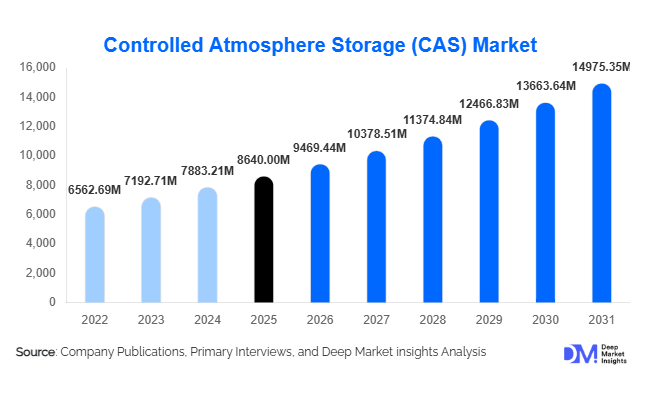
What are the latest trends in the controlled atmosphere storage market?
Shift Toward Dynamic Controlled Atmosphere (DCA) Technology
DCA systems are gaining strong traction as they continuously adjust oxygen levels based on the respiration activity of stored commodities. Unlike static CA systems, DCA improves storage precision and reduces physiological disorders in fruits. Exporters of apples, avocados, and berries are increasingly adopting DCA to maintain texture and nutritional quality during long-haul shipments. This trend is particularly prominent in Europe and North America, where premium fruit exports demand high-quality preservation standards.
Integration of Smart Monitoring and Automation
IoT-enabled sensors, cloud-based monitoring platforms, and automated gas regulation systems are transforming CAS facilities into intelligent storage ecosystems. Real-time oxygen, carbon dioxide, ethylene, and humidity monitoring enhances control accuracy and reduces human error. AI-based predictive maintenance tools are minimizing downtime and improving energy efficiency. This technology integration is especially attractive to large exporters and government grain agencies seeking operational optimization and long-term cost savings.
What are the key drivers in the controlled atmosphere storage market?
Rising Global Fresh Produce Trade
The global fruit and vegetable trade exceeds USD 150 billion annually, creating strong demand for long-term storage solutions. Apples, citrus fruits, avocados, and berries rely heavily on CA storage to maintain quality during transit. Export-oriented countries such as Chile, the United States, China, and South Africa are expanding storage capacities to meet international demand.
Food Waste Reduction Initiatives
Approximately one-third of global food production is lost post-harvest. Governments and international agencies are investing in post-harvest infrastructure to reduce losses. CAS systems can extend shelf life by two to four times compared to conventional storage, making them central to food security strategies.
Growth in Organized Retail and Food Processing
Modern retail chains and food processors require consistent raw material supply across seasons. CAS enables stable inventory management, reduces shrinkage, and ensures quality compliance with stringent food safety regulations such as HACCP and ISO 22000 standards.
What are the restraints for the global market?
High Initial Capital Expenditure
CAS facilities require 20–40% higher investment than traditional cold storage systems. Installation costs range between USD 250–400 per metric ton of installed capacity, limiting adoption among small-scale farmers without financial support.
Energy Consumption and Operational Costs
Refrigeration and gas regulation systems remain energy-intensive. Rising electricity prices in Europe and parts of Asia can impact operating margins, particularly for medium-scale operators.
What are the key opportunities in the controlled atmosphere storage industry?
Export Infrastructure Modernization in Emerging Markets
Countries such as India, Vietnam, Peru, and Kenya are expanding agri-export capabilities. Government-backed infrastructure programs and public-private partnerships present significant growth opportunities for CAS providers.
Strategic Grain Reserves and Food Security Programs
Governments in Asia and the Middle East are investing in nitrogen-based controlled atmosphere grain storage to minimize pest infestation without chemical fumigation. This segment offers large-scale, long-term contracts for CAS providers.
Report Scope
| Report Metric | Details |
|---|---|
| Market Size in 2025 | USD 8640 Million |
| Market Size in 2026 | USD 9469.44 Million |
| Market Size in 2031 | USD 14975.35 Million |
| CAGR | 9.6% (2026-2031) |
| Base Year for Estimation | 2025 |
| Historical Data | 2022-2024 |
| Forecast Period | 2026-2031 |
| Report Coverage | Revenue Forecast, Competitive Landscape, Supply Chain Disruption, Growth Factors, Environment & Regulatory Landscape and Trends |
| Geographies Covered | North America, Europe, APAC, Middle East and Africa, LATAM |
| Countries Covered | U.S., Canada, U.K., Germany, France, Spain, Italy, Russia, Nordic, Benelux, Rest of Europe, China, Korea, Japan, India, Australia, Singapore, Taiwan, South East Asia, Rest of Asia-Pacific, UAE, Turky, Saudi Arabia, South Africa, Egypt, Nigeria, Rest of MEA, Brazil, Mexico, Argentina, Chile, Colombia, Rest of LATAM |
Explore more data points, trends and opportunities Download Free Sample Report
Storage Type Insights
Ultra-Low Oxygen (ULO) storage leads the global Controlled Atmosphere Storage (CAS) market, accounting for approximately 34% of the 2025 global share. The dominance of ULO systems is primarily driven by their superior ability to extend apple and pear storage life up to 10–12 months while preserving firmness, texture, and nutritional quality. The leading segment driver for ULO storage is the strong global demand for year-round availability of premium apples, particularly in export-oriented markets across North America, Europe, and Asia-Pacific. By maintaining oxygen levels below 1.5%, ULO technology significantly slows respiration rates, reduces spoilage, and maximizes export value, making it the preferred choice for high-value fruit supply chains.
Dynamic Controlled Atmosphere (DCA) systems represent the fastest-growing segment, supported by increasing adoption among premium fruit exporters seeking enhanced quality monitoring and real-time atmosphere adjustment. DCA technology allows oxygen levels to be reduced to product tolerance thresholds, optimizing storage duration while minimizing physiological disorders. Static CA storage continues to serve grain and vegetable applications where cost efficiency and long-term bulk storage are prioritized. Meanwhile, nitrogen-based systems are expanding steadily within government-backed grain storage programs, particularly in emerging economies focused on reducing post-harvest losses and strengthening national food reserves.
Application Insights
Fruits dominate the CAS market, accounting for nearly 48% of total share in 2025. The leading segment driver is the global trade of apples, which represent over 60% of fruits stored under controlled atmosphere systems worldwide. The need to maintain consistent supply across seasons, reduce post-harvest losses, and meet export quality standards continues to accelerate CAS adoption among apple-producing nations. In addition to apples, pears, kiwifruit, cherries, and berries increasingly rely on advanced storage technologies to maintain freshness during long-distance transportation.
Vegetables such as onions and potatoes represent the second-largest application segment, supported by large-scale storage infrastructure in Europe and Asia. The primary growth driver in this segment is the need to stabilize pricing and ensure year-round supply in domestic markets. Grain and cereal storage is expanding rapidly due to food security initiatives and rising concerns over climate variability affecting harvest cycles. Governments in Asia and the Middle East are investing heavily in controlled atmosphere grain facilities to prevent pest infestation and minimize storage losses. Nuts and dry fruits are witnessing increasing CAS adoption to preserve export-grade quality, particularly in markets such as the United States, Turkey, and India where international trade volumes are rising.
Technology Component Insights
Refrigeration and HVAC systems account for approximately 29% of total market value, forming the foundational infrastructure of CAS facilities. The leading driver for this segment is the critical requirement for precise temperature stability across large-scale storage environments. Effective temperature management directly influences respiration control, moisture retention, and overall product longevity, making refrigeration systems indispensable to all CAS installations.
Gas control systems and advanced monitoring sensors are gaining traction alongside digitalization trends in agriculture and food logistics. The integration of IoT-enabled sensors and automated control platforms is improving operational efficiency, reducing human intervention, and enhancing real-time atmosphere optimization. Ethylene scrubbing systems are increasingly adopted for high-respiration fruits such as bananas, avocados, and climacteric produce, where ethylene accumulation can accelerate ripening and spoilage. As global exporters seek improved traceability and quality assurance, technology-driven CAS facilities are becoming standard in modern cold chain networks.
Capacity Insights
Large-scale facilities exceeding 25,000 metric tons (MT) capacity account for nearly 41% of global market share. The leading segment driver is the expansion of export clusters and government-managed grain reserves that require centralized, high-volume storage infrastructure. These facilities benefit from economies of scale, integrated logistics networks, and advanced automation systems that reduce operational costs per unit of stored produce.
Medium-scale facilities are growing steadily in developing economies where regional production hubs are modernizing storage capabilities to reduce post-harvest losses. These installations often serve cooperatives and regional distribution networks. Small-scale CAS installations cater to farmer cooperatives, niche exporters, and specialty produce suppliers who require quality preservation but operate at lower volumes. Increasing awareness of food waste reduction is supporting incremental growth across all capacity segments.
End-Use Insights
Fresh produce exporters represent the largest end-use segment, contributing around 45% of total market revenue. The leading driver in this segment is the globalization of fruit trade and the need to maintain premium quality standards across long transit durations. Exporters rely on CAS to meet stringent import regulations, minimize shrinkage, and maintain consistent supply throughout off-seasons.
Food processing companies are increasingly investing in controlled atmosphere storage to stabilize raw material supply and protect against price volatility caused by seasonal fluctuations. Government agencies managing national grain reserves are emerging as high-volume clients, particularly in China and India, where strategic food security planning is accelerating infrastructure investments. Floriculture exporters are adopting CAS to extend the shelf life of cut flowers, while seafood exporters utilize controlled environments to preserve freshness during international shipment, representing niche yet rapidly expanding segments.
Explore more data points, trends and opportunities Download Free Sample Report
Controlled Atmosphere Storage (CAS) Market Segmentations
- Static Controlled Atmosphere Storage
- Dynamic Controlled Atmosphere (DCA) Storage
- Ultra-Low Oxygen (ULO) Storage
- Modified Atmosphere Storage Facilities
- Nitrogen-Based Controlled Storage Systems
Application
- Fruits
- Vegetables
- Grains & Cereals
- Nuts & Dry Fruits
- Flowers & Ornamental Plants
- Meat & Seafood
Technology Component
- Gas Control Systems
- Sensors & Monitoring Systems
- Refrigeration & HVAC Systems
- Ethylene Scrubbing Systems
- Automation & Software Platforms
Capacity
- Small-Scale Facilities
- Medium-Scale Facilities
- Large-Scale Facilities
End-Use Industry
- Fresh Produce Exporters
- Food Processing Companies
- Retail & Supermarket Chains
- Government Grain Storage Agencies
- Floriculture Industry
- Seafood & Meat Processing Companies
Regional Insights
North America
North America holds approximately 28% of the 2025 global CAS market share. The United States dominates regional demand due to large-scale apple production in Washington State and Michigan, along with extensive grain storage programs across the Midwest. The primary regional growth driver is the highly organized cold chain infrastructure combined with strong export-oriented agriculture. Increasing automation in storage facilities and rising demand for year-round fresh produce availability further strengthen market expansion. Canada is expanding nitrogen-based grain storage systems to reduce chemical fumigation dependency and enhance long-term reserve protection.
Europe
Europe accounts for nearly 26% of global market share, led by the Netherlands, Poland, Italy, and Spain. Poland stands out as a major apple exporter utilizing ULO storage extensively to support year-round exports to Asia and the Middle East. The Netherlands functions as a key logistics and distribution hub with advanced controlled atmosphere infrastructure integrated into port-based supply chains. The primary growth driver in Europe is the region’s strong focus on reducing food waste and complying with strict quality and sustainability standards. Technological innovation, energy-efficient storage systems, and high export intensity continue to support steady market growth.
Asia-Pacific
Asia-Pacific represents around 30% of the global market and is the fastest-growing region, expanding at a CAGR exceeding 11%. China leads in apple storage capacity and government-backed grain reserve infrastructure, driven by national food security priorities and modernization of agricultural supply chains. India is rapidly expanding CAS facilities under agricultural infrastructure modernization programs, supported by subsidies and cold chain development initiatives. Rising population, increasing per capita fruit consumption, and export growth in countries such as Australia and New Zealand are major regional growth drivers.
Latin America
Latin America is experiencing steady growth driven by fruit exports from Chile, Peru, and Brazil. Chile accounts for more than one-third of regional CAS capacity, particularly for apples and cherries destined for North American and Asian markets. The primary growth driver in this region is export competitiveness, where maintaining fruit quality during long-distance shipments is critical. Investments in modern port infrastructure and expanding trade agreements are further accelerating CAS deployment across key agricultural hubs.
Middle East & Africa
South Africa leads fruit-export-driven demand within Africa, supported by citrus and apple exports to Europe and Asia. In the Middle East, Saudi Arabia and the United Arab Emirates are investing heavily in controlled atmosphere grain storage to enhance food security and reduce reliance on volatile import cycles. The primary regional growth driver is strategic food reserve development combined with increasing investments in cold chain logistics. Climate challenges and limited domestic production capacity further encourage governments to strengthen long-term storage infrastructure across the region.
Key Players in the Controlled Atmosphere Storage Market
- CAI Technologies
- AgroFresh Solutions
- Isolcell S.p.A.
- Van Amerongen CA Technology
- Storex Industries
- Omnivent Techniek
- Linde Plc
- Air Products and Chemicals Inc.
- Messer Group GmbH
- Greenyard NV
- Tolsma-Grisnich
- Xiamen Top Fresh
- Silos Córdoba
- RipeLocker
- Dongfang Refrigeration