Spiral Pasta Sauce Market Size
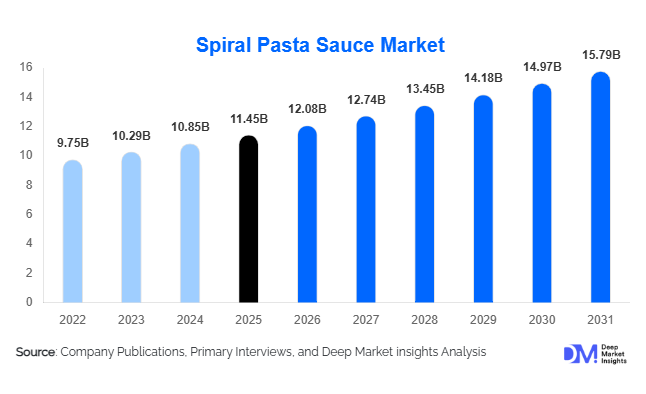
According to Deep Market Insights, the global spiral pasta sauce market size was valued at USD 11.45 billion in 2025 and is projected to grow from USD 12.08 billion in 2026 to reach USD 15.79 billion by 2031, expanding at a CAGR of 5.5% during the forecast period (2026–2031). The spiral pasta sauce market growth is primarily driven by increasing consumption of convenience foods, rising popularity of Italian cuisine worldwide, growing demand for premium and clean-label sauces, and the expansion of organized retail and e-commerce distribution channels. Consumers are increasingly seeking ready-to-use meal solutions that offer restaurant-quality taste and authentic ingredients, driving innovation in tomato-based, cream-based, and specialty sauce categories. The market is also benefiting from growing home-cooking trends, premiumization, and the adoption of healthier formulations such as organic, low-sodium, and plant-based sauces.
Key Market Insights
- Tomato-based sauces dominate the market, accounting for more than 54% of global revenue due to their versatility, affordability, and universal consumer acceptance.
- Premium and gourmet pasta sauces are witnessing rapid growth, driven by increasing consumer willingness to pay for authentic ingredients, artisanal recipes, and clean-label products.
- Europe remains the largest regional market, representing nearly 38% of global demand owing to high per-capita pasta consumption and strong culinary traditions.
- Asia-Pacific is the fastest-growing region, supported by urbanization, rising disposable incomes, and growing adoption of Western cuisines in China, India, and Southeast Asia.
- Household consumption accounts for approximately 65% of market demand, supported by increasing home cooking and demand for convenient meal preparation solutions.
- Digital commerce and quick-commerce channels are reshaping distribution, enabling manufacturers to directly engage consumers and accelerate premium product adoption.
Spiral Pasta Sauce Market Latest Trends
Premium and Clean-Label Sauces Gaining Momentum
Consumers are increasingly demanding pasta sauces made with natural ingredients, organic tomatoes, extra virgin olive oil, and reduced preservatives. This has accelerated the development of clean-label and gourmet products that command premium pricing and higher margins. Manufacturers are introducing small-batch recipes, imported ingredients, and regional Italian flavors to differentiate their offerings. The trend is particularly pronounced in North America and Europe, where consumers are willing to pay a premium for authenticity, sustainability, and transparency in ingredient sourcing. Plant-based formulations, low-sugar variants, and functional sauces enriched with proteins and vegetables are also expanding the premium category.
Digital Retail and Direct-to-Consumer Expansion
E-commerce and quick-commerce platforms are significantly transforming the pasta sauce industry. Consumers increasingly prefer online channels that provide convenience, product comparisons, and access to premium and specialty brands. Direct-to-consumer strategies are allowing manufacturers to launch niche products rapidly and establish stronger customer relationships. Subscription meal kits and bundled pasta-and-sauce offerings are becoming increasingly popular among younger demographics. Manufacturers are also leveraging digital platforms to gather consumer insights and personalize marketing strategies, thereby enhancing customer retention and improving profitability.
Spiral Pasta Sauce Market Drivers
Growing Demand for Convenience Foods
Rapid urbanization and increasingly busy lifestyles have significantly boosted demand for ready-to-use meal solutions. Pasta sauces simplify meal preparation while delivering authentic flavors and convenience, making them particularly appealing to working professionals and younger consumers. The global packaged food industry continues to expand, creating favorable conditions for growth in pasta sauce consumption.
Globalization of Food Preferences
Italian cuisine has become one of the most popular international food categories. The expansion of Italian restaurants, food delivery services, and social media-driven food trends has substantially increased global consumption of pasta dishes and associated sauces. Emerging economies are witnessing increasing adoption of Western culinary habits, further supporting market expansion.
Premiumization and Health-Conscious Consumption
Consumers increasingly prefer healthier food options, including organic, vegan, low-sodium, and preservative-free sauces. Premium products featuring high-quality ingredients and authentic recipes are driving value growth across mature markets. Manufacturers are continuously innovating with specialty ingredients and clean-label formulations to address evolving consumer preferences.
Spiral Pasta Sauce Market Restraints
Raw Material Price Volatility
Prices of tomatoes, dairy ingredients, olive oil, and packaging materials are subject to fluctuations due to climatic conditions, supply chain disruptions, and agricultural constraints. These factors increase production costs and pressure profit margins, particularly for smaller manufacturers.
Stringent Food Regulations and Labeling Requirements
Food safety regulations, nutritional labeling mandates, and sustainability standards continue to become increasingly rigorous across major markets. Compliance with these regulations increases operational costs and presents barriers for new entrants and smaller companies seeking international expansion.
Spiral Pasta Sauce Industry Key Opportunities
Expansion in Emerging Markets
Asia-Pacific, Latin America, and the Middle East represent significant growth opportunities due to rising disposable incomes, expanding middle-class populations, and increasing adoption of Western food habits. Countries such as India, China, Indonesia, and Saudi Arabia are experiencing strong demand growth for packaged foods and premium culinary products. Localized flavor development and regional manufacturing investments provide substantial opportunities for market participants.
Premium and Functional Product Innovation
The growing demand for organic, plant-based, low-sugar, and fortified sauces presents attractive opportunities for both established companies and new entrants. Consumers increasingly seek healthier and differentiated products that align with wellness trends. Functional ingredients such as added proteins, vegetables, and superfoods are creating new premium market segments and supporting higher average selling prices.
Growth of Digital and Direct-to-Consumer Channels
The rapid expansion of online grocery platforms and quick-commerce services is enabling manufacturers to increase market penetration and improve customer engagement. Direct-to-consumer business models facilitate rapid product launches, personalized offerings, and improved profitability by reducing intermediary dependence.
Report Scope
| Report Metric | Details |
|---|---|
| Market Size in 2025 | USD 11.45 Billion |
| Market Size in 2026 | USD 12.08 Billion |
| Market Size in 2031 | USD 15.79 Billion |
| CAGR | 5.5% (2026-2031) |
| Base Year for Estimation | 2025 |
| Historical Data | 2022-2024 |
| Forecast Period | 2026-2031 |
| Report Coverage | Revenue Forecast, Competitive Landscape, Supply Chain Disruption, Growth Factors, Environment & Regulatory Landscape and Trends |
| Geographies Covered | North America, Europe, APAC, Middle East and Africa, LATAM |
| Countries Covered | U.S., Canada, U.K., Germany, France, Spain, Italy, Russia, Nordic, Benelux, Rest of Europe, China, Korea, Japan, India, Australia, Singapore, Taiwan, South East Asia, Rest of Asia-Pacific, UAE, Turky, Saudi Arabia, South Africa, Egypt, Nigeria, Rest of MEA, Brazil, Mexico, Argentina, Chile, Colombia, Rest of LATAM |
Explore more data points, trends and opportunities Download Free Sample Report
Sauce Type Insights
The tomato-based sauce segment dominated the global spiral pasta sauce market in 2025, accounting for approximately 54% of total revenue and maintaining its position as the leading sauce category worldwide. The segment's leadership is primarily driven by its widespread consumer acceptance, affordability, versatility across numerous pasta preparations, and strong penetration across both developed and emerging markets. Tomato-based sauces remain a staple ingredient in household and foodservice applications due to their compatibility with diverse culinary preferences and their availability in a wide range of flavor variants, including marinara, arrabbiata, and herb-infused formulations. Continuous product innovations incorporating organic tomatoes, reduced sodium formulations, and clean-label ingredients are further strengthening the segment's market position.Cream-based sauces, including Alfredo, cheese, and butter-based variants, represent one of the fastest-growing premium categories within the market. Growth in this segment is being fueled by increasing consumer preference for indulgent and restaurant-style meal experiences, rising demand for premium convenience foods, and the growing popularity of Western cuisines in developing economies. Manufacturers are increasingly introducing premium cream-based formulations featuring artisanal cheeses, dairy alternatives, and gourmet ingredients to cater to changing consumer preferences and support higher value realization.Oil-based sauces, particularly pesto and herb-infused olive oil variants, are gaining considerable traction among health-conscious consumers seeking authentic Mediterranean flavors and minimally processed ingredients. The increasing adoption of Mediterranean dietary patterns, growing awareness regarding the health benefits of olive oil, and rising demand for plant-based meal solutions are supporting segment expansion. Meanwhile, ethnic and fusion sauces continue to emerge as niche but rapidly expanding categories, driven by increasing culinary experimentation, globalization of food cultures, and growing consumer willingness to explore international flavors and innovative taste combinations.
Ingredient Profile Insights
The conventional ingredient segment accounted for nearly 81% of global market demand in 2025, making it the largest ingredient category in the spiral pasta sauce market. The segment's dominance is primarily attributed to its affordability, extensive retail availability, established consumer familiarity, and widespread adoption by both household and foodservice consumers. Conventional formulations continue to benefit from large-scale production capabilities and extensive distribution networks, enabling manufacturers to offer competitively priced products across various markets.However, organic, clean-label, and plant-based sauce formulations are witnessing significantly higher growth rates than conventional products as consumers increasingly prioritize health, ingredient transparency, and sustainability considerations. The rising prevalence of lifestyle-related diseases and growing awareness regarding artificial additives and preservatives are accelerating demand for naturally sourced ingredients and minimally processed food products. In addition, the market is experiencing increasing demand for low-sodium, sugar-free, gluten-free, and allergen-free formulations, particularly among health-conscious consumers and individuals with dietary restrictions.Functional and fortified pasta sauces enriched with proteins, vegetables, probiotics, and micronutrients represent an emerging niche segment with substantial long-term growth potential. These products are increasingly being positioned as value-added meal solutions capable of delivering both convenience and nutritional benefits, particularly among working professionals, fitness enthusiasts, and families seeking healthier meal alternatives.
Packaging Insights
Glass jars accounted for approximately 38% of global market revenue in 2025 and remained the leading packaging format in the spiral pasta sauce market. The segment's leadership is driven by strong consumer preference for premium packaging, superior product visibility, and the ability of glass containers to preserve flavor, aroma, and product integrity without chemical interactions. Glass packaging also aligns with growing sustainability trends due to its recyclability and premium aesthetic appeal, making it particularly attractive for high-value and gourmet sauce categories.PET bottles and flexible pouches are increasingly gaining market share due to their lightweight properties, lower transportation and logistics costs, enhanced convenience, and suitability for on-the-go consumption. Flexible packaging solutions also offer manufacturers advantages in terms of reduced packaging material usage and improved shelf efficiency. The increasing focus on sustainability and cost optimization is encouraging the adoption of recyclable and lightweight packaging materials across the industry.Single-serve packaging formats are experiencing notable growth due to changing consumer lifestyles, increasing demand for portion-controlled meal solutions, and rising consumption among smaller households and individual consumers. Bulk foodservice containers are also witnessing increasing demand, driven by the expansion of restaurants, institutional food providers, and quick-service restaurant chains that require cost-effective packaging solutions for large-scale operations.
Distribution Channel Insights
Supermarkets and hypermarkets accounted for nearly 72% of global sales in 2025, making modern retail the dominant distribution channel in the spiral pasta sauce market. The segment's leadership is primarily driven by extensive product assortment, strong consumer trust, widespread geographic presence, and the ability to offer promotional pricing and private-label alternatives. Large retail chains continue to serve as critical sales channels for both mass-market and premium pasta sauce brands, particularly in developed economies.Specialty food stores and convenience stores continue to play an important role in market development by serving consumers seeking premium, imported, organic, and artisanal products. These channels provide manufacturers with opportunities to target niche consumer segments and introduce differentiated product offerings.Online retail channels are registering rapid expansion, supported by evolving shopping behaviors, increasing internet penetration, and growing consumer preference for home delivery and digital purchasing experiences. Direct-to-consumer platforms and quick-commerce services are increasingly becoming important channels for product discovery, personalized marketing, and customer engagement. The integration of subscription models, digital promotions, and data-driven consumer insights is further enhancing the importance of e-commerce within the overall distribution landscape.
End-Use Insights
The household segment accounted for approximately 65% of global demand in 2025 and remained the largest end-use category in the spiral pasta sauce market. The segment's dominance is primarily driven by increasing home cooking activities, rising preference for convenient meal preparation solutions, and growing consumption of ready-to-cook and easy-to-prepare food products. Busy lifestyles, increasing participation of women in the workforce, and the growing popularity of international cuisines are further supporting household demand for packaged pasta sauces.Restaurants and quick-service restaurant chains represent one of the fastest-growing end-use segments, driven by the continuous expansion of Italian cuisine offerings, increasing foodservice expenditure, and the rising popularity of Western dining concepts across emerging markets. Foodservice operators are increasingly adopting premium and customized sauce solutions to differentiate their menu offerings and improve operational efficiency.Industrial food processors are increasingly incorporating pasta sauces into ready meals, frozen products, meal kits, and prepared food applications, thereby creating additional demand opportunities for manufacturers. Furthermore, export-oriented food manufacturing industries are contributing to market expansion through increasing utilization of packaged sauces in processed food products intended for international markets.
Explore more data points, trends and opportunities Download Free Sample Report
Spiral Pasta Sauce Market Segmentations
By Sauce Type
- Tomato-Based Sauces
- Cream-Based Sauces
- Oil-Based Sauces
- Vegetable-Based Specialty Sauces
- Protein-Enriched Sauces
- Ethnic and Fusion Sauces
By Ingredient Profile
- Conventional
- Organic
- Clean Label/Natural
- Low Sodium
- Sugar-Free/No Added Sugar
- Gluten-Free
- Vegan/Plant-Based
- Functional and Fortified Sauces
By Packaging Format
- Glass Jars
- PET Bottles
- Flexible Pouches
- Cans
- Sachets/Single-Serve Packs
- Bulk Foodservice Containers
By Price Positioning
- Economy
- Mid-Range
- Premium
- Super Premium/Gourmet
By Distribution Channel
- Hypermarkets and Supermarkets
- Convenience Stores
- Specialty Food Stores
- Traditional Grocery Stores
- Online Retail
- Foodservice Distributors
Regional Insights
North America
North America accounted for approximately 28% of global market demand in 2025, with the United States contributing nearly 22% of worldwide revenue. The region benefits from high consumption of convenience foods, strong consumer preference for authentic Italian cuisine, and substantial spending on premium and value-added food products. The growing popularity of organic, clean-label, and gourmet pasta sauces among affluent consumers continues to support market growth. Additionally, the expansion of e-commerce channels and quick-commerce platforms is improving product accessibility and accelerating market penetration.Regional growth is further driven by increasing demand for ready-to-cook meal solutions, the expanding penetration of premium private-label products, rising consumer willingness to experiment with international cuisines, and strong innovation in plant-based and health-focused sauce formulations. The growing influence of food delivery services and meal kit providers is also creating additional demand for packaged pasta sauces across the region.
Europe
Europe remained the largest regional market, accounting for approximately 38% of global revenue in 2025. Italy, Germany, France, and the United Kingdom dominate regional demand due to high per-capita pasta consumption, established culinary traditions, and strong consumer familiarity with pasta-based meals. Italy alone contributes approximately 11% of global demand and continues to serve as a major producer and exporter of premium pasta sauces.Regional market growth is being supported by increasing consumer preference for organic and clean-label products, rising demand for artisanal and premium sauce varieties, and the growing popularity of sustainable and locally sourced ingredients. The presence of well-established food manufacturing industries, extensive retail infrastructure, and continuous product innovation in premium and functional food categories further strengthens Europe's leadership position in the global market.
Asia-Pacific
Asia-Pacific represented approximately 21% of global demand in 2025 and is projected to register the fastest growth through 2031, with a CAGR exceeding 7%. China and India are leading market expansion due to rapid urbanization, increasing disposable incomes, changing dietary preferences, and growing exposure to Western food cultures. Japan and South Korea remain important markets for premium and imported sauces, while Southeast Asian economies continue to exhibit strong growth potential owing to rapidly expanding organized retail infrastructure.The region's growth is additionally driven by rising consumption of convenience foods among younger consumers, increasing adoption of international cuisines, expansion of modern retail and e-commerce channels, growing influence of social media and food trends, and increasing investments by international food manufacturers in local production and distribution networks. The expanding middle-class population and rising demand for premium packaged foods are expected to further accelerate market development across the region.
Latin America
Latin America represents an emerging growth market for spiral pasta sauces, with Brazil and Mexico accounting for the majority of regional demand. Increasing urbanization, changing dietary patterns, and rising consumption of packaged convenience foods are supporting market expansion. The growing popularity of premium and imported products among middle-income consumers is creating attractive opportunities for international brands seeking regional expansion.Additional growth drivers include the expansion of modern retail channels, increasing penetration of international foodservice chains, rising disposable incomes, and growing consumer interest in Western cuisines and convenient meal preparation solutions. Continuous product innovation and improved availability of affordable packaged sauces are expected to further support regional demand over the forecast period.
Middle East & Africa
The Middle East and Africa market is witnessing steady growth, led by Saudi Arabia, the United Arab Emirates, and South Africa. Rapid urbanization, increasing tourism activities, and expanding restaurant industries are driving demand for pasta sauces across the region. Rising adoption of Western cuisine and increasing availability of international food products continue to support long-term market expansion.Regional growth is further supported by the increasing number of expatriate populations, rising investments in hospitality and foodservice infrastructure, growing penetration of organized retail formats, and increasing demand for convenient and premium packaged food products among younger consumers. Furthermore, the expansion of modern supermarkets and rising disposable incomes in key urban centers are expected to create significant opportunities for pasta sauce manufacturers across the region during the forecast period.
Key Players in the Spiral Pasta Sauce Market
- The Kraft Heinz Company
- Mizkan Holdings Co., Ltd.
- Barilla G. e R. Fratelli S.p.A.
- Conagra Brands, Inc.
- Nestlé S.A.
- The Campbell's Company
- Unilever PLC
- Sacla' S.p.A.
- Newman's Own, Inc.
- Rao's Homemade
- Del Monte Foods, Inc.
- Mutti S.p.A.
- B&G Foods, Inc.
- Premier Foods plc
- La Doria S.p.A.