Shrimp Powder Market Size
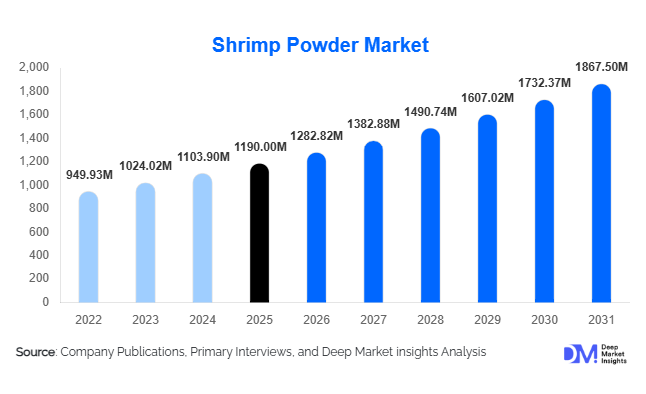
According to Deep Market Insights, the global shrimp powder market size was valued at USD 1,190 million in 2025 and is projected to grow from USD 1,282.82 million in 2026 to reach USD 1,867.50 million by 2031, expanding at a CAGR of 7.8% during the forecast period (2026–2031). The shrimp powder market growth is primarily driven by increasing demand for natural seafood-based flavor enhancers, rising consumption of protein-rich ingredients in processed foods, and expanding applications in premium pet food and aquaculture feed industries. Growing utilization of shrimp processing by-products to produce value-added ingredients and increasing investments in sustainable seafood processing technologies are further supporting market expansion globally.
Key Market Insights
- Food and beverage applications account for nearly 48% of global demand, driven by increasing consumption of instant noodles, soups, seasonings, and ready-to-eat meals.
- Asia-Pacific dominates the global shrimp powder market with approximately 49% market share, supported by extensive shrimp farming and seafood processing industries in China, India, Vietnam, and Thailand.
- Shrimp by-product powder contributes nearly 58% of global production, reflecting increasing industry focus on circular economy practices and seafood waste valorization.
- Premium pet food and aquaculture feed applications are the fastest-growing segments, registering growth rates exceeding 9% annually due to rising demand for marine protein ingredients.
- Spray-dried shrimp powder accounts for around 47% of market revenues, owing to its cost efficiency, scalability, and superior product consistency.
- Direct B2B distribution channels represent more than 60% of global sales, supported by long-term supply agreements with food and feed manufacturers.
- Natural and clean-label ingredients are reshaping product innovation, encouraging manufacturers to replace synthetic flavor enhancers with marine-based ingredients.
Shrimp Powder Market Latest Trends
Increasing Utilization of Seafood Processing By-products
One of the most significant trends in the shrimp powder market is the growing commercialization of shrimp processing residues, including shrimp shells, heads, and trimmings. Seafood processors are increasingly investing in technologies that convert processing waste into high-value ingredients such as shrimp powder, marine proteins, and chitin derivatives. Nearly 35–45% of shrimp processing output globally is generated as by-products, creating substantial opportunities for ingredient manufacturers. Governments and industry participants are also encouraging waste minimization and circular economy initiatives, resulting in increased investment in sustainable seafood ingredient production facilities. This trend is improving industry profitability while reducing environmental impact and supporting the development of value-added seafood ingredients.
Rising Demand for Natural Umami Ingredients
Food manufacturers are increasingly replacing synthetic flavor enhancers with natural ingredients to address growing consumer preference for clean-label food products. Shrimp powder is gaining popularity as a natural source of umami flavor, particularly in seasonings, soups, snack foods, and ready-to-eat meals. Manufacturers are introducing premium formulations that emphasize natural flavor, protein enrichment, and minimally processed ingredients. The growing popularity of Asian cuisine and seafood-flavored snacks across North America and Europe is also supporting demand for shrimp powder-based flavor solutions.
Shrimp Powder Market Drivers
Growing Demand for Protein-Rich Food Ingredients
Consumer preferences are shifting toward high-protein and nutrient-dense foods, supporting the demand for marine-derived proteins such as shrimp powder. The ingredient contains high concentrations of protein, essential amino acids, minerals, and natural flavor compounds, making it suitable for use in nutritional products and processed foods. Increasing awareness regarding the health benefits associated with seafood-derived ingredients is encouraging manufacturers to incorporate shrimp powder into functional food products and dietary supplements.
Expansion of Processed and Convenience Food Industries
The global processed food industry continues to experience robust growth due to urbanization, changing lifestyles, and increasing demand for convenience foods. Shrimp powder is widely utilized in instant noodles, soup bases, seasoning blends, sauces, and ready meals due to its concentrated seafood flavor and ease of incorporation into food formulations. The continued expansion of packaged food consumption in Asia-Pacific and North America is creating sustained demand for shrimp powder ingredients.
Rapid Growth of Aquaculture and Premium Pet Nutrition Markets
The aquaculture and premium pet food industries are increasingly utilizing shrimp powder because of its high digestibility, nutritional profile, and palatability-enhancing properties. Premium pet food manufacturers are incorporating marine proteins into formulations to meet growing consumer demand for natural and high-quality ingredients. Similarly, aquaculture feed producers are adopting shrimp powder to improve feed performance and nutritional value.
Shrimp Powder Market Restraints
Volatility in Shrimp Raw Material Prices
The shrimp powder industry remains vulnerable to fluctuations in shrimp supply caused by disease outbreaks, climate variability, feed cost inflation, and trade restrictions. Price volatility directly impacts production economics and can significantly affect manufacturer margins.
Stringent Food Safety and Allergen Regulations
Shrimp is classified among the major food allergens in several countries, requiring strict compliance with labeling and food safety regulations. Manufacturers incur additional costs associated with testing, certification, traceability, and regulatory compliance, particularly in North American and European markets.
Shrimp Powder Industry Key Opportunities
Expansion of Sustainable Seafood Ingredient Production
The increasing focus on circular economy practices presents a significant opportunity for shrimp powder manufacturers. Converting shrimp processing residues into high-value ingredients enables producers to reduce waste while generating additional revenue streams. Countries such as India, Vietnam, Indonesia, and Ecuador are actively investing in seafood processing infrastructure and by-product utilization technologies, creating favorable conditions for market expansion.
Growing Demand from Premium Pet Food and Aquafeed Industries
The global premium pet food and aquaculture feed sectors continue to experience strong growth, creating new demand avenues for shrimp powder. Marine proteins are increasingly preferred due to their digestibility, nutritional profile, and natural flavor properties. As pet humanization trends gain momentum and aquaculture production expands globally, demand for shrimp powder as a functional feed ingredient is expected to increase significantly.
Clean-Label and Natural Food Ingredient Innovations
Food manufacturers are increasingly reformulating products to eliminate artificial additives and synthetic flavor enhancers. Shrimp powder offers a natural alternative that provides both flavor enhancement and nutritional value. New product development in seasonings, snacks, soups, and ready meals is expected to generate significant opportunities for ingredient suppliers that can provide premium and traceable shrimp powder products.
Report Scope
| Report Metric | Details |
|---|---|
| Market Size in 2025 | USD 1190.00 Million |
| Market Size in 2026 | USD 1282.82 Million |
| Market Size in 2031 | USD 1867.50 Million |
| CAGR | 7.8% (2026-2031) |
| Base Year for Estimation | 2025 |
| Historical Data | 2022-2024 |
| Forecast Period | 2026-2031 |
| Report Coverage | Revenue Forecast, Competitive Landscape, Supply Chain Disruption, Growth Factors, Environment & Regulatory Landscape and Trends |
| Geographies Covered | North America, Europe, APAC, Middle East and Africa, LATAM |
| Countries Covered | U.S., Canada, U.K., Germany, France, Spain, Italy, Russia, Nordic, Benelux, Rest of Europe, China, Korea, Japan, India, Australia, Singapore, Taiwan, South East Asia, Rest of Asia-Pacific, UAE, Turky, Saudi Arabia, South Africa, Egypt, Nigeria, Rest of MEA, Brazil, Mexico, Argentina, Chile, Colombia, Rest of LATAM |
Explore more data points, trends and opportunities Download Free Sample Report
Product Type Insights
Natural shrimp powder dominates the global shrimp powder market, accounting for approximately 52% of total revenue in 2025. The segment maintains its leadership position due to increasing consumer and industrial preference for authentic seafood flavors, minimally processed ingredients, and clean-label product formulations. Food manufacturers are increasingly incorporating natural shrimp powder into soups, seasonings, instant noodles, sauces, and ready-to-eat products to enhance flavor profiles while meeting rising consumer demand for natural and recognizable ingredients. The expansion of processed and convenience food industries, particularly in Asia-Pacific and North America, has further strengthened demand for natural shrimp powder across multiple applications.Seasoned and flavored shrimp powders are witnessing robust growth owing to the increasing popularity of convenience foods, snack seasonings, and ready meal products that require standardized seafood flavor solutions. Manufacturers are developing customized flavor variants to cater to regional taste preferences and premium food applications. Organic shrimp powder remains a relatively niche segment but is projected to experience significant growth over the forecast period, driven by rising consumer awareness regarding sustainable sourcing practices, organic food consumption, and demand for products free from synthetic additives and preservatives.Functional and fortified shrimp powders enriched with proteins, amino acids, minerals, and bioactive compounds are emerging as high-value specialty ingredients. Growing applications in nutritional supplements, sports nutrition products, and functional food formulations are creating new revenue opportunities for market participants. Increasing research into marine-derived proteins and bioactive ingredients is expected to further expand the commercial potential of specialty shrimp powder products during the forecast period.
Application Insights
The food and beverage segment represents the largest application category, accounting for nearly 48% of global shrimp powder market revenue in 2025. The segment's dominance is primarily attributed to the rapid expansion of convenience foods, growing demand for authentic seafood flavors, and increasing consumption of processed and ready-to-eat products across both developed and emerging economies. Shrimp powder is extensively utilized in instant noodles, soups, seasonings, snacks, sauces, and frozen meal products due to its ability to provide concentrated seafood flavor, improve product consistency, and enhance nutritional value. Rising urbanization, changing dietary patterns, and increasing consumer preference for convenience-oriented food products continue to support segment expansion.Animal nutrition represents one of the fastest-growing application areas, particularly within aquaculture feed and premium pet food industries. Shrimp powder is valued for its high protein content, palatability, amino acid profile, and natural attractant properties, making it an important ingredient in specialized feed formulations. Growing investments in commercial aquaculture production and increasing premiumization of pet nutrition products are expected to accelerate demand from this segment.Nutraceutical and pharmaceutical applications currently account for a relatively small share of the market but are witnessing steady growth due to increasing interest in marine-derived functional ingredients and bioactive compounds. The rising adoption of protein supplements and natural health products is creating additional opportunities for shrimp-derived ingredients. Cosmetic applications are also emerging as manufacturers increasingly explore marine proteins, peptides, and minerals for use in anti-aging, skin-nourishing, and premium personal care formulations.
Distribution Channel Insights
Direct business-to-business sales dominate the global shrimp powder market, accounting for approximately 62% of total revenues in 2025. The predominance of this channel reflects the highly industrial nature of shrimp powder consumption, with large food processors, feed manufacturers, and ingredient companies relying on long-term supply agreements and customized product specifications. Direct procurement allows buyers to secure consistent quality, maintain supply chain reliability, and negotiate pricing arrangements that support large-scale production requirements.Ingredient distributors and specialty food ingredient suppliers continue to play an essential role in market development by serving small and medium-sized manufacturers that may not have direct access to large ingredient producers. These intermediaries facilitate product availability across regional markets and support the expansion of shrimp powder applications in niche and emerging industries.Online ingredient procurement platforms are gradually gaining traction as digitalization transforms global ingredient supply chains. The increasing adoption of e-commerce channels among specialty ingredient buyers, coupled with improvements in international logistics and cross-border trade infrastructure, is enhancing product accessibility and creating new growth opportunities for manufacturers seeking to expand their global customer base.
End-User Insights
Food processing companies account for approximately 44% of global shrimp powder demand and remain the largest end-user segment in 2025. The segment's leadership is primarily driven by the continuous expansion of the global processed food industry, rising consumption of convenience foods, and increasing demand for natural flavor enhancers in packaged food products. Food manufacturers are increasingly utilizing shrimp powder to improve flavor authenticity, nutritional value, and product differentiation across multiple product categories.Aquaculture feed manufacturers and premium pet food companies represent the fastest-growing end-user categories. The rapid expansion of global aquaculture production, increasing investments in sustainable feed solutions, and rising consumer spending on premium pet nutrition products are creating substantial demand for shrimp-based ingredients. The functional and nutritional properties of shrimp powder make it particularly attractive for specialized feed formulations aimed at improving feed intake and nutritional performance.Nutraceutical and cosmetic manufacturers are also creating niche opportunities within the market by incorporating shrimp-derived proteins, peptides, and minerals into premium formulations targeting health, wellness, and personal care applications. Continuous product innovation and growing consumer interest in marine-based ingredients are expected to support long-term growth across these emerging end-user segments.
Packaging Insights
Industrial packaging formats, particularly 10–25 kilogram bags, account for approximately 55% of global market demand owing to the predominantly business-to-business nature of shrimp powder consumption. Large food processors, feed manufacturers, and ingredient companies prefer industrial packaging solutions that facilitate efficient handling, storage, and transportation while supporting high-volume procurement requirements.Bulk sacks and large-capacity packaging formats are widely utilized by major feed manufacturers and ingredient processors due to their cost efficiency and suitability for large-scale manufacturing operations. At the same time, smaller retail packs, pouches, and consumer-oriented packaging formats are gaining popularity in specialty food applications and premium retail segments as demand for shrimp-based seasonings and culinary ingredients expands.Manufacturers are increasingly investing in moisture-resistant, oxygen-barrier, and recyclable packaging solutions to improve product shelf life, preserve flavor integrity, and align with evolving sustainability objectives. The growing emphasis on environmentally responsible packaging materials is expected to remain an important trend shaping packaging innovation within the shrimp powder industry.
Explore more data points, trends and opportunities Download Free Sample Report
Shrimp Powder Market Segmentations
By Product Type
- Natural Shrimp Powder
- Seasoned/Flavored Shrimp Powder
- Organic Shrimp Powder
- Functional/Fortified Shrimp Powder
By Raw Material Source
- Whole Shrimp-Based Powder
- Shrimp Shell Powder
- Shrimp Head Powder
- Mixed Processing Residue Powder
By Processing Technology
- Spray-Dried Shrimp Powder
- Freeze-Dried Shrimp Powder
- Drum-Dried Shrimp Powder
- Oven/Hot-Air Dried Shrimp Powder
By Application
- Food & Beverage
- Animal Nutrition
- Nutraceuticals & Dietary Supplements
- Pharmaceuticals
- Cosmetics & Personal Care
By Distribution Channel
- Direct/B2B Sales
- Ingredient Distributors
- Specialty Food Ingredient Suppliers
- Online Sales
- Retail Stores
Regional Insights
Asia-Pacific
Asia-Pacific remains the largest regional market, accounting for approximately 49% of global shrimp powder revenues in 2025. The region's dominance is supported by its extensive seafood processing infrastructure, abundant shrimp production capacity, and high consumption of seafood-based ingredients in traditional and processed food applications. China represents the largest market within the region due to its massive food manufacturing industry and extensive use of seafood ingredients across seasonings, instant foods, and prepared meals. India and Vietnam are among the fastest-growing markets, benefiting from expanding shrimp farming activities, increasing seafood exports, and growing investments in value-added seafood ingredient manufacturing. Thailand and Indonesia continue to serve as major production and export hubs due to their well-established seafood processing industries and strong export-oriented supply chains.Regional growth is primarily driven by the rapid expansion of convenience food consumption, increasing urbanization, rising disposable incomes, growing demand for natural seafood flavors, and significant investments in aquaculture and seafood processing industries. Furthermore, the presence of abundant raw material availability, competitive production costs, and expanding exports of processed seafood products continues to strengthen Asia-Pacific's leadership position in the global shrimp powder market.
North America
North America accounts for approximately 18% of the global shrimp powder market, with the United States representing nearly 78% of regional demand. Market growth is supported by increasing consumption of processed and convenience foods, expanding applications in premium pet nutrition, and rising demand for clean-label and natural ingredient formulations. Canada is also witnessing steady growth, particularly in premium food products, nutritional supplements, and specialty ingredient applications.The region's growth is driven by increasing consumer preference for natural flavor enhancers, strong demand for protein-rich and functional ingredients, growing premiumization of pet food products, and continuous innovation within the processed food industry. The expansion of health-conscious consumer segments and increasing adoption of marine-derived ingredients in nutraceutical applications are further contributing to market development across North America.
Europe
Europe accounts for nearly 20% of global market revenues and remains a significant consumer of natural seafood ingredients. Germany, France, the United Kingdom, Spain, and Italy represent the major regional markets, supported by increasing demand for clean-label foods, natural flavor ingredients, and premium pet nutrition products. The region's highly developed food processing industry and strong consumer preference for high-quality and sustainably sourced ingredients continue to support market growth.Regional expansion is being driven by growing consumer awareness regarding product traceability and sustainability, increasing demand for natural and minimally processed ingredients, and rising investments in premium pet food and functional food products. Stringent regulatory standards regarding food safety, labeling, and sustainable sourcing are also encouraging the adoption of high-quality shrimp-derived ingredients across multiple end-use industries.
Latin America
Latin America accounts for approximately 7% of global demand and is gradually emerging as an important market for shrimp-based ingredients. Ecuador is becoming a significant producer and exporter of shrimp-derived products due to its rapidly expanding shrimp farming and processing industries. Brazil and Mexico continue to witness increasing demand from processed food manufacturers and animal nutrition industries as regional food processing capabilities expand.Market growth across Latin America is supported by rising investments in aquaculture production, increasing exports of seafood products, growing demand for value-added food ingredients, and the expansion of the regional animal feed industry. Improvements in food manufacturing infrastructure and increasing consumer preference for processed and convenience foods are also creating favorable conditions for long-term market expansion.
Middle East & Africa
The Middle East and Africa represent approximately 6% of global market revenues and are projected to register the fastest regional growth during the forecast period. Saudi Arabia and South Africa are among the key regional markets, experiencing increasing demand from food processing, animal nutrition, and specialty food industries. Rising investments in food manufacturing capabilities and increasing seafood consumption are supporting market expansion across the region.The region's rapid growth is being driven by increasing urbanization, changing dietary habits, rising disposable incomes, expanding food processing industries, and growing investments aimed at strengthening food security and local manufacturing capabilities. Additionally, increasing demand for premium animal feed products, greater penetration of processed foods, and government initiatives to diversify food production and reduce import dependency are expected to create substantial opportunities for shrimp powder manufacturers across the Middle East and Africa during the forecast period.
Key Players in the Shrimp Powder Market
- Thai Union Group
- Maruha Nichiro Corporation
- Nissui Corporation
- Trident Seafoods
- Pacific Seafood
- Royal Greenland
- Dongwon Industries
- Ocean Harvest Technology
- Oceanic Foods
- Apex Frozen Foods
- Avanti Feeds
- Charoen Pokphand Foods
- Minh Phu Seafood Corporation
- Anderson Seafoods
- SeaPak