Premium Gin Market Size
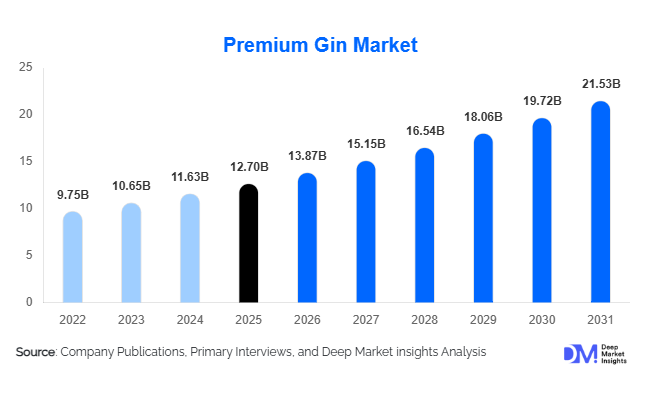
According to Deep Market Insights, the global premium gin market size was valued at USD 12.7 billion in 2025 and is projected to grow from USD 13.87 billion in 2026 to reach USD 21.53 billion by 2031, expanding at a CAGR of 9.2% during the forecast period (2026–2031). The premium gin market growth is primarily driven by rising premiumization trends in alcoholic beverages, increasing global cocktail culture adoption, strong demand for craft spirits, and growing consumer preference for botanical-based luxury alcoholic drinks.
Key Market Insights
- Premium gin consumption is increasingly shifting toward craft and botanical-infused variants, with consumers preferring authentic, artisanal, and region-specific flavor profiles.
- Luxury hospitality and cocktail culture are significantly boosting premium gin demand, particularly across bars, rooftop lounges, hotels, and fine-dining establishments.
- Europe dominates the global premium gin market, led by strong consumption in the United Kingdom, Spain, Germany, and France.
- Asia-Pacific remains the fastest-growing regional market, driven by rising disposable incomes and premium alcohol consumption in India, China, Japan, and Australia.
- E-commerce and direct-to-consumer alcohol platforms are reshaping distribution channels, enabling premium brands to expand global consumer reach.
- Sustainability-focused production and eco-friendly packaging initiatives are becoming key competitive differentiators among premium gin manufacturers.
premium gin market latest trends
Rise of Craft and Botanical Gin Variants
The premium gin industry is witnessing strong growth in demand for craft-produced and botanical-rich gin variants. Consumers are increasingly attracted toward artisanal products featuring locally sourced herbs, spices, fruits, and floral infusions that provide unique flavor experiences. Distilleries across the United Kingdom, Australia, Japan, and India are introducing region-specific botanical blends to differentiate themselves within an increasingly competitive market. Limited-edition launches, seasonal flavors, and small-batch production techniques are also gaining popularity among premium spirit consumers seeking exclusivity and authenticity. Premium gin brands are increasingly emphasizing heritage storytelling, handcrafted production methods, and transparency in ingredient sourcing to strengthen consumer loyalty.
Digitalization and Premium Alcohol E-Commerce Expansion
The rapid growth of online alcohol retailing is transforming premium gin distribution globally. Consumers increasingly prefer purchasing premium spirits through digital platforms that offer broader product access, home delivery convenience, personalized recommendations, and exclusive online launches. Direct-to-consumer channels are enabling premium gin brands to build stronger customer relationships while improving profit margins through reduced intermediary dependence. Digital marketing campaigns, influencer partnerships, AI-driven consumer targeting, and social media engagement are becoming essential growth strategies within the industry. Subscription-based premium spirit clubs and curated gin-tasting kits are also emerging as new consumer engagement models, particularly among millennials and urban professionals.
premium gin market drivers
Growing Premiumization in Alcoholic Beverages
The increasing consumer preference for premium and super-premium alcoholic beverages remains one of the primary drivers supporting global premium gin market expansion. Consumers are shifting away from mass-produced spirits toward high-quality craft beverages with superior ingredients, distinctive flavor profiles, and luxury branding. Rising disposable income levels and growing spending on lifestyle-oriented experiences are supporting demand across developed and emerging economies. Affluent millennials and urban consumers increasingly perceive premium gin as a sophisticated social beverage associated with exclusivity, quality, and modern cocktail culture. Premium packaging, artisanal production, and limited-edition product launches are further strengthening market positioning and encouraging higher consumer spending.
Expansion of Cocktail Culture and Hospitality Industry
The global expansion of cocktail culture is significantly increasing premium gin consumption across bars, restaurants, luxury hotels, and nightlife establishments. Premium gin serves as a key ingredient in classic and modern cocktails such as martinis, negronis, gin and tonic variations, and botanical spritzes. Hospitality businesses are increasingly incorporating premium spirits into curated beverage menus to enhance customer experiences and improve profit margins. Tourism growth and the recovery of international travel are further contributing to rising consumption in hospitality-driven economies such as Spain, the UAE, Thailand, Singapore, and Australia. Social media influence and experiential dining trends are also driving consumer experimentation with premium gin-based cocktails.
global market restraints
Stringent Alcohol Regulations and Taxation Policies
The premium gin market faces considerable challenges from increasing government regulations surrounding alcohol production, marketing, labeling, and distribution. Several countries continue to impose strict advertising restrictions and high excise duties on alcoholic beverages, limiting brand promotion opportunities and increasing retail prices. Regulatory inconsistencies related to online alcohol sales and cross-border trade also create operational complexities for manufacturers and distributors. These factors may reduce profitability and slow market expansion in highly regulated regions.
Volatility in Raw Material and Packaging Costs
Fluctuations in the prices of juniper berries, botanical extracts, glass bottles, imported ingredients, and transportation services continue to impact premium gin manufacturers globally. Supply chain disruptions and climate-related agricultural uncertainties have increased production costs for several distilleries. Smaller craft producers are particularly vulnerable to rising input expenses due to limited economies of scale. Increased packaging and logistics costs may place pressure on profit margins or result in higher retail pricing, potentially affecting affordability among mid-income consumers.
premium gin industry key opportunities
Expansion of Localized Craft Distilleries
The growing consumer demand for authentic and locally inspired spirits presents major opportunities for regional craft distilleries. Manufacturers are increasingly incorporating indigenous botanicals, native herbs, and regional flavor profiles to create differentiated premium gin offerings. Emerging markets such as India, Brazil, Japan, and South Africa are witnessing the rise of domestic premium gin brands capable of competing with established European labels. Consumers are increasingly valuing artisanal storytelling, local sourcing, and small-batch production, creating significant opportunities for new entrants and niche producers to establish strong brand positioning and premium pricing capabilities.
Sustainable and Eco-Friendly Premium Spirits
Sustainability-focused production methods and environmentally responsible packaging solutions are creating significant growth opportunities within the premium gin market. Consumers increasingly associate sustainability with product quality and luxury positioning. Brands investing in recyclable glass packaging, carbon-neutral distillation facilities, renewable energy adoption, and sustainable botanical sourcing are gaining competitive advantages among environmentally conscious buyers. Several manufacturers are also introducing organic premium gin variants and water-efficient production systems to align with evolving consumer preferences. Sustainability certifications and transparent sourcing practices are expected to become increasingly important purchasing factors globally.
Report Scope
| Report Metric | Details |
|---|---|
| Market Size in 2025 | USD 12.70 Billion |
| Market Size in 2026 | USD 13.87 Billion |
| Market Size in 2031 | USD 21.53 Billion |
| CAGR | 9.2% (2026-2031) |
| Base Year for Estimation | 2025 |
| Historical Data | 2022-2024 |
| Forecast Period | 2026-2031 |
| Report Coverage | Revenue Forecast, Competitive Landscape, Supply Chain Disruption, Growth Factors, Environment & Regulatory Landscape and Trends |
| Geographies Covered | North America, Europe, APAC, Middle East and Africa, LATAM |
| Countries Covered | U.S., Canada, U.K., Germany, France, Spain, Italy, Russia, Nordic, Benelux, Rest of Europe, China, Korea, Japan, India, Australia, Singapore, Taiwan, South East Asia, Rest of Asia-Pacific, UAE, Turky, Saudi Arabia, South Africa, Egypt, Nigeria, Rest of MEA, Brazil, Mexico, Argentina, Chile, Colombia, Rest of LATAM |
Explore more data points, trends and opportunities Download Free Sample Report
Product Type Insights
London Dry Gin dominates the premium gin market, accounting for the largest global revenue share due to its strong historical presence, widespread consumer familiarity, and extensive use in cocktails. The category remains highly popular across bars, restaurants, and hospitality establishments worldwide. Contemporary and botanical-infused premium gin variants are witnessing rapid growth as consumers increasingly seek innovative flavor combinations featuring floral, citrus, spice, and herbal notes. Barrel-aged and navy-strength premium gin products are also gaining traction among enthusiasts seeking differentiated drinking experiences. Organic and craft gin categories continue expanding rapidly, supported by consumer interest in artisanal production methods, sustainable sourcing, and locally inspired ingredients.
Application Insights
Cocktails and mixology applications account for the largest share of premium gin consumption globally, driven by increasing demand across nightlife venues, fine-dining establishments, and luxury hospitality chains. Premium gin remains a foundational ingredient in several classic and contemporary cocktails, supporting widespread commercial adoption. Straight consumption of premium gin is also increasing among consumers seeking sophisticated sipping experiences and botanical flavor exploration. Corporate gifting, luxury events, weddings, and premium celebrations are emerging as important application segments for ultra-premium and limited-edition gin products. The growing popularity of home mixology and cocktail experimentation is further expanding consumer demand for premium spirits.
Distribution Channel Insights
Off-trade retail channels dominate premium gin distribution globally, supported by the expansion of specialty liquor stores, supermarkets, premium beverage retailers, and online alcohol platforms. E-commerce channels are witnessing particularly strong growth due to increasing consumer preference for convenience, broader product selection, and home delivery services. Direct-to-consumer sales platforms are enabling manufacturers to improve customer engagement while enhancing profitability. On-trade channels including bars, lounges, restaurants, hotels, and nightclubs continue to play a critical role in premium brand visibility and cocktail-driven consumption. Duty-free retail and travel retail channels are also emerging as important growth avenues for luxury and limited-edition premium gin offerings.
Consumer Demographic Insights
Millennials represent the largest consumer demographic within the premium gin market, driven by strong interest in premium experiences, craft beverages, cocktail experimentation, and social drinking culture. Younger consumers are highly influenced by digital marketing, social media trends, and experiential consumption preferences. Gen Z adult consumers are increasingly adopting premium gin products through flavored variants, sustainable brands, and modern packaging aesthetics. High-net-worth individuals and luxury lifestyle consumers continue to drive demand for ultra-premium and collector-edition gin products featuring rare botanicals and exclusive packaging. Female consumers are also contributing significantly to market expansion, particularly through demand for floral, fruit-infused, and lighter botanical gin profiles.
Explore more data points, trends and opportunities Download Free Sample Report
Premium Gin Market Segmentations
By Product Type
- London Dry Gin
- Contemporary Gin
- Old Tom Gin
- Plymouth Gin
- Navy Strength Gin
- Barrel-Aged Gin
- Botanical/Flavored Premium Gin
- Organic & Craft Premium Gin
- Ultra-Premium & Limited Edition Gin
By Price Point
- Entry Premium
- Super Premium
- Ultra Premium
- Luxury/Collector Edition
By Production Method
- Distilled Gin
- Compound Gin
- Vacuum Distilled Gin
- Small-Batch Craft Gin
- Copper Pot Distilled Gin
By Distribution Channel
- On-Trade
- Supermarkets & Hypermarkets
- Specialty Liquor Stores
- Convenience Stores
- Online Retail/E-commerce
- Direct-to-Consumer Brand Stores
By Consumer Demographics
- Millennials
- Gen Z Adult Consumers
- Gen X Consumers
- High-Net-Worth Consumers
- Women Consumers
- Cocktail Enthusiasts
- Luxury Lifestyle Consumers
Regional Insights
North America
North America represents a major premium gin consumption market, accounting for nearly 28% of global demand in 2025. The United States dominates regional growth due to rising cocktail culture, expanding craft distillery operations, and strong premium alcohol spending among millennials and urban consumers. Luxury bars, rooftop lounges, and hospitality venues are significantly contributing to premium gin adoption across metropolitan areas. Canada is also witnessing rising demand for small-batch and locally produced gin products, supported by increasing consumer interest in craft spirits and artisanal alcoholic beverages.
Europe
Europe remains the dominant regional market, accounting for approximately 39% of global premium gin consumption in 2025. The United Kingdom serves as the largest single-country market globally due to its deep-rooted gin heritage, mature cocktail culture, and large concentration of premium distilleries. Spain demonstrates exceptionally strong gin consumption trends driven by widespread popularity of premium gin and tonic culture. Germany, France, Italy, and the Netherlands are also witnessing rising demand for botanical and craft premium gin variants. Strong export capabilities and advanced distribution networks continue to reinforce Europe’s leadership position within the global market.
Asia-Pacific
Asia-Pacific is projected to remain the fastest-growing premium gin market during the forecast period, expanding at a CAGR exceeding 11%. India is emerging as a major growth hub due to rising urbanization, increasing disposable incomes, and expanding domestic premium gin production utilizing indigenous botanicals. China and Japan are witnessing increasing premium spirit consumption among younger consumers and hospitality establishments. Australia remains a mature market characterized by strong craft distillery growth and premium cocktail culture adoption. Expanding e-commerce penetration and premium retail infrastructure across the region are further accelerating market growth.
Latin America
Latin America is experiencing gradual but steady premium gin market expansion, led primarily by Brazil, Argentina, and Chile. Rising nightlife culture, urban premium alcohol consumption, and increasing interest in imported craft spirits are supporting demand growth across the region. Affluent consumers are increasingly exploring premium cocktails and international spirit brands through luxury hospitality venues and premium retail outlets. Regional craft distilleries are also beginning to emerge with localized botanical gin offerings targeting younger consumers.
Middle East & Africa
The Middle East and Africa region is witnessing increasing premium gin demand driven primarily by tourism, hospitality, and expatriate consumer bases. The UAE remains the dominant regional market due to its luxury tourism industry, premium nightlife infrastructure, and strong international hospitality presence. South Africa is emerging as a notable craft gin production hub, supported by local botanical diversity and growing domestic premium spirit consumption. International tourism recovery and rising investments in luxury hospitality infrastructure are expected to further support regional market growth over the forecast period.
Key Players in the Premium Gin Market
- Diageo
- Pernod Ricard
- Bacardi Limited
- William Grant & Sons
- Beam Suntory
- Rémy Cointreau
- Campari Group
- Brown-Forman
- Lucas Bols
- The Edrington Group
- San Miguel Corporation
- Kirin Holdings
- Maison Ferrand
- Halewood Artisanal Spirits
- Davide Campari-Milano