Phalaenopsis Orchid Market Size
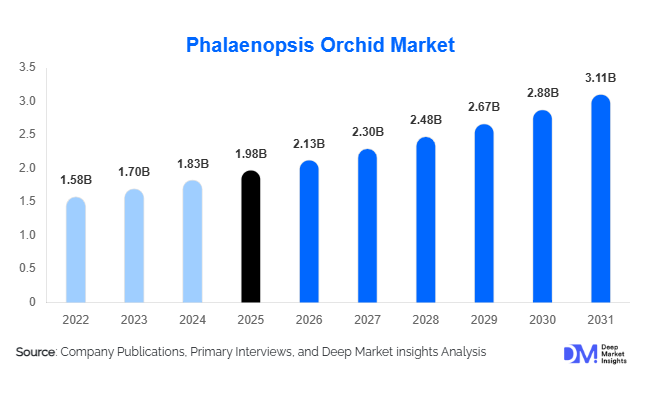
According to Deep Market Insights, the global Phalaenopsis orchid market size was valued at USD 1.98 billion in 2025 and is projected to grow from USD 2.13 billion in 2026 to reach USD 3.11 billion by 2031, expanding at a CAGR of 7.8% during the forecast period (2026–2031). The Phalaenopsis orchid market growth is primarily driven by rising consumer demand for ornamental indoor plants, increasing adoption of luxury floral décor, expansion of hospitality landscaping projects, and growing global gifting culture centered around premium flowers and decorative plants.
Key Market Insights
- Phalaenopsis orchids continue to dominate the commercial orchid industry, supported by their long bloom life, premium aesthetics, and low-maintenance characteristics.
- Asia-Pacific remains the leading production and export hub, with China, Taiwan, and Thailand driving greenhouse cultivation and international flower exports.
- Residential indoor décor applications account for the largest demand share, fueled by urban apartment living and rising interest in biophilic interior design.
- Online retail channels are rapidly transforming orchid distribution, enabling direct-to-consumer delivery and subscription-based ornamental plant services.
- Premium and designer orchid varieties are witnessing strong pricing growth, particularly in luxury gifting, weddings, and hospitality landscaping applications.
- Advanced greenhouse automation and tissue-culture propagation technologies are improving commercial production efficiency and export-quality consistency.
Phalaenopsis Orchid Market Latest Trends
Premium Indoor Plant Culture Expanding Globally
Consumers are increasingly integrating ornamental plants into modern residential and commercial interiors, making Phalaenopsis orchids one of the fastest-growing premium decorative plant categories worldwide. Minimalist home décor trends, social media-driven lifestyle aesthetics, and wellness-oriented interior design concepts are significantly boosting demand. Younger urban consumers are particularly attracted to compact orchid varieties that offer long-lasting blooms with limited maintenance requirements. Retailers are responding by introducing designer ceramic pots, customized orchid arrangements, and subscription-based indoor plant delivery services. High-end interior designers and luxury hospitality operators are also incorporating orchids into premium decorative themes, reinforcing their position as aspirational lifestyle products.
Technology-Driven Greenhouse Cultivation Accelerating
Commercial orchid cultivation is rapidly adopting advanced greenhouse technologies to improve flowering consistency, reduce operational costs, and strengthen export competitiveness. Automated irrigation systems, AI-powered climate monitoring, hydroponic cultivation, LED-assisted lighting, and tissue-culture propagation are increasingly becoming industry standards among large-scale growers. These technologies help optimize temperature, humidity, and nutrient management while reducing crop losses caused by pests and disease outbreaks. Sustainable cultivation practices, including water recycling systems and biodegradable potting materials, are also gaining traction as environmental certifications become increasingly important for international buyers and premium retailers.
Phalaenopsis Orchid Market Drivers
Growing Demand for Ornamental Indoor Plants
The rising global preference for ornamental indoor plants remains one of the strongest growth drivers for the Phalaenopsis orchid market. Consumers increasingly associate indoor plants with wellness, stress reduction, and improved living environments. Phalaenopsis orchids are especially popular because they combine visual elegance with long flowering cycles and relatively simple maintenance requirements. Urbanization and compact apartment living are further accelerating demand for decorative plants suitable for indoor spaces. The growing influence of social media platforms focused on home décor and indoor gardening is also encouraging younger demographics to purchase premium orchids for residential use.
Expansion of Hospitality and Luxury Commercial Landscaping
Hotels, luxury resorts, shopping malls, airports, restaurants, and premium office spaces are increasingly using Phalaenopsis orchids as part of sophisticated interior landscaping strategies. Orchids are favored for their premium appearance, color diversity, and ability to enhance customer experiences in hospitality environments. The rapid expansion of luxury tourism infrastructure in Southeast Asia, the Middle East, and North America is creating sustained institutional demand for large-scale orchid procurement. Event management companies and luxury wedding planners are also driving strong demand for premium cut orchid flowers and customized decorative arrangements.
Global Market Restraints
High Cultivation and Greenhouse Operating Costs
Commercial Phalaenopsis orchid cultivation requires highly controlled environmental conditions involving temperature regulation, humidity management, specialized lighting, and disease control systems. These requirements significantly increase greenhouse operating costs, particularly in regions with high energy prices. Smaller growers often struggle to compete with large-scale commercial producers capable of leveraging automation and economies of scale. Rising labor costs, fertilizer prices, and greenhouse infrastructure expenses continue to pressure industry profitability.
Cold-Chain Logistics and Perishability Challenges
Phalaenopsis orchids are highly sensitive to transportation conditions and require efficient cold-chain logistics to maintain product quality during international shipments. Delays in transportation, temperature fluctuations, and inadequate packaging can lead to flower damage and shortened bloom life. Export-oriented growers are particularly vulnerable to rising air freight costs and supply-chain disruptions. Seasonal oversupply conditions may also create pricing volatility in major export markets, limiting profit margins for producers dependent on international flower trade.
Phalaenopsis Orchid Industry Key Opportunities
Luxury Gifting and Premium Floral Arrangements
The expanding global gifting culture presents significant opportunities for premium orchid producers and retailers. Phalaenopsis orchids are increasingly used in corporate gifting, weddings, anniversaries, festive celebrations, and luxury event decoration due to their premium visual appeal and symbolic association with elegance. High-income consumers are showing growing willingness to spend on customized decorative orchid arrangements, designer pots, and rare hybrid varieties. Premium floral boutiques and online flower delivery platforms are capitalizing on this trend by offering personalized gifting experiences and subscription-based floral services.
Export Expansion Through Controlled Environment Agriculture
Investments in controlled-environment agriculture and greenhouse automation are enabling new regions to expand orchid production for export markets. Countries such as India, Vietnam, and Thailand are increasingly supporting floriculture development through greenhouse subsidies, horticulture modernization programs, and export-oriented agricultural policies. Improvements in cold-chain logistics and e-commerce-enabled international flower delivery are further strengthening export potential. Commercial growers adopting hydroponic systems, tissue-culture propagation, and AI-driven cultivation management are expected to gain substantial competitive advantages in global orchid trade.
Report Scope
| Report Metric | Details |
|---|---|
| Market Size in 2025 | USD 1.98 Billion |
| Market Size in 2026 | USD 2.13 Billion |
| Market Size in 2031 | USD 3.11 Billion |
| CAGR | 7.8% (2026-2031) |
| Base Year for Estimation | 2025 |
| Historical Data | 2022-2024 |
| Forecast Period | 2026-2031 |
| Report Coverage | Revenue Forecast, Competitive Landscape, Supply Chain Disruption, Growth Factors, Environment & Regulatory Landscape and Trends |
| Geographies Covered | North America, Europe, APAC, Middle East and Africa, LATAM |
| Countries Covered | U.S., Canada, U.K., Germany, France, Spain, Italy, Russia, Nordic, Benelux, Rest of Europe, China, Korea, Japan, India, Australia, Singapore, Taiwan, South East Asia, Rest of Asia-Pacific, UAE, Turky, Saudi Arabia, South Africa, Egypt, Nigeria, Rest of MEA, Brazil, Mexico, Argentina, Chile, Colombia, Rest of LATAM |
Explore more data points, trends and opportunities Download Free Sample Report
Product Type Insights
Potted Phalaenopsis orchids continue to dominate the global Phalaenopsis orchid market, accounting for the largest share of overall revenue owing to their long-lasting aesthetic appeal, extended blooming cycles, and growing popularity in residential as well as commercial interior decoration. Consumers increasingly prefer potted orchids because they provide long-term decorative value compared to traditional cut flowers, making them highly suitable for home décor, office environments, hospitality spaces, and premium gifting applications. The rising influence of wellness-oriented interior design trends, urban indoor gardening culture, and biophilic living concepts has significantly accelerated demand for ornamental potted plants globally. Premium ceramic-potted orchids, designer arrangements, and miniature Phalaenopsis varieties are witnessing particularly strong adoption among urban apartment residents, millennials, and luxury consumers seeking compact yet visually elegant decorative solutions. In addition, growing disposable incomes and increasing consumer willingness to spend on premium ornamental plants are further strengthening segment expansion.Cut Phalaenopsis flowers also represent an important product category within the market, particularly across weddings, luxury hospitality decoration, event management, and premium floral arrangement industries. Their sophisticated appearance, vibrant colors, and relatively long vase life make them highly desirable for upscale decorative applications. Demand for customized floral arrangements in corporate events, destination weddings, and luxury retail spaces continues to support segment growth worldwide. Meanwhile, tissue-culture propagation materials and young orchid seedlings are experiencing increasing demand as commercial greenhouse operators, export-oriented nurseries, and large-scale floriculture businesses expand production capacities to meet rising global consumption. Technological advancements in tissue-culture propagation are improving production efficiency, disease resistance, and hybrid quality, further contributing to the commercial expansion of this segment.
Application Insights
Home decoration remains the leading application segment within the global Phalaenopsis orchid market, primarily driven by rising consumer interest in premium indoor plants, aesthetic living environments, and wellness-focused residential spaces. Increasing urbanization, expanding apartment living, and the growing popularity of biophilic interior design are encouraging consumers to integrate orchids into living rooms, dining areas, balconies, bedrooms, and home office spaces. Social media-driven home décor trends and growing awareness regarding the psychological and wellness benefits associated with indoor plants are also supporting sustained market demand. Furthermore, orchids are increasingly viewed as symbols of sophistication, luxury, and positive ambiance, making them highly attractive among modern consumers seeking elegant decorative solutions.Hospitality landscaping represents one of the fastest-growing commercial application areas, supported by substantial investments in luxury hotels, resorts, premium retail environments, airports, and corporate office infrastructure. Hotels and hospitality operators increasingly utilize orchids to enhance customer experience, strengthen visual branding, and create premium interior environments. Weddings and event management applications are also witnessing rapid expansion due to rising demand for luxury floral decorations, customized event themes, and premium floral centerpieces. In addition, corporate gifting, festive decoration, and seasonal ornamental applications continue to generate recurring demand across both developed and emerging economies, particularly during holiday seasons, cultural celebrations, and business events.
Distribution Channel Insights
Offline retail channels continue to dominate the global Phalaenopsis orchid market as consumers generally prefer physically inspecting ornamental plants prior to purchase to evaluate flower quality, freshness, color consistency, and plant health. Florists, garden centers, supermarkets, hypermarkets, home improvement retailers, and specialty ornamental plant stores remain highly influential sales channels across major markets. The strong presence of organized retail networks and the ability to provide immediate product availability continue to support offline channel dominance. In addition, personalized customer guidance provided by florists and horticultural specialists further enhances consumer confidence in offline purchases.However, online retail channels are witnessing the fastest growth rate due to the rapid expansion of e-commerce infrastructure, improved cold-chain logistics, and advancements in protective packaging technologies designed specifically for live plants and flowers. Direct-to-consumer nursery websites, digital floral marketplaces, mobile shopping platforms, and subscription-based plant delivery services are reshaping consumer purchasing behavior, particularly among younger demographics and urban consumers. Social media marketing, influencer-driven home décor content, and digital lifestyle campaigns are significantly boosting online orchid sales globally. Furthermore, the convenience of doorstep delivery, broader product variety, and increasing penetration of digital payment systems are accelerating online channel adoption across emerging economies.
End-User Insights
Residential consumers account for the largest share of global demand within the Phalaenopsis orchid market, supported by rising indoor gardening trends, increasing consumer expenditure on home aesthetics, and growing interest in ornamental décor products. Consumers increasingly perceive orchids as premium decorative plants that enhance indoor ambiance while complementing modern interior design themes. The growing popularity of wellness-oriented living environments and the influence of social media-based home styling trends continue to support strong residential demand across urban markets worldwide. Compact orchid varieties and low-maintenance hybrid plants are particularly gaining popularity among apartment dwellers and first-time plant buyers.Commercial offices, luxury hotels, resorts, and premium hospitality establishments also represent significant end-user segments, utilizing orchids to improve customer experience, elevate workspace aesthetics, and reinforce luxury branding strategies. Event management companies, wedding planners, and professional florists remain major institutional buyers, especially for premium cut flower arrangements used in large-scale decorative installations and ceremonial events. Additionally, restaurants, cafés, luxury retail stores, wellness centers, and high-end shopping malls are increasingly incorporating orchids into interior design concepts to create visually distinctive environments that enhance customer engagement and brand positioning. The expansion of premium commercial real estate and luxury hospitality infrastructure globally continues to create long-term growth opportunities for commercial orchid consumption.
Cultivation Method Insights
Greenhouse cultivation dominates the global Phalaenopsis orchid market due to its ability to provide highly controlled environmental conditions necessary for consistent commercial-scale production. Orchids require precise temperature, humidity, lighting, and ventilation management, making greenhouse systems particularly suitable for maintaining year-round flowering quality and minimizing crop losses. The growing commercialization of ornamental horticulture and rising export demand are encouraging producers to invest heavily in technologically advanced greenhouse infrastructure across major producing countries.Automated climate-control systems, hydroponic cultivation methods, and precision irrigation technologies are increasingly being adopted to improve productivity, optimize resource utilization, and ensure consistent premium-quality output. Controlled-environment agriculture is expanding rapidly among export-oriented growers seeking stable year-round supply capabilities and enhanced operational efficiency. Furthermore, sustainability is becoming a critical competitive factor within global floriculture markets. As a result, producers are increasingly adopting organic growing media, biodegradable cultivation materials, renewable energy solutions, and water-efficient irrigation systems to meet evolving environmental standards and consumer preferences for eco-friendly ornamental products. International retailers and environmentally conscious consumers are placing greater emphasis on sustainably cultivated ornamental plants, further accelerating the adoption of responsible greenhouse cultivation practices.
Explore more data points, trends and opportunities Download Free Sample Report
Phalaenopsis Orchid Market Segmentations
By Product Type
- Potted Phalaenopsis Orchids
- Cut Phalaenopsis Flowers
- Tissue Culture & Propagation Materials
- Orchid Plant Extracts & By-products
By Variety Type
- White Phalaenopsis
- Pink Phalaenopsis
- Purple/Violet Phalaenopsis
- Yellow/Golden Phalaenopsis
- Striped & Patterned Hybrids
- Miniature Hybrid Varieties
- Novelty & Designer Hybrids
- Fragrant Phalaenopsis Varieties
By Cultivation Method
- Greenhouse Cultivation
- Controlled Environment Agriculture
- Hydroponic Cultivation
- Traditional Potting Media Cultivation
- Vertical Farming Cultivation
- Sustainable/Organic Cultivation
By Application
- Home Decoration
- Corporate & Commercial Decoration
- Weddings & Events
- Gifting
- Hospitality Landscaping
- Religious & Cultural Ceremonies
- Retail Floral Arrangements
- Interior Landscaping
By Distribution Channel
- Offline Retail
- Online Retail
- Wholesale Distribution
Regional Insights
Asia-Pacific
Asia-Pacific dominates the global Phalaenopsis orchid market, accounting for nearly 46% of total market revenue in 2025, and is projected to remain the fastest-growing regional market through 2031. The region benefits from strong floriculture traditions, highly developed greenhouse infrastructure, favorable climatic conditions, and rapidly expanding urban consumer populations. China remains the largest producer and consumer due to extensive commercial greenhouse operations, expanding middle-class purchasing power, strong domestic ornamental plant demand, and significant export capabilities. Rapid urbanization, rising disposable incomes, and growing adoption of premium home décor products are major drivers supporting regional market expansion.Taiwan continues to maintain global leadership in advanced orchid breeding technologies, hybrid development, and tissue-culture propagation systems, making it one of the world’s most important exporters of premium Phalaenopsis orchids. Thailand is strengthening its position as a major orchid export hub supported by favorable cultivation conditions, government support for floriculture exports, and expanding international trade partnerships. Japan and South Korea maintain strong demand for premium ornamental plants driven by gifting culture, luxury residential décor trends, aging populations interested in indoor gardening, and strong appreciation for aesthetically refined floral products. In addition, the rapid growth of e-commerce flower delivery platforms, social media-driven lifestyle trends, and increasing investment in commercial landscaping across Asia-Pacific are further accelerating regional market growth.
Europe
Europe accounts for approximately 27% of the global Phalaenopsis orchid market, led by the Netherlands, Germany, France, Italy, and the United Kingdom. The Netherlands remains the central hub for European floriculture trade due to its highly advanced greenhouse systems, internationally recognized flower auction networks, sophisticated cold-chain logistics infrastructure, and strong export-oriented horticulture industry. The presence of established floriculture research institutions and technological innovation in greenhouse cultivation continues to strengthen the region’s competitive position globally.European consumers increasingly prioritize sustainable, eco-certified, and ethically cultivated ornamental plants, encouraging producers and retailers to adopt environmentally responsible cultivation and distribution practices. Rising interest in indoor gardening, wellness-focused home décor, and premium lifestyle products is supporting stable residential demand across Western Europe. Additionally, the expansion of hospitality landscaping, luxury commercial interiors, and corporate wellness-focused workspace design continues to drive commercial orchid consumption throughout the region. Government emphasis on sustainable agriculture, increasing demand for locally grown ornamental plants, and strong retail penetration through supermarkets and garden centers are further contributing to long-term market growth across Europe.
North America
North America represents a major consumer market for Phalaenopsis orchids, led primarily by the United States and Canada. The United States accounts for the majority of regional demand due to increasing interest in indoor gardening, premium gifting culture, luxury floral arrangements, and home aesthetic enhancement. Growing consumer awareness regarding the mental wellness benefits associated with indoor plants, combined with the rising popularity of biophilic interior design concepts, continues to support strong market expansion across urban residential markets.Supermarkets, home improvement retailers, specialty florists, and e-commerce floral platforms have significantly expanded orchid offerings across the region, improving product accessibility and consumer awareness. Commercial demand from luxury hotels, office complexes, event planners, restaurants, and retail establishments also continues to support stable market growth. In addition, increasing social media influence, higher consumer spending on home décor products, and rising adoption of subscription-based plant delivery services are further accelerating orchid sales throughout North America. Technological improvements in greenhouse cultivation and import logistics are also helping ensure year-round product availability within the regional market.
Latin America
Latin America is gradually emerging as a promising market for ornamental orchids, particularly in Brazil and Mexico, driven by urbanization, expanding middle-class populations, and rising consumer interest in decorative indoor plants. Increasing disposable incomes and evolving lifestyle preferences are encouraging consumers to invest more heavily in premium ornamental products for residential and commercial applications. The growing influence of modern interior design trends and social media-driven home décor culture is further contributing to regional demand growth.Brazil benefits significantly from favorable climatic conditions that support localized orchid cultivation, greenhouse expansion, and nursery development. The country’s rich biodiversity and strong horticultural tradition also provide opportunities for the development of specialized orchid varieties and regional floriculture exports. Mexico is witnessing increasing demand from hospitality, retail, and event management sectors as commercial infrastructure development accelerates across urban centers. Improvements in organized retail networks, expanding e-commerce adoption, and increasing investment in commercial floriculture production are expected to further strengthen long-term market growth throughout Latin America.
Middle East & Africa
The Middle East & Africa region is experiencing steady growth in the Phalaenopsis orchid market, particularly across the UAE and Saudi Arabia, where luxury hospitality development, premium retail expansion, and high-end commercial infrastructure projects are driving ornamental plant consumption. Large-scale hotels, airports, shopping malls, event venues, and luxury residential developments increasingly utilize imported orchids to enhance interior aesthetics and create premium customer experiences. Strong government investment in tourism infrastructure and international event hosting activities are further supporting demand for decorative floral products across the region.Controlled-environment greenhouse farming is also gaining traction in Gulf countries seeking to reduce dependency on imported ornamental flowers and improve domestic floriculture capabilities. Rising disposable incomes, increasing expatriate populations, and growing consumer preference for luxury interior decoration products continue to support regional market expansion. In Africa, gradual urbanization, improving retail infrastructure, and expanding commercial landscaping activities are creating new opportunities for ornamental plant suppliers. Additionally, increasing investments in sustainable agriculture technologies and water-efficient greenhouse systems are expected to strengthen long-term ornamental horticulture development across the region.
Key Players in the Phalaenopsis Orchid Market
- Floricultura
- Dümmen Orange
- Royal Van Zanten
- Schoneveld Breeding
- Anthura
- Opti-flor
- Sion Orchids
- Pacific Plug & Liner
- Thai Orchids Nursery
- Matsui Nursery
- Oglesby Plants International
- Hassinger Orchids
- Kariki Group
- Florensis
- Oriental Orchids Limited