Crickets Market Size
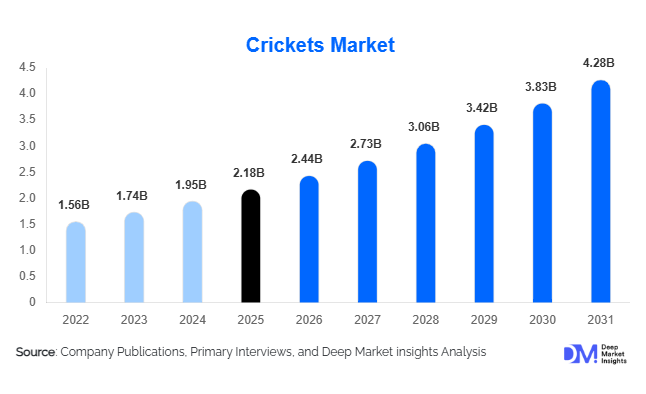
According to Deep Market Insights, the global crickets market size was valued at USD 2.18 billion in 2025 and is projected to grow from USD 2.44 billion in 2026 to reach USD 4.28 billion by 2031, expanding at a CAGR of 11.9% during the forecast period (2026–2031). Market expansion is primarily driven by the increasing demand for sustainable alternative protein sources, growing commercialization of insect farming, rising investments in food innovation, and expanding applications of cricket-derived ingredients across food, nutraceutical, animal feed, and pet nutrition industries. Favorable regulatory developments in several developed economies and increasing consumer awareness regarding environmentally sustainable protein production are further supporting long-term industry expansion.
Key Market Insights
- Cricket powder remains the leading product category, supported by its high protein concentration, excellent functionality in processed foods, and widespread adoption across bakery, beverage, and sports nutrition products.
- Food and beverage applications account for the largest market share, while nutraceutical formulations are emerging as one of the fastest-growing application areas owing to increasing consumer focus on functional nutrition.
- North America dominates the global market, driven by strong investments in commercial insect farming, growing acceptance of sustainable proteins, and expanding food innovation ecosystems.
- Asia-Pacific is projected to witness the fastest growth, supported by expanding insect farming infrastructure, increasing protein consumption, favorable climatic conditions, and rising investments in alternative protein manufacturing.
- Technological advancements in automated insect farming, including AI-enabled environmental monitoring, precision feeding systems, and climate-controlled production facilities, are significantly improving production efficiency and scalability.
- Growing sustainability initiatives and ESG investments are encouraging food manufacturers to incorporate cricket-based ingredients into mainstream protein portfolios while reducing environmental impact.
Crickets Market Trends
Automation Transforming Commercial Cricket Farming
Commercial cricket farming is rapidly transitioning toward highly automated production systems capable of improving yield consistency while reducing labor requirements and production costs. Modern facilities increasingly utilize artificial intelligence, Internet of Things (IoT) sensors, automated feeding equipment, humidity control systems, robotic harvesting technologies, and climate-controlled production chambers to optimize breeding conditions throughout the production cycle. These technologies help maintain stable temperatures, improve feed conversion efficiency, minimize mortality rates, and increase production capacity across industrial-scale farms. Automation also enables producers to standardize product quality, enhance traceability, and comply with increasingly stringent food safety regulations. As investment in precision agriculture continues to expand, automated cricket farming is expected to become the industry standard, supporting higher production volumes while improving operational sustainability and profitability.
Growing Adoption of Cricket Protein in Functional Foods
Food manufacturers are increasingly incorporating cricket-derived ingredients into functional foods as consumers seek clean-label, protein-rich, and environmentally sustainable nutrition solutions. Cricket protein powders are being utilized in protein bars, nutritional beverages, bakery products, cereals, pasta, snacks, and dietary supplements due to their complete amino acid profile, high digestibility, and micronutrient content. The expanding popularity of sports nutrition, personalized nutrition, and plant-forward diets is further encouraging food companies to diversify protein sources beyond traditional dairy and soy proteins. Product innovation is accelerating through improved processing technologies that reduce flavor intensity while enhancing ingredient functionality, enabling broader incorporation into mainstream food categories. As consumer awareness of sustainable proteins continues to rise, cricket-based ingredients are expected to secure a stronger position within the global functional food industry.
Crickets Market Drivers
Increasing Demand for Sustainable Alternative Protein Sources
Growing concerns regarding environmental sustainability, resource efficiency, and food security are significantly increasing demand for alternative protein sources worldwide. Cricket farming requires substantially less land, water, and feed than conventional livestock production while generating considerably lower greenhouse gas emissions. High protein content, balanced amino acid composition, and excellent feed conversion efficiency make crickets an attractive ingredient for food manufacturers seeking sustainable nutritional solutions. Government initiatives supporting alternative protein innovation, increasing venture capital investments, and expanding commercial farming infrastructure continue accelerating industry development. Rising consumer interest in environmentally responsible food choices, coupled with growing demand for protein-enriched products across sports nutrition, functional foods, and dietary supplements, remains a major driver supporting long-term market expansion.
Expansion of Commercial Insect Farming Infrastructure
Significant investments in industrial-scale insect farming facilities are enabling manufacturers to increase production capacity while reducing production costs through economies of scale. Companies are expanding vertically integrated production models encompassing breeding, farming, processing, ingredient manufacturing, and distribution. Modern production facilities increasingly utilize automated environmental controls, precision nutrition systems, and advanced breeding technologies that improve productivity and ensure consistent ingredient quality. Continued investment from food companies, agricultural technology providers, and sustainability-focused investors is strengthening commercial supply chains while supporting greater availability of cricket-derived ingredients across international markets. These developments are expected to improve supply reliability and facilitate broader commercialization across multiple end-use industries.
Crickets Market Restraints
Limited Consumer Acceptance Across Traditional Food Markets
Despite increasing awareness regarding sustainable proteins, consumer acceptance of edible insects remains relatively limited across many regions due to cultural perceptions, dietary preferences, and psychological barriers associated with insect consumption. Many consumers continue to demonstrate reluctance toward incorporating whole insects into their diets, slowing product adoption within mainstream retail channels. Although processed ingredients such as cricket powder have improved market acceptance by minimizing visible insect characteristics, educational initiatives and consumer awareness campaigns remain necessary to encourage broader adoption. Variations in food regulations and labeling requirements across different countries also contribute to slower commercialization, limiting market penetration in several developing and developed economies.
High Production Costs and Regulatory Complexity
Commercial cricket farming continues to involve relatively high capital investments associated with climate-controlled production facilities, automated farming technologies, food safety compliance, breeding optimization, and processing infrastructure. Manufacturers must also navigate evolving regulatory frameworks governing edible insect production, food approvals, ingredient labeling, and international trade requirements. Regulatory inconsistencies between countries create additional compliance costs while delaying product commercialization and cross-border expansion. These factors remain significant challenges for smaller producers seeking to compete with larger commercial insect farming operations.
Crickets Market Opportunities
Rapid Growth in Animal Nutrition and Premium Pet Food
The increasing adoption of sustainable protein ingredients within premium pet food, aquaculture, poultry, and livestock nutrition presents substantial growth opportunities for cricket producers worldwide. Cricket-derived proteins offer highly digestible amino acid profiles, excellent nutrient density, and lower environmental footprints compared to traditional animal protein ingredients. Premium pet food manufacturers are increasingly incorporating insect protein into hypoallergenic and specialty nutrition products targeting health-conscious pet owners. Similarly, aquaculture producers continue evaluating cricket meal as a sustainable replacement for fishmeal, creating new commercial opportunities across feed applications. As regulatory approvals continue expanding globally, cricket-based feed ingredients are expected to become an increasingly important component of sustainable animal nutrition.
Expansion into Functional Nutrition and Personalized Healthcare
Growing consumer interest in preventive healthcare, personalized nutrition, and protein supplementation is creating new opportunities for cricket-derived ingredients within functional nutrition markets. Manufacturers are developing specialized formulations for sports nutrition, healthy aging, weight management, immune health, and clinical nutrition applications utilizing cricket protein concentrates and isolates. Advances in ingredient purification, flavor optimization, and formulation technologies are improving product functionality while increasing consumer acceptance. Collaboration between food manufacturers, biotechnology companies, and nutrition researchers is expected to accelerate product innovation, enabling cricket protein to penetrate higher-value healthcare and nutraceutical applications throughout the forecast period.
Report Scope
| Report Metric | Details |
|---|---|
| Market Size in 2025 | USD 2.18 Billion |
| Market Size in 2026 | USD 2.44 Billion |
| Market Size in 2031 | USD 4.28 Billion |
| CAGR | 11.9% (2026-2031) |
| Base Year for Estimation | 2025 |
| Historical Data | 2022-2024 |
| Forecast Period | 2026-2031 |
| Report Coverage | Revenue Forecast, Competitive Landscape, Supply Chain Disruption, Growth Factors, Environment & Regulatory Landscape and Trends |
| Geographies Covered | North America, Europe, APAC, Middle East and Africa, LATAM |
| Countries Covered | U.S., Canada, U.K., Germany, France, Spain, Italy, Russia, Nordic, Benelux, Rest of Europe, China, Korea, Japan, India, Australia, Singapore, Taiwan, South East Asia, Rest of Asia-Pacific, UAE, Turky, Saudi Arabia, South Africa, Egypt, Nigeria, Rest of MEA, Brazil, Mexico, Argentina, Chile, Colombia, Rest of LATAM |
Explore more data points, trends and opportunities Download Free Sample Report
Product Type Insights
Cricket powder dominates the global crickets market owing to its superior versatility, high protein concentration, extended shelf life, and compatibility with a wide range of food formulations. The ingredient is extensively incorporated into protein bars, bakery products, cereals, nutritional beverages, snacks, and dietary supplements due to its fine particle size, excellent blending properties, and balanced amino acid profile. Food manufacturers increasingly prefer cricket powder because it can be integrated into existing production processes without significantly altering product texture or appearance. Continuous advancements in milling, drying, and protein stabilization technologies are further improving ingredient quality and consumer acceptance. Whole crickets continue to maintain demand within specialty food markets, gourmet cuisine, and snack products, particularly in regions where edible insects have long been part of traditional diets. Meanwhile, cricket protein ingredients, including protein concentrates and isolates, are emerging as one of the fastest-growing product categories as manufacturers develop premium nutrition formulations for sports nutrition, clinical nutrition, and functional food applications. Increasing commercialization of industrial-scale insect farming and growing investments in advanced processing technologies are expected to further diversify product portfolios across the global crickets market.
Application Insights
Food and beverage applications account for the largest share of the global crickets market, supported by increasing consumer demand for sustainable, protein-rich, and clean-label food products. Cricket-derived ingredients are being widely incorporated into protein bars, baked goods, pasta, cereals, confectionery products, dairy alternatives, nutritional beverages, and ready-to-eat snacks as manufacturers seek innovative protein sources with lower environmental footprints. Nutraceutical applications are experiencing rapid growth due to rising health awareness and increasing demand for high-quality protein supplements that support sports performance, muscle recovery, weight management, and healthy aging. Cricket protein's complete amino acid profile and high digestibility make it particularly attractive for functional nutrition products. Animal feed represents another important application segment as aquaculture, poultry, and premium pet food manufacturers increasingly adopt insect protein to improve sustainability while reducing dependence on conventional fishmeal and soybean meal. Expanding regulatory approvals, improved ingredient availability, and increasing investment in alternative protein research continue to accelerate application diversification throughout the global crickets market.
Distribution Channel Insights
Business-to-business (B2B) distribution dominates the crickets market as ingredient manufacturers primarily supply cricket powders, protein concentrates, and processed ingredients directly to food manufacturers, nutraceutical companies, and animal nutrition producers. Strategic partnerships between insect farming companies and food processors continue expanding global supply chains while ensuring consistent ingredient quality and long-term procurement agreements. Online distribution channels are witnessing strong growth as direct-to-consumer brands increasingly market cricket-based protein powders, nutrition supplements, healthy snacks, and specialty food products through e-commerce platforms and company-owned digital storefronts. Health food retailers, specialty nutrition stores, supermarkets, and premium grocery chains are also expanding shelf space for insect-based products in response to rising consumer awareness regarding sustainable nutrition. Digital marketing, subscription-based nutrition services, and direct brand engagement are further strengthening product accessibility and supporting broader commercialization across developed and emerging markets.
End User Insights
Food manufacturers remain the largest end-user segment within the crickets market, driven by increasing incorporation of cricket-derived ingredients into mainstream packaged foods and functional nutrition products. Nutraceutical companies represent a rapidly expanding customer base as consumer demand for protein supplementation, sports nutrition, and wellness products continues to increase globally. Animal nutrition manufacturers are also emerging as significant end users due to growing interest in sustainable feed ingredients for aquaculture, poultry, livestock, and premium pet food formulations. Research institutions, biotechnology companies, and ingredient developers are contributing to market expansion through continuous innovation in breeding technologies, protein extraction methods, and ingredient functionality. Additionally, restaurants, specialty foodservice providers, and gourmet food producers are gradually introducing cricket-based menu offerings, helping improve consumer familiarity while expanding commercial opportunities across the global crickets market.
Explore more data points, trends and opportunities Download Free Sample Report
Crickets Market Segmentations
By Product Type
- Whole Crickets
- Cricket Powder
- Cricket Protein Ingredients
By Application
- Food & Beverages
- Animal Feed
- Nutraceuticals
By Distribution Channel
- Business-to-Business (B2B)
- Online Retail
- Supermarkets & Hypermarkets
- Specialty Health & Nutrition Stores
- Direct-to-Consumer (D2C)
Regional Insights
North America
North America dominates the global crickets market, supported by well-established commercial insect farming companies, increasing consumer awareness of sustainable proteins, and significant investments in food technology innovation. The United States represents the largest regional market due to strong demand for functional foods, sports nutrition products, premium pet food, and alternative protein ingredients. Canada is also witnessing growing investments in automated insect farming facilities, research collaborations, and sustainable agriculture initiatives. The region benefits from advanced food processing infrastructure, supportive venture capital funding, and increasing partnerships between ingredient manufacturers and major food companies. Rising demand for environmentally friendly protein sources, favorable regulatory developments, and expanding commercialization of cricket-derived ingredients continue strengthening North America's leadership in the global market.
Europe
Europe represents one of the fastest-evolving markets for cricket-based products, driven by favorable regulatory approvals, increasing consumer acceptance of sustainable food ingredients, and strong environmental awareness. Countries including Germany, France, the Netherlands, Denmark, Belgium, and Finland are investing heavily in commercial insect farming, protein extraction technologies, and food innovation. The European Food Safety Authority's approvals for several edible insect species have accelerated product launches across bakery, snacks, meat alternatives, nutritional supplements, and sports nutrition categories. Increasing government support for sustainable agriculture, circular economy initiatives, and greenhouse gas reduction strategies is encouraging manufacturers to expand production capacity. Growing demand for clean-label ingredients and environmentally responsible food products continues to position Europe as a key growth region within the global crickets market.
Asia-Pacific
Asia-Pacific is projected to register the highest growth throughout the forecast period owing to expanding insect farming infrastructure, increasing protein consumption, and long-standing cultural familiarity with edible insects in several countries. Thailand, Vietnam, China, India, Japan, South Korea, and Australia are witnessing rising investments in commercial farming operations, advanced breeding technologies, and food processing capabilities. Thailand remains one of the world's leading producers of edible crickets, while China and India are rapidly expanding production capacity to address growing domestic and export demand. Increasing urbanization, rising disposable incomes, government support for alternative protein innovation, and expanding food manufacturing industries are further supporting market growth. Growing awareness regarding sustainable nutrition is expected to significantly accelerate regional demand over the coming years.
Latin America
Latin America is gradually emerging as a promising market for cricket-derived ingredients, supported by growing investments in sustainable agriculture, alternative protein production, and innovative food manufacturing. Brazil, Mexico, Chile, and Argentina are witnessing increasing research activities focused on insect farming technologies and sustainable food systems. Consumer awareness regarding environmentally responsible nutrition continues to improve, while premium pet food manufacturers and functional food companies are exploring insect protein as a high-value ingredient. Although commercial production remains relatively limited compared to North America and Europe, improving regulatory frameworks and expanding private investments are expected to strengthen regional market development throughout the forecast period.
Middle East & Africa
The Middle East & Africa region is steadily expanding within the global crickets market due to increasing interest in food security, sustainable agriculture, and innovative protein production. Countries including the United Arab Emirates, Saudi Arabia, South Africa, Kenya, and Israel are investing in agricultural technologies capable of reducing dependence on imported protein ingredients. Rising demand for premium animal feed, expanding aquaculture production, and government initiatives supporting sustainable food systems are creating favorable conditions for commercial insect farming. In Africa, the availability of favorable climatic conditions and growing agricultural diversification efforts further contribute to production potential, while Middle Eastern investments in food innovation continue supporting long-term market expansion.
Key Players in the Crickets Market
- Entomo Farms
- Aspire Food Group
- Cricket One Co., Ltd.
- All Things Bugs LLC
- Hargol FoodTech
- Protix
- Ynsect
- Beta Hatch Inc.
- Hexafly
- NextProtein
- Bugsolutely
- EnviroFlight LLC