Amino Acid Fertilizer Market Size
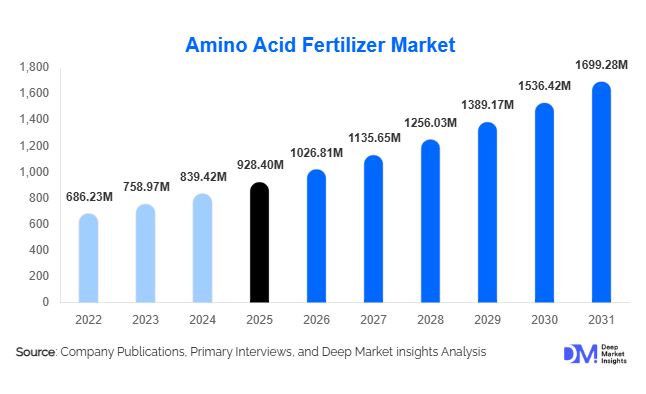
According to Deep Market Insights, the global amino acid fertilizer market size was valued at USD 928.4 million in 2025 and is projected to grow from USD 1,026.81 million in 2026 to reach USD 1,699.28 million by 2031, expanding at a CAGR of 10.6% during the forecast period (2026–2031). The amino acid fertilizer market growth is primarily driven by increasing adoption of sustainable agricultural practices, rising demand for high-efficiency bio-based crop nutrients, and the growing use of amino acid formulations in horticulture, greenhouse cultivation, and precision farming systems.
Key Market Insights
- Amino acid fertilizers are increasingly being integrated into sustainable and regenerative farming practices, as growers seek to reduce dependency on synthetic agrochemicals while improving crop productivity and soil health.
- Liquid amino acid fertilizers dominate the market, owing to their superior absorption efficiency, compatibility with fertigation systems, and widespread use in foliar spray applications.
- Asia-Pacific dominates the global amino acid fertilizer market, led by large-scale agricultural production in China and India and rising awareness regarding specialty crop nutrition.
- Europe remains one of the fastest-growing markets, supported by stringent environmental regulations limiting synthetic fertilizer usage and encouraging biological crop inputs.
- Organic farming and greenhouse cultivation are emerging as critical growth drivers, accelerating demand for plant-based and bio-fermented amino acid fertilizers globally.
- Technological advancements in microbial fermentation and protein hydrolysis are improving production efficiency, formulation quality, and scalability of amino acid fertilizer.
Amino Acid Fertilizer Market Latest Trends
Shift Toward Bio-Based and Plant-Derived Fertilizers
The amino acid fertilizer market is increasingly witnessing a shift toward plant-derived and bio-based formulations as governments and agricultural producers focus on sustainability and residue-free farming practices. Plant-based amino acid fertilizers derived from soy protein, corn protein, and seaweed hydrolysates are gaining strong traction due to their compatibility with organic farming standards and lower environmental impact compared to conventional chemical fertilizers. Agricultural producers are prioritizing bio-stimulant solutions that improve nutrient uptake efficiency while maintaining soil microbial balance. In Europe and North America, regulatory pressure to reduce nitrate pollution and greenhouse gas emissions from agriculture is further encouraging the adoption of biological crop nutrition products. Manufacturers are also investing heavily in eco-friendly fermentation technologies and low-carbon production methods to align with sustainability goals. The growing popularity of regenerative agriculture is expected to accelerate long-term demand for amino acid fertilizers globally.
Precision Agriculture and Fertigation Integration
Modern precision agriculture systems are increasingly integrating amino acid fertilizers into automated nutrient management programs. Farmers are adopting fertigation and controlled irrigation systems that allow targeted nutrient delivery with minimal wastage. Amino acid fertilizers are particularly suitable for precision farming because they improve micronutrient bioavailability and plant stress resistance even at lower application volumes. Digital farming technologies, including AI-based nutrient monitoring, soil sensors, and satellite-guided irrigation systems, are supporting optimized use of amino acid formulations. Greenhouse operators and hydroponic farming systems are increasingly utilizing water-soluble amino acid fertilizers to enhance crop quality, accelerate growth cycles, and improve resistance to heat and drought stress. This trend is especially strong in high-value horticultural crops such as berries, grapes, tomatoes, peppers, and ornamental flowers.
Amino Acid Fertilizer Market Drivers
Rising Demand for Sustainable Agriculture
Global agriculture is undergoing a major transition toward sustainable and environmentally responsible farming practices. Excessive dependence on synthetic fertilizers has resulted in soil degradation, nutrient runoff, and groundwater contamination in several agricultural economies. Amino acid fertilizers are increasingly being adopted because they improve nutrient utilization efficiency, stimulate plant metabolic activity, and reduce the requirement for conventional chemical fertilizers. Governments across Europe, Asia-Pacific, and North America are supporting sustainable nutrient management through subsidies, environmental regulations, and organic farming initiatives. The growing focus on soil health restoration and long-term agricultural productivity is expected to remain a major growth driver for the amino acid fertilizer market.
Expansion of High-Value Horticulture and Specialty Crops
The rapid expansion of horticulture, greenhouse farming, and specialty crop cultivation is significantly increasing demand for amino acid fertilizers. Fruits, vegetables, flowers, berries, and export-oriented crops require advanced nutrient management systems that support quality enhancement and stress mitigation. Amino acid formulations improve flowering intensity, fruit coloration, sugar accumulation, and post-harvest shelf life, making them highly attractive for commercial horticulture producers. Export-focused agricultural economies such as Spain, India, Morocco, Peru, and Chile are increasingly adopting specialty fertilizers to improve crop competitiveness in international markets.
Global Market Restraints
High Production and Product Costs
Despite strong market growth, amino acid fertilizers remain relatively expensive compared to traditional NPK fertilizers. Production processes involving protein hydrolysis, microbial fermentation, purification, and specialty formulation technologies require significant capital investment and operational costs. Premium pricing limits adoption among small-scale farmers, particularly in developing agricultural economies where cost sensitivity remains high. Raw material price fluctuations related to soy protein, fish hydrolysates, and fermentation substrates also impact overall profitability and pricing stability within the market.
Limited Farmer Awareness and Regulatory Standardization
In several emerging agricultural markets, limited awareness regarding the long-term benefits of amino acid fertilizers continues to restrict adoption rates. Farmers often remain dependent on conventional fertilizer programs due to familiarity and lower upfront costs. In addition, inconsistent regulatory frameworks for biostimulants and specialty fertilizers create challenges for manufacturers operating across multiple countries. Product quality inconsistency, counterfeit formulations, and lack of standardized efficacy benchmarks can affect farmer confidence and slow down market penetration in price-sensitive regions.
Amino Acid Fertilizer Industry Key Opportunities
Climate-Resilient Agriculture Solutions
The increasing frequency of droughts, salinity stress, heat waves, and irregular rainfall patterns is creating substantial opportunities for amino acid fertilizer manufacturers. Amino acids such as proline, glutamic acid, and glycine play important physiological roles in improving plant tolerance against abiotic stress conditions. Farmers are increasingly using amino acid fertilizers to protect crops during unfavorable environmental conditions and maintain productivity under climate stress. Regions such as the Middle East, India, Southeast Asia, and Africa are expected to emerge as high-growth markets for stress-management crop nutrition solutions. Manufacturers developing crop-specific climate-resilient formulations are likely to gain competitive advantages in the coming years.
Growth of Controlled Environment Agriculture
The expansion of hydroponics, vertical farming, and greenhouse cultivation systems is creating strong opportunities for specialty amino acid fertilizer suppliers. Controlled environment agriculture requires highly efficient, water-soluble, and rapidly absorbable nutrient formulations. Amino acid fertilizers improve nutrient uptake efficiency while supporting faster crop growth cycles and improved product quality in indoor farming environments. Urban farming investments are rising rapidly across North America, Europe, the Middle East, and Asia-Pacific, creating sustained demand for advanced crop nutrition solutions. Companies offering customized formulations for hydroponic and greenhouse systems are expected to benefit significantly from this trend.
Report Scope
| Report Metric | Details |
|---|---|
| Market Size in 2025 | USD 928.40 Million |
| Market Size in 2026 | USD 1026.81 Million |
| Market Size in 2031 | USD 1699.28 Million |
| CAGR | 10.6% (2026-2031) |
| Base Year for Estimation | 2025 |
| Historical Data | 2022-2024 |
| Forecast Period | 2026-2031 |
| Report Coverage | Revenue Forecast, Competitive Landscape, Supply Chain Disruption, Growth Factors, Environment & Regulatory Landscape and Trends |
| Geographies Covered | North America, Europe, APAC, Middle East and Africa, LATAM |
| Countries Covered | U.S., Canada, U.K., Germany, France, Spain, Italy, Russia, Nordic, Benelux, Rest of Europe, China, Korea, Japan, India, Australia, Singapore, Taiwan, South East Asia, Rest of Asia-Pacific, UAE, Turky, Saudi Arabia, South Africa, Egypt, Nigeria, Rest of MEA, Brazil, Mexico, Argentina, Chile, Colombia, Rest of LATAM |
Explore more data points, trends and opportunities Download Free Sample Report
Product Type Insights
Multi-amino acid blend fertilizers dominate the global market, accounting for a significant share due to their broad-spectrum physiological benefits and compatibility across multiple crop types. These formulations are widely used in horticulture, greenhouse cultivation, and commercial farming because they improve nutrient absorption, stress tolerance, and overall crop quality simultaneously. Protein hydrolysate-based fertilizers are also gaining substantial traction due to their ability to deliver naturally derived amino acids in highly bioavailable forms. Chelated amino acid fertilizers are increasingly preferred in micronutrient-deficient soils because they improve nutrient transport efficiency and reduce nutrient losses. Single amino acid formulations such as glycine-, lysine-, and proline-based fertilizers are being increasingly adopted in crop-specific stress management applications, particularly in high-value horticultural cultivation systems.
Application Insights
Foliar spray application remains the leading segment within the amino acid fertilizer market due to its rapid nutrient absorption and immediate physiological response in plants. Farmers increasingly prefer foliar applications during critical crop growth stages and environmental stress conditions. Fertigation systems are witnessing rapid growth as precision agriculture adoption expands globally, especially in greenhouse cultivation and drip irrigation-based farming systems. Soil treatment applications continue to maintain strong demand in large-scale cereal and grain farming operations, while seed treatment applications are emerging as a niche but promising segment for improving early-stage plant vigor and germination rates. Hydroponic nutrient application is also gaining traction due to the rapid expansion of vertical farming and controlled environment agriculture worldwide.
Distribution Channel Insights
Direct B2B sales dominate the amino acid fertilizer market as large agricultural enterprises and commercial farms increasingly establish long-term procurement agreements with manufacturers and specialty fertilizer suppliers. Agricultural cooperatives and specialty agrochemical retailers continue to play an important role in product distribution, particularly in developing agricultural economies where farmers rely heavily on local dealer networks. Online agricultural input platforms are rapidly emerging as an important sales channel, especially in India, China, and Latin America. Manufacturers are increasingly investing in digital platforms, agronomic advisory services, and farmer education programs to strengthen customer engagement and improve product adoption rates. Subscription-based nutrient management services are also gradually emerging within precision agriculture ecosystems.
Crop Type Insights
Fruits and vegetables account for the largest share of the amino acid fertilizer market due to the high nutritional and physiological demands associated with horticultural cultivation. Producers of export-oriented fruits and vegetables increasingly rely on amino acid fertilizers to improve crop appearance, shelf life, and overall quality. Cereals and grains continue to represent a substantial volume segment, particularly in Asia-Pacific and Latin America, where farmers are integrating specialty fertilizers into conventional nutrient programs to improve productivity and nutrient efficiency. Plantation crops such as tea, coffee, cocoa, and sugarcane are also generating increasing demand due to the growing adoption of stress-management nutrient solutions. Commercial greenhouse crops and ornamental plants represent some of the fastest-growing crop segments globally.
Explore more data points, trends and opportunities Download Free Sample Report
Amino Acid Fertilizer Market Segmentations
By Product Type
- Multi-Amino Acid Blend Fertilizers
- Protein Hydrolysate Amino Acid Fertilizers
- Chelated Amino Acid Fertilizers
- Single Amino Acid Fertilizers
- Plant-Based Amino Acid Fertilizers
- Animal-Based Amino Acid Fertilizers
- Bio-Fermented Amino Acid Fertilizers
By Application
- Foliar Spray
- Soil Treatment
- Fertigation
- Seed Treatment
- Hydroponic Nutrient Application
By Crop Type
- Fruits & Vegetables
- Cereals & Grains
- Oilseeds & Pulses
- Plantation Crops
- Turf & Ornamentals
- Greenhouse Crops
By Form
- Liquid Amino Acid Fertilizers
- Powder/Granular Fertilizers
- Water-Soluble Concentrates
- Suspension Concentrates
- Pelletized Formulations
By Distribution Channel
- Direct B2B Sales
- Agricultural Cooperatives
- Specialty Agrochemical Retailers
- Online Agricultural Input Platforms
- Distributors & Dealersx
Regional Insights
North America
North America represents a mature but steadily growing market for amino acid fertilizers, supported by increasing adoption of precision farming systems and sustainable agricultural practices. The United States leads regional demand due to extensive use of specialty fertilizers in vineyards, berry cultivation, almonds, greenhouse vegetables, and high-value horticultural crops. Canada is also witnessing rising adoption of biological crop nutrition products as greenhouse cultivation and controlled environment agriculture expand across the country. Strong awareness regarding soil health management and nutrient efficiency continues to support market growth across North America.
Europe
Europe accounts for a significant share of the global amino acid fertilizer market due to strict environmental regulations and strong growth in organic agriculture. Countries such as Germany, Spain, France, Italy, and the Netherlands are major consumers of amino acid-based crop nutrition products. European farmers are increasingly reducing dependency on synthetic agrochemicals while adopting bio-stimulants and sustainable fertilizer programs. Greenhouse horticulture and precision farming systems are particularly advanced in Western Europe, supporting high demand for liquid amino acid formulations and fertigation-compatible products.
Asia-Pacific
Asia-Pacific dominates the global amino acid fertilizer market, accounting for the largest regional share due to extensive agricultural production and increasing adoption of specialty fertilizers. China remains the largest market owing to its massive crop cultivation sector and strong domestic manufacturing base for amino acid products. India is emerging as one of the fastest-growing markets due to increasing horticulture production, government-supported micro-irrigation programs, and rising awareness regarding sustainable farming practices. Japan and South Korea are also experiencing steady growth driven by greenhouse cultivation and technologically advanced farming systems.
Latin America
Latin America is emerging as a high-growth region for amino acid fertilizers, particularly in Brazil, Argentina, Chile, and Peru. Brazil dominates regional demand due to its large-scale soybean, sugarcane, coffee, and fruit production industries. Export-oriented horticulture and increasing investments in biological crop inputs are supporting rapid market expansion across the region. Chile and Peru are witnessing growing adoption in fruit export industries where crop quality and shelf-life optimization remain critical.
Middle East & Africa
The Middle East & Africa region is witnessing increasing demand for amino acid fertilizers due to water scarcity concerns and growing investments in controlled environment agriculture. Countries such as Israel, Saudi Arabia, and the UAE are investing heavily in hydroponics, greenhouse cultivation, and food security initiatives. South Africa remains a key agricultural market within Africa, particularly for horticulture and export-oriented fruit cultivation. Fertigation systems and precision irrigation technologies are becoming increasingly important across arid agricultural regions, creating favorable opportunities for amino acid fertilizer manufacturers.
Key Players in the Amino Acid Fertilizer Market
- Syngenta Group
- BASF SE
- UPL Limited
- FMC Corporation
- Haifa Group
- Valagro
- Biolchim
- Tradecorp International
- ILSA S.p.A.
- Atlantica Agricola
- Koppert Biological Systems
- Coromandel International
- Arysta LifeScience
- Isagro
- Taminco