Silage Inoculants Market Size
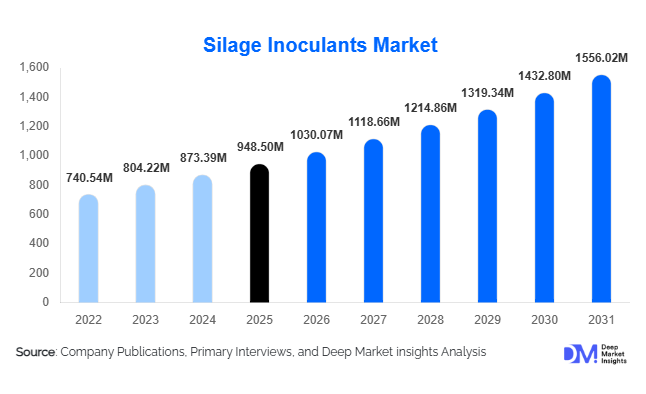
According to Deep Market Insights, the global silage inoculants market size was valued at USD 948.5 million in 2025 and is projected to grow from USD 1,030.07 million in 2026 to reach USD 1,556.02 million by 2031, expanding at a CAGR of 8.6% during the forecast period (2026–2031). The silage inoculants market growth is primarily driven by increasing demand for high-quality livestock feed, expansion of commercial dairy farming, and rising adoption of biological feed preservation technologies across developed and emerging agricultural economies.
Silage inoculants are microbial additives used to improve forage fermentation, enhance aerobic stability, and preserve nutritional quality during silage storage. The market is benefiting from the rapid industrialization of dairy and beef production systems, particularly across North America, Europe, China, Brazil, and India. Growing awareness regarding feed efficiency, nutrient retention, and spoilage reduction is encouraging livestock producers to adopt advanced silage management practices.
The increasing pressure on livestock producers to improve milk yield and feed conversion efficiency while reducing feed waste is accelerating demand for homofermentative and heterofermentative inoculant formulations. In addition, climate variability and forage quality fluctuations are making silage preservation increasingly important for ensuring year-round feed consistency. Governments and agricultural organizations are also promoting sustainable livestock farming practices, indirectly supporting adoption of biological feed additives such as silage inoculants.
Technological advancements in microbial strain engineering, enzyme-integrated formulations, and crop-specific inoculants continue to strengthen market competitiveness. Emerging economies in Asia-Pacific and Latin America are expected to witness strong growth due to rising dairy consumption, increasing mechanized forage harvesting, and growing investments in livestock productivity enhancement programs.
Key Market Insights
- Commercial dairy farming is significantly increasing global silage inoculant demand, as producers focus on improving feed conversion efficiency and milk productivity.
- Homofermentative inoculants dominate the market, driven by their superior fermentation enhancement and rapid pH reduction capabilities.
- North America leads the global market, supported by advanced forage management practices and extensive corn silage production.
- Asia-Pacific remains the fastest-growing region, fueled by rapid livestock industrialization in China and India.
- Multi-strain microbial formulations and enzyme-integrated products are gaining traction, improving nutrient preservation and aerobic stability.
- Sustainability initiatives and biological feed additive adoption are accelerating demand for environmentally friendly silage preservation technologies.
What are the latest trends in the silage inoculants market?
Adoption of Multi-Strain Biological Formulations
Silage inoculant manufacturers are increasingly developing multi-strain microbial formulations capable of delivering improved fermentation performance under varying climatic and forage conditions. These advanced products combine homofermentative and heterofermentative bacteria to enhance lactic acid production while improving aerobic stability and reducing spoilage losses. Livestock producers are increasingly preferring customized inoculants designed for specific crop types such as corn, alfalfa, and grass silage. Enzyme-enhanced inoculants are also gaining popularity due to their ability to improve fiber digestibility and nutrient availability, particularly in commercial dairy operations focused on maximizing milk yield and feed efficiency.
Precision Livestock Farming Supporting Silage Optimization
The growing adoption of precision agriculture and smart livestock management systems is transforming forage preservation practices globally. Commercial dairy farms are increasingly integrating silage inoculants with digital feed management systems, moisture monitoring technologies, and automated forage analytics. These technologies help optimize fermentation quality, reduce dry matter losses, and improve feed consistency throughout storage periods. Precision silage management is becoming especially important in large-scale dairy and beef operations where feed quality directly impacts profitability. The integration of data-driven forage management tools with advanced microbial preservation products is expected to remain a major market trend over the forecast period.
What are the key drivers in the silage inoculants market?
Expansion of Commercial Dairy and Beef Farming
The rapid growth of industrial dairy farming and commercial beef production is a major factor driving silage inoculants market growth. Rising global demand for milk, cheese, yogurt, and protein-rich meat products is increasing pressure on livestock producers to improve productivity and feed utilization efficiency. Silage inoculants help preserve forage nutrients, reduce spoilage, and improve digestibility, making them essential for large-scale livestock operations. Countries such as the United States, China, India, Brazil, and Germany are witnessing strong investments in dairy modernization, directly supporting inoculant demand.
Growing Focus on Feed Efficiency and Nutrient Preservation
Feed costs account for a substantial portion of livestock production expenses, encouraging producers to adopt technologies that minimize losses and improve nutritional retention. Silage inoculants improve fermentation quality by accelerating lactic acid production and reducing oxygen-related spoilage during storage. This helps livestock operators maintain feed consistency and improve animal performance. Increasing awareness regarding the economic impact of forage wastage and poor fermentation quality is accelerating adoption across both developed and emerging agricultural economies.
Increasing Demand for Sustainable Biological Feed Additives
Governments and agricultural organizations globally are encouraging sustainable livestock farming practices and reducing dependency on chemical feed preservatives and antibiotics. Silage inoculants, being biological solutions, align with sustainability objectives focused on lowering feed waste and improving livestock productivity with minimal environmental impact. Rising consumer preference for sustainably produced dairy and meat products is further supporting biological feed additive adoption. Manufacturers are increasingly investing in organic-certified and non-GMO inoculant formulations to address evolving regulatory and market requirements.
What are the restraints for the global market?
Limited Awareness Among Small-Scale Farmers
Despite increasing adoption among commercial livestock operations, awareness regarding the economic benefits of silage inoculants remains limited among small-scale farmers in many developing regions. Traditional forage preservation methods continue to dominate fragmented dairy markets due to cost sensitivity and lack of technical knowledge. In several emerging economies, inadequate extension services and limited access to advanced silage management technologies restrict market penetration, slowing adoption rates among smaller livestock producers.
Variability in Product Performance Under Poor Storage Conditions
The effectiveness of silage inoculants depends heavily on forage quality, moisture levels, compaction practices, and oxygen management during storage. Poor silage management practices can reduce inoculant performance and create inconsistent fermentation outcomes, affecting farmer confidence and return on investment perceptions. Variability in climatic conditions and inadequate storage infrastructure in certain regions further complicate product efficiency, representing a key restraint for broader market expansion.
What are the key opportunities in the silage inoculants industry?
Emerging Dairy Markets in Asia-Pacific and Latin America
Rapid growth in dairy farming across China, India, Brazil, and Southeast Asia presents significant opportunities for silage inoculant manufacturers. Rising milk consumption, increasing dairy cooperatives, and modernization of livestock production systems are creating substantial demand for advanced forage preservation technologies. Governments in several emerging economies are investing in dairy productivity enhancement programs, mechanized forage harvesting, and feed efficiency improvement initiatives. These trends are expected to accelerate adoption of microbial silage preservation products across high-growth agricultural markets.
Development of Climate-Specific and Crop-Specific Inoculants
The growing diversity of forage crops and climatic conditions across global livestock regions is creating opportunities for specialized inoculant formulations. Manufacturers are increasingly investing in crop-specific bacterial strains optimized for tropical, temperate, and high-moisture forage conditions. Climate-resilient silage technologies capable of improving fermentation stability under extreme weather conditions are expected to witness strong demand. This trend is particularly relevant in regions experiencing increasing climate variability and forage quality fluctuations.
Sustainable Livestock Production and Carbon Reduction Initiatives
The global push toward sustainable agriculture and lower livestock emissions is creating long-term opportunities for biological feed additives such as silage inoculants. Improved silage quality enhances feed digestibility and reduces feed waste, contributing to lower methane emissions per unit of milk or meat production. Sustainability-driven livestock certification programs and carbon reduction policies are expected to encourage wider adoption of advanced forage preservation technologies, particularly in North America and Europe.
Report Scope
| Report Metric | Details |
|---|---|
| Market Size in 2025 | USD 948.50 Million |
| Market Size in 2026 | USD 1030.07 Million |
| Market Size in 2031 | USD 1556.02 Million |
| CAGR | 8.6% (2026-2031) |
| Base Year for Estimation | 2025 |
| Historical Data | 2022-2024 |
| Forecast Period | 2026-2031 |
| Report Coverage | Revenue Forecast, Competitive Landscape, Supply Chain Disruption, Growth Factors, Environment & Regulatory Landscape and Trends |
| Geographies Covered | North America, Europe, APAC, Middle East and Africa, LATAM |
| Countries Covered | U.S., Canada, U.K., Germany, France, Spain, Italy, Russia, Nordic, Benelux, Rest of Europe, China, Korea, Japan, India, Australia, Singapore, Taiwan, South East Asia, Rest of Asia-Pacific, UAE, Turky, Saudi Arabia, South Africa, Egypt, Nigeria, Rest of MEA, Brazil, Mexico, Argentina, Chile, Colombia, Rest of LATAM |
Explore more data points, trends and opportunities Download Free Sample Report
Product Type Insights
The global silage inoculants market is witnessing significant expansion as livestock producers increasingly prioritize feed preservation, nutritional efficiency, and forage management optimization across commercial dairy and meat production systems. Product innovation within microbial silage additives has accelerated substantially in recent years as producers seek solutions capable of improving fermentation stability, reducing dry matter losses, minimizing spoilage, and enhancing overall livestock productivity. Rising awareness regarding the economic impact of poor silage quality is further strengthening demand for advanced inoculant technologies across both developed and emerging agricultural economies.Combination inoculants integrating both homofermentative and heterofermentative bacterial strains are gaining substantial traction among commercial livestock producers seeking comprehensive fermentation management solutions. These multifunctional products simultaneously improve initial fermentation quality while enhancing long-term aerobic stability. Large dairy farms and integrated livestock operations increasingly prefer combination products due to their operational efficiency and ability to deliver consistent forage performance across varying climatic and storage conditions.Enzyme-based silage inoculants are emerging as a premium and technologically advanced market segment. These products improve fiber degradation, nutrient release, and feed digestibility, thereby supporting higher animal performance and feed conversion efficiency. Increasing emphasis on precision livestock nutrition and productivity optimization is expected to drive strong future growth for enzyme-enhanced inoculants, particularly in high-performance dairy and beef production systems.
Crop Type Insights
Crop-specific silage management practices remain highly influential in shaping global inoculant demand patterns. Different forage crops exhibit varying fermentation characteristics, moisture levels, sugar content, and storage requirements, which directly impact inoculant selection and usage intensity. Growing pressure on livestock producers to maximize forage quality and reduce feed costs is encouraging greater adoption of scientifically optimized silage treatment solutions across a broad range of crop applications.Corn silage remains the leading crop segment within the global silage inoculants market, accounting for approximately 42% of total market revenue in 2025. The dominance of corn silage is strongly supported by its high energy density, superior starch content, and highly favorable fermentation profile. Corn remains one of the most widely cultivated silage crops across North America, Europe, and China, where intensive dairy and beef production systems rely heavily on high-quality preserved forage. The increasing scale of commercial dairy farming operations and the rising adoption of mechanized silage harvesting technologies continue to strengthen inoculant demand within this segment. In addition, the relatively predictable fermentation behavior of corn silage makes it highly compatible with advanced microbial inoculant applications.Mixed forage silage applications are also gaining momentum across integrated livestock systems focused on nutritional balancing and feed diversification. Producers increasingly combine multiple forage sources to optimize fiber, protein, and energy composition within animal diets. This trend is creating additional opportunities for customized inoculant formulations specifically designed for mixed-crop fermentation environments.
Form Insights
The form segment of the silage inoculants market plays a critical role in determining storage stability, application efficiency, transportation convenience, and operational compatibility with forage harvesting systems. Manufacturers continue investing heavily in formulation technologies aimed at improving microbial viability, shelf life, and ease of application under diverse environmental conditions.Dry silage inoculants dominate the global market, accounting for nearly 61% of total market share in 2025. The leadership of this segment is primarily attributed to the longer shelf life, lower storage costs, and superior transportation efficiency associated with dry formulations. Powder and granular inoculants are widely preferred across large commercial livestock operations because they integrate effectively with mechanized forage harvesting and application equipment. Dry products also offer greater operational flexibility in regions with variable climatic conditions and limited cold-chain infrastructure. Increasing adoption of industrial-scale livestock production systems across emerging agricultural economies is further supporting demand for stable and cost-effective dry inoculant solutions.Manufacturers are increasingly developing concentrated liquid formulations capable of delivering higher microbial activity while reducing transportation and handling costs. Rising integration of automated forage management systems and precision agriculture technologies is expected to create substantial growth opportunities for advanced liquid inoculant products over the coming years.
Livestock Application Insights
Growing global demand for animal protein products continues to drive substantial investments in livestock productivity enhancement, feed optimization, and forage preservation technologies. Silage inoculants are becoming increasingly important in improving feed efficiency, stabilizing nutritional quality, and supporting higher animal performance across multiple livestock categories.Dairy cattle feed remains the largest livestock application segment, contributing nearly 47% of global market revenue in 2025. The dominance of this segment is strongly supported by rising global milk consumption, rapid expansion of commercial dairy farming, and increasing emphasis on maximizing milk productivity through scientifically managed nutrition programs. High-quality silage plays a critical role in maintaining consistent milk yields and improving herd health, particularly within intensive dairy production systems. Producers are increasingly adopting advanced inoculants to minimize feed losses, improve digestibility, and optimize forage nutrient retention throughout storage periods.Applications within sheep, goat, swine, and equine feed systems are gradually expanding as awareness regarding forage quality management and nutritional optimization increases globally. Livestock producers managing smaller ruminant and specialty animal operations increasingly recognize the economic benefits associated with improved silage preservation and reduced feed spoilage.
Distribution Channel Insights
The distribution structure of the global silage inoculants market is evolving rapidly as manufacturers seek closer engagement with livestock producers while expanding accessibility across emerging agricultural regions. Distribution strategies increasingly emphasize technical support, customized product recommendations, and long-term producer partnerships.Direct sales channels dominate the global market, accounting for approximately 40% of total revenue in 2025. Large commercial dairy farms and integrated livestock operations prefer direct procurement agreements with inoculant manufacturers due to the availability of specialized technical consultation, customized microbial formulations, and after-sales agronomic support services. Direct distribution models also allow producers to access application training, forage analysis services, and performance optimization recommendations that contribute to improved silage outcomes.Agricultural cooperatives and specialty feed additive distributors remain highly important channels across Europe and emerging agricultural economies. These organizations play a critical role in expanding product accessibility among regional livestock producers while facilitating technical awareness regarding advanced forage preservation technologies.Online agricultural distribution platforms are gradually gaining importance as digital agriculture adoption accelerates globally. Small and medium-scale livestock operators increasingly utilize digital procurement channels to compare products, access technical information, and streamline purchasing processes. The growing penetration of e-commerce platforms within agricultural supply chains is expected to further transform market accessibility and distribution efficiency during the forecast period.
End-Use Insights
The growing industrialization of global livestock production systems continues to significantly influence end-use demand patterns within the silage inoculants market. Producers increasingly prioritize forage quality consistency, feed efficiency, and operational productivity to maintain profitability amid rising feed costs and growing global protein demand.Commercial dairy farms remain the largest end-use segment within the global silage inoculants market due to their extensive forage consumption requirements and ongoing focus on maximizing milk production efficiency. Large dairy operations increasingly rely on scientifically managed silage programs to stabilize nutritional intake, improve herd performance, and reduce feed-related economic losses. The expansion of high-output dairy farming systems across both developed and emerging economies continues to support robust inoculant demand growth.Feed manufacturers and integrated livestock producers are also emerging as major consumers of silage inoculants as compound feed production expands globally. Increasing vertical integration within livestock supply chains is encouraging greater investment in advanced forage preservation technologies capable of supporting year-round feed availability and consistent nutritional quality.Contract silage producers represent another emerging customer segment, particularly in developed agricultural economies where outsourced forage harvesting and preservation services are gaining popularity. These specialized service providers increasingly adopt advanced inoculant solutions to improve service quality, maximize fermentation consistency, and enhance customer satisfaction.
Explore more data points, trends and opportunities Download Free Sample Report
Silage Inoculants Market Segmentations
By Product Type
- Homofermentative Inoculants
- Heterofermentative Inoculants
- Combination Inoculants
- Enzyme-Based Silage Additives
- Organic Acid-Based Inoculants
By Crop Type
- Corn Silage
- Grass Silage
- Alfalfa Silage
- Sorghum Silage
- Cereal Crop Silage
- Mixed Forage Silage
By Form
- Dry Inoculants
- Liquid Inoculants
By Function
- Fermentation Enhancement
- Aerobic Stability Improvement
- Nutrient Preservation
- Mold & Yeast Control
- Fiber Digestibility Improvement
By Livestock Application
- Dairy Cattle Feed
- Beef Cattle Feed
- Sheep & Goat Feed
- Swine Feed
- Poultry Feed
- Equine Feed
Regional Insights
North America
North America accounted for approximately 34% of the global silage inoculants market in 2025, making it the leading regional market. The United States dominates regional demand due to its highly advanced dairy farming systems, extensive corn silage cultivation, and widespread adoption of precision livestock farming technologies. The region benefits from highly mechanized forage harvesting infrastructure, strong producer awareness regarding feed preservation economics, and substantial investments in livestock productivity optimization.Canada remains an important regional market supported by stringent forage quality standards, increasing dairy productivity investments, and growing adoption of sustainable livestock management practices. The strong presence of major silage inoculant manufacturers, extensive agricultural research infrastructure, and rapid commercialization of microbial technologies continue supporting North American market leadership.
Europe
Europe held nearly 28% of the global silage inoculants market share in 2025, driven primarily by the region’s highly developed dairy industry and advanced forage management practices. Germany, France, the Netherlands, and the United Kingdom remain major regional markets due to their large dairy cattle populations and extensive reliance on silage-based feeding systems.Demand for organic-certified and environmentally sustainable inoculant products is particularly strong across Western Europe where organic dairy and livestock production continues to expand steadily. In addition, Europe benefits from highly advanced forage harvesting infrastructure, strong agricultural extension services, and widespread adoption of scientific silage management techniques. Increasing investments in reducing greenhouse gas emissions from livestock systems are also expected to support future market growth.
Asia-Pacific
Asia-Pacific is projected to be the fastest-growing regional market, expanding at a CAGR exceeding 10% during the forecast period. Rapid modernization of dairy and livestock industries across China, India, Southeast Asia, Australia, and New Zealand is significantly increasing regional demand for advanced forage preservation technologies.Australia and New Zealand remain important contributors due to their export-oriented dairy and beef industries, which require high-quality preserved forage to maintain international competitiveness. Increasing investments in precision livestock farming technologies, forage harvesting equipment, and feed management automation are expected to further accelerate regional market growth.
Latin America
Latin America accounted for nearly 14% of global silage inoculants demand in 2025, led primarily by Brazil and Argentina. The region’s strong beef and dairy export industries continue supporting large-scale forage preservation practices and increasing adoption of advanced feed management technologies.Government initiatives supporting agricultural modernization, livestock productivity enhancement, and export growth remain major regional market drivers. Argentina also continues witnessing increasing adoption of silage inoculants due to the expansion of commercial dairy farming and rising investments in forage management infrastructure. Climatic variability and seasonal feed availability challenges are further encouraging producers to adopt advanced silage preservation technologies.
Middle East & Africa
The Middle East & Africa silage inoculants market is witnessing steady growth due to rising investments in food security, commercial livestock farming, and climate-resilient agricultural technologies. Harsh climatic conditions and limited availability of natural grazing resources are increasing dependence on preserved forage solutions across several countries within the region.The United Arab Emirates is emerging as an important market due to rising investments in technologically advanced livestock production systems and increasing utilization of imported forage crops requiring efficient preservation. Growing awareness regarding the economic benefits of improved silage quality, combined with increasing adoption of precision feed management technologies, is expected to support long-term regional market expansion.
Key Players in the Silage Inoculants Market
- Corteva Agriscience
- Chr. Hansen Holding
- Lallemand Inc.
- ADM
- Kemin Industries
- Volac International
- Provita Supplements
- BASF
- Biomin
- Micron Bio-Systems
- Schaumann BioEnergy
- Josera
- Agri-King
- American Farm Products
- ForFarmers