Nutmeg Market Size
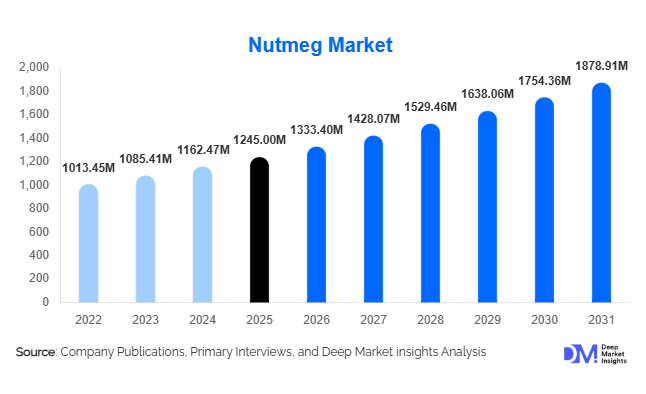
According to Deep Market Insights, the global nutmeg market size was valued at USD 1,245 million in 2025 and is projected to grow from USD 1,333.40 million in 2026 to reach USD 1,878.91 million by 2031, expanding at a CAGR of 7.1% during the forecast period (2026–2031). Market growth is primarily driven by rising global demand for natural spices, increasing use of nutmeg in processed foods and beverages, expanding pharmaceutical and nutraceutical applications, and growing consumer preference for clean-label flavoring ingredients. Nutmeg’s multifunctional properties—including flavor enhancement, preservative benefits, and medicinal characteristics—are supporting its adoption across multiple industries.
Key Market Insights
- Food processing remains the dominant demand driver, accounting for the largest share of global nutmeg consumption due to bakery, confectionery, and seasoning applications.
- Asia-Pacific leads global production and consumption, supported by Indonesia and India as major cultivation and export hubs.
- Demand for organic and sustainably sourced spices is rising, particularly in Europe and North America.
- Nutmeg oil and extracts are gaining traction in cosmetics, aromatherapy, and pharmaceutical formulations.
- Export-driven trade flows dominate market dynamics, with spice-importing countries relying heavily on Southeast Asian supply chains.
- Technological improvements in drying, grading, and processing are improving yield quality and export competitiveness.
What are the latest trends in the nutmeg market?
Shift Toward Natural and Functional Ingredients
Global consumers are increasingly shifting toward natural food ingredients and plant-derived flavoring agents, positioning nutmeg as a premium spice across processed food categories. Manufacturers are reformulating products to eliminate artificial additives, boosting demand for authentic spice ingredients. Nutmeg’s antioxidant and digestive properties further support its positioning within functional foods and wellness-oriented product lines. Clean-label movement adoption across bakery mixes, ready meals, and beverages has significantly increased bulk spice procurement by multinational food companies.
Growth of Value-Added Nutmeg Products
The market is witnessing expansion beyond raw whole nutmeg into value-added derivatives such as nutmeg powder, essential oils, oleoresins, and standardized extracts. Essential oils derived from nutmeg are increasingly used in perfumery, aromatherapy, and pharmaceutical formulations. Processing companies are investing in steam distillation and solvent extraction technologies to capture higher margins. This shift toward downstream processing is enabling producing countries to enhance export revenues while reducing dependence on raw commodity pricing cycles.
What are the key drivers in the nutmeg market?
Expansion of Global Processed Food Industry
The rapid growth of packaged foods and convenience meals globally is significantly driving nutmeg consumption. Bakery goods, spice blends, sauces, and meat seasonings increasingly incorporate nutmeg for flavor depth and aroma enhancement. Rising urbanization and changing dietary habits across Asia-Pacific and Latin America are accelerating demand from food manufacturers seeking consistent flavor profiles.
Rising Demand from Pharmaceutical and Nutraceutical Applications
Nutmeg contains bioactive compounds such as myristicin and essential oils that support digestive health and anti-inflammatory formulations. Pharmaceutical companies are expanding herbal product portfolios, incorporating nutmeg extracts into traditional and modern remedies. Growth in herbal medicine adoption across Asia and Europe is strengthening industrial demand beyond culinary uses.
Export Market Expansion and Spice Trade Liberalization
Trade agreements and improved logistics infrastructure have facilitated spice exports from producing nations. Indonesia and India continue to expand cultivation areas and processing facilities, improving supply reliability. Increased traceability and certification programs are enhancing buyer confidence in international markets.
What are the restraints for the global market?
Price Volatility Due to Agricultural Dependency
Nutmeg production remains heavily dependent on climatic conditions, leading to periodic supply shortages and price fluctuations. Weather disruptions and crop diseases directly impact yields, creating uncertainty for manufacturers relying on stable input costs.
Quality Standardization and Regulatory Compliance
Strict import regulations in Europe and North America related to pesticide residues and contamination present challenges for exporters. Small-scale farmers often lack infrastructure to meet global certification standards, limiting supply scalability.
What are the key opportunities in the nutmeg industry?
Organic and Certified Spice Production
Demand for organic-certified spices is growing rapidly across premium food markets. Producers adopting sustainable farming practices and certification programs can capture higher export margins and secure long-term contracts with multinational buyers.
Expansion into Cosmetics and Aromatherapy Markets
Nutmeg essential oil is increasingly used in skincare, fragrances, and wellness therapies due to antimicrobial and aromatic properties. The expanding global personal care industry presents opportunities for spice processors to diversify revenue streams.
Technology Integration in Post-Harvest Processing
Investments in automated drying systems, grading technologies, and traceability platforms are improving product consistency and export value. Digital supply-chain monitoring enables exporters to meet stringent international buyer requirements, opening new premium markets.
Report Scope
| Report Metric | Details |
|---|---|
| Market Size in 2025 | USD 1245 Million |
| Market Size in 2026 | USD 1333.40 Million |
| Market Size in 2031 | USD 1878.91 Million |
| CAGR | 7.1% (2026-2031) |
| Base Year for Estimation | 2025 |
| Historical Data | 2022-2024 |
| Forecast Period | 2026-2031 |
| Report Coverage | Revenue Forecast, Competitive Landscape, Supply Chain Disruption, Growth Factors, Environment & Regulatory Landscape and Trends |
| Geographies Covered | North America, Europe, APAC, Middle East and Africa, LATAM |
| Countries Covered | U.S., Canada, U.K., Germany, France, Spain, Italy, Russia, Nordic, Benelux, Rest of Europe, China, Korea, Japan, India, Australia, Singapore, Taiwan, South East Asia, Rest of Asia-Pacific, UAE, Turky, Saudi Arabia, South Africa, Egypt, Nigeria, Rest of MEA, Brazil, Mexico, Argentina, Chile, Colombia, Rest of LATAM |
Explore more data points, trends and opportunities Download Free Sample Report
Product Type Insights
The global nutmeg market is characterized by a diverse range of product types, each catering to unique applications and consumer preferences. Among these, whole nutmeg continues to dominate the market, largely due to its longer shelf life and versatility in both commercial and domestic kitchens. Whole nutmeg is preferred by spice processors, exporters, and wholesalers because it retains its aromatic compounds for extended periods, ensuring consistent quality in processed food products. Additionally, whole nutmeg is favored in culinary applications where freshly grated nutmeg enhances the flavor profile of a wide variety of dishes, from savory stews to sweet desserts.Ground nutmeg represents another significant product type and enjoys widespread adoption in retail and packaged foods. The convenience of pre-ground nutmeg appeals to end consumers and food manufacturers alike, particularly in bakery, confectionery, and ready-to-eat food segments. Its fine texture allows for even distribution in recipes and consistent flavor, which is essential for large-scale food production. The demand for ground nutmeg is further driven by increasing urbanization and the growing prevalence of convenience-oriented cooking habits, where consumers prefer ready-to-use spice options.Powdered nutmeg also continues to expand, particularly in the ready-to-use seasoning mix segment. These pre-mixed formulations cater to both commercial food production and home cooking, providing convenience without compromising flavor quality. Powdered nutmeg is widely integrated into sauces, soups, marinades, and industrial food preparation, reflecting the growing trend toward global flavor fusion and innovation in packaged foods. Overall, product type segmentation highlights a dynamic market where traditional whole nutmeg maintains steady demand, while value-added derivatives such as oil, oleoresins, and powdered forms drive growth in industrial, cosmetic, and nutraceutical applications.
Application Insights
The applications of nutmeg are varied, spanning food and beverage, pharmaceuticals, cosmetics, and emerging nutraceutical segments. Among these, the food and beverage sector accounts for the largest share of global demand, underpinned by its extensive use in bakery, dairy desserts, and spice blends. Nutmeg enhances both flavor and aroma, making it a key ingredient in cakes, pastries, biscuits, puddings, sauces, and beverages such as mulled wines and flavored coffees. The rising global preference for exotic flavors, fusion cuisine, and authentic ethnic recipes has further fueled its adoption. Bakery applications, in particular, continue to see strong demand as packaged bakery products proliferate across emerging and developed markets, supported by urbanization, increasing disposable income, and changing consumer lifestyles.Cosmetics and personal care applications are steadily expanding, driven by the rising popularity of natural fragrances and botanical ingredients in skincare, hair care, and perfumery products. Nutmeg oil is prized for its aromatic and therapeutic qualities, finding use in creams, lotions, shampoos, and essential oil blends. The “clean beauty” trend and consumer inclination toward chemical-free formulations have prompted manufacturers to integrate nutmeg derivatives as premium ingredients. The cosmetic application is particularly strong in regions such as Europe and North America, where consumers are willing to pay a premium for natural and sustainably sourced components.Nutraceutical applications are emerging as a promising avenue for growth. With increasing research into the health benefits of plant-based ingredients, nutmeg is being explored for its role in dietary supplements, functional foods, and immune-boosting formulations. Manufacturers are leveraging its antioxidant, anti-inflammatory, and digestive health benefits to develop capsules, powders, and fortified beverages targeted at health-conscious consumers. This nascent yet rapidly growing segment indicates the potential for significant value addition in the coming years as consumer awareness and demand for botanical health supplements increase globally.
Distribution Channel Insights
The global nutmeg market is characterized by a mix of traditional and modern distribution channels. Business-to-business (B2B) bulk trade remains the dominant mode of distribution, particularly for spice processors, food manufacturers, and industrial buyers. These buyers often procure nutmeg directly from exporters, ensuring consistent quality, traceability, and cost-effectiveness for large-scale production. Bulk trade enables strategic partnerships between suppliers and buyers, facilitating global supply chain integration and ensuring year-round availability of high-demand varieties.Online specialty spice retail channels are experiencing rapid growth, particularly for organic and premium-grade nutmeg products. E-commerce platforms, subscription boxes, and direct-to-consumer online stores have become pivotal in reaching niche consumer segments seeking high-quality, sustainably sourced spices. The convenience of doorstep delivery, coupled with detailed product information and traceability certifications, has significantly enhanced consumer confidence in online purchases. This trend is particularly strong in North America, Europe, and parts of Asia-Pacific, where tech-savvy consumers are increasingly exploring culinary experimentation at home.Traditional retail channels such as supermarkets and specialty food stores continue to be important, particularly in developed markets. Supermarkets offer visibility and accessibility to a wide range of nutmeg products, including whole, ground, and powdered forms. Specialty food stores, on the other hand, cater to discerning consumers looking for premium, organic, or single-origin nutmeg. These retail channels are often complemented by value-added services such as in-store cooking demonstrations, tasting events, and recipe promotions, further stimulating consumer engagement and loyalty.
End-Use Industry Insights
The food processing industry remains the largest end-use segment for nutmeg, accounting for nearly 58% of global demand in 2025. This dominance is driven by expanding packaged food production, particularly in emerging markets where urbanization and lifestyle changes are fueling demand for convenience foods. Nutmeg’s versatility in enhancing flavor and aroma makes it a staple ingredient across multiple product categories, from bakery goods and sauces to beverages and ready-to-eat meals. Additionally, the industry benefits from the development of innovative spice blends and premixes, which integrate nutmeg for both taste and functional properties, such as antioxidant enhancement.The pharmaceutical sector is projected to grow at over 8% annually, reflecting the rising adoption of herbal formulations and plant-based medicines. Nutmeg’s bioactive properties, including digestive support and antioxidant activity, make it a sought-after ingredient in dietary supplements and over-the-counter herbal remedies. Pharmaceutical companies increasingly prefer natural compounds like nutmeg as consumers seek safer, plant-based alternatives to synthetic medications. Regulatory frameworks supporting the use of botanical extracts in health products further reinforce this growth trajectory.Export-driven demand is a critical factor influencing global nutmeg consumption, with over 70% of production entering international trade markets. Countries such as Indonesia, India, and Grenada play pivotal roles as leading exporters, ensuring a steady supply to major importing regions including North America, Europe, and East Asia. The combination of domestic consumption, value-added product development, and export demand underpins the overall growth of the global nutmeg market.
Explore more data points, trends and opportunities Download Free Sample Report
Nutmeg Market Segmentations
By Product Type
- Whole Nutmeg
- Ground Nutmeg Powder
- Nutmeg Oil & Oleoresins
- Nutmeg Extracts and Concentrates
By Application
- Food & Beverages
- Pharmaceuticals and Herbal Medicine
- Cosmetics & Personal Care
- Nutraceuticals and Dietary Supplements
By Distribution Channel
- B2B Bulk Trade (Exporters & Processors)
- Online Retail Platforms
- Supermarkets & Hypermarkets
- Specialty Spice Stores
- Direct Export and Contract Supply
By End-Use Industry
- Food Processing Industry
- Pharmaceutical Industry
- Cosmetics & Personal Care Industry
- Household & Retail Consumption
Regional Insights
Asia-Pacific
Asia-Pacific dominates the global nutmeg market with approximately 46% market share in 2025. Indonesia, the world’s largest nutmeg producer, leads the region in both production and export volumes. The country’s dominance is driven by favorable climatic conditions, extensive cultivation areas, and government support for spice farming initiatives. India represents a significant consumer market, where nutmeg is extensively used in culinary preparations, Ayurvedic medicine, and traditional home remedies. The region’s growth is further supported by the rising middle-class population, increasing disposable income, and expanding processed food industries in countries such as China, Indonesia, and India. China, in particular, is emerging as a major importer due to the growth of its bakery, confectionery, and processed food sectors, which increasingly rely on exotic and aromatic spices to enhance product differentiation.
Europe
Europe accounts for nearly 24% of global nutmeg demand, led by countries such as Germany, the Netherlands, and the United Kingdom. The region’s market growth is primarily driven by strong consumer preference for organic and sustainably sourced spices, combined with stringent quality and safety regulations. European consumers are increasingly inclined to pay premium prices for high-quality nutmeg, particularly in specialty and gourmet segments. The demand is further bolstered by a thriving culinary culture that embraces global cuisines and artisanal food products. Importers and distributors in Europe are investing in supply chain transparency, traceability, and certifications, ensuring compliance with regulatory standards and maintaining consumer trust. Additionally, the growing popularity of plant-based and functional foods, as well as the natural cosmetics trend, reinforces Europe’s role as one of the fastest-growing import markets.
North America
North America, led by the United States, represents a substantial market for nutmeg due to its mature food and beverage industry. The region’s growth is primarily fueled by bakery, beverage, and snack production, where nutmeg is extensively used to enhance flavor and aroma. Rising demand for ethnic cuisines, natural flavoring ingredients, and gourmet food products is driving steady adoption across both retail and foodservice channels. Online retail penetration, coupled with specialty spice subscription services, has further amplified consumer access to premium and organic nutmeg products. In addition, increasing consumer awareness regarding the health benefits of botanicals and natural spices is stimulating the demand for nutraceutical and functional food applications, providing additional growth avenues for the market.
Middle East & Africa
The Middle East & Africa (MEA) market is experiencing steady growth, driven by the region’s spice-intensive culinary culture and the increasing popularity of processed and ready-to-eat foods. Countries such as the United Arab Emirates, Saudi Arabia, and South Africa serve as major consumption hubs, benefiting from high per capita spice consumption. The region’s strategic trade hubs, particularly in the Gulf Cooperation Council (GCC) countries, facilitate re-export activities to neighboring markets, thereby strengthening overall market expansion. Additionally, the MEA market is witnessing rising investment in retail infrastructure, modern supermarkets, and specialty food stores, which improves consumer access to high-quality nutmeg products. Health-conscious consumption patterns and the rising adoption of natural remedies further support pharmaceutical and nutraceutical applications in the region.
Latin America
Latin America, led by Brazil and Mexico, is emerging as a growing consumer of nutmeg products. The expansion of the processed food industry, particularly in bakery and confectionery sectors, is a key driver for regional demand. Urbanization, rising disposable income, and increasing interest in ethnic and gourmet cuisines are encouraging greater nutmeg adoption across both commercial and household applications. Additionally, local spice manufacturing and processing capacities are improving, which enhances product availability and market penetration. The trend toward functional foods, natural flavoring ingredients, and herbal formulations is gradually gaining traction, positioning Latin America as a region with significant untapped growth potential for nutmeg across food, pharmaceutical, and cosmetic applications.
Key Players in the Nutmeg Market
- Olam Group Limited
- McCormick & Company Inc.
- Kancor Ingredients Limited
- PT Indo Spice
- Visimex Corporation
- Everest Spices
- DS Group
- Ajinomoto Genexine (spice extracts division)
- Baria Pepper
- Sun Impex International Foods LLC
- Elite Spice Inc.
- VLC Spices
- Royal Spices
- Pacific Spice Company
- Sharika Enterprises