Global Moringa Leaf Powder Market Size
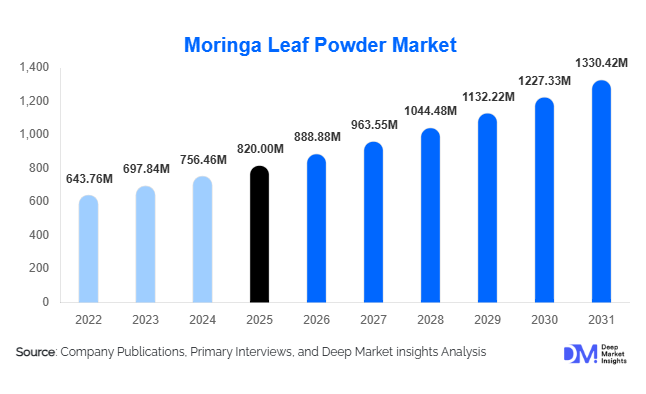
According to Deep Market Insights, the global moringa leaf powder market size was valued at USD 820 million in 2026 and is projected to grow from USD 888.88 million in 2027 to reach USD 1,330.42 million by 2031, expanding at a CAGR of 8.4% during the forecast period (2026–2031). The market growth is primarily driven by increasing global demand for plant-based nutrition, rising adoption of preventive healthcare supplements, and expanding applications of moringa in functional foods, beverages, cosmetics, and nutraceutical formulations.
Key Market Insights
- Rising demand for plant-based superfoods is positioning moringa leaf powder as a key functional ingredient in global nutrition markets.
- Organic-certified products dominate premium demand, especially across North America and Europe where clean-label consumption is accelerating.
- Asia-Pacific leads production and supply, driven by large-scale cultivation in India and favorable agro-climatic conditions.
- Nutraceutical applications account for the largest consumption share, supported by increasing preventive healthcare awareness.
- E-commerce channels are expanding rapidly, enabling direct global access to herbal and wellness products.
- Functional food and beverage integration is increasing, especially in energy drinks, smoothies, and protein blends.
What are the latest trends in the Global Moringa Leaf Powder Market?
Functional Food and Beverage Integration
Moringa leaf powder is increasingly being incorporated into functional foods such as protein bars, herbal teas, smoothies, and fortified snacks. Food manufacturers are leveraging its high nutritional density, antioxidant profile, and natural origin to align with rising consumer demand for clean-label ingredients. This trend is particularly strong in urban markets where wellness-oriented diets and vegan lifestyles are expanding rapidly.
Cosmeceutical and Personal Care Expansion
The cosmetics industry is emerging as a high-growth adopter of moringa-based ingredients. Its anti-inflammatory and antioxidant properties make it suitable for skincare, anti-aging formulations, and scalp health products. Brands are increasingly introducing moringa-infused creams, oils, and serums, strengthening its position in herbal and natural personal care segments.
What are the key drivers in the Global Moringa Leaf Powder Market?
Rising Health Consciousness and Preventive Healthcare
Global consumers are shifting toward preventive healthcare, driving demand for natural supplements that support immunity, digestion, and overall wellness. Moringa leaf powder, rich in vitamins, minerals, and amino acids, is gaining strong traction as a daily dietary supplement across both developed and emerging economies.
Expansion of Nutraceutical Industry
The rapid growth of the global nutraceutical sector is significantly supporting market expansion. Moringa is widely used in capsules, powders, and protein blends due to its functional benefits. Increasing R&D in herbal formulations and growing acceptance of plant-based supplements are further strengthening demand.
Growing Organic Agriculture and Export Infrastructure
Government initiatives promoting organic farming and herbal exports, especially in India and African countries, are enhancing global supply chains. Improved processing capabilities and export incentives are making moringa leaf powder more accessible in international markets.
What are the restraints for the Global Moringa Leaf Powder Market?
Quality Variability and Standardization Challenges
Inconsistent cultivation practices, processing methods, and storage conditions often lead to variability in nutrient content and product quality. This limits adoption in regulated pharmaceutical and premium nutraceutical segments where consistency and certification are critical.
Price Sensitivity in Emerging Markets
Despite rising global demand, price sensitivity remains a barrier in developing regions. Consumers in these markets often prefer traditional herbal alternatives, limiting penetration of premium-certified moringa products.
What are the key opportunities in the Global Moringa Leaf Powder Industry?
Expansion of Clean-Label and Organic Product Lines
Increasing demand for certified organic and chemical-free products presents a strong opportunity for manufacturers. Companies investing in traceability systems, sustainable sourcing, and international certifications can capture premium pricing segments in developed markets.
Growth of D2C and E-commerce Distribution
Digital commerce platforms are enabling direct access to global consumers, reducing dependency on intermediaries. Subscription-based wellness models and online supplement platforms are significantly expanding market reach for small and mid-sized producers.
Cosmetic and Personal Care Innovation
The growing demand for herbal skincare and natural beauty products is opening new revenue streams. Moringa-based cosmeceuticals are gaining traction in anti-aging, hair care, and skin repair applications, especially in urban consumer markets.
Report Scope
| Report Metric | Details |
|---|---|
| Market Size in 2025 | USD 820.00 Million |
| Market Size in 2026 | USD 888.88 Million |
| Market Size in 2031 | USD 1330.42 Million |
| CAGR | 8.4% (2026-2031) |
| Base Year for Estimation | 2025 |
| Historical Data | 2022-2024 |
| Forecast Period | 2026-2031 |
| Report Coverage | Revenue Forecast, Competitive Landscape, Supply Chain Disruption, Growth Factors, Environment & Regulatory Landscape and Trends |
| Geographies Covered | North America, Europe, APAC, Middle East and Africa, LATAM |
| Countries Covered | U.S., Canada, U.K., Germany, France, Spain, Italy, Russia, Nordic, Benelux, Rest of Europe, China, Korea, Japan, India, Australia, Singapore, Taiwan, South East Asia, Rest of Asia-Pacific, UAE, Turky, Saudi Arabia, South Africa, Egypt, Nigeria, Rest of MEA, Brazil, Mexico, Argentina, Chile, Colombia, Rest of LATAM |
Explore more data points, trends and opportunities Download Free Sample Report
Segmental Analysis
The global moringa leaf powder market is witnessing strong expansion as consumers increasingly shift toward plant-based nutrition, preventive healthcare products, and clean-label functional ingredients. The market has evolved from a niche herbal supplement category into a mainstream wellness ingredient used across nutraceuticals, food & beverages, cosmetics, and animal nutrition industries. Growing scientific awareness regarding moringa’s nutritional profile, including its high concentration of vitamins, minerals, antioxidants, amino acids, and anti-inflammatory compounds, continues to strengthen commercial demand across developed and emerging economies.The supplement industry’s continued shift toward botanical ingredients and plant-derived nutrition is creating favorable opportunities for moringa manufacturers globally. E-commerce expansion and direct-to-consumer wellness brands are also contributing significantly to product accessibility and consumer adoption. Increasing clinical studies supporting moringa’s antioxidant, anti-inflammatory, and nutritional benefits are strengthening consumer trust and expanding its inclusion across mainstream nutraceutical portfolios.Meanwhile, the B2C retail segment is expanding steadily through online wellness platforms, specialty health stores, supermarkets, and organic food chains. The rise of digital commerce and health-focused subscription models is significantly improving accessibility of moringa-based products among individual consumers worldwide. Social media marketing, influencer-led wellness trends, and increasing awareness regarding superfoods are additionally helping boost retail demand.Animal nutrition applications are also gaining momentum, particularly in livestock and poultry feed industries. Moringa leaf powder is valued for its high protein and micronutrient content, making it beneficial for improving animal health and productivity. Growing focus on sustainable and plant-based animal feed ingredients is expected to support long-term expansion of this segment.
End-Use Analysis
The global demand for moringa leaf powder is primarily concentrated in the nutraceutical and food & beverage industries, which collectively account for the majority of total market consumption. These industries are benefiting from a significant global shift toward preventive healthcare, natural wellness products, and plant-based nutrition solutions. Rising incidences of lifestyle disorders, including obesity, diabetes, cardiovascular diseases, and digestive health issues, are encouraging consumers to adopt nutrient-rich supplements and functional food products, thereby increasing commercial demand for moringa-based ingredients.The cosmetics industry is emerging as one of the most promising high-growth application sectors. Consumers are increasingly demanding botanical skincare products that offer antioxidant protection, anti-aging properties, hydration benefits, and reduced chemical exposure. Moringa leaf powder and moringa extracts are gaining popularity in facial care, haircare, soaps, and organic beauty products due to their nutrient-rich composition and compatibility with clean beauty trends. Premium skincare brands are particularly emphasizing natural and sustainable ingredients, creating substantial growth opportunities for moringa-based formulations.Animal nutrition applications are also expanding steadily, particularly in developing agricultural economies. Moringa is increasingly used in poultry, aquaculture, and livestock feed formulations because of its protein-rich profile and nutritional efficiency. Rising concerns regarding feed quality and sustainable livestock production are encouraging agricultural industries to explore plant-based nutritional supplements, thereby contributing to market diversification.Export-driven demand continues to play a critical role in market development, with India and several African nations serving as major global suppliers of moringa leaf powder. International demand from nutraceutical manufacturers, organic food companies, and cosmetic producers is supporting strong export revenues and agricultural investment in key producing countries. Improvements in cultivation techniques, drying technologies, and international certification compliance are further strengthening global trade potential.
Explore more data points, trends and opportunities Download Free Sample Report
Moringa Leaf Powder Market Segmentations
By Nature
- Organic Moringa Leaf Powder
- Conventional Moringa Leaf Powder
By Form
- Fine Micronized Powder
- Coarse Powder
- Encapsulated Powder
- Blended Functional Powders
By Application
- Dietary Supplements & Nutraceuticals
- Functional Foods
- Functional Beverages
- Cosmetics & Personal Care
- Pharmaceutical Applications
- Animal Nutrition & Feed
By Distribution Channel
- B2B Bulk Suppliers
- Online E-commerce Platforms
- Retail Health Stores
- Specialty Organic Stores
By End-Use Industry
- Food & Beverage Industry
- Pharmaceutical & Healthcare Industry
- Cosmetics & Personal Care Industry
- Animal Feed Industry
- Sports Nutrition Industry
Regional Insights
North America
North America accounts for approximately 26% of the global market share in 2025, driven primarily by strong consumer demand for dietary supplements, plant-based nutrition, and organic superfoods across the United States and Canada. The region benefits from highly developed retail infrastructure, strong purchasing power, and increasing consumer awareness regarding preventive healthcare and functional nutrition. Rising adoption of vegan diets, clean-label foods, and herbal supplements is significantly supporting moringa product penetration across mainstream wellness markets.Regional growth is also supported by increasing health concerns related to obesity, diabetes, and cardiovascular disorders, which are encouraging consumers to seek nutrient-dense natural products. Strong marketing activities by supplement brands, rising demand for plant-derived proteins, and growing interest in sustainable sourcing practices are expected to continue driving market expansion across North America.
Europe
Europe holds around 20% share of the global moringa leaf powder market, led by Germany, the United Kingdom, France, Italy, and the Netherlands. The region demonstrates strong demand for organic and sustainably sourced nutritional products, supported by strict food safety regulations and high consumer preference for clean-label ingredients. European consumers are increasingly prioritizing natural wellness products and environmentally responsible consumption, creating favorable conditions for moringa-based formulations.Regional growth is further driven by stringent organic certification standards, which encourage premium positioning of moringa products. Expanding health-conscious populations, rising adoption of preventive healthcare practices, and growing investment in sustainable food innovation continue to strengthen long-term market prospects throughout Europe.
Asia-Pacific
Asia-Pacific dominates the global moringa leaf powder market with approximately 42% share, led primarily by India, which serves as the world’s largest producer and exporter of moringa products. The region functions as both a major supply hub and an increasingly important consumption market due to rising health awareness, strong agricultural production capacity, and growing domestic supplement demand.India plays a central role in global market development because of favorable climatic conditions, extensive moringa cultivation, low production costs, and established export infrastructure. Increasing government support for agricultural exports and organic farming initiatives is further strengthening the country’s competitive position in international markets. Domestic consumption is also rising steadily due to growing urban health consciousness and expanding use of herbal nutrition products.The Asia-Pacific region additionally benefits from abundant raw material availability, low-cost processing capabilities, and strong export-oriented manufacturing industries. Continued expansion of e-commerce health platforms and rising investments in nutraceutical innovation are expected to further accelerate market growth across the region.
Latin America
Latin America is emerging as a promising market for moringa leaf powder, supported by increasing consumer interest in herbal nutrition, functional foods, and natural wellness products. Brazil and Mexico are among the leading regional markets due to rising health awareness and expanding demand for plant-based dietary supplements.The region is experiencing gradual shifts toward preventive healthcare and nutritional supplementation, particularly among urban consumers seeking natural alternatives for immunity support and general wellness. Growing retail availability of organic products and increasing penetration of international wellness brands are helping improve market visibility and consumer adoption.Regional growth is also supported by favorable agricultural conditions for moringa cultivation in certain Latin American countries. Expanding local production capabilities, increasing investment in herbal product manufacturing, and rising consumer preference for sustainable nutrition solutions are expected to strengthen long-term market development across Latin America.
Middle East & Africa
The Middle East & Africa region is experiencing rapid growth in the moringa leaf powder market, supported by increasing wellness awareness, rising herbal product demand, and expanding export-oriented agricultural activities. Africa is emerging as a major production hub due to favorable climatic conditions and growing international demand for organically cultivated moringa products.In the Middle East, Gulf countries are driving demand through increasing imports of premium wellness products, dietary supplements, and organic functional foods. Rising disposable incomes, growing health-conscious expatriate populations, and expanding luxury wellness retail sectors are contributing significantly to market growth. Increasing demand for herbal cosmetics and natural healthcare products is also supporting regional expansion.The region’s long-term growth outlook remains highly favorable due to increasing international trade opportunities, improving agricultural investments, and expanding consumer awareness regarding the nutritional benefits of moringa-based products.
Key Players in the Global Moringa Leaf Powder Market
- Organic India
- Grenera Nutrients
- Kuli Kuli Foods
- Ancient Greenfields
- Earth Expo Company
- Moringa Initiative Ltd
- Zija International
- Green Virgin Products
- Saipro Biotech
- Moringa Farms
- Tree of Life Seeds
- Botanical Ingredients Ltd
- Bio Moringa Products
- Earth Root Naturals
- Herbal Hills