Mint Powder Market Size
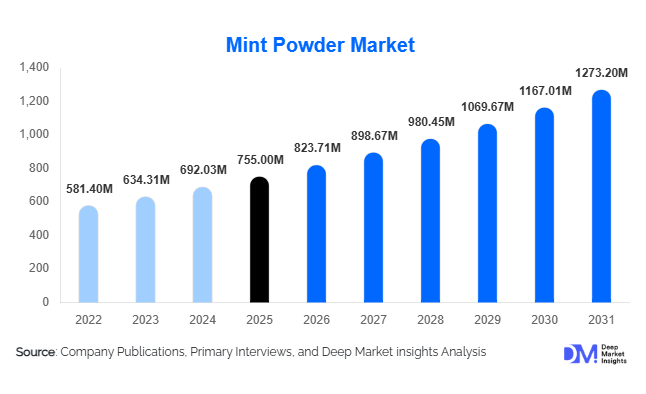
According to Deep Market Insights, the global mint powder market size was valued at USD 755 million in 2025 and is projected to grow from USD 823.71 million in 2026 to reach USD 1,273.20 million by 2031, expanding at a CAGR of 9.1% during the forecast period (2026–2031). The mint powder market growth is primarily driven by increasing demand for natural flavoring ingredients, rising consumer preference for clean-label food products, growing adoption of herbal and botanical ingredients in nutraceuticals, and expanding applications in pharmaceutical and personal care formulations. Manufacturers are increasingly incorporating mint powder into functional foods, digestive health products, oral care solutions, herbal teas, and wellness products due to its natural cooling, antimicrobial, and digestive properties. Growing awareness regarding plant-based ingredients and sustainable sourcing practices is further supporting long-term market expansion globally.
Key Market Insights
- Food and beverage applications account for approximately 42% of global mint powder consumption, making it the largest application segment worldwide.
- Organic mint powder is the fastest-growing product category, benefiting from strong demand for certified organic and clean-label ingredients.
- Asia-Pacific dominates the global market with nearly 39% market share, supported by extensive mint cultivation and processing capabilities in India and China.
- North America accounts for approximately 24% of global demand, driven by strong consumption across nutraceutical, food processing, and personal care industries.
- Nutraceutical and dietary supplement applications are expanding at over 11% CAGR, outpacing overall market growth.
- Advanced drying technologies including freeze-drying and vacuum-drying are improving product quality, shelf life, and retention of active compounds.
- India remains the world's largest producer and exporter of mint-derived ingredients, supplying major food and pharmaceutical manufacturers globally.
- Direct B2B industrial sales represent approximately 55% of market revenues, reflecting strong demand from large-scale manufacturers.
Mint Powder Market Latest Trends
Growing Preference for Organic and Clean-Label Ingredients
The global food and beverage industry is increasingly shifting toward clean-label formulations, creating significant demand for organic mint powder. Consumers are actively scrutinizing ingredient lists and favoring products free from synthetic additives, artificial flavors, and preservatives. This trend has encouraged food manufacturers, beverage producers, and nutraceutical companies to replace artificial mint flavorings with naturally sourced mint powder. Organic-certified variants are gaining premium positioning across developed markets such as North America and Europe. Additionally, retailers and foodservice companies are expanding organic product portfolios, creating new opportunities for certified mint powder suppliers. As regulatory agencies continue promoting transparency and sustainability across food supply chains, organic mint powder is expected to gain further traction globally.
Expansion of Functional Foods and Herbal Wellness Products
Mint powder is increasingly being utilized in functional foods, herbal teas, digestive supplements, immunity formulations, and botanical wellness products. Consumers are seeking multifunctional ingredients that provide both flavor and health benefits. Mint's natural digestive support, cooling effects, and antioxidant properties have positioned it as a preferred ingredient in wellness-oriented product development. Functional beverage manufacturers are incorporating mint powder into detox drinks, herbal infusions, and nutritional beverages. Meanwhile, nutraceutical companies are launching innovative formulations targeting digestive health, respiratory wellness, and stress management. The convergence of food, health, and wellness industries is creating sustained demand for high-quality mint powder across global markets.
Mint Powder Market Drivers
Rising Demand for Natural Flavoring Ingredients
The growing consumer preference for natural and minimally processed foods is significantly driving demand for mint powder. Food manufacturers are increasingly replacing synthetic flavoring agents with botanical alternatives that offer authentic taste profiles and consumer-friendly labeling. Mint powder provides a versatile solution for seasoning blends, bakery products, confectionery, beverages, and ready-to-eat meals. As regulatory scrutiny around artificial additives intensifies across major markets, natural flavor ingredients such as mint powder are becoming increasingly important in product formulation strategies.
Growth of Herbal Medicine and Preventive Healthcare
Global interest in herbal remedies and preventive healthcare is creating strong growth opportunities for mint powder manufacturers. Mint has long been recognized for its digestive, respiratory, antimicrobial, and soothing properties, making it a valuable ingredient in traditional and modern healthcare products. Pharmaceutical and nutraceutical companies are increasingly incorporating mint powder into herbal formulations, dietary supplements, and wellness products. Rising healthcare awareness among consumers and increasing adoption of plant-based healthcare solutions continue to strengthen demand across developed and emerging economies.
Expanding Personal Care and Oral Care Applications
The personal care industry is witnessing increasing demand for plant-based ingredients that deliver functional benefits alongside sustainability credentials. Mint powder is widely utilized in toothpaste, mouthwash, oral hygiene products, skin care formulations, and hair care products due to its refreshing aroma and antimicrobial properties. Consumer preference for natural cosmetics and clean beauty products is encouraging manufacturers to increase botanical ingredient usage, thereby supporting market growth.
Mint Powder Market Restraints
Agricultural Supply Volatility and Climate Risks
Mint cultivation remains highly dependent on weather conditions, irrigation availability, and crop health. Climate-related disruptions including droughts, floods, and temperature fluctuations can significantly impact mint leaf yields and quality. Such volatility affects raw material availability and creates pricing instability across the value chain. Producers must increasingly invest in climate-resilient cultivation practices and sustainable farming methods to mitigate supply risks.
Quality Standardization Challenges
Maintaining consistent quality remains a challenge for the global mint powder industry. Variations in cultivation practices, harvesting methods, drying technologies, and storage conditions can affect menthol content, aroma profile, color, and microbiological quality. Pharmaceutical and nutraceutical manufacturers require strict quality standards, making standardization essential for market growth. Investments in testing infrastructure, traceability systems, and quality assurance programs are becoming increasingly important for industry participants.
Mint Powder Industry Key Opportunities
Rapid Growth of Nutraceutical and Functional Food Markets
The global nutraceutical industry continues to expand rapidly as consumers prioritize preventive healthcare and wellness. Mint powder aligns well with this trend due to its recognized digestive and respiratory health benefits. Manufacturers can capitalize on opportunities in herbal supplements, functional beverages, digestive health products, and immunity-support formulations. Premium nutraceutical-grade mint powder is expected to generate significant value growth over the coming years as health-conscious consumers increasingly seek plant-based solutions.
Expansion of Organic Cultivation and Sustainable Sourcing
Growing consumer awareness regarding environmental sustainability is encouraging food and personal care companies to source certified organic ingredients. Organic mint powder commands premium pricing and offers attractive profit margins for producers. Governments and agricultural agencies in major producing countries are supporting organic farming initiatives, creating opportunities for cultivation expansion. Companies that invest in traceability, sustainability certifications, and responsible sourcing programs are likely to gain competitive advantages in export markets.
Emerging Market Demand and Export Expansion
Rising disposable incomes and increasing health awareness across Southeast Asia, Latin America, and the Middle East are generating new demand for mint-based products. Food manufacturers, beverage producers, and pharmaceutical companies in these regions are increasing usage of botanical ingredients. Export-oriented producers, particularly in India and Egypt, are well positioned to benefit from growing international demand and expanding trade relationships with developed economies.
Report Scope
| Report Metric | Details |
|---|---|
| Market Size in 2025 | USD 755.00 Million |
| Market Size in 2026 | USD 823.71 Million |
| Market Size in 2031 | USD 1273.20 Million |
| CAGR | 9.1% (2026-2031) |
| Base Year for Estimation | 2025 |
| Historical Data | 2022-2024 |
| Forecast Period | 2026-2031 |
| Report Coverage | Revenue Forecast, Competitive Landscape, Supply Chain Disruption, Growth Factors, Environment & Regulatory Landscape and Trends |
| Geographies Covered | North America, Europe, APAC, Middle East and Africa, LATAM |
| Countries Covered | U.S., Canada, U.K., Germany, France, Spain, Italy, Russia, Nordic, Benelux, Rest of Europe, China, Korea, Japan, India, Australia, Singapore, Taiwan, South East Asia, Rest of Asia-Pacific, UAE, Turky, Saudi Arabia, South Africa, Egypt, Nigeria, Rest of MEA, Brazil, Mexico, Argentina, Chile, Colombia, Rest of LATAM |
Explore more data points, trends and opportunities Download Free Sample Report
Product Type Insights
The organic mint powder segment dominated the global mint powder market in 2025, accounting for approximately 44% of total market revenue. The segment’s leadership is primarily attributed to growing consumer preference for organic and chemical-free food ingredients, increasing awareness regarding sustainable agricultural practices, and rising demand for clean-label products across food, nutraceutical, and personal care industries. Organic mint powder is widely utilized in premium herbal supplements, functional food formulations, botanical beverages, and natural cosmetic products, where consumers increasingly prioritize ingredient transparency and certification standards. In addition, favorable regulatory support for organic farming and the expansion of certified organic retail channels across developed and emerging economies continue to strengthen market penetration. The segment also benefits from premium pricing structures, allowing manufacturers to generate higher margins compared to conventional products.Conventional mint powder continues to maintain a significant presence in the market, particularly among large-scale food processors, beverage manufacturers, and industrial ingredient suppliers where cost efficiency and large-volume procurement remain critical purchasing considerations. Conventional variants offer broader availability and lower production costs, making them attractive for mass-market applications. However, as consumer purchasing behavior increasingly shifts toward premium and naturally sourced ingredients, organic mint powder is expected to capture additional market share throughout the forecast period.
Mint Variety Insights
Based on mint variety, peppermint powder emerged as the largest segment, representing approximately 38% of global demand in 2025. Peppermint’s strong flavor profile, high menthol concentration, and multifunctional properties have positioned it as the preferred variety across food and beverage, pharmaceutical, oral care, and nutraceutical applications. The ingredient is widely incorporated into confectionery products, herbal teas, digestive health supplements, cough remedies, toothpaste formulations, and wellness products due to its refreshing sensory characteristics and recognized therapeutic benefits. Growing consumer awareness regarding digestive health and natural wellness solutions continues to support increasing utilization of peppermint-based ingredients globally.Spearmint powder represents another important segment, benefiting from increasing use in culinary products, herbal infusions, chewing gum, and beverage applications. Its comparatively milder flavor profile appeals to consumers seeking less intense mint flavors, particularly in food and beverage formulations. Japanese mint remains strategically important within pharmaceutical and industrial sectors owing to its exceptionally high menthol content and extensive use in menthol extraction processes. Continuous product innovation and growing demand for specialized botanical ingredients are creating opportunities for manufacturers to diversify product portfolios and target niche applications across various mint varieties.
Application Insights
The food and beverage segment accounted for nearly 42% of total global demand in 2025, making it the leading application area for mint powder worldwide. The ingredient is extensively used in seasonings, confectionery products, bakery formulations, dairy products, herbal teas, instant beverage mixes, snack foods, and functional drinks. Rising consumer demand for natural flavoring ingredients, clean-label food products, and plant-based formulations continues to support sustained consumption growth across the food processing sector. Manufacturers increasingly utilize mint powder to enhance flavor profiles while meeting consumer expectations for naturally sourced ingredients.Nutraceutical applications are projected to register some of the fastest growth rates during the forecast period, supported by rising awareness regarding digestive health, immunity support, and preventive healthcare. Mint powder is increasingly incorporated into dietary supplements, herbal capsules, functional nutrition products, and wellness beverages. Pharmaceutical applications continue to generate substantial demand due to mint's established use in digestive remedies, respiratory treatments, and traditional herbal medicines. Meanwhile, cosmetic and personal care applications are expanding steadily as manufacturers incorporate mint powder into oral care products, skin care formulations, hair care products, and aromatherapy-based solutions. The broadening application landscape reflects the growing convergence of food, healthcare, and wellness industries.
Distribution Channel Insights
Direct business-to-business (B2B) sales remained the dominant distribution channel in 2025, accounting for approximately 55% of total market revenues. Large food manufacturers, nutraceutical companies, pharmaceutical producers, and personal care brands increasingly prefer direct sourcing arrangements to ensure supply chain stability, product traceability, and consistent quality standards. Long-term procurement contracts and strategic supplier relationships have become increasingly important as manufacturers seek to mitigate raw material price volatility and secure reliable access to botanical ingredients.Ingredient distributors continue to play a vital role in serving small and medium-sized manufacturers that require flexible purchasing volumes and broader product portfolios. Additionally, digital commerce platforms are emerging as a rapidly expanding channel for specialty ingredient distribution. E-commerce adoption is particularly increasing among small food producers, wellness brands, herbal supplement manufacturers, and retail consumers seeking convenient access to premium botanical ingredients. The continued digitalization of ingredient procurement processes is expected to enhance market accessibility and support future channel diversification.
End-Use Industry Insights
Food processing companies represented the largest end-use industry segment in 2025, accounting for approximately 34% of overall market demand. The segment’s leadership reflects the widespread utilization of mint powder across packaged foods, beverages, confectionery products, seasonings, bakery products, and functional food formulations. Ongoing expansion of the global processed food industry, coupled with increasing demand for natural flavoring ingredients, continues to generate substantial consumption volumes across food manufacturing operations.The key driver supporting the food processing segment is the sustained growth of the global processed and convenience food industry, which increasingly relies on natural ingredients and flavor enhancers to meet evolving consumer preferences for clean-label and plant-based products.Nutraceutical companies represent the fastest-growing end-use segment, supported by growing consumer interest in preventive healthcare, herbal supplementation, and functional nutrition. Pharmaceutical manufacturers continue incorporating mint powder into digestive health products, respiratory formulations, and traditional medicinal preparations. Meanwhile, personal care manufacturers are expanding utilization across oral care, skin care, and hair care applications as demand for botanical and naturally derived ingredients continues to rise. The increasing overlap between food, health, wellness, and beauty sectors is expected to create new growth opportunities and further diversify end-use demand throughout the forecast period.
Explore more data points, trends and opportunities Download Free Sample Report
Mint Powder Market Segmentations
By Product Type
- Organic Mint Powder
- Conventional Mint Powder
By Mint Variety
- Peppermint Powder
- Spearmint Powder
- Japanese Mint Powder
- Apple Mint Powder
- Mixed Mint Variety Powder
By Processing Method
- Air-Dried Mint Powder
- Freeze-Dried Mint Powder
- Spray-Dried Mint Powder
- Vacuum-Dried Mint Powder
By Grade
- Food Grade
- Pharmaceutical Grade
- Cosmetic Grade
- Nutraceutical Grade
By Application
- Food & Beverage Ingredients
- Pharmaceuticals
- Nutraceuticals & Dietary Supplements
- Cosmetics & Personal Care
- Aromatherapy & Wellness Products
- Animal Feed & Pet Nutrition
Regional Insights
Asia-Pacific
Asia-Pacific dominated the global mint powder market in 2025, accounting for approximately 39% of total market revenue. The region benefits from abundant raw material availability, favorable climatic conditions for mint cultivation, competitive production costs, and a well-established agricultural supply chain. India serves as the world's largest producer and exporter of mint-derived products, supported by extensive cultivation acreage, strong processing capabilities, and significant export activity. China remains both a major producer and consumer due to the substantial demand generated by its food processing, pharmaceutical, and traditional medicine industries. Japan and South Korea continue to expand consumption of premium botanical ingredients across food, nutraceutical, and cosmetic applications, while Southeast Asian markets are witnessing growing adoption of herbal and functional products.The growth of the Asia-Pacific market is primarily driven by expanding mint cultivation activities, increasing exports of botanical ingredients, rapid urbanization, rising disposable incomes, growing consumer awareness regarding natural health products, and the continued expansion of food processing and nutraceutical industries across major regional economies. The presence of large-scale production hubs and favorable agricultural economics further strengthens the region's global leadership position.
North America
North America accounted for approximately 24% of global market demand in 2025. The United States remains the largest contributor to regional revenues, supported by strong demand from food manufacturers, dietary supplement companies, pharmaceutical producers, and personal care brands. Consumer preference for organic products, clean-label foods, plant-based ingredients, and natural wellness solutions continues to drive market expansion. Canada is also experiencing increasing adoption of botanical ingredients across healthcare, nutrition, and food applications.The region's growth is largely driven by rising demand for functional foods and dietary supplements, growing consumer focus on preventive healthcare, increasing penetration of organic products, and strong innovation activity within the natural ingredients industry. Additionally, advanced regulatory frameworks, high purchasing power, and well-developed retail distribution networks continue to support demand for premium-quality mint powder products.
Europe
Europe represented approximately 23% of global market revenues in 2025, with Germany, the United Kingdom, France, Italy, and Spain serving as major demand centers. The region's market growth is supported by stringent food safety regulations, strong consumer preference for sustainably sourced ingredients, and increasing demand for organic and clean-label products. Mint powder is widely utilized across functional foods, herbal supplements, pharmaceutical preparations, and personal care products as consumers increasingly prioritize natural and environmentally responsible products.Key growth drivers in Europe include rising consumption of organic food products, increasing demand for herbal and plant-based wellness solutions, strong sustainability initiatives, and growing preference for transparent supply chains. The region's mature nutraceutical and functional food sectors continue to create significant opportunities for certified mint powder manufacturers.
Latin America
Latin America accounted for approximately 6% of global demand in 2025, led by Brazil, Mexico, and Argentina. The market continues to benefit from expanding food processing industries, improving consumer awareness regarding natural ingredients, and increasing availability of herbal and wellness products. Demand for botanical ingredients is gradually rising across food, beverage, nutraceutical, and personal care sectors as regional consumers become more health-conscious.Regional growth is primarily supported by increasing investment in food manufacturing, expanding middle-class populations, rising consumption of functional foods and dietary supplements, and growing awareness of natural health and wellness products. The gradual modernization of retail and distribution infrastructure is also improving access to specialty botanical ingredients across the region.
Middle East & Africa
The Middle East & Africa region represented approximately 8% of global demand in 2025. Egypt serves as a significant producer and exporter of mint products, contributing substantially to regional supply capabilities. Countries such as Saudi Arabia and the United Arab Emirates are witnessing increasing demand for herbal wellness products, natural food ingredients, and imported botanical extracts. Expanding food manufacturing activities and improving healthcare infrastructure are further supporting market development.The region's growth is being driven by rising consumer interest in herbal and traditional wellness products, increasing investments in food processing and healthcare industries, expanding imports of premium botanical ingredients, and growing demand for natural alternatives within food, pharmaceutical, and personal care applications. Ongoing economic diversification initiatives across Gulf countries are also contributing to stronger long-term market prospects.
Key Players in the Mint Powder Market
- McCormick & Company
- Givaudan
- Symrise AG
- Kalsec Inc.
- Döhler Group
- Vinayak Ingredients
- AOS Products
- Plant Lipids
- SMP Nutra
- Arjuna Natural
- Organic Herb Inc.
- Varmora Foods
- Farmvilla Food Industries
- Penta Pure Foods
- Santosh Food Products