Infused Olive Oil Market Size
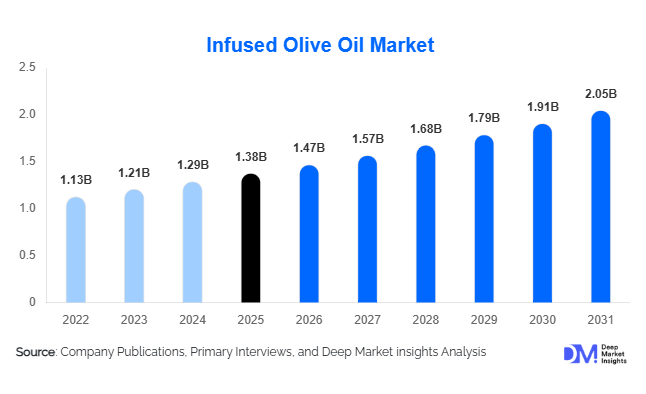
According to Deep Market Insights, the global infused olive oil market size was valued at USD 1.38 billion in 2025 and is projected to grow from USD 1.47 billion in 2026 to reach USD 2.05 billion by 2031, expanding at a CAGR of 6.8% during the forecast period (2026–2031). The infused olive oil market growth is primarily driven by increasing consumer preference for premium and healthy cooking ingredients, rising adoption of Mediterranean dietary patterns, growing demand for gourmet and artisanal food products, and the expansion of specialty food retail channels. Increasing experimentation in home cooking and the popularity of flavored oils in restaurants and foodservice applications are further supporting market expansion globally.
Key Market Insights
- Premiumization of edible oils is reshaping consumer purchasing behavior, with infused olive oils increasingly positioned as gourmet and health-focused products.
- Herb-infused and garlic-infused olive oils account for the largest share of global demand, owing to their versatility in cooking applications and widespread consumer familiarity.
- Europe dominates the global market, accounting for approximately 44% of total revenues due to its strong olive oil culture and extensive production base.
- Asia-Pacific is the fastest-growing regional market, driven by increasing disposable income, premium food consumption, and expanding Western culinary influences.
- E-commerce and direct-to-consumer sales channels are transforming market accessibility, enabling artisanal and niche brands to expand globally.
- Organic and clean-label products are witnessing above-average growth, supported by rising health consciousness and demand for naturally sourced ingredients.
Infused Olive Oil Market Latest Trends
Premium and Artisanal Infused Oils Gaining Popularity
The global edible oils industry is witnessing rapid premiumization, with consumers increasingly shifting toward high-quality and artisanal products. Infused olive oils are benefiting significantly from this trend, as consumers seek differentiated flavor experiences and premium ingredients for home cooking and gourmet applications. Manufacturers are introducing small-batch production methods, single-origin olive oils, and innovative infusion combinations such as black truffle, smoked chili, citrus blends, and botanical extracts. Premium packaging, including ceramic bottles and handcrafted glass containers, is also becoming an important differentiator in the market. The premium segment commands substantially higher margins than conventional edible oils and continues to attract affluent consumers seeking authenticity and culinary sophistication.
Growth of Organic and Functional Infused Olive Oils
Organic and functional infused olive oils are becoming one of the fastest-growing product categories within the market. Consumers increasingly associate olive oil with health and wellness, leading manufacturers to develop products infused with ingredients such as turmeric, rosemary, garlic, ginger, and antioxidant-rich botanicals. These products are marketed not only for flavor enhancement but also for their perceived health benefits, including anti-inflammatory and antioxidant properties. Certifications such as USDA Organic and EU Organic are gaining importance as consumers increasingly prioritize transparency, sustainability, and clean-label ingredients. Functional positioning is also creating opportunities in nutraceutical and personal care applications, expanding the market beyond traditional culinary uses.
Infused Olive Oil Market Drivers
Growing Consumer Preference for Healthy Cooking Oils
Rising awareness regarding cardiovascular health and healthy dietary fats is driving increased consumption of olive oil products worldwide. Infused olive oils provide consumers with both nutritional benefits and enhanced flavor profiles, making them increasingly attractive alternatives to conventional cooking oils. The growing popularity of Mediterranean diets and plant-based eating patterns is accelerating demand across North America, Europe, and emerging Asian markets.
Expansion of Gourmet Food Consumption and Home Cooking
The global gourmet food industry has expanded considerably over the past decade, driven by rising disposable incomes and increasing interest in culinary experimentation. Social media platforms, food influencers, and cooking programs have encouraged consumers to adopt premium ingredients and recreate restaurant-quality meals at home. Infused olive oils have become a preferred ingredient in salads, marinades, dipping sauces, and finishing applications, supporting robust market growth.
Rapid Growth of Specialty Retail and E-Commerce Channels
The proliferation of specialty food stores and online retail platforms has significantly improved product accessibility. E-commerce platforms have enabled small and artisanal brands to reach consumers globally while offering greater product variety and convenience. Subscription-based gourmet food services and direct-to-consumer business models are also expanding, creating new growth opportunities for manufacturers.
Infused Olive Oil Market Restraints
Volatility in Olive Production and Raw Material Prices
Olive production is highly susceptible to weather conditions, droughts, and climate-related disruptions, particularly in Mediterranean producing countries. Fluctuations in olive harvests significantly affect raw material prices and profit margins for infused olive oil manufacturers. Supply chain disruptions and increasing transportation costs have further intensified pricing volatility across global markets.
Shelf-Life and Product Stability Challenges
Natural infusions can accelerate oxidation and affect the stability of olive oil products. Manufacturers must invest in advanced processing technologies and packaging solutions to ensure product quality and food safety compliance. Smaller producers often face challenges related to preservation technologies and regulatory requirements, potentially limiting market expansion.
Infused Olive Oil Industry Key Opportunities
Expansion in Asia-Pacific Premium Food Markets
Asia-Pacific represents the most attractive growth opportunity for market participants. Countries such as China, India, Japan, South Korea, and Singapore are witnessing substantial growth in premium food consumption and imported gourmet products. Rising disposable incomes and increasing adoption of Western cuisines are creating significant opportunities for infused olive oil manufacturers. The rapid expansion of modern retail infrastructure and e-commerce channels further enhances market accessibility in the region.
Development of Functional and Wellness-Oriented Products
The increasing convergence of food and wellness presents substantial opportunities for manufacturers to develop infused olive oils containing ingredients associated with health benefits. Products incorporating turmeric, garlic, rosemary, ginger, and botanical extracts are gaining traction among health-conscious consumers. Functional positioning enables manufacturers to command premium pricing while differentiating themselves from conventional edible oil producers.
Growth in Premium Gifting and Hospitality Applications
Infused olive oils are increasingly being positioned as premium gifting products and luxury culinary accessories. Hotels, fine dining establishments, and gourmet food retailers are expanding their use of infused oils in premium dining experiences and gift baskets. The hospitality industry's growing focus on personalized and artisanal experiences is expected to create long-term opportunities for manufacturers.
Report Scope
| Report Metric | Details |
|---|---|
| Market Size in 2025 | USD 1.38 Billion |
| Market Size in 2026 | USD 1.47 Billion |
| Market Size in 2031 | USD 2.05 Billion |
| CAGR | 6.8% (2026-2031) |
| Base Year for Estimation | 2025 |
| Historical Data | 2022-2024 |
| Forecast Period | 2026-2031 |
| Report Coverage | Revenue Forecast, Competitive Landscape, Supply Chain Disruption, Growth Factors, Environment & Regulatory Landscape and Trends |
| Geographies Covered | North America, Europe, APAC, Middle East and Africa, LATAM |
| Countries Covered | U.S., Canada, U.K., Germany, France, Spain, Italy, Russia, Nordic, Benelux, Rest of Europe, China, Korea, Japan, India, Australia, Singapore, Taiwan, South East Asia, Rest of Asia-Pacific, UAE, Turky, Saudi Arabia, South Africa, Egypt, Nigeria, Rest of MEA, Brazil, Mexico, Argentina, Chile, Colombia, Rest of LATAM |
Explore more data points, trends and opportunities Download Free Sample Report
Infusion Type Insights
Herb-infused olive oil dominates the global infused olive oil market, accounting for approximately 29% of total market revenues in 2025. Its leadership is strongly supported by the deep-rooted culinary integration of Mediterranean herbs such as rosemary, basil, oregano, and thyme, which align with global consumer preferences for natural, aromatic, and clean-label flavor enhancements. The segment benefits from the ongoing premiumization of everyday cooking ingredients, where consumers increasingly seek restaurant-style flavors at home, particularly in urban households and gourmet cooking segments.Garlic-infused olive oil remains the second-largest category, driven by its universal applicability across global cuisines and its strong penetration in foodservice applications. Its growth is reinforced by its perceived health benefits, including antimicrobial and cardiovascular associations, which further enhance consumer adoption. Chili and spice-infused oils are emerging as one of the fastest-growing sub-segments, supported by rising demand for bold, ethnic, and fusion flavors, particularly among younger demographics and experimental home cooks. Truffle-infused olive oils, while niche in volume, occupy a high-value luxury segment characterized by premium pricing, gifting applications, and strong demand in fine dining establishments, contributing disproportionately to overall market profitability.
Olive Oil Grade Insights
Extra virgin olive oil (EVOO) represents approximately 61% of global infused olive oil revenues and remains the dominant base grade due to its superior sensory profile, high antioxidant content, and strong association with health and authenticity. The segment’s leadership is further reinforced by growing consumer awareness of cold-pressed extraction methods and minimal processing, which align with clean-label consumption trends. Manufacturers continue to prioritize EVOO as a base due to its ability to absorb and retain infused flavors effectively, thereby enhancing product differentiation in premium categories.Virgin and refined olive oils continue to serve as important base categories, particularly in cost-sensitive and large-volume applications. These segments are primarily driven by demand from emerging markets where affordability and accessibility remain key purchasing criteria. Additionally, refined oils are widely used in industrial food processing and large-scale foodservice operations, where consistency, stability, and cost efficiency are prioritized over premium sensory characteristics.
Nature Insights
Conventional infused olive oils accounted for nearly 73% of the global market in 2025, primarily driven by broader availability, established supply chains, and lower price points. The segment continues to benefit from strong penetration in mass retail and foodservice channels, where cost efficiency and scalability are critical purchasing drivers.However, organic infused olive oils are expanding at a significantly faster pace than the overall market, driven by accelerating consumer demand for clean-label, non-GMO, and sustainably sourced products. The growth of this segment is strongly supported by regulatory certifications, increased transparency in sourcing, and rising health consciousness. North America and Europe remain the most mature organic markets, where consumers demonstrate a strong willingness to pay premiums for traceable and environmentally responsible production practices.
Packaging Insights
Glass bottles dominate the global market with approximately 68% share, primarily due to their superior ability to preserve flavor integrity, prevent oxidation, and reinforce premium brand positioning. The segment’s dominance is further supported by consumer perception of glass as a more natural and sustainable packaging material, particularly in high-value and artisanal product categories.Ceramic packaging is gaining traction in ultra-premium and gift-oriented product lines, where aesthetic appeal and exclusivity play a key role in purchasing decisions. Metal tins continue to serve foodservice and export-oriented applications due to their durability, cost efficiency, and suitability for bulk handling. Meanwhile, bulk packaging formats are expanding steadily in institutional and industrial applications, driven by the growing demand from restaurants, catering services, and food manufacturers seeking operational efficiency and reduced per-unit costs.
Distribution Channel Insights
Supermarkets and hypermarkets remain the leading distribution channels, accounting for approximately 38% of global revenues in 2025. Their dominance is supported by strong shelf visibility, wide product assortment, and the ability to influence impulse purchases through in-store promotions and tastings. These channels are particularly effective in driving mainstream adoption across mid-tier product categories.Specialty food retailers continue to play a critical role in the premium segment, offering curated selections, expert guidance, and strong brand storytelling that enhances consumer trust and product discovery. Online retail and direct-to-consumer platforms represent the fastest-growing channels, driven by increasing digital penetration, improved logistics infrastructure, and rising consumer preference for convenience and product variety. E-commerce has also enabled small-scale and artisanal producers to access global markets directly, significantly reducing traditional distribution barriers and accelerating market fragmentation.
End-Use Insights
Household consumption accounts for approximately 48% of global infused olive oil demand, driven by rising home cooking trends, increased health awareness, and the growing popularity of gourmet cooking at home. Consumers are increasingly incorporating infused olive oils as finishing oils and flavor enhancers, reflecting broader lifestyle shifts toward healthier and more flavorful diets.The foodservice sector represents the fastest-growing end-use segment, supported by the expansion of premium dining establishments, boutique hotels, and high-end catering services. Chefs are increasingly adopting infused olive oils as signature ingredients to enhance culinary differentiation and menu innovation. Food manufacturers are also expanding usage in ready-to-eat meals, premium sauces, and marinades, leveraging infused oils to improve taste profiles and perceived product quality. Additionally, niche applications in cosmetics and personal care are emerging, driven by the antioxidant, moisturizing, and anti-inflammatory properties of olive oil, creating new cross-industry opportunities.
Explore more data points, trends and opportunities Download Free Sample Report
Infused Olive Oil Market Segmentations
By Infusion Type
- Herb-Infused Olive Oil
- Garlic-Infused Olive Oil
- Chili & Spice-Infused Olive Oil
- Citrus-Infused Olive Oil
- Truffle-Infused Olive Oil
- Vegetable-Infused Olive Oil
- Fruit-Infused Olive Oil
- Specialty & Gourmet Infusions
By Olive Oil Grade
- Extra Virgin Olive Oil
- Virgin Olive Oil
- Refined Olive Oil
- Blended Olive Oil
By Nature
- Conventional
- Organic
By Packaging Format
- Glass Bottles
- PET Bottles
- Metal Cans/Tins
- Ceramic Bottles
- Bulk Containers (≥5 Liters)
By Distribution Channel
- Supermarkets & Hypermarkets
- Specialty Food Stores
- Convenience Stores
- Online Retail/E-commerce
- Direct-to-Consumer (D2C)
- Foodservice Distributors
- Wholesale & Cash-and-Carry
Regional Insights
North America
North America accounted for approximately 26% of global market revenues in 2025, with the United States leading regional consumption. Market growth is primarily driven by increasing health consciousness, rising adoption of Mediterranean dietary patterns, and strong demand for premium and artisanal food products. The expanding gourmet food culture, supported by food influencers and cooking media, is further accelerating product penetration. Canada is also witnessing steady growth, supported by rising disposable incomes, multicultural culinary preferences, and increasing demand for organic and clean-label food products. The regional growth is further reinforced by strong retail infrastructure and rapid expansion of e-commerce grocery platforms.
Europe
Europe remains the largest regional market, accounting for nearly 44% of global revenues. The region’s dominance is anchored by Italy, Spain, France, and Greece, which serve as both production hubs and high-consumption markets. Growth is strongly supported by deeply embedded culinary traditions, high per capita olive oil consumption, and continuous innovation in infused and artisanal variants. The increasing preference for geographically authentic and locally sourced products is also strengthening demand for small-batch and region-specific infused oils. Additionally, tourism and gastronomic culture significantly contribute to product awareness and premiumization trends across the region.
Asia-Pacific
Asia-Pacific is projected to register the highest growth rate during the forecast period, with a CAGR exceeding 8%. The region’s growth is driven by rising disposable incomes, rapid urbanization, and increasing exposure to international cuisines. Countries such as China and India are experiencing strong demand for imported gourmet ingredients, supported by expanding middle-class populations and evolving dietary preferences. Japan, South Korea, and Australia are further contributing to growth through established premium food cultures and high consumer willingness to experiment with specialty oils. The rapid expansion of e-commerce platforms and cross-border food trade is significantly improving product accessibility across the region, further accelerating adoption.
Latin America
Latin America accounts for approximately 5% of global revenues, with Brazil, Mexico, and Chile leading regional demand. Growth is driven by increasing urbanization, rising exposure to global cuisines, and gradual expansion of premium food retail infrastructure. Consumers are increasingly adopting infused olive oils as part of healthier cooking habits, supported by growing awareness of Mediterranean diet benefits. The expansion of gourmet retail chains and specialty stores in major urban centers is also improving product availability and accelerating market penetration across middle- and upper-income consumer groups.
Middle East & Africa
The Middle East and Africa represent approximately 7% of global demand, with strong growth momentum in premium food categories. The United Arab Emirates and Saudi Arabia are key markets, driven by high disposable incomes, large expatriate populations, and strong demand for imported gourmet and luxury food products. The hospitality sector, including luxury hotels and fine dining restaurants, plays a significant role in driving demand for infused olive oils in culinary applications. South Africa is emerging as a growing market, supported by increasing health awareness, expanding modern retail infrastructure, and gradual shifts toward premium and natural food consumption patterns.
Key Players in the Infused Olive Oil Market
- Deoleo S.A.
- Borges International Group
- Salov Group
- Colavita USA LLC
- Pompeian Inc.
- California Olive Ranch
- Filippo Berio
- Oliviers & Co
- Brightland
- La Tourangelle
- Mantova Fine Foods
- Terra Delyssa
- Frantoio Muraglia
- Partanna
- Basso Fedele & Figli