Home Care Products Market Size
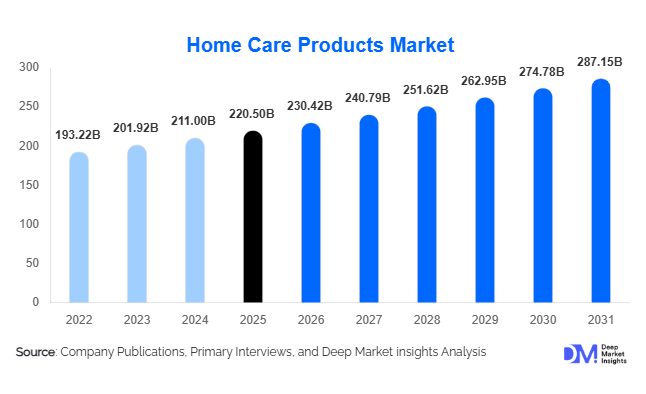
According to Deep Market Insights, the global home care products market size was valued at USD 220.5 billion in 2025 and is projected to grow from USD 230.42 billion in 2026 to reach USD 287.15 billion by 2031, expanding at a CAGR of 4.5% during the forecast period (2026–2031). The home care products market growth is primarily driven by increasing consumer awareness regarding hygiene and sanitation, rising urbanization, growing penetration of modern retail channels, and continued innovation in sustainable and premium cleaning solutions. Demand remains strong across laundry care, dishwashing products, surface cleaners, air care products, and household disinfectants as consumers globally prioritize cleanliness, health protection, and convenience.
Key Market Insights
- Laundry care remains the largest product category, accounting for approximately 32% of global market revenue owing to widespread household usage and premium detergent adoption.
- Sustainable and bio-based cleaning products are gaining significant traction, driven by consumer preference for environmentally responsible formulations and stricter environmental regulations.
- Asia-Pacific dominates the global market, representing nearly 39% of total revenue, supported by rapid urbanization, population growth, and rising disposable incomes.
- India is among the fastest-growing national markets, supported by expanding middle-class consumption and increasing penetration of branded home care products.
- E-commerce and direct-to-consumer channels are transforming distribution, enabling manufacturers to improve market reach and customer engagement.
- Product premiumization continues to reshape competition, with concentrated detergents, refillable packaging systems, and multifunctional cleaning solutions driving value growth.
Home Care Products Market Trends
Sustainable and Eco-Friendly Formulations Becoming Mainstream
Environmental sustainability has emerged as one of the most influential trends shaping the home care products market. Consumers increasingly prefer products formulated with biodegradable ingredients, plant-derived surfactants, and environmentally responsible packaging materials. Manufacturers are investing heavily in phosphate-free detergents, concentrated cleaning solutions, refillable packaging systems, and reduced-plastic product designs. Major brands are introducing carbon-reduction targets across manufacturing operations while emphasizing recyclability and circular economy initiatives. Premium eco-friendly products continue gaining shelf space across both developed and emerging markets, creating a long-term structural shift toward greener household cleaning solutions.
Growth of Concentrated and Convenience-Oriented Products
Consumers are increasingly seeking products that offer convenience, superior performance, and ease of storage. This trend has accelerated demand for detergent pods, concentrated liquids, multifunctional cleaners, and pre-moistened disinfectant wipes. Compact product formats reduce packaging requirements and transportation costs while improving consumer convenience. Manufacturers are also integrating smart dispensing technologies and dosage-control systems to enhance efficiency and minimize product waste. The trend is particularly strong in North America, Europe, Japan, and urban markets across Asia-Pacific where convenience-driven purchasing behavior continues to expand.
Home Care Products Market Drivers
Growing Consumer Focus on Hygiene and Health Protection
Heightened awareness regarding cleanliness, disease prevention, and personal well-being continues to support long-term growth across the home care products industry. Consumers maintain higher cleaning frequencies than pre-pandemic levels, resulting in sustained demand for disinfectants, surface cleaners, antibacterial products, and laundry sanitizers. Educational campaigns by health authorities and growing concerns regarding household pathogens have reinforced consumer adoption of advanced cleaning solutions. Commercial establishments, healthcare facilities, and educational institutions are similarly increasing expenditure on cleaning and sanitation products to meet evolving hygiene standards.
Rapid Urbanization and Rising Household Formation
Urban population growth across Asia-Pacific, Latin America, the Middle East, and Africa continues to create substantial demand for household cleaning products. Rising disposable incomes and increasing numbers of nuclear households are supporting greater consumption of laundry detergents, dishwashing products, and specialty cleaning solutions. Modern retail expansion and improved product accessibility are further encouraging consumers to transition from unbranded products toward premium branded alternatives. Urban lifestyles are also driving demand for convenient and multifunctional cleaning products that save time and effort.
Home Care Products Market Restraints
Volatility in Raw Material Prices
Manufacturers continue to face challenges associated with fluctuating prices of surfactants, petrochemicals, fragrances, enzymes, packaging resins, and specialty chemicals. Supply chain disruptions, geopolitical uncertainty, and commodity price fluctuations can significantly impact production costs and profit margins. In highly competitive and price-sensitive markets, producers often struggle to fully pass increased costs to consumers, creating margin pressure across the value chain.
Stringent Environmental Regulations
Governments worldwide are implementing stricter regulations concerning chemical ingredients, packaging waste, emissions, and environmental impact. Compliance often requires significant investments in research and development, product reformulation, testing, and certification. Smaller manufacturers may face difficulties adapting to changing regulatory frameworks, potentially limiting innovation and increasing operational costs. While these regulations support sustainability objectives, they also present challenges for industry participants seeking to maintain profitability and product performance.
Home Care Products Market Opportunities
Expansion of Bio-Based and Green Cleaning Products
The growing preference for sustainable consumption creates substantial opportunities for manufacturers developing environmentally responsible cleaning solutions. Consumers increasingly seek products containing natural ingredients, biodegradable formulations, and recyclable packaging. Companies capable of delivering effective green alternatives while maintaining competitive pricing are expected to capture significant market share. Regulatory support for sustainable products and growing retailer preference for environmentally friendly offerings further strengthen this opportunity.
Growth Potential Across Emerging Economies
Emerging markets including India, Indonesia, Vietnam, Nigeria, the Philippines, and several Latin American countries continue to offer considerable growth opportunities. Rising incomes, increasing urbanization, improving retail infrastructure, and expanding middle-class populations are driving demand for branded home care products. Market penetration remains significantly lower than developed economies, creating substantial room for future expansion. Manufacturers are increasingly introducing affordable pack sizes and localized product formulations to accelerate adoption among first-time consumers.
Report Scope
| Report Metric | Details |
|---|---|
| Market Size in 2025 | USD 220.5 Billion |
| Market Size in 2026 | USD 230.42 Billion |
| Market Size in 2031 | USD 287.15 Billion |
| CAGR | 4.5% (2026-2031) |
| Base Year for Estimation | 2025 |
| Historical Data | 2022-2024 |
| Forecast Period | 2026-2031 |
| Report Coverage | Revenue Forecast, Competitive Landscape, Supply Chain Disruption, Growth Factors, Environment & Regulatory Landscape and Trends |
| Geographies Covered | North America, Europe, APAC, Middle East and Africa, LATAM |
| Countries Covered | U.S., Canada, U.K., Germany, France, Spain, Italy, Russia, Nordic, Benelux, Rest of Europe, China, Korea, Japan, India, Australia, Singapore, Taiwan, South East Asia, Rest of Asia-Pacific, UAE, Turky, Saudi Arabia, South Africa, Egypt, Nigeria, Rest of MEA, Brazil, Mexico, Argentina, Chile, Colombia, Rest of LATAM |
Explore more data points, trends and opportunities Download Free Sample Report
Product Type Insights
Laundry Care dominated the global home care products market, accounting for approximately 32% of total revenue in 2025, making it the largest product category worldwide. The segment’s leadership is primarily driven by its high consumption frequency across both developed and developing economies, where laundry detergents represent an essential household necessity rather than a discretionary purchase. Increasing washing machine penetration, particularly across Asia-Pacific, Latin America, and parts of Africa, has significantly boosted demand for premium liquid detergents, detergent capsules, fabric conditioners, and specialized stain removers. Consumers are increasingly shifting from traditional powder detergents toward concentrated liquid formulations and pods due to superior convenience, dosing accuracy, and enhanced cleaning performance.
The premiumization trend has further strengthened segment growth, with manufacturers introducing enzyme-based detergents, fragrance-enhanced products, and fabric-specific formulations targeting higher-income consumers. Surface care products represent the second-largest category, supported by increasing household cleaning frequency and heightened sanitation awareness across residential and commercial settings. Meanwhile, air care products are among the fastest-growing segments due to rising consumer focus on indoor air quality, home ambiance, and wellness-oriented lifestyles. Household insecticides continue to maintain strong demand across tropical and subtropical regions including India, Southeast Asia, Latin America, and Africa, where vector-borne disease prevention remains a key consumer priority. Overall, laundry care is expected to maintain its market leadership throughout the forecast period due to recurring consumption patterns, technological product innovation, and increasing adoption of premium cleaning solutions globally.
Ingredient Type Insights
Synthetic formulations accounted for nearly 76% of global market revenue in 2025, maintaining their position as the dominant ingredient category across the home care products industry. The segment's leadership is largely attributable to superior cleaning efficiency, lower production costs, broad formulation flexibility, and strong consumer familiarity. Conventional surfactants, bleaching agents, antimicrobial compounds, solvents, and specialty chemicals continue to serve as the backbone of most laundry care, dishwashing, surface care, and disinfectant products. These ingredients provide consistent performance across diverse cleaning applications, enabling manufacturers to deliver effective solutions at competitive price points.
Despite synthetic products maintaining market dominance, the industry is witnessing a structural shift toward sustainable alternatives. Natural and bio-based formulations represent the fastest-growing ingredient category as consumers increasingly prioritize environmentally responsible products and regulators impose stricter restrictions on certain chemical compounds. Demand for plant-derived surfactants, enzyme-based cleaning systems, biodegradable ingredients, and essential oil-based formulations is rising significantly across North America and Europe. Major manufacturers are investing heavily in green chemistry technologies and bio-based raw material sourcing to reduce environmental impact while maintaining cleaning performance. However, challenges associated with higher production costs and scalability limitations are expected to keep synthetic formulations as the dominant segment throughout the forecast period.
Distribution Channel Insights
Offline retail channels accounted for approximately 71% of global home care product sales in 2025, making them the leading distribution segment worldwide. Supermarkets, hypermarkets, convenience stores, drugstores, and grocery chains continue to dominate consumer purchasing behavior due to their extensive product assortment, promotional pricing strategies, and immediate product availability. Home care products are typically high-frequency purchase items, encouraging consumers to buy them during routine grocery shopping trips. Bulk purchasing opportunities and in-store product comparisons further strengthen the position of traditional retail channels.
Although offline channels maintain market leadership, online retail is emerging as the fastest-growing distribution segment globally. The rapid expansion of e-commerce platforms, direct-to-consumer websites, subscription-based replenishment models, and quick-commerce services is reshaping purchasing behavior across urban markets. Digital channels are particularly influential for premium and environmentally sustainable products, where consumers actively research product ingredients, performance claims, certifications, and customer reviews before making purchasing decisions. In emerging markets, growing internet penetration and smartphone adoption are accelerating online sales growth, while in developed economies, convenience and automatic replenishment programs are driving increased consumer engagement. The coexistence of traditional retail and digital commerce is expected to define future channel strategies across the global home care products market.
End User Insights
Residential households represented the largest end-user segment, accounting for nearly 75% of global market demand in 2025. The segment's dominance is supported by the universal and recurring nature of household cleaning activities, making home care products essential consumer goods across all income groups and geographies. Increasing urbanization, rising household formation, growing disposable incomes, and heightened awareness regarding cleanliness and hygiene continue to drive sustained demand within residential applications. Consumers are increasingly adopting specialized cleaning products tailored for different household surfaces, fabrics, and living environments, further increasing per-household spending.
Commercial and institutional applications represent the fastest-growing end-use segment, supported by stricter sanitation requirements and professional facility management practices. Healthcare facilities are witnessing particularly strong growth due to infection prevention protocols and increased demand for hospital-grade disinfectants and surface sanitizers. The hospitality industry is also emerging as a significant growth driver, with hotels, resorts, restaurants, and serviced apartments investing heavily in premium cleaning products and air care solutions to enhance guest satisfaction and maintain brand standards. Educational institutions, office complexes, and industrial facilities are further contributing to commercial demand growth as organizations increasingly prioritize workplace hygiene, employee well-being, and regulatory compliance.
Explore more data points, trends and opportunities Download Free Sample Report
Home Care Products Market Segmentations
By Product Type
- Laundry Care
- Dishwashing Care
- Surface Care
- Toilet Care
- Air Care
- Household Insecticides
- Bleaches & Disinfectants
- Polishes & Specialty Care Products
By Ingredient Type
- Synthetic Formulations
- Natural & Bio-Based Formulations
By Packaging Format
- Liquid Products
- Powder Products
- Pods & Capsules
- Aerosols
- Gels
- Tablets
- Wipes
- Bars & Solid Formats
By Distribution Channel
- Hypermarkets & Supermarkets
- Convenience Stores
- Grocery Stores
- Drug Stores & Pharmacies
- Specialty Retail Stores
- Online Retail & E-Commerce
By End User
- Residential Households
- Hospitality
- Healthcare Facilities
- Educational Institutions
- Commercial Offices
- Industrial Facilities
Regional Insights
Asia-Pacific
Asia-Pacific accounted for approximately 39% of the global home care products market in 2025, making it the largest regional market worldwide. China remains the dominant contributor due to its large consumer base, extensive manufacturing capabilities, and growing demand for premium household cleaning products. India represents one of the fastest-growing markets globally, supported by rapid urbanization, rising disposable incomes, increasing washing machine penetration, and growing awareness regarding hygiene and sanitation. Southeast Asian countries including Indonesia, Vietnam, Thailand, and the Philippines are experiencing robust demand growth as expanding middle-class populations increase spending on branded home care products.
The primary growth drivers across Asia-Pacific include urban population expansion, rising household formation rates, increasing penetration of organized retail channels, and growing adoption of premium and specialized cleaning products. Government initiatives promoting public health and sanitation, coupled with strong e-commerce growth, are further accelerating regional market expansion. Asia-Pacific is expected to remain the fastest-growing major region throughout the forecast period.
North America
North America accounted for approximately 25% of global market revenue in 2025, with the United States representing the largest national market within the region. The market is characterized by high per-capita consumption, strong brand loyalty, and significant demand for premium cleaning products. Consumers increasingly favor concentrated detergents, detergent pods, disinfecting wipes, specialty cleaners, and environmentally sustainable formulations.
Key growth drivers include strong consumer purchasing power, high household appliance penetration, growing demand for convenience-oriented products, and increasing adoption of eco-friendly cleaning solutions. The region also benefits from advanced retail infrastructure, strong e-commerce adoption, and continuous product innovation by leading manufacturers. Sustainability initiatives and consumer willingness to pay premium prices for green products continue to support value growth across the North American market.
Europe
Europe remains one of the most mature and innovation-driven home care products markets globally, led by Germany, the United Kingdom, France, Italy, and Spain. Western Europe accounts for the majority of regional demand, supported by high living standards and strong consumer awareness regarding environmental sustainability. Consumers increasingly prefer products with biodegradable ingredients, recyclable packaging, and reduced carbon footprints.
The region's primary growth drivers include stringent environmental regulations, widespread adoption of sustainable products, strong demand for premium cleaning solutions, and continuous innovation in green chemistry technologies. Regulatory frameworks encouraging reduced plastic waste and environmentally responsible formulations are accelerating the transition toward bio-based products. Premiumization remains a significant growth catalyst as consumers prioritize performance, convenience, and sustainability when selecting home care products.
Latin America
Latin America represents an important emerging growth market, with Brazil accounting for the largest regional share, followed by Mexico, Argentina, Chile, and Colombia. Demand is increasingly shifting toward branded products as consumers seek higher-quality cleaning solutions and improved product performance. Laundry care and surface cleaning products remain the most widely consumed categories across the region.
Regional growth is primarily driven by increasing urbanization, expanding middle-class populations, rising disposable incomes, and ongoing modernization of retail infrastructure. Growing penetration of supermarkets, hypermarkets, and digital commerce platforms is improving product accessibility across both urban and semi-urban areas. Manufacturers are increasingly introducing affordable package sizes and localized product offerings to address diverse consumer needs and purchasing power levels.
Middle East & Africa
The Middle East & Africa region is emerging as a high-potential growth market, supported by favorable demographic trends and improving economic development. Saudi Arabia and the United Arab Emirates lead demand within the Middle East, while South Africa, Egypt, and Nigeria represent the largest markets across Africa. Rising urbanization and increasing awareness regarding hygiene are contributing to growing consumption of household cleaning products.
Key regional growth drivers include rapid population growth, expanding urban middle-class populations, increasing investment in retail infrastructure, and government initiatives focused on public health and sanitation. The region also benefits from strong demand for household insecticides and disinfectants due to climatic conditions and disease prevention requirements. Economic diversification initiatives across Gulf countries, combined with rising household spending and greater availability of international brands, are expected to support sustained long-term market growth throughout the forecast period.
Key Players in the Home Care Products Market
- Procter & Gamble
- Unilever
- Reckitt
- Henkel AG & Co. KGaA
- SC Johnson
- The Clorox Company
- Kao Corporation
- Colgate-Palmolive Company
- Church & Dwight Co., Inc.
- Ecolab Inc.
- Godrej Consumer Products Limited
- Lion Corporation
- LG Household & Health Care Ltd.
- Amway Corporation
- Method Products PBC