Holiday Blend Coffee Market Size
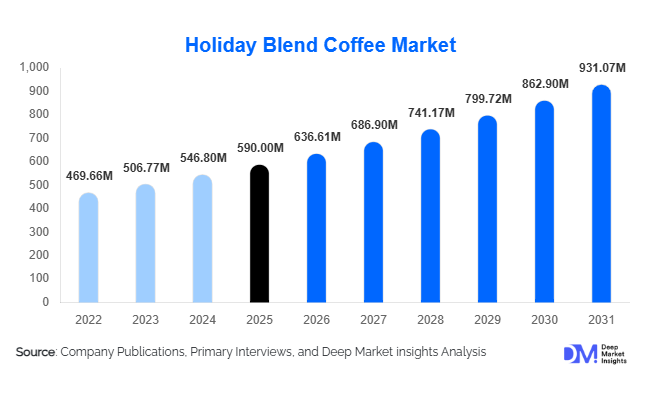
According to Deep Market Insights, the global holiday blend coffee market size was valued at USD 590 million in 2025 and is projected to grow from USD 636.61 million in 2026 to reach USD 931.07 million by 2031, expanding at a CAGR of 7.9% during the forecast period (2026–2031). The market growth is primarily driven by rising premium coffee consumption, increasing consumer preference for limited-edition and seasonal beverages, and growing demand for coffee-based gifting products during festive seasons. Holiday blend coffee, traditionally concentrated in North America, has evolved into a global premium specialty coffee segment, supported by the expansion of café culture, e-commerce channels, and increasing consumer willingness to pay for differentiated flavor experiences.
Manufacturers are increasingly introducing innovative seasonal flavor profiles, including cinnamon, nutmeg, peppermint, chocolate, and fruit-inspired blends, to attract consumers seeking unique and experiential beverages. The market is also benefiting from premiumization trends, with artisanal roasters and specialty coffee brands launching organic, ethically sourced, and single-origin seasonal offerings. Growing corporate gifting expenditure, direct-to-consumer coffee subscriptions, and digital retail platforms have further expanded the market's reach across developed and emerging economies.
Key Market Insights
- North America accounts for approximately 46% of global demand, with the United States representing nearly 38% of the overall market owing to strong seasonal coffee consumption habits.
- Household consumers dominate the market with around 58% share, supported by rising home brewing trends and festive consumption patterns.
- Ground holiday blend coffee remains the leading product category, contributing nearly 39% of total market revenue due to its convenience and broad consumer appeal.
- Asia-Pacific is the fastest-growing regional market, projected to expand at a CAGR exceeding 9.5% during the forecast period.
- Premium and artisanal blends are increasingly gaining traction, driven by consumer preference for high-quality ingredients, sustainable sourcing, and unique flavor experiences.
- E-commerce and subscription-based coffee sales are reshaping market dynamics, enabling seasonal product launches and direct consumer engagement.
Holiday Blend Coffee Market Latest Trends
Premiumization and Artisanal Seasonal Coffee Gaining Momentum
Consumers are increasingly shifting toward premium and artisanal holiday blend coffee products that offer differentiated flavor experiences and superior bean quality. Specialty coffee roasters are introducing limited-edition seasonal blends made from single-origin Arabica beans, organic ingredients, and sustainably sourced coffee. Premium gift packaging and small-batch roasting are becoming major differentiators in the market. The willingness of consumers to pay premium prices for unique holiday coffee experiences is encouraging companies to launch super-premium offerings with higher margins and stronger brand loyalty. This trend is particularly evident in North America, Europe, Japan, and South Korea, where specialty coffee culture has become deeply embedded within consumer preferences.
Digital Commerce and Coffee Subscription Models Transforming Seasonal Sales
The rapid growth of e-commerce platforms and direct-to-consumer subscription models is significantly changing the way holiday blend coffee is marketed and sold. Seasonal product launches increasingly rely on online exclusivity, personalized recommendations, and limited-edition offerings to generate urgency among consumers. Subscription-based coffee clubs are incorporating holiday blends into curated seasonal packages, creating recurring revenue streams and improving customer retention. Digital marketing strategies, influencer collaborations, and social media campaigns are also playing an increasingly important role in driving seasonal demand and consumer engagement.
Holiday Blend Coffee Market Drivers
Growing Premium Coffee Consumption Worldwide
The global specialty coffee industry has experienced robust growth due to increasing consumer willingness to spend on premium beverages that provide superior taste, authenticity, and unique experiences. Holiday blend coffee aligns perfectly with this trend by combining premium ingredients with limited-time exclusivity. Consumers increasingly associate seasonal coffee offerings with indulgence and celebration, driving repeat purchases and premium pricing opportunities for manufacturers.
Increasing Demand for Seasonal and Limited-Edition Products
Modern consumers increasingly seek novelty and exclusivity in food and beverage products. Seasonal coffee blends create a sense of urgency and scarcity that encourages impulse purchasing behavior. Limited-edition products also enable manufacturers to generate significant media attention and strengthen brand differentiation. Seasonal launches have become an important growth strategy for specialty coffee companies seeking to increase customer engagement and brand loyalty.
Expansion of Corporate and Consumer Gifting Culture
Holiday blend coffee has become a preferred gifting category among both consumers and businesses. Companies are increasingly using premium coffee gift boxes and customized seasonal hampers for employee recognition and client appreciation programs. The growing popularity of premium gifting has substantially expanded the addressable market for holiday blend coffee products and created opportunities for product innovation and customization.
Holiday Blend Coffee Market Restraints
Volatility in Green Coffee Bean Prices
The holiday blend coffee market remains highly exposed to fluctuations in Arabica and Robusta coffee prices. Climate-related disruptions, adverse weather conditions, supply chain constraints, and geopolitical uncertainties significantly influence coffee bean availability and pricing. These factors can negatively affect manufacturer profitability and create challenges in maintaining stable retail pricing.
Highly Seasonal Demand Patterns
The majority of holiday blend coffee sales are concentrated within a short period between October and January. Such seasonality creates inventory management challenges, forecasting difficulties, and production inefficiencies. Companies must carefully balance production volumes to avoid excess inventory while ensuring adequate product availability during peak demand periods.
Holiday Blend Coffee Industry Key Opportunities
Expansion of Premium and Artisanal Offerings
The premium coffee category continues to outperform conventional coffee segments, creating substantial opportunities for manufacturers to introduce small-batch, organic, and ethically sourced holiday blends. Consumers increasingly value authenticity, traceability, and craftsmanship, enabling companies to command premium pricing and improve margins through differentiated offerings.
Growth in Corporate Seasonal Gifting
Corporate gifting has emerged as a major revenue stream for specialty coffee manufacturers. Businesses increasingly include premium coffee gift boxes in employee appreciation and customer engagement programs. Customized packaging, co-branded products, and exclusive seasonal assortments present attractive opportunities for both established companies and new entrants seeking to penetrate the premium gifting market.
Digital Commerce and Personalized Subscription Services
Subscription-based coffee models and direct-to-consumer platforms offer significant opportunities to strengthen customer relationships and generate recurring revenues. The integration of artificial intelligence, consumer analytics, and personalized recommendations enables companies to improve customer engagement and optimize seasonal product launches through targeted marketing initiatives.
Report Scope
| Report Metric | Details |
|---|---|
| Market Size in 2025 | USD 590.00 Million |
| Market Size in 2026 | USD 636.61 Million |
| Market Size in 2031 | USD 931.07 Million |
| CAGR | 7.9% (2026-2031) |
| Base Year for Estimation | 2025 |
| Historical Data | 2022-2024 |
| Forecast Period | 2026-2031 |
| Report Coverage | Revenue Forecast, Competitive Landscape, Supply Chain Disruption, Growth Factors, Environment & Regulatory Landscape and Trends |
| Geographies Covered | North America, Europe, APAC, Middle East and Africa, LATAM |
| Countries Covered | U.S., Canada, U.K., Germany, France, Spain, Italy, Russia, Nordic, Benelux, Rest of Europe, China, Korea, Japan, India, Australia, Singapore, Taiwan, South East Asia, Rest of Asia-Pacific, UAE, Turky, Saudi Arabia, South Africa, Egypt, Nigeria, Rest of MEA, Brazil, Mexico, Argentina, Chile, Colombia, Rest of LATAM |
Explore more data points, trends and opportunities Download Free Sample Report
Product Type Insights
The global holiday blend coffee market is segmented into ground coffee, whole bean coffee, single-serve pods and capsules, ready-to-drink (RTD) beverages, and instant seasonal coffee products. Among these, ground holiday blend coffee remains the leading product category, accounting for approximately 39% of global revenue in 2025. The segment's leadership is primarily driven by strong consumer preference for convenience-oriented products that can be prepared without specialized brewing equipment while still delivering premium seasonal flavors and aromas. Ground coffee also benefits from widespread retail availability, affordable pricing across multiple consumer groups, and its suitability for gifting and household consumption during festive occasions. The growing popularity of home brewing and the increasing tendency of consumers to recreate café-style experiences at home continue to reinforce demand for premium ground holiday blends.Single-serve pods and capsules are witnessing robust growth and are expected to gain substantial market share over the forecast period. The segment is being driven by increasing penetration of single-serve coffee machines, growing demand for portion-controlled brewing systems, and consumer preference for convenience and consistency. Manufacturers are increasingly launching festive and limited-edition pod variants to capitalize on seasonal demand, while the emergence of recyclable and biodegradable capsules is further enhancing consumer acceptance, particularly among environmentally conscious buyers.Ready-to-drink holiday coffee beverages and instant seasonal blends remain comparatively niche categories but are expanding steadily, particularly in urban markets characterized by busy lifestyles and increasing on-the-go consumption patterns. The growing popularity of cold brew products, premium canned coffee beverages, and portable consumption formats is supporting demand for RTD holiday offerings. Meanwhile, improvements in instant coffee quality and the introduction of premium instant seasonal products are enabling manufacturers to address evolving consumer preferences for convenience without compromising flavor quality.
Flavor Profile Insights
Based on flavor profile, the market is segmented into traditional spiced blends, chocolate and cocoa-based varieties, peppermint and mint-inspired products, vanilla-based offerings, fruit-flavored seasonal blends, and other innovative seasonal formulations. Traditional spiced blends, including cinnamon, nutmeg, clove, and ginger, continue to dominate the market and account for approximately 34% of global revenue. The segment's leadership is primarily attributed to the strong emotional and cultural association between warm spices and festive celebrations. Consumers across major markets consistently seek familiar seasonal flavors that evoke nostalgia and traditional holiday experiences, resulting in sustained demand for spiced coffee products.Chocolate and cocoa-based blends continue to gain significant traction, particularly among younger consumers and premium coffee drinkers seeking indulgent flavor experiences. These products benefit from the increasing convergence between confectionery-inspired flavors and specialty coffee innovations. Manufacturers are increasingly combining chocolate notes with caramel, mocha, and dessert-inspired ingredients to create differentiated premium offerings that appeal to experiential consumers.Peppermint, vanilla, and fruit-inspired seasonal blends are increasingly being introduced as limited-edition products to capture changing consumer preferences and encourage repeat purchases during the festive season. Seasonal product launches featuring cranberry, orange spice, apple cinnamon, and berry-inspired flavors have gained popularity among consumers seeking novelty and variety. In addition, manufacturers are experimenting with innovative flavor combinations such as gingerbread, caramel apple, hazelnut praline, toasted marshmallow, and maple pecan to strengthen product differentiation and enhance seasonal demand. The increasing focus on flavor innovation and limited-time offerings has become a key competitive strategy among leading market participants.
Bean Composition Insights
The market is categorized into 100% Arabica blends, Arabica-Robusta blends, and organic and sustainably sourced coffee products. Holiday blends based on 100% Arabica coffee account for approximately 56% of market revenue, making them the dominant bean composition segment. The leading position of Arabica coffee is driven by increasing consumer preference for premium products offering smoother taste profiles, lower bitterness, and superior aromatic complexity. The premiumization trend in the global coffee industry has significantly benefited Arabica-based seasonal products, particularly among consumers seeking high-quality gifting options and specialty coffee experiences during festive periods.Arabica-Robusta blends continue to represent an important segment within the market due to their affordability, stronger flavor characteristics, and higher caffeine content. These products cater to price-sensitive consumers while enabling manufacturers to achieve cost efficiencies and maintain competitive pricing across mass-market channels. The segment remains particularly relevant in emerging economies where value-oriented purchasing decisions continue to influence consumer behavior.Organic and sustainably sourced holiday blends are experiencing above-average growth rates and are expected to gain increasing market prominence during the forecast period. Rising consumer awareness regarding ethical sourcing, environmental sustainability, and traceability in coffee production is driving demand for certified products. Manufacturers are increasingly investing in fair-trade, organic, and sustainably sourced coffee programs to strengthen brand positioning and appeal to environmentally conscious consumers. The growing willingness among consumers to pay premium prices for responsibly sourced products is expected to further accelerate segment growth.
Distribution Channel Insights
The holiday blend coffee market is distributed through supermarkets and hypermarkets, specialty coffee stores, online channels, convenience stores, and other retail formats. Supermarkets and hypermarkets account for approximately 36% of global sales, making them the largest distribution channel. The segment's dominance is primarily supported by extensive product availability, strong seasonal promotions, attractive merchandising strategies, and broad consumer reach. Retail chains often dedicate prominent shelf space to seasonal coffee products during festive periods, significantly increasing product visibility and impulse purchases.Specialty coffee stores remain critical channels for premium and artisanal holiday blend products, particularly in developed markets characterized by mature coffee cultures. These outlets offer consumers opportunities to experience limited-edition products, receive product recommendations, and explore premium coffee varieties that are often unavailable through mass-market channels. The growing popularity of specialty coffee consumption and premium gifting continues to support the importance of this distribution segment.Online channels, including brand websites, e-commerce marketplaces, and subscription services, represent the fastest-growing distribution segment and are projected to expand at a double-digit growth rate during the forecast period. The rapid growth of e-commerce is being driven by increasing digital adoption, growing consumer preference for convenience, expanding direct-to-consumer strategies, and rising demand for personalized and subscription-based coffee experiences. The ability to offer exclusive seasonal products, customized packaging, and recurring deliveries has significantly improved the profitability and customer engagement strategies of premium coffee brands.
End-Use Insights
Based on end use, the market is segmented into households, cafés and coffee chains, hotels and resorts, and corporate gifting applications. Household consumers dominate the holiday blend coffee market, contributing nearly 58% of global demand. The segment's leadership is primarily driven by rising home brewing trends, increasing preference for premium coffee experiences, and growing consumer willingness to purchase seasonal products for personal consumption and gifting purposes. The increasing adoption of premium coffee machines and the desire to replicate café-quality beverages at home continue to strengthen household demand for holiday blend coffee products.Cafés and coffee chains represent one of the fastest-growing commercial segments, leveraging seasonal beverage menus to improve customer engagement and increase average transaction values. Seasonal beverages often serve as important traffic drivers, encouraging repeat visits and supporting brand differentiation. Leading coffee chains continue to expand their seasonal product portfolios, contributing significantly to market growth.Hotels and resorts are increasingly incorporating premium seasonal beverages into their hospitality offerings to enhance guest experiences during festive periods. Luxury hospitality operators are introducing customized holiday beverage menus and seasonal coffee programs to strengthen customer satisfaction and create differentiated experiences.Corporate gifting represents an emerging application segment and is generating additional demand for premium packaging, customized seasonal products, and limited-edition gift assortments. Companies are increasingly utilizing premium coffee products as employee appreciation gifts and client engagement tools, creating new revenue opportunities for manufacturers and specialty coffee brands.
Explore more data points, trends and opportunities Download Free Sample Report
Holiday Blend Coffee Market Segmentations
By Product Type
- Ground Holiday Blend Coffee
- Whole Bean Holiday Blend Coffee
- Single-Serve Pods/Capsules
- Ready-to-Drink (RTD) Holiday Coffee Beverages
- Instant Holiday Blend Coffee
By Flavor Profile
- Traditional Spiced Blends
- Chocolate & Cocoa-Based Blends
- Vanilla & Caramel Blends
- Peppermint & Mint-Based Blends
- Fruit & Nut-Inspired Blends
- Limited-Edition Experimental Flavors
By Bean Composition
- 100% Arabica Holiday Blends
- Arabica-Robusta Blends
- Premium Single-Origin Seasonal Blends
- Organic Holiday Blends
- Decaffeinated Holiday Blends
By Roast Level
- Light Roast
- Medium Roast
- Medium-Dark Roast
- Dark Roast
By Packaging Format
- Bags/Pouches
- Tins and Gift Boxes
- Capsules/Pods Packs
- Sachets and Single-Serve Packs
- Seasonal Gift Hampers
Regional Insights
North America
North America remains the largest market for holiday blend coffee, accounting for approximately 46% of global revenue in 2025. The United States alone contributes nearly 38% of worldwide demand, driven by deeply established seasonal coffee consumption traditions, a highly mature specialty coffee industry, and a strong premium gifting culture. Canada also represents an important market due to its high per-capita coffee consumption and growing preference for artisanal seasonal products.Regional growth is being driven by strong consumer spending on premium food and beverage products, widespread adoption of home brewing equipment, increasing demand for limited-edition seasonal offerings, and continuous product innovation by major coffee chains and specialty roasters. The growing popularity of e-commerce and subscription-based coffee services is further supporting market expansion, while rising demand for ethically sourced and sustainably produced coffee products is creating additional opportunities for premium brands across the region.
Europe
Europe accounts for approximately 28% of global demand, with Germany, the United Kingdom, France, and Italy representing the largest consuming countries. Premiumization trends, increasing interest in sustainable sourcing, and rising demand for organic products continue to support regional market growth. European consumers demonstrate a strong preference for ethically sourced and environmentally responsible coffee products, creating favorable conditions for premium and certified holiday blends.The region's growth is further supported by a deeply rooted coffee culture, rising consumer expenditure on premium beverages, increasing penetration of specialty coffee stores, and growing interest in artisanal and small-batch coffee products. In addition, stringent sustainability standards and increasing consumer awareness regarding environmental and social responsibility are accelerating demand for fair-trade and organic seasonal coffee products throughout the region.
Asia-Pacific
Asia-Pacific is the fastest-growing regional market and is expected to expand at a CAGR exceeding 9.5% during the forecast period. China represents the fastest-growing national market, driven by an expanding café culture, rising disposable incomes, and growing interest in premium imported beverages. Japan and South Korea continue to exhibit strong demand for specialty coffee products, while India is emerging as a promising market supported by rapid urbanization and increasing coffee consumption among younger demographics.Regional growth is being fueled by the rapid expansion of organized café chains, increasing westernization of consumption patterns, growing middle-class populations, and rising demand for premium and experiential food and beverage products. The increasing adoption of digital commerce platforms and growing consumer exposure to international coffee trends through social media and global travel are also accelerating demand for seasonal and limited-edition coffee products across the region.
Latin America
Latin America, led by Brazil and Mexico, is witnessing steady growth in domestic consumption of premium seasonal coffee products. Although the region remains one of the world's largest coffee-producing hubs, premium holiday blend consumption remains relatively underpenetrated, creating significant long-term opportunities for market expansion.Growth in the region is being driven by increasing urbanization, rising disposable incomes, growing awareness of specialty coffee products, and the emergence of premium café chains targeting affluent consumers. The strong coffee heritage of the region, combined with increasing domestic appreciation for value-added and specialty coffee offerings, is expected to support the gradual expansion of holiday blend coffee consumption over the forecast period.
Middle East & Africa
The Middle East and Africa region is emerging as an important growth market, particularly in the United Arab Emirates and Saudi Arabia, where premium beverage consumption continues to increase. Expanding café chains and rising consumer spending on luxury food and beverage products are creating favorable conditions for holiday blend coffee manufacturers. South Africa is also emerging as an important specialty coffee market within the region.Regional growth is being supported by increasing urbanization, rising disposable incomes, expanding tourism and hospitality industries, and growing consumer interest in premium and international beverage trends. The rapid development of modern retail infrastructure, increasing penetration of specialty coffee outlets, and rising demand for premium gifting products during festive occasions are expected to create significant opportunities for market participants throughout the forecast period.
Key Players in the Holiday Blend Coffee Market
- Starbucks Corporation
- Nestlé S.A.
- Keurig Dr Pepper
- The J.M. Smucker Company
- Peet's Coffee
- Dunkin' Brands
- Green Mountain Coffee Roasters
- Intelligentsia Coffee
- Stumptown Coffee Roasters
- Verve Coffee Roasters
- Caffè Vita
- Café Britt
- Cameron's Coffee
- Lifeboost Coffee
- Barnie's Coffee & Tea Co.