Bread Embryo Market Size
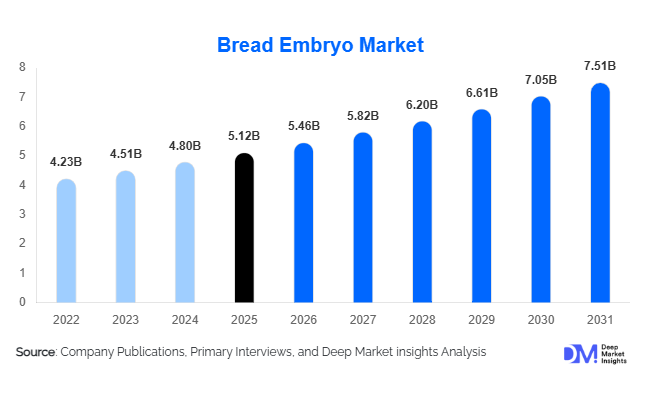
According to Deep Market Insights, the global bread embryo market size was valued at USD 5.12 billion in 2025 and is projected to grow from USD 5.46 billion in 2026 to reach USD 7.51 billion by 2031, expanding at a CAGR of 6.6% during the forecast period (2026–2031). The bread embryo market growth is primarily driven by increasing demand for functional food ingredients, rising consumer preference for natural sources of vitamins and proteins, and expanding applications of wheat germ derivatives across nutraceutical, bakery, and personal care industries. Bread embryo, commonly commercialized as wheat germ, has transitioned from being a milling by-product into a high-value ingredient owing to its rich composition of vitamin E, essential fatty acids, minerals, antioxidants, and dietary fiber.
The market is witnessing substantial investments in stabilization technologies and ingredient innovation to improve shelf life and expand applications in premium food products. Increasing adoption of fortified foods, preventive healthcare trends, and clean-label formulations are supporting market expansion globally. Emerging economies in Asia-Pacific are rapidly increasing consumption of functional ingredients, while North America and Europe continue to dominate demand for organic and premium-grade wheat germ products. Growing awareness regarding plant-based nutrition and the incorporation of wheat germ into sports nutrition, dietary supplements, and cosmetic products are expected to further support long-term market growth.
Key Market Insights
- Functional food and fortified bakery applications account for the largest share of demand, driven by consumer preference for nutrient-dense ingredients.
- Stabilized wheat germ remains the leading product category, accounting for more than one-third of global revenue due to its improved shelf life and wider industrial applicability.
- Asia-Pacific dominates global demand, supported by expanding food processing industries and increasing health awareness among consumers.
- Organic bread embryo ingredients are emerging as the fastest-growing segment, benefiting from premiumization and clean-label trends.
- Nutraceutical and sports nutrition applications are recording the highest growth rates, driven by demand for natural vitamin E and plant-based protein ingredients.
- Technological advancements in stabilization and extraction methods are improving product quality, shelf stability, and profitability for manufacturers.
Bread Embryo Market Latest Trends
Functional Nutrition and Clean-Label Foods Driving Ingredient Innovation
Consumers are increasingly seeking foods that offer benefits beyond basic nutrition, leading manufacturers to incorporate bread embryo ingredients into cereals, bakery products, dairy products, and nutrition bars. Wheat germ's naturally high content of antioxidants, dietary fiber, and proteins makes it highly suitable for clean-label and fortified food formulations. Food processors are introducing premium bread and snack products enriched with wheat germ to target health-conscious consumers seeking immunity support, digestive health, and cardiovascular benefits. The growing preference for minimally processed ingredients is also encouraging manufacturers to develop non-GMO and organic wheat germ products.
Expansion of Wheat Germ Oil and Nutraceutical Applications
Wheat germ oil is gaining popularity due to its exceptionally high vitamin E content and antioxidant properties. Nutraceutical manufacturers are increasingly incorporating wheat germ oil into capsules, softgels, and sports nutrition formulations aimed at improving immunity, skin health, and anti-aging benefits. The personal care industry is also expanding the use of wheat germ derivatives in skincare and haircare formulations. Technological advancements in cold-press extraction and stabilization are improving oil quality and increasing commercial adoption across premium health and wellness products.
Bread Embryo Market Drivers
Rising Demand for Functional and Fortified Foods
The rapid expansion of the global functional food industry has significantly increased demand for nutrient-rich ingredients such as bread embryo. Manufacturers are increasingly incorporating wheat germ into bakery products, cereals, snacks, and dairy products to enhance nutritional profiles. Consumer demand for immunity-boosting and preventive health products continues to drive the adoption of wheat germ ingredients worldwide.
Growth of Preventive Healthcare and Nutraceutical Consumption
The increasing prevalence of lifestyle-related diseases and growing health consciousness are encouraging consumers to seek natural sources of vitamins, antioxidants, and dietary fiber. Bread embryo ingredients provide a concentrated source of vitamin E, essential fatty acids, and minerals, making them increasingly attractive for dietary supplements and functional nutrition products.
Expansion of Plant-Based Nutrition
The global shift toward plant-based diets and natural ingredients is creating favorable conditions for bread embryo market growth. Wheat germ protein concentrates are increasingly used as plant-based protein ingredients in nutrition bars, meal replacements, and sports nutrition products. The trend toward sustainable and minimally processed ingredients further supports market expansion.
Bread Embryo Market Restraints
Limited Shelf Life and Product Stability Challenges
Bread embryo contains significant quantities of unsaturated fats that are susceptible to oxidation and rancidity. Manufacturers are required to invest in stabilization technologies, increasing production costs and limiting adoption among smaller processors. The need for advanced processing technologies remains a challenge in developing economies.
Volatility in Wheat Production and Raw Material Prices
The market remains highly dependent on wheat production and flour milling activities. Adverse weather conditions, supply chain disruptions, and fluctuations in wheat prices directly influence the availability and pricing of bread embryo ingredients. Raw material volatility can significantly impact profit margins and limit investment decisions.
Bread Embryo Industry Key Opportunities
Expansion of Organic and Premium Functional Ingredients
Consumer preference for organic and clean-label products presents substantial opportunities for manufacturers. Organic wheat germ products command premium pricing and are increasingly demanded by food processors and nutraceutical companies. Investments in organic certification, sustainable sourcing, and traceability systems are expected to generate significant growth opportunities, particularly in North America and Europe.
Rapid Growth of Nutraceutical and Sports Nutrition Applications
The global dietary supplement industry is creating significant opportunities for bread embryo ingredients. Wheat germ protein concentrates and wheat germ oil are increasingly being used in products targeting immunity, anti-aging, cardiovascular health, and sports performance. The development of specialized formulations and personalized nutrition products is expected to open new avenues for market participants.
Rising Demand from Emerging Markets
Asia-Pacific, the Middle East, and Latin America are witnessing increasing demand for fortified foods and premium nutritional ingredients. Growing disposable incomes, urbanization, and health awareness are supporting the adoption of wheat germ ingredients. Export-oriented manufacturers have significant opportunities to expand into these high-growth markets through strategic partnerships and local manufacturing investments.
Report Scope
| Report Metric | Details |
|---|---|
| Market Size in 2025 | USD 5.12 Billion |
| Market Size in 2026 | USD 5.46 Billion |
| Market Size in 2031 | USD 7.51 Billion |
| CAGR | 6.6% (2026-2031) |
| Base Year for Estimation | 2025 |
| Historical Data | 2022-2024 |
| Forecast Period | 2026-2031 |
| Report Coverage | Revenue Forecast, Competitive Landscape, Supply Chain Disruption, Growth Factors, Environment & Regulatory Landscape and Trends |
| Geographies Covered | North America, Europe, APAC, Middle East and Africa, LATAM |
| Countries Covered | U.S., Canada, U.K., Germany, France, Spain, Italy, Russia, Nordic, Benelux, Rest of Europe, China, Korea, Japan, India, Australia, Singapore, Taiwan, South East Asia, Rest of Asia-Pacific, UAE, Turky, Saudi Arabia, South Africa, Egypt, Nigeria, Rest of MEA, Brazil, Mexico, Argentina, Chile, Colombia, Rest of LATAM |
Explore more data points, trends and opportunities Download Free Sample Report
Product Type Insights
Stabilized wheat germ accounted for approximately 34% of global bread embryo market revenue in 2025, making it the leading product category. The segment's dominance is primarily attributed to its extended shelf life, improved oxidative stability, and superior compatibility with large-scale industrial food processing operations. Stabilization technologies preserve the nutritional integrity of wheat germ while preventing rancidity, enabling manufacturers to incorporate the ingredient into a broad range of applications, including fortified bakery products, breakfast cereals, nutritional snacks, infant nutrition products, and dietary supplements. The growing preference among food manufacturers for shelf-stable, nutrient-dense ingredients that support clean-label and functional food positioning continues to strengthen demand for stabilized wheat germ. In addition, increasing investments in food fortification programs and the expansion of functional bakery and convenience food categories are further supporting segment growth.Wheat germ oil is emerging as the fastest-growing product segment, driven by increasing utilization in nutraceutical formulations, dietary supplements, and premium personal care products. The oil's high concentration of vitamin E, essential fatty acids, and antioxidant compounds has made it increasingly popular in skincare, anti-aging, and haircare applications. Rising consumer awareness regarding natural ingredients and preventive health solutions is accelerating the adoption of wheat germ oil globally. Meanwhile, defatted wheat germ and wheat germ protein concentrates are gaining significant traction in sports nutrition, plant-based protein formulations, and high-protein functional foods due to their nutritional profile and cost competitiveness compared to other specialty protein ingredients.
Application Insights
Food and beverage applications accounted for approximately 47% of global demand in 2025, making this the largest application segment within the bread embryo market. The segment's leadership is primarily driven by the growing incorporation of wheat germ ingredients into bakery products, breakfast cereals, nutrition bars, dairy products, and fortified food formulations due to their high nutritional value, fiber content, and natural source of vitamins and minerals. Rising consumer demand for functional foods, clean-label ingredients, and nutrient-enriched convenience products has encouraged manufacturers to increasingly utilize bread embryo ingredients across mainstream food categories. The expanding global market for health-oriented bakery and snack products, coupled with increasing investments in food fortification initiatives, continues to support segment growth.Nutraceutical applications represent the fastest-growing segment, supported by increasing consumer interest in preventive healthcare, dietary supplementation, and natural wellness products. Wheat germ's rich concentration of antioxidants, vitamins, and bioactive compounds makes it an attractive ingredient for immunity support, cardiovascular health, and sports nutrition products. Personal care applications are also experiencing substantial growth as wheat germ oil becomes increasingly incorporated into premium skincare, anti-aging formulations, and haircare products due to its moisturizing and antioxidant properties.
Distribution Channel Insights
Direct B2B ingredient sales accounted for approximately 54% of global market revenue in 2025, reflecting the dominance of industrial procurement channels and long-term supply agreements between ingredient processors and food manufacturers. The segment's leadership is primarily driven by the increasing demand for customized ingredient formulations, consistent product quality, and large-volume procurement by bakery, cereal, and nutraceutical manufacturers. Direct supply arrangements also enable producers to maintain greater pricing stability and establish long-term strategic relationships with end users, further reinforcing the segment's market position.Ingredient distributors continue to play a critical role in expanding regional market penetration, particularly in emerging economies where localized supply chains and smaller production volumes necessitate intermediary distribution networks. Online retail channels are experiencing rapid expansion, supported by growing consumer demand for packaged wheat germ products, dietary supplements, and functional nutrition products through e-commerce platforms. Specialty health stores and pharmacies remain important distribution channels for premium, organic, and value-added wheat germ products, particularly in developed markets where consumers increasingly seek specialized health and wellness solutions.
End-Use Industry Insights
Food manufacturers accounted for nearly 45% of global market demand in 2025, making them the largest end users of bread embryo ingredients. The segment's dominance is primarily supported by the growing use of wheat germ in fortified bakery products, functional snacks, breakfast cereals, and nutritional formulations aimed at health-conscious consumers. Rising global demand for clean-label foods, nutrient-enriched products, and functional ingredients has encouraged food manufacturers to increasingly incorporate bread embryo ingredients into mainstream product portfolios. The ongoing expansion of the functional food industry and increasing consumer preference for naturally derived ingredients continue to strengthen demand from food processors worldwide.Nutraceutical companies are expected to register the fastest growth owing to increasing demand for dietary supplements, sports nutrition products, and preventive healthcare solutions. Cosmetic manufacturers are also becoming increasingly important consumers of wheat germ oil due to its antioxidant, moisturizing, and anti-aging properties, driving demand from premium personal care applications. In addition, feed manufacturers are utilizing bread embryo ingredients in premium livestock and pet nutrition formulations, creating additional revenue opportunities and broadening the market's end-use diversification.
Explore more data points, trends and opportunities Download Free Sample Report
Bread Embryo Market Segmentations
By Product Type
- Raw Wheat Germ
- Stabilized Wheat Germ
- Toasted Wheat Germ
- Defatted Wheat Germ
- Wheat Germ Powder
- Wheat Germ Flakes
- Wheat Germ Oil
- Wheat Germ Protein Concentrates
- Wheat Germ Extracts
By Nature
- Conventional
- Organic
By Form
- Powder
- Granules
- Flakes
- Liquid Oil
- Capsules & Softgels
By Application
- Food & Beverages
- Nutraceuticals
- Personal Care & Cosmetics
- Animal Nutrition
- Pharmaceuticals
By Distribution Channel
- Direct B2B Sales
- Ingredient Distributors
- Supermarkets & Hypermarkets
- Specialty Health Stores
- Pharmacies
- Online Retail
- Foodservice Distribution
Regional Insights
North America
North America accounted for approximately 28% of the global bread embryo market in 2025. The United States dominates regional demand due to its mature functional foods, dietary supplements, and health and wellness industries. Rising consumer preference for organic ingredients, clean-label products, and plant-based nutrition continues to drive demand across bakery, nutraceutical, and personal care applications. Canada is also witnessing increasing demand for premium and organic wheat germ products, supported by growing health consciousness and expanding natural food retail channels.Regional growth is being driven by increasing investments in functional food innovation, rising demand for protein-enriched and fortified products, strong penetration of dietary supplements, and the growing popularity of preventive healthcare and personalized nutrition solutions. The presence of established food processing companies, advanced ingredient manufacturing capabilities, and high consumer spending on wellness products further supports market expansion across North America.
Europe
Europe represented nearly 25% of global demand in 2025, with Germany, France, Italy, and the United Kingdom serving as major consumers. Germany alone contributed around 7% of global market revenue, supported by strong demand for clean-label foods, fortified bakery products, and premium nutritional ingredients. The region remains a significant importer and consumer of premium and organic wheat germ ingredients, reflecting increasing consumer preference for natural and minimally processed products.Growth across Europe is primarily driven by stringent regulations supporting clean-label and natural ingredients, increasing demand for functional and fortified foods, rising adoption of plant-based diets, and strong consumer awareness regarding preventive healthcare and nutritional wellness. Additionally, the expansion of organic food markets and increasing investments in sustainable and value-added food ingredients continue to create favorable growth opportunities for bread embryo manufacturers in the region.
Asia-Pacific
Asia-Pacific is the largest regional market, accounting for approximately 32% of global revenue in 2025. China contributes nearly 12% of global demand, while India accounts for approximately 6%. Rapid urbanization, rising disposable incomes, changing dietary patterns, and increasing awareness regarding preventive healthcare are driving market growth throughout the region. Asia-Pacific is also expected to register the fastest growth rate through 2031, supported by expanding food processing industries and increasing consumption of functional and fortified foods.Regional expansion is being accelerated by the rapid growth of middle-class populations, increasing government initiatives promoting nutrition and food fortification, rising demand for dietary supplements and functional ingredients, and significant investments in food manufacturing infrastructure. The growing popularity of protein-enriched products, increasing penetration of modern retail channels, and expanding e-commerce platforms for health and wellness products are further contributing to strong market growth across the region.
Latin America
Latin America contributes around 8% of global market demand, led by Brazil, Mexico, and Argentina. Increasing demand for fortified foods, functional nutrition products, and dietary supplements is supporting market expansion across the region. Growing investments in food processing infrastructure and increasing consumer awareness regarding nutritional health are expected to improve long-term growth prospects.The region's growth is being driven by rising urbanization, improving disposable income levels, expanding middle-class populations, and increasing government initiatives aimed at improving food nutrition and reducing micronutrient deficiencies. The expansion of organized retail channels and growing investments by multinational food companies in local manufacturing facilities are also expected to support the adoption of bread embryo ingredients across Latin America.
Middle East & Africa
The Middle East and Africa accounted for approximately 7% of global market revenue in 2025. GCC countries increasingly import premium functional ingredients to support expanding food manufacturing industries and growing demand for value-added nutritional products. South Africa remains an important regional market, while increasing health awareness and food fortification initiatives are creating opportunities across the broader region.Regional growth is supported by rising investments in food security initiatives, increasing demand for fortified and functional foods, expanding healthcare awareness, and rapid development of modern retail and food processing industries across key economies. Population growth, increasing incidences of lifestyle-related diseases, and government-led nutrition programs are also encouraging the adoption of nutrient-rich ingredients such as wheat germ in both food and dietary supplement applications throughout the Middle East and Africa.
Key Players in the Bread Embryo Market
- Garuda International Inc.
- VIOBIN USA
- Kreuzmayr GmbH
- AgMotion Specialty Grains
- Kanta Enterprises
- Bioriginal Food & Science Corp.
- Henry Lamotte Oils GmbH
- Grupo Plimon
- ConnOils LLC
- Hebei Jiafeng Plant Oils
- Aromaaz International
- Germinal Holding
- Biorganic Foods
- Kun Hua Biological Technology
- Nature's Way