Banana Syrup Market Size
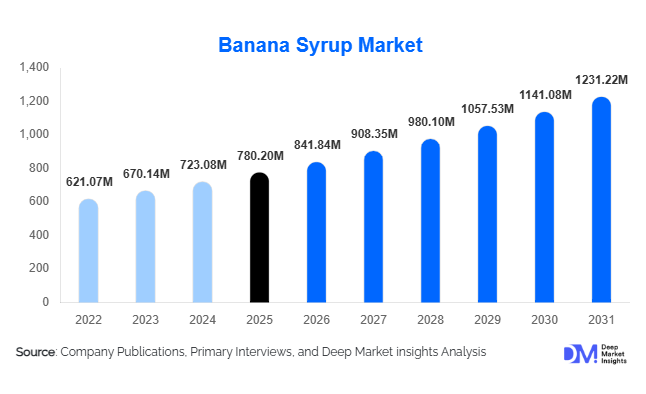
According to Deep Market Insights, the global banana syrup market size was valued at USD 780.2 million in 2025 and is projected to grow from USD 841.84 million in 2026 to reach USD 1,231.22 million by 2031, expanding at a CAGR of 7.9% during the forecast period (2026–2031). The banana syrup market growth is primarily driven by increasing demand for natural fruit-based flavoring ingredients, the rapid expansion of specialty beverages and café culture, and growing consumer preference for clean-label and exotic fruit formulations. Banana syrup has evolved beyond its traditional use in desserts and confectionery and is increasingly being incorporated into smoothies, flavored milk, bakery products, dairy desserts, and premium beverage applications. The rising popularity of tropical flavors among younger consumers and the expansion of foodservice industries across emerging economies are further accelerating global demand.
Key Market Insights
- Beverage manufacturing remains the largest application segment, accounting for nearly 34% of global banana syrup consumption due to increasing demand for smoothies, milkshakes, and specialty coffee beverages.
- Conventional banana syrup dominates the market, representing approximately 56% of global demand owing to its affordability and extensive use across industrial food applications.
- North America leads the global market, accounting for nearly 33% of global revenue due to the strong presence of premium cafés and specialty beverage chains.
- Asia-Pacific is the fastest-growing region, supported by rising disposable incomes, expanding foodservice infrastructure, and increasing adoption of Western-style beverages.
- Organic and reduced-sugar banana syrups are gaining significant traction, driven by consumer demand for healthier and clean-label ingredients.
- Technological advancements in fruit extraction and aseptic processing are improving flavor retention, shelf life, and product consistency, creating new opportunities for manufacturers.
Banana Syrup Market Latest Trends
Clean-Label and Organic Formulations Witnessing Strong Demand
Consumers are increasingly prioritizing natural ingredients and transparent labeling in food products, creating significant opportunities for organic and clean-label banana syrup manufacturers. Products formulated with organic bananas, non-GMO ingredients, and natural sweeteners are gaining popularity, particularly in North America and Europe. Foodservice operators and beverage manufacturers are increasingly incorporating clean-label fruit syrups to meet evolving consumer expectations. Organic banana syrup products are also commanding premium pricing, enabling manufacturers to improve profit margins while strengthening brand differentiation.
Premium Beverage Innovation Driving New Applications
Banana syrup is increasingly being utilized in premium beverage applications including smoothies, frappes, bubble tea, protein drinks, and specialty coffees. The global expansion of café chains and premium beverage concepts has substantially increased demand for exotic fruit flavors. Manufacturers are launching customized formulations with reduced sugar content, improved flavor profiles, and functional ingredients to cater to younger consumers seeking differentiated beverage experiences. The integration of banana syrup into plant-based beverages and nutritional drinks is further broadening its application scope.
Banana Syrup Market Drivers
Growing Consumer Preference for Natural Fruit Ingredients
Consumers are increasingly replacing artificial flavorings with fruit-derived ingredients due to growing health awareness and concerns regarding synthetic additives. Banana syrup offers authentic flavor profiles and natural positioning, making it attractive across multiple food and beverage categories. The growing clean-label movement and demand for minimally processed ingredients continue to support long-term market growth.
Rapid Expansion of Global Foodservice and Café Industries
The expansion of coffee chains, dessert cafés, and quick-service restaurants has significantly increased demand for fruit-based syrups globally. Banana syrup is extensively used in smoothies, flavored milk beverages, desserts, and specialty drinks, making foodservice one of the most important growth drivers. The increasing penetration of international café brands across Asia-Pacific and the Middle East is creating substantial incremental demand.
Innovation in Sugar-Free and Functional Products
Growing concerns regarding sugar consumption and obesity have accelerated innovation in low-sugar and sugar-free banana syrup formulations. Manufacturers are increasingly introducing products sweetened with stevia, monk fruit, and other natural alternatives. Functional formulations enriched with vitamins and dietary fiber are also emerging as a promising segment, particularly in nutraceutical beverages and wellness-oriented food products.
Banana Syrup Market Restraints
Volatility in Banana Supply and Raw Material Prices
The banana industry is vulnerable to climate-related disruptions, crop diseases, and supply chain challenges that can significantly impact raw material prices. Fluctuations in banana production and international trade volumes often create cost pressures for syrup manufacturers, affecting profitability and pricing stability.
Intense Competition from Alternative Fruit Syrups
Banana syrup faces strong competition from established fruit syrup categories such as strawberry, mango, vanilla, and caramel syrups. These products enjoy broader consumer awareness and greater application diversity, creating challenges for banana syrup manufacturers seeking wider market penetration.
Banana Syrup Industry Key Opportunities
Expansion of Organic and Premium Product Portfolios
The premium food ingredients industry is increasingly shifting toward organic and natural products. Manufacturers introducing organic-certified, low-sugar, and functional banana syrup formulations are likely to capture premium market segments and benefit from higher margins. Consumer willingness to pay for healthier and sustainably sourced ingredients is creating long-term opportunities across developed economies.
Growth in Emerging Foodservice Markets
Rapid urbanization and increasing disposable incomes in countries such as India, China, Indonesia, Brazil, and Saudi Arabia are driving demand for specialty beverages and premium desserts. The expansion of modern retail and international foodservice brands in these markets presents substantial opportunities for banana syrup suppliers to establish local manufacturing and distribution networks.
Report Scope
| Report Metric | Details |
|---|---|
| Market Size in 2025 | USD 780.20 Million |
| Market Size in 2026 | USD 841.84 Million |
| Market Size in 2031 | USD 1231.22 Million |
| CAGR | 7.9% (2026-2031) |
| Base Year for Estimation | 2025 |
| Historical Data | 2022-2024 |
| Forecast Period | 2026-2031 |
| Report Coverage | Revenue Forecast, Competitive Landscape, Supply Chain Disruption, Growth Factors, Environment & Regulatory Landscape and Trends |
| Geographies Covered | North America, Europe, APAC, Middle East and Africa, LATAM |
| Countries Covered | U.S., Canada, U.K., Germany, France, Spain, Italy, Russia, Nordic, Benelux, Rest of Europe, China, Korea, Japan, India, Australia, Singapore, Taiwan, South East Asia, Rest of Asia-Pacific, UAE, Turky, Saudi Arabia, South Africa, Egypt, Nigeria, Rest of MEA, Brazil, Mexico, Argentina, Chile, Colombia, Rest of LATAM |
Explore more data points, trends and opportunities Download Free Sample Report
Product Type Insights
The global banana syrup market is segmented into conventional, organic, sugar-free and reduced-sugar, and fortified banana syrup products. Conventional banana syrup continues to dominate the market and is estimated to account for approximately 56% of global revenue in 2025. The segment's leadership is primarily attributed to its cost competitiveness, extensive availability of raw materials, and widespread adoption across large-scale food and beverage manufacturing applications. Conventional formulations are extensively utilized by beverage producers, bakery manufacturers, dairy processors, and foodservice operators due to their stable supply chain, favorable pricing structure, and ease of incorporation into industrial formulations. The continued expansion of processed food and beverage industries in both developed and emerging economies is further supporting demand for conventional banana syrup products.Sugar-free and reduced-sugar banana syrup formulations are also experiencing substantial growth, supported by increasing health consciousness, rising incidences of obesity and diabetes, and growing consumer preference for low-calorie and functional beverages. Food and beverage companies are investing in innovative sweetening technologies and alternative formulations to cater to consumers seeking healthier indulgence options without compromising flavor profiles. Furthermore, regulatory initiatives aimed at reducing sugar consumption across several countries are encouraging manufacturers to expand their portfolios of reduced-sugar products.Fortified banana syrups enriched with vitamins, minerals, dietary fiber, and functional ingredients are emerging as a niche yet rapidly expanding segment within the global market. Demand for these products is being fueled by the growing popularity of functional foods, wellness beverages, and nutritional supplementation products. Fortified formulations are increasingly being incorporated into protein drinks, meal replacement beverages, and health-focused food applications, creating significant opportunities within premium and value-added product categories.
Application Insights
The banana syrup market serves a wide range of applications, including beverages, bakery and confectionery products, dairy products, nutraceuticals, and functional food formulations. Beverage manufacturing remains the leading application segment, accounting for approximately 34% of global demand in 2025. The dominance of this segment is primarily driven by the rapid expansion of specialty beverages and the growing consumer preference for fruit-based flavor ingredients in smoothies, milkshakes, flavored coffees, bubble tea, cocktails, and ready-to-drink beverages. Increasing innovation within premium beverage categories and the rising popularity of customized café-style drinks continue to strengthen the position of beverage applications within the global market.Bakery and confectionery applications represent another significant segment, with banana syrup increasingly utilized in cakes, pastries, dessert fillings, toppings, chocolates, and frozen desserts. Consumer demand for indulgent flavors, premium bakery products, and innovative dessert formulations is creating favorable growth opportunities for manufacturers. The growing popularity of artisanal bakery products and premium confectionery offerings is further driving demand for fruit-based syrups as natural flavoring and sweetening ingredients.Dairy applications, including flavored milk, yogurt, ice cream, and frozen desserts, continue to witness steady growth as consumers increasingly seek unique flavor combinations and value-added dairy products. Banana syrup provides manufacturers with opportunities to develop differentiated products with enhanced sensory appeal and natural ingredient positioning.Nutraceutical and functional food applications are emerging as an important growth avenue for the market. The increasing incorporation of banana syrup into protein beverages, meal replacement products, energy drinks, and wellness-focused formulations reflects the broader industry shift toward functional nutrition and health-oriented food products. The growing popularity of sports nutrition and fortified beverages is expected to further support demand from this application segment over the forecast period.
Distribution Channel Insights
The global banana syrup market is distributed through supermarkets and hypermarkets, foodservice distributors, online retail platforms, and direct business-to-business sales channels. Supermarkets and hypermarkets account for the largest share of retail sales, representing nearly 36% of global revenue in 2025. The leadership of this segment is attributed to extensive product visibility, broad consumer reach, the expansion of premium and private-label offerings, and consumers' preference for one-stop shopping destinations that provide access to diverse product varieties.Foodservice distributors remain a critical channel for market growth due to increasing demand from cafés, restaurants, hotels, quick-service restaurants, and beverage chains. The continued expansion of the global foodservice industry and rising consumption of specialty beverages and desserts are driving procurement of banana syrup through organized distribution networks.Online retail is emerging as one of the fastest-growing distribution channels, particularly among premium, organic, and specialty product manufacturers. E-commerce platforms enable direct consumer engagement, facilitate broader geographic reach, and provide consumers with convenient access to niche and imported products that may not be readily available through traditional retail channels. The growing penetration of digital commerce and changing consumer purchasing behavior are expected to further strengthen online sales during the forecast period.Direct B2B sales channels continue to play a dominant role in industrial procurement, particularly among food and beverage manufacturers seeking customized formulations, bulk purchasing arrangements, and long-term supply agreements. Increasing strategic collaborations between syrup manufacturers and food processors are contributing to the sustained importance of this distribution channel.
End-Use Insights
The banana syrup market caters to food and beverage manufacturers, cafés and quick-service restaurants, households, and industrial ingredient processors. Food and beverage manufacturers constitute the largest end-user segment, accounting for approximately 39% of global demand in 2025. The segment's dominance is primarily driven by the extensive use of banana syrup as a natural flavoring, sweetening, and texturizing ingredient across beverages, dairy products, confectionery, bakery products, and processed foods. The continuous launch of innovative food products and increasing demand for natural ingredients are further supporting segment expansion.Cafés and quick-service restaurants represent one of the fastest-growing end-user segments due to the global expansion of specialty coffee chains, bubble tea outlets, dessert cafés, and premium beverage concepts. Growing consumer spending on out-of-home consumption and increasing demand for customized beverages are encouraging foodservice operators to incorporate fruit-based syrups into their offerings.Household consumption is also increasing steadily as consumers experiment with premium syrups in homemade beverages, desserts, pancakes, ice creams, and bakery preparations. Rising interest in home cooking, premium ingredients, and café-style beverages prepared at home is creating additional growth opportunities within the retail segment.Industrial ingredient processors continue to generate stable demand through the incorporation of banana syrup into food formulations, ingredient blends, and private-label products. Their growing focus on developing clean-label and fruit-based ingredient solutions is expected to support long-term demand for banana syrup products.
Explore more data points, trends and opportunities Download Free Sample Report
Banana Syrup Market Segmentations
By Product Type
- Conventional Banana Syrup
- Organic Banana Syrup
- Sugar-Free Banana Syrup
- Reduced-Sugar Banana Syrup
- Functional/Fortified Banana Syrup
By Formulation Base
- Pure Banana Concentrate Syrup
- Banana-Flavored Syrup
- Blended Fruit Syrup
By Sweetener Composition
- Cane Sugar-Based
- Corn Syrup-Based
- Honey-Based
- Stevia-Based
- Monk Fruit-Based
- Other Natural Sweetener-Based Formulations
By Nature
- Natural/Clean Label
- Artificial/Flavored
By Packaging Type
- Glass Bottles
- PET Bottles
- Squeeze Bottles
- Pouches/Sachets
- Bulk Containers
Regional Insights
North America
North America remains the largest regional market, accounting for approximately 33% of global revenue in 2025. The United States dominates regional demand owing to its mature specialty beverage industry, well-established café culture, high consumer spending on premium food ingredients, and strong presence of leading beverage and food manufacturers. Canada is witnessing increasing demand for organic and reduced-sugar banana syrup formulations, supported by rising health consciousness and growing preference for clean-label products.Regional market growth is further supported by the rapid expansion of premium coffee chains, increasing demand for natural flavor ingredients in functional beverages, rising adoption of organic food products, and strong consumer willingness to pay for premium and health-oriented ingredients. Additionally, the region's advanced retail infrastructure, continuous product innovation, and increasing popularity of plant-based and wellness beverages continue to create favorable conditions for banana syrup consumption.
Europe
Europe accounts for approximately 26% of the global banana syrup market and is led by Germany, the United Kingdom, France, Italy, and Spain. Demand within the region is primarily driven by the strong presence of premium bakery and confectionery industries, increasing preference for natural and fruit-derived ingredients, and rising consumer interest in clean-label food products. Organic and sustainably sourced banana syrups have gained considerable popularity across Western European countries due to increasing environmental awareness and consumer preference for ethically sourced ingredients.Regional growth is being further supported by stringent regulations encouraging the use of natural ingredients, growing demand for reduced-sugar products, increasing consumption of specialty beverages and artisanal desserts, and rising investments in premium and organic food categories. The expansion of functional food applications and strong consumer inclination toward health and sustainability are expected to continue driving market growth across Europe.
Asia-Pacific
Asia-Pacific represents the fastest-growing regional market and is projected to expand at a CAGR exceeding 9.5% during the forecast period. China and India collectively account for nearly 45% of regional demand due to rapid urbanization, increasing disposable incomes, changing dietary preferences, and the rapid expansion of café chains and modern foodservice establishments. Japan and South Korea represent mature markets characterized by strong demand for premium food products and high adoption of specialty beverages.The region's robust growth is being driven by the increasing penetration of international coffee chains, rapid expansion of modern retail and e-commerce channels, rising consumption of ready-to-drink beverages, growing middle-class populations, and increasing demand for innovative fruit-based flavors in food and beverage applications. In addition, the abundance of banana production in several Asian countries supports regional supply chains and encourages the development of value-added banana-derived ingredients, further accelerating market expansion.
Latin America
Latin America accounts for approximately 7% of global market revenue, with Brazil and Mexico representing the largest markets in the region. Growing food processing industries, expanding modern retail infrastructure, and increasing demand for premium desserts and specialty beverages are supporting regional market growth.The region also benefits from substantial banana production and availability of raw materials, enabling cost-effective manufacturing and supporting the development of value-added banana products. Rising urbanization, increasing consumer spending on convenience foods, growing café culture, and expanding investments in processed food manufacturing are further contributing to the steady growth of the banana syrup market across Latin America.
Middle East & Africa
The Middle East and Africa account for approximately 6% of global demand. The United Arab Emirates and Saudi Arabia are emerging as high-growth markets due to expanding hospitality industries, increasing consumption of premium beverages and desserts, and rising investments in foodservice infrastructure. South Africa remains an important market supported by its relatively developed foodservice sector and growing demand for innovative food ingredients.Regional growth is being driven by rapid urbanization, increasing tourism activities, expanding café and restaurant chains, rising disposable incomes, and growing consumer exposure to international food and beverage trends. The increasing popularity of premium desserts, specialty beverages, and imported food products, coupled with the gradual development of organized retail channels, is expected to create significant opportunities for banana syrup manufacturers across the Middle East and Africa during the forecast period.
Key Players in the Banana Syrup Market
- Monin
- Torani
- DaVinci Gourmet
- 1883 Maison Routin
- Fabbri 1905
- Giffard
- Toschi Vignola
- Sonoma Syrup Co.
- Amoretti
- Sweetbird
- Jordan's Skinny Mixes
- The Simple Syrup Co.
- Bacanha
- R. Torre & Company
- Senzani Brevetti