Aloe Vera Market Size
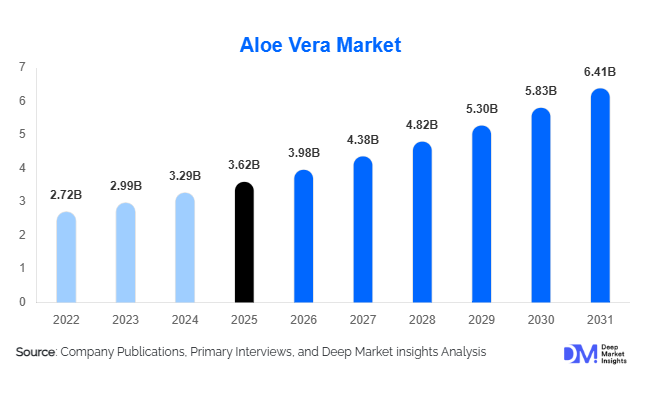
According to Deep Market Insights, the global aloe vera market size was valued at USD 3.62 billion in 2025 and is projected to grow from USD 3.98 billion in 2026 to reach USD 6.41 billion by 2031, expanding at a CAGR of 10.0% during the forecast period (2026–2031). The aloe vera market growth is primarily driven by increasing consumer preference for natural and plant-based ingredients across cosmetics, food & beverages, nutraceuticals, and pharmaceutical applications. Rising awareness regarding digestive wellness, skin health, immunity support, and clean-label personal care products continues to accelerate aloe vera consumption globally.Aloe vera has transformed from a traditional herbal ingredient into a mainstream industrial raw material used extensively in functional beverages, dietary supplements, skincare formulations, herbal medicines, and wellness products. Demand is particularly strong for aloe vera gel and juice products owing to their multifunctional health benefits and broad commercial applications. Cosmetic manufacturers are increasingly integrating aloe vera into moisturizers, anti-aging products, shampoos, and dermatological formulations due to its hydrating and anti-inflammatory properties.Asia-Pacific dominates the global aloe vera market due to large-scale cultivation and processing activities in India, China, and Thailand, while North America and Europe remain high-value consumption hubs driven by premium organic and botanical product demand. Technological advancements in stabilization, freeze-drying, and cold-processing technologies are improving product quality and shelf stability, enabling wider adoption across industries. Additionally, increasing e-commerce penetration, rising demand for vegan products, and expanding investments in herbal healthcare are expected to support long-term market expansion.
Key Market Insights
- Aloe vera is increasingly being adopted in clean-label cosmetics and functional beverages, driven by rising consumer preference for natural wellness ingredients.
- Cosmetics and personal care remain the largest application segment, accounting for nearly 39% of global aloe vera market demand in 2025.
- Asia-Pacific dominates the global aloe vera market, supported by extensive cultivation capacity, low production costs, and rising domestic consumption.
- North America remains a major premium consumption market, fueled by growing demand for organic skincare products and nutraceutical supplements.
- Organic aloe vera products are witnessing rapid growth, benefiting from premium pricing and strong consumer preference for pesticide-free ingredients.
- Technological innovation in extraction and stabilization processes is enhancing product quality, shelf life, and pharmaceutical-grade applications.
Aloe Vera Market Latest Trends
Growing Demand for Organic and Clean-Label Aloe Products
Consumer demand for organic and clean-label wellness products is significantly reshaping the aloe vera market. Cosmetic and food manufacturers are increasingly sourcing organically cultivated aloe vera to meet rising consumer expectations regarding sustainability, chemical-free formulations, and transparency in ingredient sourcing. Organic-certified aloe vera products command higher profit margins and are witnessing strong demand across North America and Europe. Clean beauty brands are increasingly integrating aloe vera into vegan skincare formulations, herbal shampoos, and natural moisturizers. Simultaneously, beverage manufacturers are launching preservative-free aloe drinks with low sugar content and botanical blends, further accelerating demand for premium aloe ingredients.
Expansion of Functional Beverages and Nutraceutical Applications
The rapid expansion of the global functional beverage industry is creating substantial opportunities for aloe vera manufacturers. Aloe vera juice is increasingly marketed for digestive wellness, detoxification, hydration, and immunity support. Beverage producers are introducing aloe-based probiotic drinks, collagen-infused beverages, and vitamin-enriched wellness formulations targeting health-conscious consumers. Nutraceutical manufacturers are also expanding aloe vera applications in dietary supplements, digestive capsules, and immunity-support products. This trend is especially prominent in the United States, Japan, South Korea, and India, where preventive healthcare spending continues to increase. Improved stabilization technologies are enabling manufacturers to preserve bioactive compounds more effectively, enhancing product efficacy and shelf life.
Aloe Vera Market Drivers
Rising Consumer Preference for Herbal and Natural Products
The global shift toward herbal healthcare and plant-based consumer products is a major driver for the aloe vera market. Consumers increasingly prefer natural alternatives over synthetic chemicals in food, cosmetics, and pharmaceutical products. Aloe vera’s association with skin hydration, digestive support, immunity enhancement, and anti-inflammatory properties has significantly expanded its commercial relevance across multiple industries. Growing awareness regarding wellness-focused lifestyles and preventive healthcare is further accelerating demand for aloe vera-based formulations globally.
Strong Growth in Cosmetics and Personal Care Industry
The rapid expansion of the cosmetics and personal care sector is substantially driving aloe vera demand worldwide. Aloe vera is widely used in moisturizers, anti-aging creams, sunscreens, facial masks, herbal shampoos, and dermatological products due to its soothing and hydrating properties. Global beauty brands are increasingly investing in botanical ingredient formulations to align with clean-label and sustainable beauty trends. Rising disposable incomes, increasing skincare awareness, and growing demand for vegan cosmetics continue to support aloe vera consumption across premium beauty segments.
Aloe Vera Market Restraints
Quality Standardization and Regulatory Challenges
One of the major restraints in the aloe vera market is inconsistency in product quality and standardization. Variations in cultivation methods, harvesting practices, and extraction technologies can significantly affect aloe vera purity, active compound concentration, and shelf stability. Regulatory authorities in North America and Europe have introduced strict standards regarding aloin content, labeling accuracy, and contaminant levels, increasing compliance costs for manufacturers and exporters.
Raw Material Price Volatility and Climatic Dependence
Aloe vera cultivation remains vulnerable to climatic fluctuations, water availability, and agricultural yield instability. Drought conditions, irregular rainfall patterns, and crop diseases can affect raw aloe leaf production and increase supply chain volatility. Since aloe vera leaves are highly perishable, transportation and processing inefficiencies can further impact operational costs. Small-scale cultivators often struggle to maintain consistent quality and export-grade production volumes, limiting supply reliability in international markets.
Aloe Vera Industry Key Opportunities
Expansion of Premium Organic Cosmetics
The growing global organic cosmetics industry presents strong opportunities for aloe vera ingredient manufacturers and skincare brands. Consumers increasingly prefer chemical-free beauty products that align with sustainability and wellness trends. Aloe vera is emerging as a key ingredient in premium moisturizers, anti-aging products, herbal face masks, scalp care formulations, and natural sun-care products. Companies investing in organic cultivation, sustainable sourcing, and cold-processing technologies are expected to gain competitive advantages within premium beauty categories.
Export-Oriented Processing and Functional Beverage Innovation
Export-driven demand for aloe vera ingredients is expanding rapidly, particularly from Europe and North America where manufacturers seek high-quality botanical ingredients for nutraceutical and wellness products. Investments in advanced extraction facilities, freeze-drying infrastructure, and pharmaceutical-grade processing technologies are enabling suppliers to target higher-value export markets. Simultaneously, innovation in aloe vera beverages, including probiotic drinks, collagen-infused wellness beverages, and low-calorie hydration products, is opening new revenue streams for beverage manufacturers and ingredient suppliers globally.
Report Scope
| Report Metric | Details |
|---|---|
| Market Size in 2025 | USD 3.62 Billion |
| Market Size in 2026 | USD 3.98 Billion |
| Market Size in 2031 | USD 6.41 Billion |
| CAGR | 10% (2026-2031) |
| Base Year for Estimation | 2025 |
| Historical Data | 2022-2024 |
| Forecast Period | 2026-2031 |
| Report Coverage | Revenue Forecast, Competitive Landscape, Supply Chain Disruption, Growth Factors, Environment & Regulatory Landscape and Trends |
| Geographies Covered | North America, Europe, APAC, Middle East and Africa, LATAM |
| Countries Covered | U.S., Canada, U.K., Germany, France, Spain, Italy, Russia, Nordic, Benelux, Rest of Europe, China, Korea, Japan, India, Australia, Singapore, Taiwan, South East Asia, Rest of Asia-Pacific, UAE, Turky, Saudi Arabia, South Africa, Egypt, Nigeria, Rest of MEA, Brazil, Mexico, Argentina, Chile, Colombia, Rest of LATAM |
Explore more data points, trends and opportunities Download Free Sample Report
Product Type Insights
Aloe vera gel dominates the global market, accounting for approximately 34% of market share in 2025 due to its extensive application across cosmetics, pharmaceuticals, and personal care products. Stabilized aloe gel products are witnessing particularly strong demand because they provide improved shelf life while preserving bioactive compounds. Aloe vera juice represents another major product category, supported by rapid expansion in functional beverages and digestive wellness applications. Powdered aloe vera products are increasingly utilized in nutraceuticals and dietary supplements owing to their longer shelf stability and ease of transportation. Aloe vera extracts are also gaining traction in pharmaceutical-grade formulations and dermatological products, particularly in premium healthcare applications requiring high-purity botanical ingredients.
Application Insights
Cosmetics and personal care remain the leading application segment, accounting for nearly 39% of global aloe vera demand in 2025. Aloe vera is widely used in skincare, anti-aging products, haircare solutions, and herbal beauty formulations due to its moisturizing and anti-inflammatory properties. Food and beverage applications are rapidly expanding, particularly within functional beverages and nutraceutical foods targeting digestive wellness and hydration benefits. Pharmaceutical applications continue to grow steadily due to increasing use of aloe vera in wound-healing products, dermatological formulations, and immunity-support supplements. Animal wellness, herbal hygiene products, and natural oral care solutions are also emerging as niche application segments contributing to long-term market diversification.
Distribution Channel Insights
Direct B2B sales dominate the aloe vera market, accounting for approximately 41% of total sales in 2025, as large cosmetic, pharmaceutical, and beverage manufacturers prefer sourcing directly from processors to ensure quality consistency and stable supply volumes. Supermarkets and hypermarkets remain significant retail channels for aloe vera beverages, gels, and wellness products. E-commerce platforms are witnessing rapid growth due to increasing consumer preference for online wellness shopping and direct-to-consumer herbal brands. Pharmacies and specialty health stores continue to play an important role in premium nutraceutical and therapeutic aloe vera product distribution. Digital marketing and influencer-driven product promotion are also significantly influencing online aloe vera product sales globally.
End-Use Industry Insights
The beauty and cosmetics industry represents the largest end-use segment for aloe vera products globally, accounting for nearly 36% of market demand in 2025. Rising global spending on herbal skincare, vegan beauty products, and natural cosmetics continues driving strong consumption growth. The healthcare and pharmaceutical sector is another major end-use industry, supported by increasing adoption of botanical supplements and herbal medicinal formulations. Food processing and nutraceutical manufacturing industries are witnessing rapid growth due to increasing consumer demand for digestive wellness products and functional beverages. The hospitality and wellness sector is also emerging as a growing consumer of aloe vera-based spa, wellness, and therapeutic products.
Explore more data points, trends and opportunities Download Free Sample Report
Aloe Vera Market Segmentations
By Product Type
- Aloe Vera Gel
- Aloe Vera Juice
- Aloe Vera Powder
- Aloe Vera Extracts
- Aloe Vera Capsules & Supplements
- Aloe Vera Oils
- Aloe Vera Creams & Ointments
- Aloe Vera Personal Care Ingredients
By Application
- Food & Beverages
- Cosmetics & Personal Care
- Pharmaceuticals
- Nutraceuticals
- Animal Feed & Veterinary Care
- Household & Hygiene Products
By Form
- Liquid
- Semi-Solid
- Powder
- Capsules/Tablets
By Nature
- Organic Aloe Vera Products
- Conventional Aloe Vera Products
By Distribution Channel
- Direct Sales/B2B
- Supermarkets & Hypermarkets
- Pharmacies & Drug Stores
- Specialty Stores
- Online Retail/E-Commerce
- Convenience Stores
Regional Insights
North America
North America accounted for approximately 27% of the global aloe vera market in 2025, led primarily by the United States. Strong consumer demand for organic beverages, botanical skincare products, and nutraceutical supplements continues supporting market growth across the region. The United States remains a key importer of processed aloe vera ingredients for cosmetic and healthcare manufacturing. Mexico also plays an important role as both a cultivation and processing hub supplying North American manufacturers. Rising preference for vegan and clean-label wellness products is expected to further accelerate aloe vera demand across the region.
Europe
Europe represented nearly 22% of the global aloe vera market in 2025, with Germany, France, the United Kingdom, Italy, and Spain emerging as major consumption markets. Germany leads regional demand owing to strong nutraceutical consumption and advanced herbal healthcare industries. France remains a major center for premium cosmetic formulations incorporating aloe vera ingredients. European consumers demonstrate strong preference for organic-certified and sustainably sourced botanical products, encouraging manufacturers to adopt stringent quality and traceability standards. Demand for clean beauty and natural wellness products continues to support steady regional market expansion.
Asia-Pacific
Asia-Pacific dominates the global aloe vera market with approximately 41% market share in 2025. India and China are among the largest aloe vera producers globally due to favorable climatic conditions, expanding cultivation acreage, and low production costs. India is also witnessing rapid growth in Ayurvedic healthcare, nutraceutical manufacturing, and herbal cosmetics, significantly boosting domestic aloe vera demand. China continues to expand functional beverage production and botanical skincare manufacturing. Japan and South Korea remain major consumers of premium cosmetic-grade aloe vera ingredients due to strong demand for advanced skincare products and natural formulations.
Latin America
Latin America is emerging as an important aloe vera cultivation and export region, particularly in Brazil and Mexico. Favorable climatic conditions and increasing investments in medicinal plant farming are supporting regional market expansion. Domestic cosmetic and nutraceutical industries are also contributing to rising aloe vera consumption. Export-oriented processing activities are increasing as Latin American suppliers strengthen trade relationships with North American and European manufacturers.
Middle East & Africa
The Middle East & Africa region is witnessing gradual growth in aloe vera cultivation and consumption, particularly in the UAE, Saudi Arabia, and South Africa. Aloe vera farming is gaining traction in arid agricultural zones because of comparatively lower water requirements than traditional commercial crops. Rising urban demand for herbal wellness products, natural cosmetics, and botanical healthcare solutions is supporting regional market expansion. Increasing investments in medicinal plant cultivation and herbal processing industries are expected to strengthen long-term growth opportunities across the region.
Key Players in the Aloe Vera Market
- Forever Living Products
- Aloecorp Inc.
- Lily of the Desert
- Herbalife International
- Patanjali Ayurved
- Aloe Farms Inc.
- Terry Laboratories Inc.
- Aloe Laboratories Inc.
- Fruit of the Earth
- Natural Aloe Costa Rica
- Foodchem International Corporation
- LR Health & Beauty Systems
- Real Aloe Inc.
- Pharmachem Laboratories
- Aloe Vera Australia