Asia Pacific Functional Foods Market Size & Outlook, 2026-2034
Last Updated : 30 July, 2026 |
Study Period : 2022-2034 |
Format : PDF, Excel |
Author : Hannah Blake
Asia Pacific Functional Foods Market Insights
- Deep Market Insights analysis indicates that the Asia Pacific Functional Foods Market size, which was USD 98.96 Billion in 2025, is projected to attain USD 203.72 Billion by 2034.
- The market is expected to register a CAGR of 8.24% over the period 2026–2034.
- In 2025, Probiotics emerged as the dominant Ingredient or benefit based on market size.
- Prebiotics is projected to register the fastest growth, positioning it as the most attractive Ingredient or benefit segment over the forecast horizon.
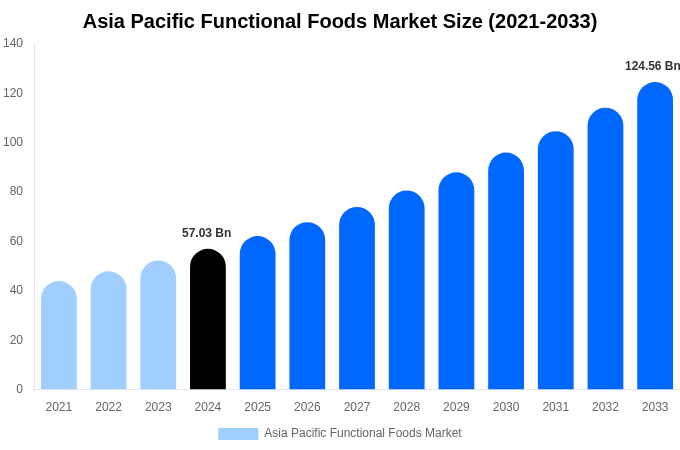
Source: DMI Analysis Company Publications, Primary Interviews.

Other Key Findings
- Asia Pacific represented 26.19% of the global Functional Foods Market size in 2025.
- By 2034, United States is estimated to hold the largest position in the global market in terms of size.
- Japan is estimated to remain the fastest-growing market in Asia Pacific, advancing to USD 34.65 Billion by 2034.
Asia Pacific Functional Foods Market Dynamics
- Asia Pacific's functional foods market is driven by increasing health consciousness, rising disposable incomes, expanding middle-class populations, growing demand for preventive healthcare products, and increasing adoption of nutrition-enhanced foods. Consumers increasingly adopt functional foods such as probiotics, fortified beverages, herbal nutrition products, protein foods, supplements, and immunity-supporting products due to rising awareness of health benefits.
- Food manufacturers, beverage companies, pharmaceutical nutrition brands, supermarkets, e-commerce platforms, pharmacies, health food retailers, and wellness companies strengthen market accessibility through extensive distribution networks. Companies increasingly improve functional ingredient sourcing, product innovation, digital commerce strategies, and personalized nutrition solutions.
- Functional food producers invest in biotechnology, fermentation technologies, traditional ingredient research, nutraceutical development, and advanced food processing systems to strengthen competitive differentiation. Innovation also emphasizes probiotics, herbal functional foods, plant-based nutrition, immune health products, and beauty nutrition solutions.
- Market participants collaborate with agricultural organizations, universities, healthcare institutions, retailers, and food technology companies to strengthen product development and market expansion. Continued investment in wellness consumption, functional ingredients, digital retail, and preventive healthcare reinforces competitiveness across Asia Pacific's functional foods industry.
Key Market Insights
- Wellness awareness strengthens demand.
- Traditional ingredients support innovation.
- E-commerce expands reach.
- Preventive nutrition drives growth.
Asia Pacific Functional Foods Market Country 2026-2034 (USD Billion)
| Asia Pacific | 2022 | 2023 | 2024 | 2025 | 2026 | 2027 | 2028 | 2029 | 2030 | 2031 | 2032 | 2033 | 2034 |
|---|---|---|---|---|---|---|---|---|---|---|---|---|---|
| China | XX.x | XX.x | XX.x | 37.87 | XX.x | XX.x | XX.x | XX.x | XX.x | XX.x | XX.x | XX.x | XX.x |
| India | XX.x | XX.x | XX.x | XX.x | XX.x | XX.x | XX.x | XX.x | XX.x | XX.x | XX.x | XX.x | XX.x |
| Japan | XX.x | XX.x | XX.x | XX.x | XX.x | XX.x | XX.x | XX.x | XX.x | XX.x | XX.x | XX.x | XX.x |
| Korea | XX.x | XX.x | XX.x | XX.x | XX.x | XX.x | XX.x | XX.x | XX.x | XX.x | XX.x | XX.x | XX.x |
| Taiwan | XX.x | XX.x | XX.x | XX.x | XX.x | XX.x | XX.x | XX.x | XX.x | XX.x | XX.x | XX.x | XX.x |
| Australia | XX.x | XX.x | XX.x | XX.x | XX.x | XX.x | XX.x | XX.x | XX.x | XX.x | XX.x | XX.x | XX.x |
| Singapore | XX.x | XX.x | XX.x | XX.x | XX.x | XX.x | XX.x | XX.x | XX.x | XX.x | XX.x | XX.x | XX.x |
| South East Asia | XX.x | XX.x | XX.x | XX.x | XX.x | XX.x | XX.x | XX.x | XX.x | XX.x | XX.x | XX.x | XX.x |
| Total | XX.x | XX.x | XX.x | 98.97 | XX.x | XX.x | XX.x | XX.x | XX.x | XX.x | XX.x | XX.x | XX.x |
Source: DMI Analysis Company Publications, Primary Interviews.
Asia Pacific Functional Foods Market Ingredient or benefit 2026-2034 (USD Billion)
| Ingredient or benefit | 2022 | 2023 | 2024 | 2025 | 2026 | 2027 | 2028 | 2029 | 2030 | 2031 | 2032 | 2033 | 2034 |
|---|---|---|---|---|---|---|---|---|---|---|---|---|---|
| Probiotics | XX.x | XX.x | XX.x | 31.31 | XX.x | XX.x | XX.x | XX.x | XX.x | XX.x | XX.x | XX.x | XX.x |
| Prebiotics | XX.x | XX.x | XX.x | XX.x | XX.x | XX.x | XX.x | XX.x | XX.x | XX.x | XX.x | XX.x | XX.x |
| Omega-3 | XX.x | XX.x | XX.x | XX.x | XX.x | XX.x | XX.x | XX.x | XX.x | XX.x | XX.x | XX.x | XX.x |
| Vitamins and minerals | XX.x | XX.x | XX.x | XX.x | XX.x | XX.x | XX.x | XX.x | XX.x | XX.x | XX.x | XX.x | XX.x |
| Botanicals | XX.x | XX.x | XX.x | XX.x | XX.x | XX.x | XX.x | XX.x | XX.x | XX.x | XX.x | XX.x | XX.x |
| Others | XX.x | XX.x | XX.x | XX.x | XX.x | XX.x | XX.x | XX.x | XX.x | XX.x | XX.x | XX.x | XX.x |
| Total | XX.x | XX.x | XX.x | 98.96 | XX.x | XX.x | XX.x | XX.x | XX.x | XX.x | XX.x | XX.x | XX.x |
Source: DMI Analysis Company Publications, Primary Interviews.
Asia Pacific Functional Foods Market Product 2026-2034 (USD Billion)
| Product | 2022 | 2023 | 2024 | 2025 | 2026 | 2027 | 2028 | 2029 | 2030 | 2031 | 2032 | 2033 | 2034 |
|---|---|---|---|---|---|---|---|---|---|---|---|---|---|
| Dairy-based functional foods | XX.x | XX.x | XX.x | 42.08 | XX.x | XX.x | XX.x | XX.x | XX.x | XX.x | XX.x | XX.x | XX.x |
| Bakery and cereals | XX.x | XX.x | XX.x | XX.x | XX.x | XX.x | XX.x | XX.x | XX.x | XX.x | XX.x | XX.x | XX.x |
| Snacks | XX.x | XX.x | XX.x | XX.x | XX.x | XX.x | XX.x | XX.x | XX.x | XX.x | XX.x | XX.x | XX.x |
| Beverages | XX.x | XX.x | XX.x | XX.x | XX.x | XX.x | XX.x | XX.x | XX.x | XX.x | XX.x | XX.x | XX.x |
| Others | XX.x | XX.x | XX.x | XX.x | XX.x | XX.x | XX.x | XX.x | XX.x | XX.x | XX.x | XX.x | XX.x |
| Total | XX.x | XX.x | XX.x | 98.95 | XX.x | XX.x | XX.x | XX.x | XX.x | XX.x | XX.x | XX.x | XX.x |
Source: DMI Analysis Company Publications, Primary Interviews.
Asia Pacific Functional Foods Market Distribution channel 2026-2034 (USD Billion)
| Distribution channel | 2022 | 2023 | 2024 | 2025 | 2026 | 2027 | 2028 | 2029 | 2030 | 2031 | 2032 | 2033 | 2034 |
|---|---|---|---|---|---|---|---|---|---|---|---|---|---|
| Supermarkets and hypermarkets | XX.x | XX.x | XX.x | 44.65 | XX.x | XX.x | XX.x | XX.x | XX.x | XX.x | XX.x | XX.x | XX.x |
| Convenience stores | XX.x | XX.x | XX.x | XX.x | XX.x | XX.x | XX.x | XX.x | XX.x | XX.x | XX.x | XX.x | XX.x |
| Pharmacies | XX.x | XX.x | XX.x | XX.x | XX.x | XX.x | XX.x | XX.x | XX.x | XX.x | XX.x | XX.x | XX.x |
| Online | XX.x | XX.x | XX.x | XX.x | XX.x | XX.x | XX.x | XX.x | XX.x | XX.x | XX.x | XX.x | XX.x |
| Total | XX.x | XX.x | XX.x | 98.97 | XX.x | XX.x | XX.x | XX.x | XX.x | XX.x | XX.x | XX.x | XX.x |
Source: DMI Analysis Company Publications, Primary Interviews.
Report Summary
| Report Scope | Details |
|---|---|
| Base Year for Study | 2025 |
| Study Period | 2022-2034 |
| Historical Period | 2022-2024 |
| Forecast Period | 2026-2034 |
| Market Size In 2025 | USD 98.96 Billion |
| Market Size In 2034 | USD 203.72 Billion |
| Largest segment | Probiotics |
| Units | Revenue in USD Billion |
| CAGR | 8.24% (2026-2034) |
| Report Coverage | Revenue Forecast, Competitive Landscape, Growth Factors, Environment & Regulatory Landscape and Trends |