Women Personal Massager Market Size
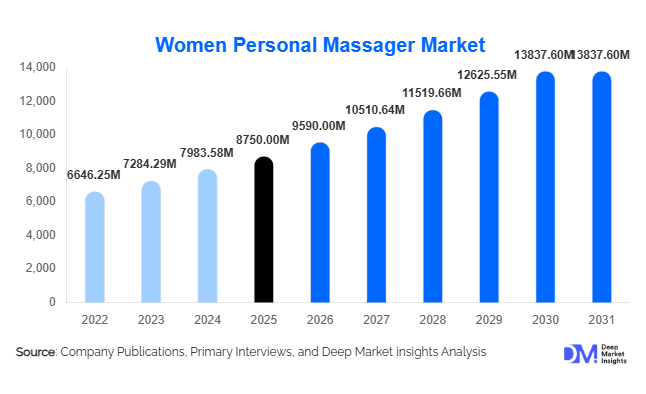
According to Deep Market Insights, the global women personal massager market size was valued at USD 8,750 million in 2025 and is projected to grow from USD 9,590.00 million in 2026 to reach USD 13,837.60 million by 2031, expanding at a CAGR of 9.6% during the forecast period (2026–2031). The market growth is primarily driven by increasing acceptance of sexual wellness as a key component of overall health, rapid technological advancements in product design, and the expansion of discreet e-commerce distribution channels. Rising consumer awareness, particularly among millennials and Gen Z, along with premiumization trends and smart device integration, are further accelerating global demand.
Key Market Insights
- Sexual wellness is increasingly recognised as part of holistic health, driving mainstream adoption of women personal massagers globally.
- E-commerce dominates distribution, accounting for over 55% of total sales, supported by discreet purchasing and wider product accessibility.
- North America leads the global market, driven by high consumer awareness, disposable income, and strong brand presence.
- Asia-Pacific is the fastest-growing region, fueled by urbanisation, digital penetration, and evolving cultural attitudes.
- Technological innovation, including app-controlled and AI-enabled devices, is reshaping product differentiation and user experience.
- Medical-grade silicone products dominate material demand, reflecting increasing consumer preference for safety and body-friendly materials.
What are the latest trends in the women personal massager market?
Smart and App-Connected Devices Transforming User Experience
The integration of smart technologies is redefining product innovation in the women personal massager market. App-controlled devices with Bluetooth and Wi-Fi connectivity allow users to customise vibration patterns, intensity levels, and usage modes remotely. These features are particularly appealing to younger, tech-savvy consumers who value personalisation and digital integration. AI-enabled devices are also emerging, offering adaptive responses based on user preferences. Additionally, brands are incorporating data-driven insights and compatibility with broader wellness ecosystems, positioning these products within the digital health landscape.
Premiumization and Body-Safe Materials Gaining Importance
Consumers are increasingly prioritising product quality, safety, and aesthetics, leading to a shift toward premium offerings. Medical-grade silicone has become the material of choice due to its hypoallergenic and durable properties, accounting for nearly 65% of the market. High-end products emphasise ergonomic design, quiet motors, waterproof features, and sleek finishes. Sustainability is also influencing purchasing decisions, with brands adopting recyclable packaging and environmentally conscious production methods. This trend toward premiumization is enabling companies to command higher price points while enhancing brand loyalty.
What are the key drivers in the women personal massager market?
Rising Acceptance of Sexual Wellness
Growing awareness around sexual wellness as a component of mental and physical health is a major driver of market growth. Educational campaigns, influencer advocacy, and media discussions have significantly reduced stigma associated with these products. This cultural shift is expanding the consumer base across diverse demographics and geographies, enabling broader market penetration.
Expansion of E-commerce and Direct-to-Consumer Channels
The rapid growth of online retail platforms has revolutionised product accessibility and consumer engagement. E-commerce enables discreet purchasing, detailed product comparisons, and access to global brands. Direct-to-consumer strategies allow companies to build strong relationships with customers, leverage personalised marketing, and improve margins. Subscription models and digital communities are further enhancing customer retention.
Continuous Product Innovation
Technological advancements in motor efficiency, noise reduction, and ergonomic design are enhancing product performance and user satisfaction. The introduction of multifunctional devices, waterproof designs, and customizable features has significantly improved user experience. These innovations are driving repeat purchases and encouraging consumers to upgrade to premium products.
What are the restraints for the global market?
Cultural and Regulatory Barriers
Despite increasing acceptance, certain regions still face cultural stigmas and strict regulations that limit product availability and marketing. Import restrictions and legal constraints in parts of the Middle East and Asia can hinder market expansion and restrict brand penetration.
Price Sensitivity in Emerging Markets
High costs associated with premium products can limit adoption in price-sensitive markets. While demand exists, affordability remains a barrier, particularly in developing economies where disposable incomes are lower. This creates a gap between product availability and consumer purchasing power.
What are the key opportunities in the women personal massager industry?
Expansion into Emerging Markets
Rapid urbanisation and increasing digital penetration in regions such as the Asia-Pacific and Latin America present significant growth opportunities. Countries like India and Brazil are witnessing rising consumer awareness and acceptance, supported by e-commerce platforms that enable discreet purchasing. Localised marketing and culturally sensitive branding can unlock untapped demand in these regions.
Integration with Healthcare and Therapeutic Applications
The growing use of personal massagers for pelvic health, menopause symptom relief, and post-partum recovery is opening new avenues in the healthcare sector. Collaborations with medical professionals and physiotherapists can enhance product credibility and expand into institutional sales channels. Regulatory approvals for therapeutic applications can further strengthen market positioning.
Smart Technology and AI-Driven Personalisation
The integration of AI and smart technologies offers opportunities for product differentiation and premiumization. Devices that adapt to user preferences and integrate with digital wellness platforms can attract high-value consumers. This trend also supports the development of subscription-based services and data-driven user engagement models.
Report Scope
| Report Metric | Details |
|---|---|
| Market Size in 2025 | USD 8750 Million |
| Market Size in 2026 | USD 9590 Million |
| Market Size in 2031 | USD 13837.60 Million |
| CAGR | 9.6% (2026-2031) |
| Base Year for Estimation | 2025 |
| Historical Data | 2022-2024 |
| Forecast Period | 2026-2031 |
| Report Coverage | Revenue Forecast, Competitive Landscape, Supply Chain Disruption, Growth Factors, Environment & Regulatory Landscape and Trends |
| Geographies Covered | North America, Europe, APAC, Middle East and Africa, LATAM |
| Countries Covered | U.S., Canada, U.K., Germany, France, Spain, Italy, Russia, Nordic, Benelux, Rest of Europe, China, Korea, Japan, India, Australia, Singapore, Taiwan, South East Asia, Rest of Asia-Pacific, UAE, Turky, Saudi Arabia, South Africa, Egypt, Nigeria, Rest of MEA, Brazil, Mexico, Argentina, Chile, Colombia, Rest of LATAM |
Explore more data points, trends and opportunities Download Free Sample Report
Product Type Insights
Clitoral suction devices lead the women personal massager market with approximately 28% share in 2025, primarily driven by their advanced air-pulse technology that offers non-invasive stimulation and a differentiated user experience. The leading driver for this segment is the growing consumer shift toward targeted and customizable pleasure solutions, particularly among first-time users seeking intuitive and less intimidating products. Their strong adoption is also supported by aggressive product innovation, premium branding, and positive word-of-mouth through digital platforms.
Wand massagers and rabbit-style dual-stimulation devices continue to hold a substantial share due to their versatility, strong legacy presence, and ability to cater to a wide range of user preferences. Meanwhile, wearable and hands-free devices are emerging as a high-growth niche, driven by increasing demand for convenience, discreet usage, and multi-tasking lifestyles. App-controlled smart devices are further strengthening the premium segment, as consumers increasingly prefer connected, tech-enabled products that enhance personalisation and user engagement.
Technology Insights
App-connected devices dominate the technology segment, accounting for nearly 32% of the market, with the primary growth driver being the rapid proliferation of smartphones and increasing demand for digitally integrated experiences. Consumers are increasingly valuing remote control functionality, personalised settings, and compatibility with mobile ecosystems, particularly in urban markets.
Multi-mode programmable devices continue to lead the mid-range category due to their affordability and flexibility, offering multiple vibration patterns at accessible price points. AI-enabled devices are gaining traction as a next-generation innovation, with their growth driven by the rising importance of hyper-personalisation and data-driven user experiences. Basic vibration devices remain relevant in entry-level segments, particularly in emerging markets, where affordability and simplicity are key purchasing factors.
Material Insights
Medical-grade silicone dominates the material segment with around 65% market share, driven by increasing consumer awareness of product safety, hygiene, and long-term durability. The leading driver for this segment is the rising preference for body-safe, hypoallergenic materials, particularly in developed markets where regulatory standards are stringent and consumers are highly informed.
ABS plastic continues to be widely used in budget and mid-range products due to its cost efficiency and ease of manufacturing, making it suitable for price-sensitive markets. Hybrid materials, combining silicone with metal or glass components, are gaining popularity in premium segments, driven by demand for enhanced aesthetics, luxury appeal, and differentiated tactile experiences.
Distribution Channel Insights
E-commerce platforms lead the market, accounting for approximately 55% of total sales, with the primary driver being the need for privacy, discreet purchasing, and convenience. The rise of direct-to-consumer (D2C) brands and digital marketing strategies has further accelerated online sales, allowing companies to reach global audiences while maintaining higher margins.
Speciality retail stores remain important for premium products, offering personalised consultations and curated brand experiences that enhance consumer trust and engagement. Pharmacy and wellness chains are gradually expanding their offerings, particularly for therapeutic applications, driven by increasing recognition of sexual wellness within healthcare. Subscription-based platforms are emerging as innovative channels, enabling recurring revenue models and stronger customer retention through personalised product offerings.
End-Use Insights
Individual consumers dominate the market, contributing nearly 70% of total demand, with the key driver being the growing emphasis on self-care, mental well-being, and personal wellness. This segment has expanded significantly due to increasing acceptance of sexual health as a core component of overall health. The couples segment is experiencing strong growth, driven by changing relationship dynamics, increasing openness toward shared experiences, and the rise of long-distance relationships that benefit from app-controlled devices. Therapeutic applications, including pelvic health and physiotherapy, represent a smaller but rapidly growing segment, supported by increasing medical endorsement and integration into wellness and rehabilitation programs. This segment is expected to witness accelerated growth as healthcare professionals increasingly recommend such devices for clinical use.
Explore more data points, trends and opportunities Download Free Sample Report
Women Personal Massager Market Segmentations
By Product Type
- Wand Massagers
- Bullet Massagers
- Rabbit/Vibrating Dual-Stimulation Devices
- Clitoral Suction/Air Pulse Devices
- G-Spot Massagers
- Wearable/Hands-Free Devices
- App-Controlled Smart Devices
By Technology
- Basic Vibration Devices
- Multi-Mode Programmable Devices
- App-Connected Devices
- AI-Enabled Adaptive Devices
By Material
- Medical-Grade Silicone
- ABS Plastic
- Hybrid Materials
By Distribution Channel
- E-commerce Platforms
- Specialty Retail Stores
- Pharmacy & Wellness Chains
- Subscription/Direct-to-Consumer Platforms
By End-Use
- Individual Consumers
- Couples
- Therapeutic/Medical Applications
Regional Insights
North America
North America dominates the market with approximately 38% share in 2025, led by the United States, with market demand exceeding USD 3,200 million. The primary growth drivers in this region include high consumer awareness, strong purchasing power, and widespread cultural acceptance of sexual wellness products. Additionally, the presence of leading global brands, advanced e-commerce infrastructure, and strong digital marketing penetration contribute significantly to market expansion. The region also benefits from increasing demand for premium and technologically advanced products, supported by early adoption of smart devices and wellness-focused lifestyles.
Europe
Europe holds around 28% market share, with major markets including Germany, the United Kingdom, and France. Growth in this region is primarily driven by progressive regulatory frameworks, high awareness of sexual health, and strong consumer preference for sustainable and body-safe products. European consumers are particularly inclined toward eco-friendly materials and ethically produced products, which has encouraged manufacturers to focus on sustainability. Additionally, well-established retail networks and increasing acceptance of wellness-oriented products continue to support steady demand growth across the region.
Asia-Pacific
Asia-Pacific accounts for approximately 22% of the market and is the fastest-growing region, with a CAGR exceeding 12%. Key markets include China, Japan, and India, with India emerging as the fastest-growing country. The primary drivers for regional growth include rapid urbanization, increasing internet penetration, and rising middle-class income levels. Changing cultural norms, particularly among younger populations, are also reducing stigma associated with these products. The expansion of e-commerce platforms and discreet delivery services has further enabled market penetration, making products more accessible across diverse consumer segments.
Latin America
Latin America contributes about 7% of global demand, with Brazil and Mexico leading regional growth. The key drivers in this region include increasing urbanization, improving digital infrastructure, and rising exposure to global consumer trends through social media. Growing acceptance of personal wellness products and the expansion of online retail channels are also supporting market growth. However, cultural sensitivities and economic constraints continue to limit the pace of adoption in certain areas, making affordability a critical factor for market expansion.
Middle East & Africa
The Middle East & Africa region holds approximately 5% market share, with growth concentrated in urban centers such as the UAE and South Africa. The primary drivers include increasing digital adoption, rising disposable incomes in select markets, and gradual shifts in consumer attitudes toward personal wellness. The expansion of cross-border e-commerce platforms is enabling access to international brands, overcoming traditional retail limitations. Despite ongoing cultural sensitivities, the market is witnessing steady growth due to changing demographics, increased privacy in purchasing channels, and growing awareness of health and wellness benefits.
Key Players in the Women Personal Massager Market
- Lelo
- Womanizer
- We-Vibe
- Lovehoney Group
- Doc Johnson Enterprises
- Fun Factory
- Tenga Co., Ltd.
- Svakom
- Dame Products
- Je Joue
- BMS Factory
- LELOi AB
- MysteryVibe
- Satisfyer
- PicoBong