Vegan Skin Care Market Size
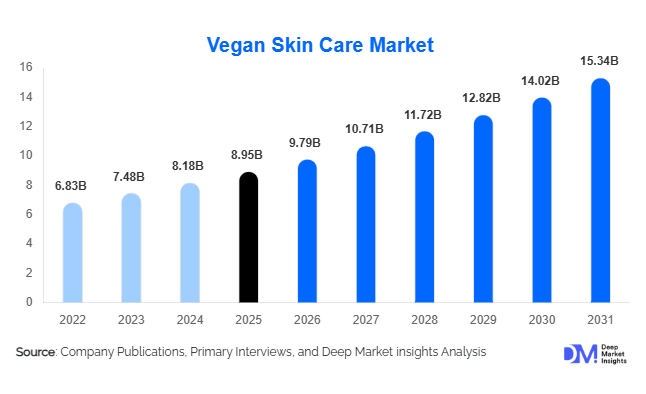
According to Deep Market Insights, the global vegan skin care market size was valued at USD 8.95 billion in 2025 and is projected to grow from USD 9.79 billion in 2026 to reach USD 15.34 billion by 2031, expanding at a CAGR of 9.4% during the forecast period (2026–2031). The vegan skin care market growth is primarily driven by increasing consumer awareness regarding cruelty-free cosmetics, rising demand for clean-label beauty products, and the growing preference for plant-based formulations across premium and mass-market skin care categories.
Key Market Insights
- Consumers are increasingly prioritizing ethical and sustainable beauty products, accelerating the adoption of vegan-certified skin care formulations globally.
- Premium facial skin care products dominate market revenue, driven by high demand for anti-aging serums, botanical moisturizers, and clean-label active ingredients.
- North America leads the global market, supported by strong consumer awareness, premium beauty spending, and widespread cruelty-free product adoption.
- Asia-Pacific is the fastest-growing region, fueled by rising disposable incomes, expanding e-commerce penetration, and increasing beauty consciousness in China, India, South Korea, and Japan.
- Online distribution channels are rapidly transforming market accessibility, enabling direct-to-consumer vegan beauty brands to scale internationally.
- Biotechnology-derived vegan ingredients and sustainable packaging innovations are emerging as major competitive differentiators among global skin care manufacturers.
Vegan Skin Care Market Trends
Rise of Biotechnology-Based Vegan Ingredients
The vegan skin care industry is increasingly integrating biotechnology-derived ingredients to improve product efficacy and sustainability. Traditional vegan formulations often relied heavily on botanical extracts, but manufacturers are now utilizing precision fermentation, lab-grown collagen alternatives, microbiome-friendly actives, and plant stem cell technologies to enhance anti-aging, hydration, and skin repair performance. Biotechnology enables companies to create high-performance vegan ingredients without environmental strain associated with conventional sourcing. Premium brands are investing heavily in research and development to create clinically validated vegan formulations capable of competing directly with synthetic and animal-derived alternatives. This trend is particularly evident in serums, therapeutic skin care, and sensitive-skin products where efficacy remains a critical purchasing factor.
Sustainable Packaging Becoming a Core Purchasing Driver
Sustainability is no longer limited to product ingredients, as packaging innovation is becoming a major purchasing criterion within the vegan skin care market. Consumers increasingly prefer refillable containers, recyclable materials, biodegradable packaging, and plastic-free delivery systems. Brands are adopting circular economy strategies to reduce packaging waste and improve environmental positioning. Luxury and premium vegan skin care companies are introducing refill stations, reusable glass packaging, and compostable mailers to strengthen brand loyalty among environmentally conscious consumers. Regulatory pressure regarding plastic reduction across Europe and North America is further accelerating investment in eco-friendly packaging technologies. Companies integrating sustainability across sourcing, production, packaging, and logistics are gaining stronger premium positioning and long-term consumer trust.
Vegan Skin Care Market Drivers
Growing Consumer Preference for Ethical and Cruelty-Free Beauty
Global consumers are increasingly aligning purchasing decisions with ethical, environmental, and animal welfare considerations. Vegan skin care products eliminate animal-derived ingredients while often complying with cruelty-free testing standards, making them highly attractive to younger demographics seeking transparent and responsible beauty solutions. Millennials and Gen Z consumers are significantly influencing demand patterns through strong preference for clean-label, sustainable, and socially responsible brands. Social media campaigns, influencer endorsements, and celebrity-backed vegan beauty brands are accelerating market visibility and consumer education globally.
Increasing Demand for Clean-Label and Sensitive Skin Products
Consumers are becoming more aware of ingredient safety and the long-term effects of synthetic chemicals used in conventional cosmetics. Vegan skin care products are increasingly associated with natural, plant-based, and dermatologically safer ingredients. Growing concerns regarding parabens, sulfates, synthetic fragrances, and petrochemical additives are encouraging consumers to transition toward vegan formulations emphasizing botanical extracts and non-toxic ingredients. This trend is particularly strengthening demand for facial serums, moisturizers, sunscreens, and therapeutic skin care products designed for sensitive or acne-prone skin.
Vegan Skin Care Market Restraints
High Product Pricing Compared to Conventional Skin Care
Vegan skin care products often carry premium pricing due to higher costs associated with botanical ingredient sourcing, cruelty-free certifications, sustainable packaging, and smaller-scale manufacturing operations. This pricing gap can restrict broader adoption, particularly in developing economies where consumers remain highly price sensitive. Premium positioning also limits penetration into mass-market retail channels in certain regions.
Raw Material Supply Volatility and Sourcing Challenges
The market faces supply chain challenges related to the availability and pricing of plant-based oils, natural extracts, essential oils, and specialty vegan active ingredients. Climate variability, agricultural disruptions, and geopolitical uncertainties can significantly affect raw material availability and pricing consistency. Manufacturers must increasingly diversify sourcing networks and invest in long-term supplier partnerships to maintain stable production and profitability.
Vegan Skin Care Market Opportunities
Expansion of Premium Vegan Beauty in Emerging Economies
Emerging economies such as India, Brazil, Indonesia, Thailand, and the UAE present major growth opportunities for vegan skin care brands. Rising middle-class populations, expanding disposable incomes, and growing exposure to global beauty trends are increasing consumer willingness to spend on premium and ethical skin care products. Urban consumers in these regions are becoming increasingly aware of ingredient transparency, sustainability, and cruelty-free certifications. International manufacturers can capitalize on this opportunity by introducing localized formulations tailored to regional skin concerns, climate conditions, and cultural beauty preferences. The rapid growth of organized retail and e-commerce infrastructure further strengthens market accessibility in developing economies.
AI-Powered Personalized Vegan Skin Care
The integration of artificial intelligence and digital diagnostics is creating new growth opportunities within the vegan skin care market. AI-powered skin analysis applications can evaluate hydration levels, acne conditions, pigmentation, aging signs, and environmental exposure to generate customized product recommendations. Personalized vegan skin care subscription models are gaining traction among younger consumers seeking highly targeted beauty solutions. Companies utilizing data-driven personalization can improve customer retention, enhance product efficacy perception, and create recurring revenue streams. This trend is expected to reshape premium beauty retail over the next decade.
Report Scope
| Report Metric | Details |
|---|---|
| Market Size in 2025 | USD 8.95 Billion |
| Market Size in 2026 | USD 9.79 Billion |
| Market Size in 2031 | USD 15.34 Billion |
| CAGR | 9.4% (2026-2031) |
| Base Year for Estimation | 2025 |
| Historical Data | 2022-2024 |
| Forecast Period | 2026-2031 |
| Report Coverage | Revenue Forecast, Competitive Landscape, Supply Chain Disruption, Growth Factors, Environment & Regulatory Landscape and Trends |
| Geographies Covered | North America, Europe, APAC, Middle East and Africa, LATAM |
| Countries Covered | U.S., Canada, U.K., Germany, France, Spain, Italy, Russia, Nordic, Benelux, Rest of Europe, China, Korea, Japan, India, Australia, Singapore, Taiwan, South East Asia, Rest of Asia-Pacific, UAE, Turky, Saudi Arabia, South Africa, Egypt, Nigeria, Rest of MEA, Brazil, Mexico, Argentina, Chile, Colombia, Rest of LATAM |
Explore more data points, trends and opportunities Download Free Sample Report
Product Type Insights
Facial skin care products account for the largest share of the vegan skin care market, contributing nearly 43% of global revenue in 2025. High demand for serums, moisturizers, cleansers, and anti-aging formulations continues to drive category dominance. Consumers increasingly prioritize facial products due to concerns regarding hydration, acne control, skin sensitivity, and visible aging. Serums enriched with botanical actives and biotechnology-derived vegan ingredients are experiencing particularly strong growth in premium beauty markets.
Body skin care products, including lotions, body butter, and hand creams, are also witnessing strong demand as consumers extend clean beauty preferences beyond facial care routines. Therapeutic vegan skin care products designed for acne, eczema, and microbiome repair are emerging rapidly due to increasing dermatological awareness. Men’s vegan skin care remains one of the fastest-growing sub-segments globally, driven by expanding male grooming routines and rising acceptance of premium personal care products among younger male consumers.
Ingredient Type Insights
Plant-based oils and botanical extracts dominate ingredient demand within the vegan skin care market, accounting for approximately 38% of total ingredient consumption globally. Aloe vera, jojoba oil, chamomile, tea tree oil, green tea extracts, and rosehip oil remain highly preferred due to their multifunctional skin benefits and perceived safety profile. Biotechnology-derived vegan actives are emerging as the fastest-growing ingredient category, particularly in anti-aging and therapeutic skin care applications. Vegan collagen alternatives, algae-based actives, and microbiome-supporting ingredients are increasingly being incorporated into premium formulations to improve product efficacy and differentiation.
Distribution Channel Insights
Online distribution channels lead the vegan skin care market, contributing nearly 36% of global sales in 2025. Direct-to-consumer websites, e-commerce marketplaces, and social commerce platforms have significantly improved accessibility for independent vegan beauty brands. Consumers increasingly rely on digital channels for ingredient transparency, customer reviews, influencer recommendations, and personalized product discovery. Subscription beauty platforms and influencer-driven product launches continue to accelerate online conversion rates.
Offline retail channels, including specialty beauty stores, pharmacies, salons, and premium department stores, remain important for product education and experiential purchasing. Premium vegan beauty brands are increasingly adopting omnichannel retail strategies to strengthen customer engagement and brand loyalty.
Consumer Category Insights
Women remain the dominant consumer segment within the vegan skin care market, accounting for approximately 64% of global demand in 2025. Female consumers continue driving premium facial care purchases, anti-aging product adoption, and clean beauty spending. However, gender-neutral beauty positioning is becoming increasingly popular as brands shift toward inclusive marketing strategies.
Gen Z and millennial consumers are significantly shaping global demand trends through strong emphasis on sustainability, cruelty-free certifications, and social media-driven beauty purchasing behavior. Men’s vegan skin care is emerging as a high-growth segment, supported by increasing grooming awareness, rising disposable incomes, and broader acceptance of skin care routines among younger male demographics.
Price Range Insights
Premium and mid-premium products collectively account for nearly 58% of global vegan skin care revenue. Consumers often associate vegan skin care with superior ingredient quality, sustainability, and ethical manufacturing practices, enabling brands to command higher price points. Luxury vegan skin care products are particularly strong in North America, Europe, Japan, and South Korea, where affluent consumers are willing to pay premium prices for high-performance botanical formulations and sustainable packaging.
Mass-market vegan skin care products are also expanding steadily as large multinational cosmetic companies introduce affordable vegan product lines targeting mainstream consumers. This trend is expected to improve market accessibility and drive higher adoption rates in emerging economies.
Explore more data points, trends and opportunities Download Free Sample Report
Vegan Skin Care Market Segmentations
By Product Type
- Facial Skin Care
- Body Skin Care
- Therapeutic & Dermatology-Oriented Vegan Skin Care
- Men’s Vegan Skin Care
- Baby & Kids Vegan Skin Care
By Ingredient Type
- Plant-Based Oils
- Botanical Extracts
- Biotechnology-Derived Vegan Actives
- Algae & Marine Botanicals
- Vegan Collagen Alternatives
By Distribution Channel
- Online Retail
- Specialty Beauty Stores
- Hypermarkets & Supermarkets
- Pharmacies & Drugstores
- Salons & Spas
By Consumer Category
- Women
- Men
- Gender-Neutral Consumers
- Gen Z Consumers
- Millennials
Regional Insights
North America
North America accounted for approximately 34% of the global vegan skin care market in 2025, making it the largest regional market. The United States dominates regional demand due to high consumer awareness regarding cruelty-free beauty, strong premium cosmetics spending, and extensive product availability across online and offline retail channels. Canada is also experiencing rising demand driven by sustainability-focused consumers and increasing adoption of clean beauty products. The region benefits from strong influencer marketing ecosystems, advanced retail infrastructure, and growing investments in biotechnology-driven skin care innovation.
Europe
Europe represented nearly 31% of global market share in 2025, supported by strict regulations against animal testing and high consumer preference for ethical cosmetics. Germany, the United Kingdom, France, Italy, and the Netherlands remain key revenue-generating countries. Germany leads regional demand due to strong organic cosmetics adoption and environmentally conscious purchasing behavior. The U.K. market continues expanding rapidly through premium direct-to-consumer vegan beauty brands and increasing online skin care sales. European consumers strongly prioritize sustainable packaging, ingredient transparency, and cruelty-free certifications.
Asia-Pacific
Asia-Pacific is projected to be the fastest-growing regional market during the forecast period, expanding at more than 11% CAGR through 2031. China, South Korea, Japan, India, and Australia are driving regional growth. South Korea remains a global innovation hub for advanced vegan beauty formulations and skin care technologies. India is emerging as a major high-potential market due to rising disposable incomes, expanding urban middle-class populations, and increasing consumer awareness regarding herbal and plant-based cosmetics. China’s premium beauty segment is also growing rapidly as regulatory changes improve market accessibility for cruelty-free and vegan cosmetic brands.
Latin America
Latin America accounted for nearly 8% of global vegan skin care demand in 2025. Brazil and Mexico dominate regional consumption due to strong beauty-conscious populations and expanding e-commerce penetration. Brazilian consumers increasingly prefer botanical beauty products and sustainable cosmetics, strengthening vegan skin care adoption across premium and mid-range categories. International brands are expanding retail partnerships and localized marketing campaigns throughout the region.
Middle East & Africa
The Middle East & Africa region remains smaller in overall market size but is witnessing strong growth driven by premium beauty spending and wellness-oriented consumer trends. The UAE and Saudi Arabia are emerging as major luxury beauty markets due to high disposable incomes and expanding premium retail infrastructure. South Africa is experiencing rising demand for cruelty-free and sustainable skin care products, particularly among younger urban consumers. Growing wellness tourism and luxury hospitality expansion are also supporting institutional demand for vegan skin care amenities and spa products.
Key Players in the Vegan Skin Care Market
- L'Oréal
- The Estée Lauder Companies
- e.l.f. Beauty
- The Body Shop
- Pacifica Beauty
- Coty Inc.
- Milk Makeup
- Herbivore Botanicals
- Youth To The People
- Drunk Elephant
- Biossance
- Tata Harper
- OSEA Malibu
- Beauty Without Cruelty
- Arbonne International