Smart Home Devices Market Size
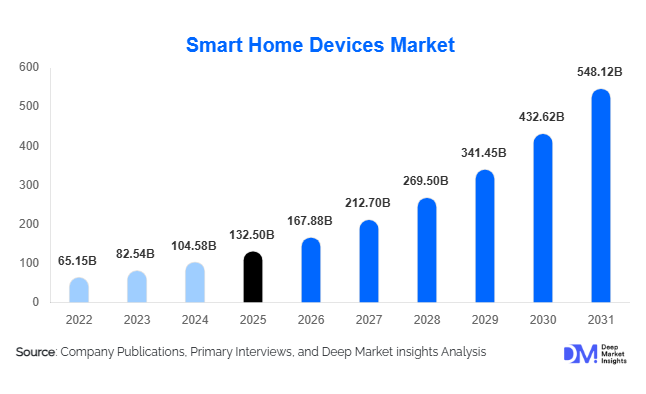
According to Deep Market Insights, the global smart home devices market size was valued at USD 132.5 billion in 2025 and is projected to grow from USD 167.88 billion in 2026 to reach USD 548.12 billion by 2031, expanding at a CAGR of 26.7% during the forecast period (2026–2031). The smart home devices market growth is primarily driven by the rapid adoption of Internet of Things (IoT)-enabled consumer ecosystems, increasing penetration of AI-powered automation technologies, and growing consumer demand for energy-efficient and secure connected living environments.
Key Market Insights
- Smart security and surveillance devices dominate the market, driven by rising consumer concerns regarding home safety, remote monitoring, and AI-enabled threat detection.
- AI-powered home automation platforms are transforming user experiences, enabling predictive climate control, intelligent lighting optimization, and adaptive device orchestration.
- North America dominates the global market, supported by high smart speaker penetration, strong consumer spending power, and widespread adoption of connected ecosystems.
- Asia-Pacific is the fastest-growing regional market, led by China, India, South Korea, and Japan due to expanding urbanization and smart city investments.
- Smart energy management solutions are witnessing strong demand, supported by rising electricity prices, sustainability initiatives, and government-backed green building regulations.
- Interoperability standards such as Matter and Thread are accelerating cross-platform compatibility and simplifying smart home integration for consumers.
Smart Home Devices Market Trends
AI-Driven Smart Home Automation Gaining Momentum
The smart home devices industry is increasingly shifting toward AI-driven automation systems capable of learning user behavior and optimizing household functions autonomously. AI-enabled smart speakers, intelligent thermostats, and connected appliances are now capable of predictive scheduling, adaptive energy management, and contextual voice interaction. Consumers are increasingly demanding personalized experiences where devices can coordinate seamlessly across multiple rooms and functions. Smart ecosystems integrated with machine learning algorithms can automatically adjust lighting, room temperature, entertainment preferences, and security settings based on occupancy patterns and historical user activity. Major technology companies are aggressively investing in edge AI processing and cloud-based home orchestration platforms to strengthen ecosystem engagement and recurring subscription revenues.
In addition, generative AI integration is creating new opportunities for conversational interfaces and intelligent home assistants capable of handling complex household tasks. AI-powered diagnostics, automated maintenance alerts, and predictive appliance servicing are emerging as major product differentiators. The growing availability of AI chips and low-latency connectivity infrastructure is expected to further accelerate adoption of intelligent automation solutions across residential environments.
Energy-Efficient Smart Homes Becoming Mainstream
Rising global focus on sustainability and energy conservation is significantly influencing purchasing decisions in the smart home devices market. Consumers are increasingly adopting smart thermostats, intelligent HVAC controls, connected lighting systems, and smart plugs to reduce electricity consumption and improve household energy efficiency. Governments and utility companies are also supporting adoption through incentives, rebates, and smart grid integration programs.
Smart energy management platforms capable of monitoring real-time electricity usage and optimizing appliance performance are becoming increasingly popular among environmentally conscious consumers. Integration of smart homes with renewable energy systems, battery storage technologies, and electric vehicle charging infrastructure is also gaining traction. In Europe and North America, energy efficiency regulations and carbon reduction targets are accelerating deployment of connected energy optimization systems across residential buildings. Smart homes are increasingly viewed as essential components of broader sustainable living ecosystems.
Smart Home Devices Market Drivers
Growing Consumer Demand for Home Security
The increasing importance of residential security remains one of the strongest drivers supporting smart home device adoption globally. Consumers are investing heavily in connected cameras, smart locks, motion sensors, video doorbells, and AI-powered surveillance systems to improve home safety and remote monitoring capabilities. The rise in urbanization, increasing awareness regarding property protection, and growth in remote work environments have significantly increased demand for connected security infrastructure.
Advanced technologies such as facial recognition, object classification, real-time threat alerts, and cloud-based video analytics are improving the value proposition of smart security devices. Insurance companies in several developed economies are also offering incentives and premium reductions for homes equipped with connected surveillance systems. The ability to remotely monitor properties using smartphones and voice assistants is further strengthening consumer adoption across both developed and emerging markets.
Rapid Expansion of IoT and Connected Ecosystems
The rapid proliferation of IoT-enabled consumer electronics is accelerating growth across the smart home ecosystem. Improvements in wireless communication technologies including Wi-Fi 6, Bluetooth Low Energy, Zigbee, Thread, and Matter are enabling seamless connectivity across multiple devices and platforms. Consumers increasingly prefer centralized ecosystems where entertainment, lighting, HVAC systems, appliances, and security infrastructure can be managed through unified interfaces.
Technology companies are investing aggressively in ecosystem expansion strategies designed to improve customer retention and recurring service monetization. Smart speakers and voice assistants have become central control hubs for connected households, encouraging consumers to expand device ownership within compatible ecosystems. The increasing affordability of smart devices is also improving adoption among middle-income consumers globally.
Smart Home Devices Market Restraints
Cybersecurity and Data Privacy Concerns
Cybersecurity remains one of the most significant challenges facing the smart home devices industry. Connected devices continuously collect large amounts of personal and behavioral data, increasing vulnerability to cyberattacks, unauthorized surveillance, and data breaches. Consumers remain concerned about privacy risks associated with cloud-based storage systems, voice recordings, and AI-enabled monitoring technologies.
Manufacturers must continuously invest in encryption technologies, software updates, secure firmware, and cybersecurity certifications to maintain consumer trust. Regulatory compliance requirements related to consumer privacy are also becoming increasingly stringent, particularly in Europe and North America. Failure to adequately address cybersecurity concerns could negatively impact mainstream adoption rates.
Fragmented Ecosystems and Compatibility Issues
Despite progress toward interoperability standards, ecosystem fragmentation remains a major restraint within the smart home market. Consumers often face challenges integrating devices from multiple brands due to incompatible communication protocols and proprietary software platforms. Installation complexity and inconsistent device performance can discourage broader consumer adoption.
Premium smart home ecosystems also involve relatively high upfront installation costs, particularly for fully integrated residential automation systems. In emerging economies, affordability concerns continue to limit penetration among price-sensitive households. Although Matter and Thread standards are improving compatibility, ecosystem standardization remains an ongoing industry challenge.
Smart Home Devices Market Opportunities
Integration of Smart Home Technologies in Smart Cities
The rapid development of smart cities and connected urban infrastructure presents major opportunities for smart home device manufacturers and platform providers. Governments across Asia-Pacific, the Middle East, and Europe are investing heavily in digitally connected residential infrastructure, energy-efficient housing, and intelligent urban ecosystems. Smart home integration is increasingly becoming a core feature within premium residential developments and large-scale urban housing projects.
Developers are incorporating centralized home automation systems, smart access control, intelligent energy management, and connected appliance ecosystems into new construction projects. Government-backed smart city initiatives in China, India, the UAE, and Southeast Asia are expected to create substantial long-term demand for integrated smart home technologies.
Expansion of Home Healthcare and Assisted Living Solutions
The convergence of healthcare and connected home technologies is creating significant growth opportunities within the smart home devices industry. Aging populations across developed economies are driving demand for remote health monitoring systems, connected elderly care devices, fall detection technologies, and AI-enabled wellness management solutions.
Smart healthcare devices integrated within residential environments can support medication reminders, sleep monitoring, emergency response systems, and remote patient diagnostics. Healthcare providers and insurance companies are increasingly supporting home-based monitoring solutions to reduce long-term hospitalization costs and improve patient convenience. This segment is expected to register one of the fastest growth rates within the broader smart home ecosystem during the forecast period.
Report Scope
| Report Metric | Details |
|---|---|
| Market Size in 2025 | USD 132.5 Billion |
| Market Size in 2026 | USD 167.88 Billion |
| Market Size in 2031 | USD 548.12 Billion |
| CAGR | 26.7% (2026-2031) |
| Base Year for Estimation | 2025 |
| Historical Data | 2022-2024 |
| Forecast Period | 2026-2031 |
| Report Coverage | Revenue Forecast, Competitive Landscape, Supply Chain Disruption, Growth Factors, Environment & Regulatory Landscape and Trends |
| Geographies Covered | North America, Europe, APAC, Middle East and Africa, LATAM |
| Countries Covered | U.S., Canada, U.K., Germany, France, Spain, Italy, Russia, Nordic, Benelux, Rest of Europe, China, Korea, Japan, India, Australia, Singapore, Taiwan, South East Asia, Rest of Asia-Pacific, UAE, Turky, Saudi Arabia, South Africa, Egypt, Nigeria, Rest of MEA, Brazil, Mexico, Argentina, Chile, Colombia, Rest of LATAM |
Explore more data points, trends and opportunities Download Free Sample Report
Product Type Insights
Smart security and access control devices represent the largest segment within the smart home devices market, accounting for nearly 29% of global revenue in 2025. Consumers increasingly prioritize investments in connected cameras, video doorbells, smart locks, and AI-powered alarm systems due to rising security concerns and remote monitoring requirements. Smart lighting systems continue to experience strong adoption because of growing emphasis on energy efficiency and convenience. Smart bulbs, connected switches, and ambient lighting ecosystems are becoming mainstream across residential households.
Smart HVAC and energy management systems are witnessing rapid growth, particularly in regions with rising electricity prices and sustainability-focused regulations. Smart thermostats, intelligent air conditioning systems, and energy optimization platforms are gaining traction among environmentally conscious consumers. Smart appliances including refrigerators, washing machines, robotic vacuum cleaners, and connected kitchen devices are also becoming increasingly popular due to improvements in AI functionality and voice-controlled integration.
Connectivity Technology Insights
Wi-Fi remains the dominant connectivity technology within the smart home devices market, accounting for approximately 41% of global market revenue in 2025. Consumers prefer Wi-Fi-enabled devices because they integrate easily with existing residential internet infrastructure and support remote accessibility through cloud platforms. Bluetooth Low Energy continues to gain adoption in short-range automation applications such as wearable integration and localized device control.
Zigbee and Z-Wave technologies remain important within advanced automation ecosystems due to their low-power consumption and mesh networking capabilities. However, Matter and Thread protocols are emerging as transformative standards because they improve interoperability across multiple brands and ecosystems. The growing adoption of hybrid connectivity systems integrating multiple communication standards is expected to improve consumer experience and reduce compatibility challenges.
Distribution Channel Insights
Online retail and e-commerce platforms dominate smart home device distribution globally, accounting for nearly 38% of total sales in 2025. Consumers increasingly prefer digital purchasing channels because they offer extensive product selection, transparent pricing, customer reviews, and bundled ecosystem packages. Major e-commerce companies are also strengthening direct smart home ecosystem integration and subscription-based service offerings.
Consumer electronics retailers remain important distribution channels for premium smart home systems requiring in-store demonstrations and installation consultation. Telecom providers and utility companies are also emerging as important distribution partners by bundling connected devices with broadband subscriptions, energy optimization services, and home security packages. System integrators and professional installers continue to play a critical role within luxury residential automation projects and commercial residential infrastructure developments.
End User Insights
Residential consumers represent the largest end-user segment in the smart home devices market, accounting for nearly 78% of total global demand in 2025. Independent homes, premium apartments, gated communities, and luxury residential projects continue to drive adoption of connected ecosystems focused on convenience, security, and energy management. Consumers increasingly prioritize voice-controlled automation systems capable of integrating entertainment, lighting, climate control, and surveillance functions.
Hospitality and senior living facilities are emerging as important commercial residential applications for smart home technologies. Hotels are deploying intelligent room automation systems, smart access control, and connected energy management solutions to improve guest experience and operational efficiency. Assisted living facilities are increasingly investing in remote monitoring technologies, emergency response systems, and connected healthcare devices to support aging populations.
Explore more data points, trends and opportunities Download Free Sample Report
Smart Home Devices Market Segmentations
By Product Type
- Smart Security & Access Control Devices
- Smart Lighting Devices
- Smart HVAC & Energy Management Devices
- Smart Entertainment & Connected Media Devices
- Smart Kitchen & Home Appliances
- Smart Healthcare & Assisted Living Devices
- Smart Home Control & Automation Systems
By Connectivity Technology
- Wi-Fi
- Bluetooth/BLE
- Zigbee
- Z-Wave
- Thread/Matter
- Cellular/5G
- Hybrid Connectivity Systems
By Distribution Channel
- Online Retail & E-commerce
- Brand-Owned Direct Sales
- Consumer Electronics Retailers
- Telecom & Utility Providers
- System Integrators & Smart Home Installers
- Real Estate & Builder Partnerships
By End User
- Residential Consumers
- Commercial Residential Infrastructure
- Real Estate Developers & Smart Building Projects
Regional Insights
North America
North America dominates the global smart home devices market, accounting for approximately 32% of global revenue in 2025. The United States represents the largest market within the region due to high smart speaker penetration, advanced broadband infrastructure, and strong consumer purchasing power. American consumers demonstrate particularly strong demand for connected security systems, AI-enabled voice assistants, and intelligent HVAC solutions. Canada is also experiencing steady market growth driven by increasing adoption of energy-efficient home technologies and connected residential ecosystems.
Europe
Europe represents nearly 24% of global market demand, supported by strict energy efficiency regulations, rising electricity costs, and increasing consumer awareness regarding sustainability. Germany, the United Kingdom, and France are the leading regional markets due to strong demand for smart energy management systems, intelligent lighting infrastructure, and connected heating solutions. European consumers show strong preference for environmentally sustainable smart home technologies integrated with renewable energy ecosystems and carbon reduction initiatives.
Asia-Pacific
Asia-Pacific is the fastest-growing regional market for smart home devices, accounting for approximately 29% of global revenue in 2025. China dominates regional demand due to its strong electronics manufacturing ecosystem, rapid urbanization, and extensive smart city investments. India is emerging as one of the fastest-growing national markets globally, supported by rising smartphone penetration, expanding middle-class income, and increasing adoption of affordable connected devices. Japan and South Korea continue to lead demand for premium automation systems and AI-enabled home healthcare technologies.
Latin America
Latin America is witnessing gradual adoption of smart home technologies, particularly in Brazil and Mexico. Expanding e-commerce penetration, improving internet connectivity, and growing affordability of entry-level smart devices are supporting regional market growth. Consumers within the region increasingly prioritize connected entertainment systems and affordable security solutions. International manufacturers are expanding regional distribution partnerships to strengthen market penetration.
Middle East & Africa
The Middle East & Africa region is emerging as a high-potential market for premium smart home technologies. Countries such as the UAE and Saudi Arabia are investing heavily in luxury residential infrastructure, smart city initiatives, and digitally connected urban developments. Demand for intelligent home automation systems, integrated surveillance technologies, and premium connected appliances is increasing across affluent residential communities. South Africa also represents a growing market for smart security and energy management solutions.
Key Players in the Smart Home Devices Market
- Amazon.com Inc.
- Google LLC
- Samsung Electronics Co. Ltd.
- Apple Inc.
- LG Electronics Inc.
- Xiaomi Corporation
- Honeywell International Inc.
- Schneider Electric SE
- Siemens AG
- ABB Ltd.
- Robert Bosch GmbH
- Philips (Signify N.V.)
- Legrand S.A.
- Assa Abloy AB
- Sony Group Corporation