Seafood Mushroom Market Size
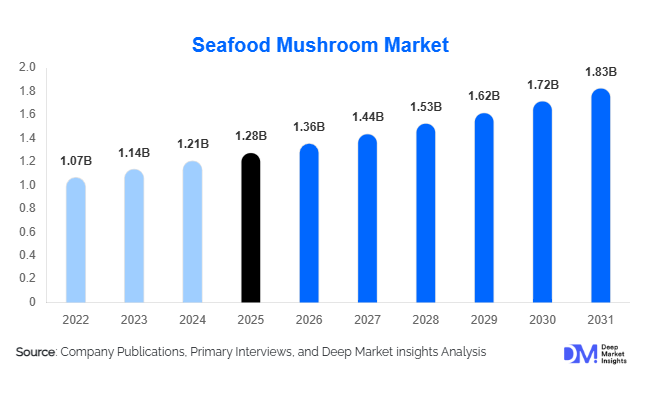
According to Deep Market Insights, the global seafood mushroom market size was valued at USD 1.28 billion in 2025 and is projected to grow from USD 1.36 billion in 2026 to reach USD 1.83 billion by 2031, expanding at a CAGR of 6.1% during the forecast period (2026–2031). The seafood mushroom market growth is primarily driven by increasing demand for premium specialty mushrooms, expanding adoption across food processing industries, growing consumer preference for plant-based ingredients, and continuous investments in controlled-environment mushroom cultivation technologies.
Key Market Insights
- Commercial cultivation is increasingly shifting toward climate-controlled indoor farming, enabling higher productivity, consistent quality, and year-round production of seafood mushrooms.
- Food processing remains the largest application segment, supported by rising incorporation of seafood mushrooms into ready meals, frozen foods, soups, sauces, and premium packaged food products.
- Asia-Pacific dominates the global market, led by China, Japan, South Korea, and India owing to large-scale cultivation capacity and strong domestic consumption.
- Latin America represents the fastest-growing regional market, supported by expanding commercial cultivation investments and increasing retail availability of specialty mushrooms.
- Retail distribution continues expanding globally, driven by organized supermarkets, specialty grocery stores, and e-commerce platforms offering packaged fresh and processed seafood mushrooms.
- Automation and precision cultivation technologies, including AI-based climate monitoring, automated harvesting, and smart humidity management systems, are improving production efficiency while reducing operational costs.
Seafood Mushroom Market Latest Trends
Controlled Environment Cultivation Expanding Worldwide
Commercial producers are rapidly investing in indoor cultivation facilities equipped with automated climate control, AI-powered monitoring systems, humidity optimization technologies, and energy-efficient growing chambers. These facilities enable year-round production while maintaining consistent product quality and reducing crop losses. Automated harvesting and environmental monitoring systems are also improving labor productivity, minimizing contamination risks, and supporting premium-grade seafood mushroom production. Growing investments in vertical farming and precision agriculture continue strengthening commercial cultivation capabilities across both developed and emerging markets.
Growing Demand for Value-Added Mushroom Products
Manufacturers are increasingly developing frozen, canned, dried, and ready-to-cook seafood mushroom products to meet rising demand from food processors, restaurants, and retail consumers. Premium packaged mushroom products continue gaining popularity because of their convenience, extended shelf life, and consistent quality. Advanced dehydration technologies, improved cold-chain logistics, and innovative food preservation methods are enabling processors to expand product portfolios while improving export competitiveness across international markets.
Seafood Mushroom Market Drivers
Growing Consumer Preference for Premium Plant-Based Ingredients
Consumers are increasingly adopting seafood mushrooms as premium culinary ingredients due to their nutritional profile, distinctive texture, and versatility across multiple cuisines. Rising demand for specialty mushrooms from restaurants, food manufacturers, and retail consumers is encouraging commercial cultivation expansion. Increasing awareness regarding healthy eating, functional foods, and plant-based dietary preferences continues supporting long-term demand across both developed and emerging economies.
Expansion of Industrial Food Processing Applications
Food manufacturers are increasingly utilizing seafood mushrooms in soups, frozen meals, ready-to-cook products, sauces, seasonings, and premium packaged foods. Continuous innovation in food manufacturing, coupled with increasing consumer demand for convenient meal solutions, has accelerated industrial procurement of specialty mushrooms. Growing investments in mushroom processing facilities and advanced preservation technologies further strengthen demand across the global food processing sector.
Seafood Mushroom Market Restraints
Limited Shelf Life of Fresh Products
Fresh seafood mushrooms require temperature-controlled storage and efficient logistics due to their relatively short shelf life. Maintaining product quality throughout transportation increases cold-chain infrastructure requirements and logistics costs. Product spoilage during transportation and storage remains a significant operational challenge, particularly across developing markets where refrigerated supply chains continue to evolve.
Rising Production and Energy Costs
Commercial indoor cultivation depends heavily on climate-controlled production facilities that require substantial investments in electricity, humidity control, ventilation, substrate materials, and skilled labor. Fluctuating energy prices and increasing operational expenditures continue affecting production economics, particularly for small and medium-scale commercial growers operating advanced cultivation systems.
Seafood Mushroom Industry Key Opportunities
Expansion of Functional Food Manufacturing
Growing consumer interest in functional foods and premium nutritional ingredients is creating new commercial opportunities for seafood mushroom producers. Food manufacturers are incorporating specialty mushrooms into fortified food products, healthy snacks, nutritional supplements, and premium packaged meals. Increasing investments in food innovation and value-added ingredient development are expected to create additional growth opportunities throughout the forecast period.
Growth of Premium Retail and Online Distribution
Rapid expansion of organized retail chains, specialty grocery stores, and online grocery platforms is improving product accessibility for consumers worldwide. Digital grocery platforms enable producers to reach premium consumer segments while offering packaged fresh, dried, and processed seafood mushrooms through direct-to-consumer sales channels. Enhanced retail visibility is expected to further strengthen long-term market expansion.
Report Scope
| Report Metric | Details |
|---|---|
| Market Size in 2025 | USD 1.28 Billion |
| Market Size in 2026 | USD 1.36 Billion |
| Market Size in 2031 | USD 1.83 Billion |
| CAGR | 6.1% (2026-2031) |
| Base Year for Estimation | 2025 |
| Historical Data | 2022-2024 |
| Forecast Period | 2026-2031 |
| Report Coverage | Revenue Forecast, Competitive Landscape, Supply Chain Disruption, Growth Factors, Environment & Regulatory Landscape and Trends |
| Geographies Covered | North America, Europe, APAC, Middle East and Africa, LATAM |
| Countries Covered | U.S., Canada, U.K., Germany, France, Spain, Italy, Russia, Nordic, Benelux, Rest of Europe, China, Korea, Japan, India, Australia, Singapore, Taiwan, South East Asia, Rest of Asia-Pacific, UAE, Turky, Saudi Arabia, South Africa, Egypt, Nigeria, Rest of MEA, Brazil, Mexico, Argentina, Chile, Colombia, Rest of LATAM |
Explore more data points, trends and opportunities Download Free Sample Report
Type Insights
Fresh seafood mushrooms accounted for the largest share of the global seafood mushrooms market, primarily driven by rising consumer preference for premium-quality, minimally processed, and nutrient-rich mushrooms with superior taste, texture, and culinary versatility. Fresh seafood mushrooms are extensively utilized across households, restaurants, hotels, and specialty food outlets owing to their natural flavor profile, high protein content, and suitability for a wide range of Asian and international cuisines. The expansion of modern retail formats, improvements in cold-chain logistics, and increasing availability through supermarkets and online grocery platforms have further strengthened the dominance of this segment. Growing consumer inclination toward clean-label, fresh, and organic food products continues to reinforce demand for fresh seafood mushrooms worldwide.Processed seafood mushrooms, including frozen, canned, vacuum-packed, and ready-to-cook products, are projected to witness the fastest growth during the forecast period. Rising consumer demand for convenience foods, busy lifestyles, increasing adoption of meal kits, and expanding applications across food processing industries are driving segment expansion. Food manufacturers are increasingly incorporating processed seafood mushrooms into frozen meals, ready-to-eat products, instant noodles, sauces, and value-added packaged foods owing to their consistency, longer shelf life, and ease of industrial processing.
Application Insights
Food processing emerged as the leading application segment, driven by the expanding utilization of seafood mushrooms across soups, sauces, frozen foods, ready meals, canned products, snack formulations, seasonings, and other value-added packaged food products. Growing global demand for functional foods, plant-based ingredients, and clean-label formulations has encouraged manufacturers to increasingly incorporate specialty mushrooms into processed food products. Continuous product innovation, expansion of convenience food categories, and rising investments in food manufacturing facilities are further strengthening the dominance of this application segment.Retail sales are witnessing steady growth as consumers increasingly purchase fresh, dried, and processed seafood mushrooms through supermarkets, hypermarkets, specialty grocery stores, organic food retailers, and e-commerce platforms for home consumption. Expanding organized retail infrastructure, greater product availability, improved cold-chain distribution, and increasing consumer awareness regarding the nutritional benefits of specialty mushrooms continue driving retail market expansion globally.
Explore more data points, trends and opportunities Download Free Sample Report
Seafood Mushroom Market Segmentations
By Type
- Fresh Seafood Mushroom
- Dried Seafood Mushroom
- Processed Seafood Mushroom
By Application
- Food Processing
- Foodservice
- Retail
By Distribution Channel
- Supermarkets & Hypermarkets
- Specialty Grocery Stores
- Online Retail Platforms
- Direct Sales & Institutional Distribution
Regional Insights
Asia-Pacific
Asia-Pacific dominated the global seafood mushrooms market and is expected to maintain its leadership throughout the forecast period owing to its extensive commercial cultivation infrastructure, favorable climatic conditions, well-established mushroom farming expertise, and high domestic consumption. China remains the world's largest producer and consumer, while Japan, South Korea, and India continue expanding commercial cultivation through investments in controlled-environment agriculture and advanced cultivation technologies. The region also benefits from strong cultural acceptance of mushrooms as a dietary staple, increasing disposable incomes, expanding food processing industries, rapid urbanization, growing organized retail networks, government support for high-value horticultural production, and rising exports of specialty mushroom products, all of which continue to strengthen regional market growth.
North America
North America represents a significant market supported by increasing consumer demand for specialty mushrooms, expanding plant-based food consumption, and widespread adoption across premium restaurants and packaged food manufacturing industries. Commercial cultivation continues expanding through investments in automation, climate-controlled production facilities, advanced harvesting technologies, and sustainable farming practices. Regional growth is further driven by increasing health consciousness, growing demand for functional and clean-label food ingredients, expanding retail availability across supermarkets and online grocery platforms, rising popularity of gourmet culinary experiences, and continuous product innovation by food manufacturers.
Europe
Europe continues demonstrating strong demand for premium seafood mushrooms owing to growing consumer awareness regarding healthy nutrition, sustainable agriculture, and gourmet culinary applications. Germany, France, Italy, the Netherlands, and Poland represent major consuming and producing countries with well-established mushroom industries. Regional growth is supported by stringent food quality standards, increasing preference for organic and locally produced foods, expanding vegan and vegetarian populations, rising investments in controlled-environment cultivation technologies, growing food manufacturing activities, and continuous innovation in premium packaged food products utilizing specialty mushrooms.
Latin America
Latin America is projected to register the fastest market growth during the forecast period due to increasing investments in specialty mushroom cultivation, expanding food processing industries, and improving retail distribution infrastructure. Brazil, Mexico, and Chile continue strengthening commercial production capabilities while rising consumer awareness regarding the nutritional value of specialty mushrooms supports long-term demand across foodservice and retail channels. Regional expansion is further driven by increasing urbanization, rising disposable incomes, growing demand for premium and functional food products, improving agricultural technologies, expanding exports, and government initiatives promoting diversification of high-value agricultural production.
Middle East & Africa
The Middle East & Africa seafood mushrooms market continues expanding through growing hospitality industries, increasing premium food consumption, and rising investments in greenhouse and controlled-environment cultivation technologies. Countries including the United Arab Emirates, Saudi Arabia, South Africa, and Egypt are strengthening commercial production capabilities while expanding imports to satisfy rising demand from restaurants, hotels, and modern retail outlets. Market growth is further supported by rapid urbanization, increasing tourism, expanding supermarket and hypermarket penetration, improving cold-chain logistics, rising consumer awareness of healthy dietary choices, and government efforts to enhance domestic agricultural production and food security.
Key Players in the Seafood Mushroom Market
- Hokto Corporation
- Yukiguni Maitake Co., Ltd.
- Monaghan Mushrooms
- Greenyard NV
- Bonduelle Group
- Costa Group
- South Mill Champs
- Phillips Mushroom Farms
- Drinkwater Mushrooms
- CMP Mushrooms
- Banken Champignons
- OKECHAMP S.A.
- Monterey Mushrooms
- Shanghai Finc Bio-Tech Inc.
- Hirano Mushroom LLC