Guava Market Size
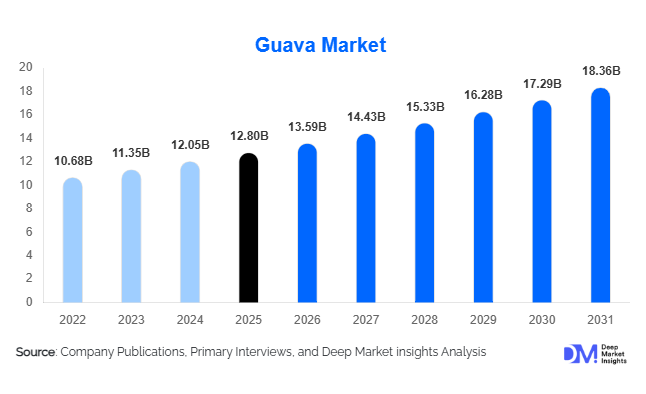
According to Deep Market Insights, the global guava market size was valued at USD 12.8 billion in 2025 and is projected to grow from USD 13.4 billion in 2026 to reach USD 21.6 billion by 2031, expanding at a CAGR of 6.2% during the forecast period (2026–2031). The guava market growth is primarily driven by increasing consumption of nutrient-rich tropical fruits, rising demand for processed fruit beverages, expansion of organic farming practices, and growing utilization of guava pulp and extracts across food, beverage, and nutraceutical industries. The report analyzes global production trends, market segmentation, regional contribution, competitive landscape, and evolving consumption patterns across fresh and processed guava categories.
Key Market Insights
- Asia-Pacific dominates the global guava market, accounting for approximately 52.4% market share in 2025, supported by high production volumes from India, China, Indonesia, and Thailand, while Latin America is projected to register the fastest growth with a CAGR of 7.1% during 2026–2031.
- Fresh guava remains the dominant product category, holding nearly 68% market share in 2025, supported by direct consumption patterns, while organic guava is emerging as the fastest-growing segment with an expected CAGR of 8.3%.
- Food and beverage applications dominate guava consumption, contributing approximately 46% share in 2025, driven by increasing demand for juices, concentrates, purees, jams, and functional beverages.
- India represents the largest production contributor, accounting for nearly 25% of global guava production with output exceeding 5.5 million metric tons in 2025.
- Brazil is emerging as a high-growth country market, with the guava market forecast to reach approximately USD 1.9 billion by 2031, expanding at a CAGR of 6.8% due to increasing industrial processing and export activities.
- Technology adoption is transforming guava cultivation and processing, with precision farming, automated sorting, and cold-chain systems improving productivity by approximately 15–25% across commercial production regions.
Guava Market Latest Trends
Expansion of Processed Guava Products and Advanced Cultivation Practices
The global guava industry is experiencing a major shift toward processed products, with processed guava accounting for approximately 27% of total market consumption in 2025. Global guava production exceeded 55 million metric tons, with nearly 15 million metric tons utilized for pulp, puree, concentrate, frozen products, and beverage applications. Food manufacturers are increasingly adopting advanced extraction technologies, high-pressure processing, and automated quality control systems to improve product consistency and shelf life. Digital farming solutions, including smart irrigation and crop monitoring platforms, have reached nearly 35% adoption among commercial guava farms, improving resource efficiency and reducing production losses. Beverage companies are expanding guava-based product portfolios as demand for tropical flavors increases across urban markets, strengthening the overall guava market trend.
Growing Demand for Organic Guava and Sustainable Farming Models
Organic guava cultivation is gaining momentum as consumers increasingly prioritize chemical-free and sustainably produced fruits. Organic guava production reached approximately 2.7 million metric tons in 2025, representing nearly 5% of the total guava market share. Adoption of organic farming practices has increased by approximately 12% annually between 2022 and 2025, supported by premium pricing opportunities and rising demand from health-conscious consumers. Sustainable irrigation systems have reduced water usage by nearly 30% in several commercial farming regions, while controlled cultivation methods have improved yields by approximately 15–20%. Retailers and food processors are increasingly sourcing certified organic guava to meet consumer demand for clean-label products, supporting long-term guava market trend development.
Guava Market Drivers
Rising Nutritional Awareness and Health-Focused Consumption
Increasing awareness regarding nutritional benefits is one of the major factors supporting guava market expansion. Guava contains approximately 228 mg of vitamin C per 100 grams, making it one of the most nutrient-dense tropical fruits available globally. Consumer preference for immunity-supporting foods increased significantly after 2022, contributing to higher demand for fresh fruits, juices, and functional beverages. Global guava beverage production increased by approximately 10% between 2022 and 2025, while processed guava demand expanded at nearly 8% annual growth. Food manufacturers are integrating guava ingredients into juices, dairy products, snacks, and supplements, strengthening guava market growth.
Increasing Demand for Processed Fruit Ingredients
The expansion of the processed food industry is accelerating demand for guava-based ingredients. Processed guava applications account for approximately 27% market share, with more than 15 million metric tons of guava utilized annually for industrial applications. Beverage producers, confectionery manufacturers, and dairy companies are increasingly using guava pulp and concentrates due to their flavor profile and nutritional value. Advanced processing facilities are improving extraction efficiency to approximately 85–90%, reducing wastage and enhancing commercial scalability. Growing consumption of tropical fruit beverages across Asia-Pacific, North America, and Europe continues to create new opportunities for guava market development.
Guava Market Restraints
Climate Variability and Agricultural Production Risks
Climate dependency remains a significant challenge for guava cultivation due to sensitivity to temperature fluctuations, rainfall changes, and extreme weather conditions. Weather-related disruptions can create production variations of approximately 20–25% in vulnerable regions. Small-scale farmers account for nearly 65% of global guava cultivation, limiting access to advanced agricultural technologies and climate-resilient farming methods. Pest outbreaks, inconsistent rainfall patterns, and changing cultivation conditions impact productivity and supply stability. These agricultural uncertainties increase operational risks and create challenges for maintaining consistent supply within the global guava market.
Post-Harvest Losses and Supply Chain Limitations
Post-harvest management challenges continue to restrict market efficiency, particularly in developing economies. Approximately 15–30% of harvested guava production can be lost due to inadequate storage, transportation limitations, and insufficient cold-chain infrastructure. Logistics expenses contribute nearly 18% of fresh guava pricing in export markets, affecting profitability for producers and distributors. Limited access to refrigerated transportation and modern packaging technologies reduces export competitiveness for several producing countries. Improving supply chain efficiency remains a critical factor influencing future guava market performance.
Guava Market Opportunities
Expansion of Organic and Functional Food Applications
The rising popularity of organic and functional foods is creating significant opportunities within the guava industry. Organic fruit consumption increased by approximately 14% between 2022 and 2025, supporting premium guava product development. Nutraceutical companies are increasingly utilizing guava extracts due to antioxidant properties, with functional food applications growing at nearly 9% CAGR. Emerging economies across Southeast Asia, the Middle East, and Latin America are expected to generate more than USD 3 billion in additional demand by 2031. Manufacturers are expanding organic juices, dietary supplements, and health-focused beverages incorporating guava ingredients.
Growth of International Trade and Premium Fruit Categories
International trade expansion is creating new opportunities for premium guava categories, including specialty varieties and organic-certified products. Export-oriented producers are investing in improved packaging, grading systems, and cold-chain infrastructure to increase global availability. Premium guava varieties command higher prices due to superior taste, appearance, and nutritional characteristics. Countries investing in modern cultivation systems have achieved productivity improvements of approximately 20%, supporting higher export volumes and strengthening the global guava market outlook.
Report Scope
| Report Metric | Details |
|---|---|
| Market Size in 2025 | USD 12.80 Billion |
| Market Size in 2026 | USD 13.59 Billion |
| Market Size in 2031 | USD 18.36 Billion |
| CAGR | 6.2% (2026-2031) |
| Base Year for Estimation | 2025 |
| Historical Data | 2022-2024 |
| Forecast Period | 2026-2031 |
| Report Coverage | Revenue Forecast, Competitive Landscape, Supply Chain Disruption, Growth Factors, Environment & Regulatory Landscape and Trends |
| Geographies Covered | North America, Europe, APAC, Middle East and Africa, LATAM |
| Countries Covered | U.S., Canada, U.K., Germany, France, Spain, Italy, Russia, Nordic, Benelux, Rest of Europe, China, Korea, Japan, India, Australia, Singapore, Taiwan, South East Asia, Rest of Asia-Pacific, UAE, Turky, Saudi Arabia, South Africa, Egypt, Nigeria, Rest of MEA, Brazil, Mexico, Argentina, Chile, Colombia, Rest of LATAM |
Explore more data points, trends and opportunities Download Free Sample Report
Product Type Insights
Fresh guava represents the largest segment in the guava market, accounting for nearly 68% share in 2025 with global production exceeding 37 million metric tons annually. The segment includes white-flesh, pink-flesh, and red-flesh guava varieties, generally containing 8–12% natural sugar content and approximately 80–85% moisture levels. Fresh guava consumption is primarily driven by household consumption, supermarkets, fruit retailers, and local markets, contributing nearly 70% of total fresh guava utilization. Asia-Pacific remains the largest production hub, producing more than 22 million metric tons annually due to favorable climatic conditions and established cultivation practices. Increasing demand for fresh tropical fruits and expanding organized retail networks continue supporting fresh guava market expansion.Processed guava accounted for approximately 27% market share in 2025, representing nearly 15 million metric tons of annual fruit utilization. This segment includes guava pulp, puree, concentrate, frozen guava, dried products, jams, and beverage ingredients. Industrial processors utilize advanced extraction technologies achieving approximately 85–90% processing efficiency, reducing raw material waste and improving profitability. Beverage manufacturers represent a major consumer group, with guava-based juices and concentrates witnessing demand growth of approximately 8–10% annually. The segment is expanding due to increasing consumption of tropical fruit beverages, ready-to-drink products, and flavored dairy applications across developed and emerging markets.
Application Insights
Food and beverage applications represent the largest application segment in the guava market, accounting for approximately 46% share in 2025. The segment consumes more than 25 million metric tons of guava-derived products annually through juices, smoothies, dairy beverages, jams, confectionery products, and fruit-based snacks. Guava pulp and concentrate are widely used due to their strong flavor profile, nutritional value, and compatibility with blended fruit beverages. Urban markets demonstrate approximately 40% penetration of guava-based beverage products, supported by changing consumer preferences toward natural and functional drinks. Food manufacturers are increasingly incorporating guava ingredients into premium product lines, strengthening demand across global markets.Retail consumption accounted for nearly 34% market share in 2025, representing approximately 19 million metric tons of fresh guava consumption worldwide. Supermarkets, hypermarkets, online grocery platforms, and traditional fruit markets serve as major distribution channels. Consumer adoption increased by approximately 7% between 2022 and 2025 due to rising awareness regarding antioxidants, vitamins, and natural nutrition benefits. Retailers are expanding tropical fruit categories by introducing premium packaging, organic labels, and ready-to-eat fruit formats. Growing e-commerce penetration is also improving accessibility of fresh guava products across urban regions.
Distribution Channel Insights
The guava market distribution landscape includes traditional retail, supermarkets, online grocery platforms, wholesalers, and direct supply channels. Traditional markets continue to dominate fresh guava distribution, particularly in Asia-Pacific and Latin America, accounting for approximately 55% of fresh fruit sales. Organized retail channels are expanding rapidly, supported by improved cold-chain infrastructure and premium fruit displays. Online grocery platforms are gaining traction, with digital fruit purchasing increasing by nearly 15% annually in urban markets. Food processors generally rely on direct contracts with farmers and agricultural suppliers to secure consistent raw material supply. The growing integration of farm-to-retail supply chains is improving product traceability, reducing losses, and enhancing consumer confidence across the guava market.
Explore more data points, trends and opportunities Download Free Sample Report
Guava Market Segmentations
By Type
- Fresh Guava
- Processed Guava
- Organic Guava
By Application
- Food & Beverage
- Retail Consumption
- Industrial Processing
By Distribution Channel
- Supermarkets & Hypermarkets
- Online Grocery Platforms
- Traditional Fruit Markets
- Wholesalers & Distributors
- Direct Farm Supply Channels
Regional Insights
Asia-Pacific
Asia-Pacific dominates the global guava market, accounting for approximately 52.4% market share in 2025, supported by strong production capacity, favorable climatic conditions, and high domestic consumption. The region produced more than 30 million metric tons of guava in 2025, with India, China, Indonesia, and Thailand representing major contributors. India alone contributed approximately 25% of global production, producing more than 5.5 million metric tons. Fresh guava consumption represents nearly 70% of regional demand, while processed applications account for approximately 30%. Rising disposable income, expanding food processing industries, and government support for horticulture development are strengthening regional growth.India remains the leading guava-producing country within Asia-Pacific due to extensive cultivation areas and established agricultural practices. China contributes approximately 6 million metric tons annually, supported by increasing investment in processing facilities and domestic fruit consumption. Southeast Asian countries including Indonesia and Thailand are expanding export-oriented cultivation, with improved irrigation and farming technologies increasing productivity by approximately 15–20%. The region is expected to maintain its leadership position through 2031 due to strong supply availability and growing consumer demand.
Latin America
Latin America accounted for approximately 22% market share in 2025, producing nearly 12 million metric tons of guava annually. Brazil represents the largest contributor, accounting for nearly 50% of regional production due to favorable agricultural conditions and established fruit processing industries. The region has a stronger focus on industrial processing compared with other regions, with processed guava representing approximately 40% of consumption. Brazil and Mexico are increasing investments in guava-based beverages, pulp production, and export activities.Latin American producers are adopting modern cultivation methods, including precision irrigation and improved crop management systems, increasing production efficiency by approximately 20%. Growing international demand for tropical fruit ingredients is encouraging manufacturers to expand processing capacity. The region is projected to achieve a 7.1% CAGR during 2026–2031, making it the fastest-growing regional market.
North America
North America accounted for approximately 8% market share in 2025, with regional guava consumption exceeding 4 million metric tons. The United States, Canada, and Mexico represent the major markets, with Mexico contributing nearly 65% of regional fresh guava supply. Demand in North America is primarily driven by growing interest in tropical fruits, multicultural food consumption patterns, and increasing availability through supermarkets and online grocery platforms. Fresh guava represents approximately 60% of regional consumption, while processed guava products including juices, purees, and concentrates account for nearly 40%.The United States represents the largest consumer market within the region due to rising demand for premium fruits, functional beverages, and natural food ingredients. Guava-based beverages have gained increasing acceptance among health-focused consumers, with tropical fruit beverage consumption expanding by approximately 9% annually. Food manufacturers are incorporating guava flavors and extracts into beverages, snacks, and nutritional products. Improved import networks, cold-chain infrastructure, and expanding Hispanic consumer influence continue supporting North American guava market development through 2031.
Europe
Europe represented approximately 10% market share in 2025, with guava consumption reaching nearly 5.5 million metric tons. Major consuming countries include Germany, France, the United Kingdom, Spain, and Italy. The region relies significantly on imports from tropical producing countries, with fresh guava and processed products distributed through supermarkets, specialty fruit retailers, and food processing companies. Organic guava demand has increased substantially, growing at approximately 15% annually due to rising consumer preference for sustainable and certified agricultural products.European consumers are increasingly adopting premium tropical fruits, supporting expansion of organic and ethically sourced guava categories. Fresh consumption contributes approximately 55% of regional demand, while food processing applications account for nearly 45%. Beverage manufacturers are increasing the use of guava concentrates in juices, smoothies, and functional drinks due to consumer interest in natural ingredients. Strong sustainability regulations, advanced retail infrastructure, and growing demand for clean-label foods are expected to support steady guava market expansion across Europe.
Middle East & Africa
The Middle East and Africa region accounted for approximately 8% market share in 2025, with production and consumption volumes reaching nearly 4 million metric tons. Egypt, South Africa, Saudi Arabia, and other emerging agricultural economies contribute significantly to regional development. The region benefits from favorable climates for guava cultivation and increasing investment in greenhouse farming technologies. Fresh consumption represents approximately 65% of regional demand, while processed applications contribute around 35%.Countries across the Middle East are increasing imports of premium tropical fruits due to rising disposable income and expanding hospitality sectors. Africa continues to strengthen its cultivation base through improved irrigation systems and agricultural modernization programs, increasing productivity by approximately 20% in several commercial farming areas. Growing food processing investments, export opportunities, and rising consumer interest in healthy fruit products are expected to create additional opportunities for the guava market across the region.
Top Players in the Guava Market
- Del Monte Foods, Inc.
- Dole Food Company, Inc.
- Fresh Del Monte Produce Inc.
- Jain Irrigation Systems Ltd.
- ITC Limited
- PepsiCo Inc.
- The Coca-Cola Company
- Döhler GmbH
- AGRANA Beteiligungs-AG
- Kerry Group plc
- Symrise AG
- Louis Dreyfus Company
- Olam Group
- Fyffes plc