Manuka Honey Market Size
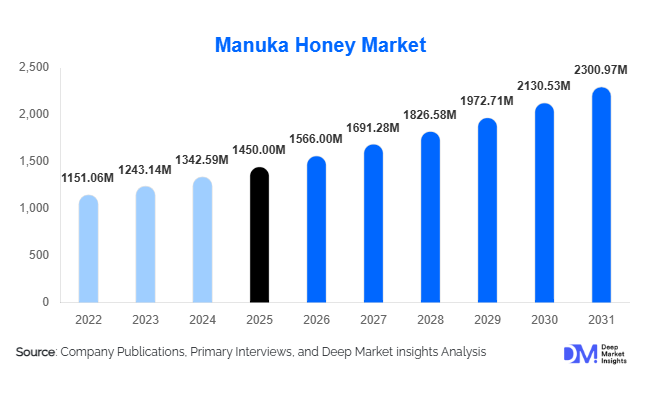
According to Deep Market Insights, the global Manuka Honey market size was valued at USD 1,450 million in 2025 and is projected to grow from USD 1,566.00 million in 2026 to reach USD 2,300.97 million by 2031, expanding at a CAGR of 8.0% during the forecast period (2026–2031). The Manuka honey market growth is primarily driven by rising demand for natural immunity-boosting products, increasing adoption in nutraceutical and pharmaceutical applications, and growing consumer preference for premium functional foods with proven antibacterial properties.
Key Market Insights
- Manuka honey is increasingly positioned as a functional medicinal superfood, moving beyond traditional honey consumption into healthcare and nutraceutical applications.
- UMF-certified premium grades dominate demand, with consumers prioritizing authenticity, purity, and methylglyoxal (MGO) concentration.
- Asia-Pacific leads global consumption, driven by China, Japan, and South Korea’s strong demand for imported wellness products.
- North America remains a high-value market, supported by strong nutraceutical adoption and high disposable income.
- E-commerce channels are accelerating global distribution, improving accessibility and authenticity verification for premium honey products.
- Skincare and pharmaceutical applications are expanding rapidly, creating new non-food demand streams for Manuka honey.
Manuka Honey Market Trends
Premiumization and Certification-Led Demand Growth
The market is increasingly driven by premiumization, where consumers prefer high-grade UMF 10+ to UMF 20+ products due to their higher therapeutic potency. Certification systems such as UMF (Unique Manuka Factor) and MGO ratings have become critical purchasing criteria, ensuring authenticity and quality assurance. This trend has elevated Manuka honey from a commodity sweetener to a luxury wellness product. Consumers are willing to pay significantly higher prices for certified products, particularly in North America and Asia-Pacific. Retailers and brands are investing heavily in traceability systems and lab-tested authentication to differentiate genuine products from counterfeit alternatives.
Expansion into Skincare and Functional Wellness Products
Manuka honey is increasingly being integrated into skincare, dermatology, and nutraceutical formulations due to its antibacterial and anti-inflammatory properties. Cosmetic companies are incorporating it into anti-acne creams, moisturizers, and anti-aging products. In parallel, nutraceutical firms are using Manuka honey in immunity supplements, digestive health formulations, and energy boosters. This diversification beyond food applications is significantly expanding the total addressable market and driving cross-industry adoption.
Manuka Honey Market Drivers
Rising Demand for Natural Immunity-Boosting Products
Growing global awareness of preventive healthcare has significantly increased demand for natural immunity enhancers. Manuka honey, known for its antibacterial and antiviral properties, is widely consumed as a daily wellness product. Post-pandemic health consciousness has further strengthened demand across developed markets such as the United States and Europe, where consumers are shifting toward chemical-free natural remedies.
Growth of Functional Food and Nutraceutical Industry
The expansion of the global nutraceutical industry is a major growth driver. Consumers increasingly prefer functional foods that offer both nutrition and therapeutic benefits. Manuka honey’s positioning as a superfood with scientifically supported health benefits has enabled strong adoption in dietary supplements, health drinks, and medical nutrition products.
Expansion of E-commerce and Global Distribution Networks
The rapid growth of e-commerce platforms has significantly improved accessibility to certified Manuka honey products. Online channels allow consumers to verify authenticity, compare UMF ratings, and access global brands directly. This has been particularly important in combating counterfeit products and expanding penetration in emerging markets.
Manuka Honey Market Restraints
High Price and Limited Production Capacity
Manuka honey is highly expensive due to its limited geographic production in New Zealand and parts of Australia. Seasonal dependency and bee population sensitivity restrict supply, making it a premium-priced product. This limits mass-market adoption, especially in price-sensitive regions such as parts of Asia, Africa, and Latin America.
Counterfeit and Adulteration Concerns
The high value of Manuka honey has led to widespread counterfeit products in global markets. Adulteration and mislabeling issues undermine consumer trust and force stricter regulatory oversight. Companies must invest heavily in certification and traceability systems to maintain credibility and market share.
Manuka Honey Market Opportunities
Expansion in Pharmaceutical and Medical Applications
Increasing clinical validation of Manuka honey’s antibacterial properties is driving its adoption in wound care, burn treatments, and gastrointestinal therapies. Hospitals and healthcare providers are gradually integrating it into medical-grade applications, opening a high-value institutional demand channel.
Growth in Asia-Pacific Premium Wellness Markets
Rising disposable incomes in China, Japan, and South Korea are creating strong demand for premium imported wellness products. Consumers in these regions are increasingly purchasing high-grade Manuka honey for immunity, skincare, and dietary supplementation, making APAC a key growth engine for global expansion.
Integration into the Cosmetics and Personal Care Industry
The cosmetics industry is rapidly adopting Manuka honey due to its moisturizing and antibacterial properties. It is increasingly used in acne treatment products, anti-aging formulations, and natural skincare solutions, creating strong cross-industry demand growth.
Report Scope
| Report Metric | Details |
|---|---|
| Market Size in 2025 | USD 1450 Million |
| Market Size in 2026 | USD 1566.00 Million |
| Market Size in 2031 | USD 2300.97 Million |
| CAGR | 8% (2026-2031) |
| Base Year for Estimation | 2025 |
| Historical Data | 2022-2024 |
| Forecast Period | 2026-2031 |
| Report Coverage | Revenue Forecast, Competitive Landscape, Supply Chain Disruption, Growth Factors, Environment & Regulatory Landscape and Trends |
| Geographies Covered | North America, Europe, APAC, Middle East and Africa, LATAM |
| Countries Covered | U.S., Canada, U.K., Germany, France, Spain, Italy, Russia, Nordic, Benelux, Rest of Europe, China, Korea, Japan, India, Australia, Singapore, Taiwan, South East Asia, Rest of Asia-Pacific, UAE, Turky, Saudi Arabia, South Africa, Egypt, Nigeria, Rest of MEA, Brazil, Mexico, Argentina, Chile, Colombia, Rest of LATAM |
Explore more data points, trends and opportunities Download Free Sample Report
Product Grade Insights
The UMF 10+ to 15+ segment dominates the Manuka honey market, accounting for approximately 38% of global market share in 2025. This segment leads primarily due to its optimal balance between affordability and clinically recognized therapeutic potency, making it the most widely adopted grade across both retail consumers and healthcare-oriented buyers. It is particularly preferred in developed markets such as North America and Europe, where consumers actively seek certified wellness products with proven antibacterial strength without the extreme price premium of UMF 20+ variants.
The leadership of this segment is further supported by its strong adoption in daily wellness consumption, immunity-boosting routines, and nutraceutical formulations. Manufacturers also prioritize UMF 10+ to 15+ production because it offers higher scalability compared to ultra-premium grades, which are limited by raw nectar availability and stringent grading requirements. While UMF 20+ and above grades are witnessing rapid growth in pharmaceutical and medical applications, their niche positioning and limited supply base restrict broader market penetration.
Additionally, increasing consumer trust in UMF certification systems has reinforced demand concentration in this mid-to-high grade category, as it is perceived as the “gold standard entry point” for premium Manuka honey consumption globally.
Application Insights
The food and beverage segment holds the largest share at approximately 44%, driven by widespread direct consumption, functional food integration, and increasing inclusion in health-focused diets. Consumers are increasingly using Manuka honey as a natural sweetener replacement and daily immunity booster, particularly in breakfast foods, teas, and wellness drinks.
However, the pharmaceutical and nutraceutical segments are emerging as the fastest-growing applications, supported by rising clinical validation of antibacterial, anti-inflammatory, and wound-healing properties. These segments are expanding rapidly due to increasing use in immunity supplements, gastrointestinal health formulations, and medical-grade wound care products, particularly in North America, Europe, and advanced healthcare systems in Asia-Pacific.
The cosmetics and personal care segment is also gaining strong traction, leveraging Manuka honey’s antimicrobial and moisturizing properties. Its adoption in anti-acne treatments, anti-aging creams, and dermatological formulations is being driven by the global shift toward natural, chemical-free skincare solutions, particularly in premium beauty markets in South Korea, Japan, and Europe.
Distribution Channel Insights
Supermarkets and specialty stores account for approximately 41% of total distribution share, as consumers prefer physical verification of authenticity, UMF grading labels, and origin certification before purchasing premium-priced honey products. Specialty health stores also play a critical role in educating consumers about grading systems and product differentiation.
Online retail, however, represents the fastest-growing distribution channel, driven by rising e-commerce penetration, global accessibility, and improved transparency tools such as batch tracking and certification verification. Direct-to-consumer (D2C) brand websites are also expanding rapidly, supported by premium branding strategies, subscription models, and authenticity-focused marketing campaigns. This shift is particularly strong in China, the United States, and parts of Europe, where digital wellness purchasing behavior is accelerating.
End-Use Industry Insights
Demand for Manuka honey is concentrated across nutraceuticals, pharmaceuticals, food & beverages, and personal care industries, with nutraceuticals emerging as the fastest-growing end-use segment. The global nutraceutical industry, valued at several hundred billion dollars, is increasingly integrating natural bioactive ingredients, positioning Manuka honey as a high-value functional component.
The pharmaceutical industry is witnessing rising adoption due to clinically validated antibacterial and wound-healing properties, particularly in burn treatment, infection control, and digestive health therapies. Meanwhile, the cosmetics industry is expanding its use of Manuka honey in dermatological and skincare formulations, driven by demand for natural, bioactive, and sustainable beauty ingredients.
Food and beverage applications continue to dominate overall volume consumption, supported by increasing consumer preference for natural sweeteners and immunity-boosting dietary products. Export-driven demand from developed economies to Asia-Pacific is also reinforcing growth across all end-use categories.
Explore more data points, trends and opportunities Download Free Sample Report
Manuka Honey Market Segmentations
By Product Grade
- UMF 5+ – 10+
- UMF 10+ – 15+
- UMF 15+ – 20+
- UMF 20+ & Above
By Application
- Food & Beverages
- Nutraceuticals
- Pharmaceuticals
- Cosmetics & Personal Care
By Distribution Channel
- Supermarkets & Hypermarkets
- Specialty Health Stores
- Online Retail / E-commerce Platforms
- Direct-to-Consumer (D2C) Brand Websites
- Pharmacies & Medical Stores
By End-Use Industry
- Nutraceutical Industry
- Pharmaceutical Industry
- Food & Beverage Industry
- Cosmetics & Personal Care Industry
Regional Insights
Asia-Pacific
Asia-Pacific holds the largest share of approximately 34% of global demand, led by China, Japan, and South Korea. The region’s growth is driven by rising disposable incomes, strong cultural emphasis on natural wellness products, and increasing demand for premium imported health supplements. China is the single largest driver due to its rapidly expanding e-commerce ecosystem and strong preference for certified functional foods.
Additional growth drivers include increasing urbanization, growing middle-class health awareness, and rising demand for skincare-oriented applications of Manuka honey in South Korea and Japan. Australia also contributes to regional consumption and acts as a key supply-adjacent market with strong domestic branding influence.
North America
North America accounts for around 28% of global demand, with the United States leading consumption. Growth is primarily driven by high nutraceutical adoption, strong purchasing power, and increasing preference for natural immunity-enhancing products.
The region benefits from advanced retail infrastructure, strong online penetration, and widespread consumer awareness of UMF certification systems. Rising interest in preventive healthcare and functional foods is further accelerating demand, particularly among health-conscious millennials and aging populations seeking natural alternatives to synthetic supplements.
Europe
Europe contributes approximately 24% of global demand, with Germany, the United Kingdom, and France as key markets. The region’s growth is strongly influenced by consumer preference for organic, traceable, and sustainably sourced products, aligning well with Manuka honey’s premium positioning.
Strict regulatory frameworks around food authenticity and labeling further enhance demand for certified products. Rising interest in natural wellness, ethical sourcing, and clean-label food trends is driving adoption across both retail and pharmaceutical applications, particularly in Western Europe.
Latin America
Latin America represents approximately 6% of global demand, with Brazil and Mexico leading consumption. Growth is supported by increasing awareness of premium wellness products and rising urban middle-class income levels.
Although price sensitivity remains a challenge, demand is gradually expanding through premium retail channels and imported specialty health stores. The region is also witnessing growing interest in natural immunity-boosting products, particularly among affluent urban consumers.
Middle East & Africa
The Middle East & Africa region holds around 8% of global share, with GCC countries such as the UAE, Saudi Arabia, and Qatar driving most of the demand. High-income populations, strong preference for imported luxury wellness products, and growing health consciousness are key growth drivers.
In Africa, South Africa leads regional consumption, supported by both domestic production and rising awareness of functional foods. The region also benefits from expanding retail availability of premium imported honey products in urban centers and increasing demand from hospitality and wellness tourism sectors.
Key Players in the Manuka Honey Market
- Comvita
- Manuka Health
- Wedderspoon
- Capilano Honey
- Watson & Son
- Arataki Honey
- Airborne Honey
- New Zealand Honey Co.
- Egmont Honey
- Manuka Doctor