Rice Cookers Market Size
According to Deep Market Insights,the global rice cookers market size was valued at USD 5,450 million in 2025 and is projected to grow from USD 5,858.75 million in 2026 to reach USD 8,410.99 million by 2031, expanding at a CAGR of 7.5% during the forecast period (2026–2031). The rice cookers market growth is primarily driven by rising global rice consumption, increasing adoption of automated cooking appliances, and the expansion of smart kitchen technologies across households worldwide.
Rice cookers have evolved from simple electric heating devices to advanced multi-functional cooking appliances capable of preparing multiple grains, soups, and steamed dishes. Rapid urbanization, rising disposable incomes, and changing consumer lifestyles are encouraging households to adopt convenient cooking solutions. In addition, growing awareness of energy-efficient appliances and the integration of smart cooking technologies are enhancing product innovation and adoption across both developed and emerging economies.
Asia-Pacific dominates the global rice cooker industry due to high rice consumption and strong penetration of household appliances in countries such as China, Japan, South Korea, and India. However, North America and Europe are experiencing increasing demand driven by multicultural cuisines, rising popularity of Asian food, and the growing preference for convenient kitchen appliances. Manufacturers are also focusing on premium product categories featuring induction heating, pressure cooking technology, and smart connectivity, which is boosting average selling prices and market revenue. As kitchen automation trends accelerate globally, rice cookers are expected to remain a key product segment within the broader small kitchen appliance market.
Key Market Insights
- Asia-Pacific dominates the global rice cookers market, accounting for more than 60% of total global demand due to high rice consumption and strong appliance penetration.
- Multi-functional rice cookers are rapidly gaining popularity, offering features such as steaming, slow cooking, porridge preparation, and grain cooking in a single appliance.
- Smart and IoT-enabled rice cookers are emerging as a premium segment, integrating mobile apps, voice assistants, and programmable cooking modes.
- Commercial foodservice demand is expanding, supported by the growth of Asian cuisine restaurants and institutional kitchens worldwide.
- E-commerce channels are accelerating global market expansion, allowing manufacturers to reach new consumers with competitive pricing and product comparison features.
- Technological innovations such as induction heating and fuzzy logic cooking are improving cooking precision, energy efficiency, and product differentiation
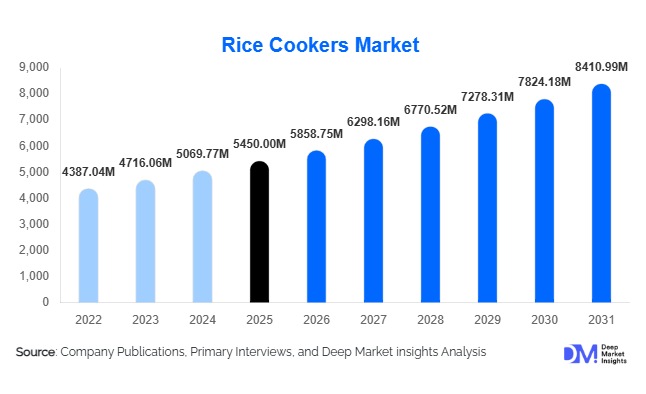
What are the latest trends in the rice cookers market?
Premiumization of Kitchen Appliances
The global rice cooker industry is witnessing strong premiumization trends as consumers increasingly prefer high-performance appliances with advanced cooking technologies. Premium rice cookers equipped with induction heating, pressure cooking mechanisms, and fuzzy logic temperature control systems provide superior cooking results and enhanced convenience. These products are particularly popular in developed markets such as Japan, South Korea, and urban China where consumers value precise cooking and product durability.
Manufacturers are also introducing high-end models with advanced inner pot materials, multi-layer heating systems, and AI-driven cooking algorithms. Premium rice cookers often feature improved insulation, multiple rice cooking modes for different grain types, and energy-efficient operation. As consumer awareness of quality and cooking performance grows, the premium segment is expected to contribute significantly to overall market revenue growth.
Integration of Smart and Connected Appliances
Smart kitchen ecosystems are becoming increasingly common, and rice cookers are being integrated into connected home environments. Manufacturers are developing rice cookers equipped with Wi-Fi connectivity, mobile applications, and voice assistant compatibility that allow users to control cooking functions remotely.
These smart appliances enable users to monitor cooking progress, schedule cooking times, and select recipes through mobile applications. The integration of AI-based cooking sensors is also improving cooking precision by automatically adjusting temperature and cooking time according to the rice type and quantity. As smart homes become more prevalent worldwide, connected rice cookers are expected to become a major product category within the industry.
What are the key drivers in the rice cookers market?
Growing Demand for Convenience Cooking
Modern lifestyles and busy work schedules are increasing demand for convenient cooking appliances that simplify meal preparation. Rice cookers provide a one-touch cooking solution that eliminates the need for constant monitoring and manual temperature control. Consumers appreciate the ability to cook rice consistently while performing other household activities.
The growing popularity of automated cooking appliances among working professionals, students, and urban households is significantly boosting market demand. Multi-functional rice cookers that can prepare soups, porridge, grains, and steamed vegetables are further expanding the appliance’s appeal beyond traditional rice cooking.
High Global Rice Consumption
Rice is one of the most widely consumed staple foods globally, particularly in Asia and Africa. Countries such as China, India, Indonesia, Vietnam, and Bangladesh rely heavily on rice as a primary dietary component. This high consumption level drives consistent demand for rice cooking appliances.
In many Asian households, rice cookers are considered an essential kitchen appliance. Increasing household incomes and rising penetration of electrical appliances in emerging economies are further accelerating rice cooker adoption.
What are the restraints for the global market?
Competition from Multi-Cookers and Pressure Cookers
The emergence of multi-functional pressure cookers and programmable kitchen appliances presents a challenge to traditional rice cookers. Consumers in several developed markets prefer appliances capable of performing multiple cooking functions rather than purchasing a dedicated rice cooker.
Many modern multi-cookers include rice cooking modes alongside slow cooking, sautéing, and pressure cooking capabilities, reducing the need for a separate rice cooker in some households.
Price Sensitivity in Developing Economies
In many developing regions, traditional stovetop cooking methods remain common due to lower cost and familiarity. Although rice cookers offer convenience, the initial cost of purchasing an electric appliance can limit adoption among low-income households.
Manufacturers must address this challenge by introducing affordable models targeted at emerging markets while maintaining acceptable product quality and durability.
What are the key opportunities in the rice cookers industry?
Expansion in Emerging Consumer Markets
Rapid urbanization and rising middle-class populations in countries such as India, Indonesia, Vietnam, and the Philippines present major opportunities for rice cooker manufacturers. Increasing disposable income and expanding access to electricity are encouraging households to adopt modern cooking appliances.
Affordable rice cooker models designed for local rice varieties and cooking preferences are expected to drive strong growth in these emerging markets. Companies that focus on localized product design and competitive pricing strategies can significantly expand their market presence.
Growth of Commercial Foodservice Demand
The global expansion of Asian cuisine restaurants, quick-service food chains, and institutional kitchens is creating strong demand for commercial rice cookers. Restaurants and catering businesses require high-capacity cooking appliances capable of preparing large volumes of rice efficiently and consistently.
Commercial rice cookers with capacities exceeding five liters are becoming essential equipment in professional kitchens. This segment is expected to grow rapidly as international demand for Asian cuisine continues to expand.
Report Scope
| Report Metric | Details |
|---|---|
| Market Size in 2025 | USD 5450 Million |
| Market Size in 2026 | USD 5858.75 Million |
| Market Size in 2031 | USD 8410.99 Million |
| CAGR | 7.5% (2026-2031) |
| Base Year for Estimation | 2025 |
| Historical Data | 2022-2024 |
| Forecast Period | 2026-2031 |
| Report Coverage | Revenue Forecast, Competitive Landscape, Supply Chain Disruption, Growth Factors, Environment & Regulatory Landscape and Trends |
| Geographies Covered | North America, Europe, APAC, Middle East and Africa, LATAM |
| Countries Covered | U.S., Canada, U.K., Germany, France, Spain, Italy, Russia, Nordic, Benelux, Rest of Europe, China, Korea, Japan, India, Australia, Singapore, Taiwan, South East Asia, Rest of Asia-Pacific, UAE, Turky, Saudi Arabia, South Africa, Egypt, Nigeria, Rest of MEA, Brazil, Mexico, Argentina, Chile, Colombia, Rest of LATAM |
Explore more data points, trends and opportunities Download Free Sample Report
Product Type Insights
Multi-functional rice cookers represent the leading product segment in the global rice cookers market, accounting for approximately 32% of total demand. The dominance of this segment is largely driven by consumer preference for versatile kitchen appliances that can perform multiple cooking tasks within a single device. Modern households increasingly favor appliances that provide convenience and efficiency, particularly in urban environments where kitchen space is limited. Multi-functional rice cookers are designed to prepare a wide range of meals beyond rice, including steamed vegetables, porridge, soups, grains, and slow-cooked dishes, allowing consumers to simplify meal preparation while reducing the need for multiple appliances. Technological improvements such as digital control panels, programmable cooking modes, and smart temperature regulation have further strengthened demand for these products.
Traditional electric rice cookers continue to maintain a substantial share of the market due to their affordability, ease of use, and reliability. These cookers remain particularly popular in developing and emerging economies where consumers prioritize cost-effective appliances that deliver consistent cooking performance. Pressure rice cookers and induction heating rice cookers form the premium segment of the market and are widely adopted in technologically advanced markets such as Japan and South Korea. These products offer enhanced cooking precision, improved texture, and faster cooking times, which appeal to consumers seeking superior cooking quality and advanced kitchen technology. Growing consumer interest in premium kitchen appliances and smart cooking solutions is expected to further support the growth of these high-end rice cooker categories.
Application Insights
The household segment dominates the rice cookers market, accounting for nearly 72% of global demand. The leading position of this segment is driven primarily by the widespread consumption of rice as a staple food across many regions, particularly in Asia-Pacific countries. Rice cookers provide a convenient and automated cooking solution that eliminates the need for manual monitoring, making them highly attractive for busy households and working professionals. Increasing urbanization, rising disposable incomes, and growing adoption of modern kitchen appliances are encouraging consumers to invest in devices that simplify everyday cooking tasks. In addition, technological innovations such as smart connectivity, preset cooking programs, and energy-efficient heating systems are further enhancing the appeal of rice cookers in residential kitchens.
The commercial foodservice sector represents an important and rapidly expanding application area within the market. Restaurants specializing in Asian cuisine, sushi establishments, and large-scale foodservice operations rely heavily on rice cookers to maintain consistent cooking quality and improve kitchen productivity. Institutional kitchens in schools, hospitals, and corporate cafeterias also use high-capacity rice cookers to efficiently prepare large quantities of rice. The expansion of global restaurant chains, the growing popularity of Asian food culture, and increasing demand for quick-service restaurants are contributing significantly to commercial rice cooker adoption worldwide. Catering companies, hotels, and food courts also require durable and high-capacity cooking equipment, which is further driving growth in this segment.
Distribution Channel Insights
Offline retail channels continue to dominate the rice cooker market, accounting for approximately 64% of total sales. The leading position of this segment is supported by consumer preference for physically examining appliances before making purchasing decisions. Supermarkets, hypermarkets, consumer electronics retailers, and specialty appliance stores allow buyers to evaluate product size, build quality, and features directly, which increases purchase confidence. In addition, in-store promotions, product demonstrations, and expert guidance from sales staff often influence purchasing decisions, particularly for higher-priced or technologically advanced models. These factors continue to sustain strong demand through brick-and-mortar retail networks across both developed and emerging markets.
Online retail channels are expanding rapidly as e-commerce platforms gain widespread adoption across global markets. Online marketplaces provide consumers with access to a broader range of product options, competitive pricing, and detailed product comparisons, which enhances the overall shopping experience. Customer reviews, rating systems, and digital marketing strategies also play a critical role in influencing purchasing behavior. Furthermore, manufacturers are increasingly strengthening their direct-to-consumer sales channels through official brand websites and digital storefronts, allowing them to improve brand engagement and expand global reach. As internet penetration and smartphone usage continue to increase worldwide, the online distribution channel is expected to experience strong growth in the coming years.
Capacity Insights
Medium-capacity rice cookers ranging from 1 to 3 liters represent the largest capacity segment in the market, accounting for approximately 41% of global demand. The leadership of this segment is primarily driven by its suitability for typical household usage. These models provide sufficient capacity to prepare meals for small to medium-sized families while maintaining an affordable price point and compact design. As urban households increasingly prioritize efficient kitchen appliances that balance functionality and space efficiency, medium-capacity rice cookers have become the preferred choice for residential consumers. Their versatility, moderate power consumption, and wide availability across retail channels further contribute to their strong market presence.
Large-capacity rice cookers with capacities above 3 liters are widely used in commercial environments such as restaurants, catering operations, and institutional kitchens where large quantities of rice must be prepared quickly and consistently. The expansion of the global foodservice industry and increasing demand for bulk meal preparation are supporting the growth of this segment. At the same time, small-capacity rice cookers below 1 liter are gaining popularity among single-person households, students, and young professionals living in compact urban apartments. The rising number of single-person households and micro-living spaces in major cities is encouraging demand for compact, energy-efficient cooking appliances designed for smaller meal portions.
Explore more data points, trends and opportunities Download Free Sample Report
Rice Cookers Market Segmentations
By Product Type
- Conventional Electric Rice Cookers
- Induction Heating Rice Cookers
- Micom (Microcomputer Controlled) Rice Cookers
- Pressure Rice Cookers
- Multi-Functional Rice Cookers
By Capacity
- Below 1 Liter
- 1–3 Liters
- 3–5 Liters
- Above 5 Liters
By Application
- Household / Residential
- Commercial Foodservice
- Institutional Kitchens (Schools, Hospitals, Corporate Cafeterias)
By Distribution Channel
- Online Retail / E-commerce
- Hypermarkets and Supermarkets
- Electronics and Appliance Specialty Stores
- Department Stores
- Direct-to-Consumer Brand Stores
Regional Insights
Asia-Pacific
Asia-Pacific dominates the global rice cooker market with approximately 63% of total market share, making it the largest and most influential regional market. The region’s leadership is primarily attributed to the cultural and dietary importance of rice, which serves as a staple food for a large proportion of the population. China represents the largest national market due to its massive population, high rice consumption levels, and widespread adoption of household cooking appliances. Japan and South Korea are technologically advanced markets characterized by strong consumer demand for premium rice cookers equipped with induction heating systems, artificial intelligence cooking algorithms, and smart connectivity features.
Rapid urbanization, rising disposable incomes, and the expansion of middle-class populations across emerging Asian economies are further accelerating market growth. Countries such as India, Indonesia, Thailand, and Vietnam are experiencing increasing adoption of modern kitchen appliances as consumers shift toward more convenient cooking solutions. Government initiatives supporting electrification, improving living standards, and expanding retail infrastructure are also contributing to greater appliance penetration. Additionally, the presence of leading rice cooker manufacturers and strong regional manufacturing capabilities further strengthens Asia-Pacific’s dominance in the global market.
North America
North America accounts for around 12% of global demand and represents a steadily expanding market for rice cookers. The United States is the primary contributor to regional demand, supported by the growing popularity of international cuisine and increasing consumer interest in convenient kitchen appliances. The rising influence of Asian food culture, including sushi, Korean, and Southeast Asian cuisine, has encouraged more households to adopt rice cookers as part of their everyday cooking routines. A large Asian immigrant population also contributes significantly to regional demand.
Consumers in North America are increasingly attracted to multifunctional and technologically advanced appliances that simplify meal preparation. Smart rice cookers with programmable settings, digital interfaces, and multi-cooking capabilities are gaining traction among tech-savvy households. Canada also represents a growing market, particularly in multicultural urban centers where rice consumption is increasing. The expansion of e-commerce platforms and improved access to international appliance brands are further supporting market growth throughout the region.
Europe
Europe holds approximately 11% of the global rice cooker market and is witnessing steady growth driven by evolving consumer lifestyles and dietary preferences. Countries such as the United Kingdom, Germany, and France represent major markets due to the rising popularity of global cuisine and increasing awareness of convenient cooking appliances. Busy urban lifestyles and a growing number of dual-income households are encouraging consumers to adopt automated cooking solutions that reduce meal preparation time.
The expansion of multicultural communities and the rising influence of Asian and Middle Eastern cuisine have also contributed to increased rice consumption across European countries. Retailers and appliance manufacturers are responding by expanding product availability and introducing compact, energy-efficient rice cooker models tailored to European kitchens. In addition, the growth of online retail platforms and cross-border e-commerce is improving product accessibility and driving greater market penetration across the region.
Latin America
Latin America accounts for roughly 7% of the global rice cooker market, with Brazil and Mexico representing the largest national markets in the region. Rice is an important staple food across many Latin American countries, which naturally supports demand for efficient cooking appliances. Increasing urbanization, expanding middle-class populations, and improvements in household income levels are encouraging consumers to invest in modern kitchen equipment.
The growth of organized retail networks and the rising availability of affordable household appliances are also contributing to market expansion. As consumers become more familiar with automated cooking solutions, rice cookers are increasingly viewed as convenient alternatives to traditional stovetop cooking methods. In addition, the expansion of regional foodservice industries and institutional kitchens is supporting demand for large-capacity rice cookers in commercial settings.
Middle East & Africa
The Middle East and Africa region represents approximately 7% of the global rice cooker market and is expected to experience steady growth over the coming years. Countries such as Saudi Arabia, the United Arab Emirates, and South Africa are among the leading markets due to rising household incomes, rapid urbanization, and increasing adoption of modern kitchen appliances. Growing expatriate populations and the popularity of rice-based dishes in Middle Eastern and African cuisines are also contributing to sustained demand.
Infrastructure development, expanding retail sectors, and greater access to imported consumer electronics are improving product availability throughout the region. In addition, the growing hospitality and foodservice industries are creating additional opportunities for commercial rice cooker adoption. As living standards continue to improve and consumers seek more efficient cooking solutions, the rice cooker market across the Middle East and Africa is expected to expand steadily in the coming years.
Key Players in the Rice Cookers Market
- Panasonic Corporation
- Zojirushi Corporation
- Tiger Corporation
- Midea Group
- Philips
- Toshiba Corporation
- Sharp Corporation
- Cuckoo Electronics
- Cuchen Co., Ltd.
- Breville Group
- Tefal
- Hamilton Beach Brands
- Aroma Housewares
- Supor
- Joyoung