Portable Chargers Market Size
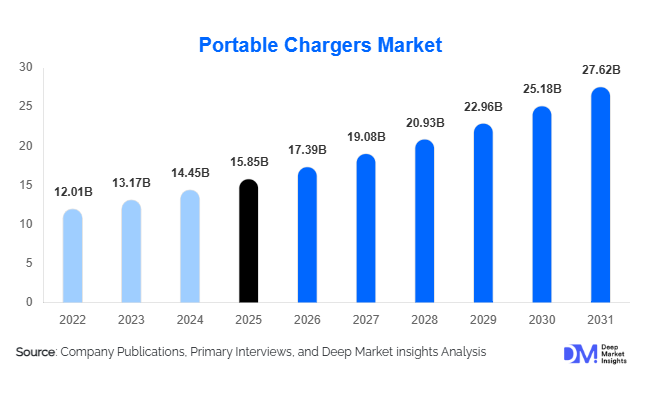
According to Deep Market Insights,The global portable chargers market size was valued at USD 15.85 billion in 2026 and is projected to grow from USD 17.39 billion in 2026 to reach USD 27.62 billion by 2031, expanding at a CAGR of 9.7% during the forecast period (2026–2031). The market growth is primarily driven by the increasing adoption of smartphones, tablets, and wearables, rising demand for fast-charging technologies, and growing consumer preference for portable power solutions in travel, outdoor, and professional environments.
Key Market Insights
- Power banks dominate the market, accounting for more than 70% of global demand due to their universal compatibility with multiple devices and frequent usage.
- High-capacity chargers (10,000–20,000 mAh) are increasingly preferred, balancing portability and multi-device charging convenience for both consumers and professionals.
- Asia-Pacific leads the market, with China and India driving demand through high smartphone penetration and expanding mobile ecosystems.
- North America represents a major share, led by the U.S., where high disposable income and premium device adoption fuel portable charger sales.
- Technological advancements, including wireless charging, USB-C PD fast charging, and solar-powered solutions, are transforming product offerings and consumer expectations.
- Online retail channels dominate distribution, providing wide product visibility, competitive pricing, and convenience for tech-savvy buyers worldwide.
What are the latest trends in the portable chargers market?
High-Capacity and Fast-Charging Solutions
Consumers are increasingly adopting portable chargers with higher battery capacities and fast-charging capabilities. Models supporting USB Power Delivery (PD) and Qualcomm Quick Charge enable multiple devices to recharge rapidly, catering to professionals, travelers, and gaming enthusiasts. The trend toward 20,000 mAh and above power banks allows users to power smartphones, tablets, and laptops without frequent recharging, driving upgrades in existing devices.
Integration of Wireless and Solar Charging Technologies
Wireless charging and solar-powered portable chargers are gaining traction. Consumers value cable-free convenience, especially for smartphones and wearables, while solar-enabled chargers appeal to outdoor enthusiasts and emergency preparedness users. Hybrid solutions combining wired and wireless charging with eco-friendly solar panels are increasingly marketed as sustainable, multifunctional products.
Compact and Multi-Device Charging Ecosystems
Manufacturers are focusing on compact, lightweight designs with multiple output ports to enable simultaneous charging of several devices. Portable charging hubs for smartphones, laptops, and wearables are becoming popular among remote workers and digital nomads, creating new market segments within the accessory ecosystem.
What are the key drivers in the portable chargers market?
Rapid Growth of Mobile Devices
With over 6.8 billion smartphone users globally and rising adoption of tablets, wearables, and gaming devices, continuous battery demand is fueling the portable chargers market. High-power applications like gaming, video streaming, and augmented reality accelerate battery depletion, driving consumers to invest in reliable charging solutions.
Travel and Remote Work Trends
Increasing travel, outdoor activities, and remote working arrangements are propelling demand for portable chargers. Consumers seek uninterrupted device connectivity for communication, work, and entertainment during transit, vacations, and outdoor excursions. The recovery of the global travel industry further reinforces this trend.
Technological Advancements in Battery and Charging
Innovations in lithium-polymer batteries, fast-charging protocols, and energy-efficient circuitry have enhanced charger portability, safety, and performance. High-capacity, lightweight, and smart charging devices enable differentiated offerings, catering to tech-savvy consumers who value convenience and speed.
What are the restraints for the global market?
Safety Concerns and Regulatory Compliance
Lithium-based batteries pose safety risks such as overheating and swelling, prompting stringent international transport and safety standards. Compliance increases production costs and presents challenges for small and medium-sized manufacturers.
Intense Price Competition
The market faces high price pressure from low-cost manufacturers, which reduces profitability for small brands. Consumers often opt for inexpensive options over premium products, limiting market expansion for high-end chargers without strong differentiation.
What are the key opportunities in the portable chargers market?
Emerging Markets Growth
Rising smartphone adoption and expanding digital connectivity in India, Indonesia, Brazil, and Nigeria offer substantial opportunities. Companies investing in localized manufacturing, distribution, and marketing can capitalize on this growing consumer base.
Renewable and Sustainable Charging Technologies
Solar-powered chargers and eco-friendly battery designs appeal to environmentally conscious consumers and outdoor enthusiasts. Manufacturers focusing on recyclable materials, energy-efficient circuits, and smart solar integration can differentiate their offerings.
Multi-Device Charging Solutions
The demand for chargers supporting multiple devices simultaneously, including smartphones, tablets, laptops, and wearables, creates opportunities for high-capacity, multi-port solutions. Bundled ecosystems, smart charging features, and USB-C PD integration are emerging areas for innovation.
Report Scope
| Report Metric | Details |
|---|---|
| Market Size in 2025 | USD 15.85 Billion |
| Market Size in 2026 | USD 17.39 Billion |
| Market Size in 2031 | USD 27.62 Billion |
| CAGR | 9.7% (2026-2031) |
| Base Year for Estimation | 2025 |
| Historical Data | 2022-2024 |
| Forecast Period | 2026-2031 |
| Report Coverage | Revenue Forecast, Competitive Landscape, Supply Chain Disruption, Growth Factors, Environment & Regulatory Landscape and Trends |
| Geographies Covered | North America, Europe, APAC, Middle East and Africa, LATAM |
| Countries Covered | U.S., Canada, U.K., Germany, France, Spain, Italy, Russia, Nordic, Benelux, Rest of Europe, China, Korea, Japan, India, Australia, Singapore, Taiwan, South East Asia, Rest of Asia-Pacific, UAE, Turky, Saudi Arabia, South Africa, Egypt, Nigeria, Rest of MEA, Brazil, Mexico, Argentina, Chile, Colombia, Rest of LATAM |
Explore more data points, trends and opportunities Download Free Sample Report
Product Type Insights
The power banks segment leads the portable chargers market and accounts for nearly 72% of the overall revenue share. The dominance of this segment is primarily driven by the widespread need for convenient and portable power solutions for smartphones and other connected devices. Increasing smartphone penetration, rising mobile data consumption, and the growing reliance on portable electronics for communication, entertainment, and work-related activities have significantly boosted the demand for power banks globally. Consumers increasingly prefer compact, high-capacity power banks with fast-charging capabilities and multiple output ports that allow simultaneous charging of several devices. In addition, technological advancements such as USB-C Power Delivery, quick charge compatibility, and improved lithium-ion battery efficiency are enhancing the performance and reliability of modern power banks. Furthermore, the growing popularity of wireless charging technologies and eco-conscious products is encouraging manufacturers to introduce wireless-enabled and solar-powered power banks that appeal to tech-savvy consumers and outdoor enthusiasts. Portable charging cases designed for smartphones, wireless earbuds, and wearable devices are also gaining traction as complementary products, while multi-device charging hubs are emerging as premium solutions for professionals, digital nomads, and frequent travelers who require reliable power access for multiple gadgets while on the move.
Application Insights
The smartphones segment represents the largest application area for portable chargers, accounting for more than 54% of total market demand. The segment’s leadership is primarily driven by the global surge in smartphone usage, increasing mobile internet penetration, and the rising consumption of high-power applications such as video streaming, gaming, and social media. As smartphones continue to evolve with larger displays, advanced processors, and 5G connectivity, battery consumption has increased significantly, creating strong demand for external charging solutions. Consumers are increasingly relying on portable chargers to maintain uninterrupted connectivity throughout the day, particularly in situations where access to conventional power outlets is limited. Beyond smartphones, tablets, laptops, and wearable devices are also contributing to market expansion as remote work, digital learning, and mobile productivity become more prevalent worldwide. The proliferation of smartwatches, wireless earbuds, and other connected accessories has further increased the need for portable charging solutions that support multiple device types. Additionally, emerging applications in outdoor recreation, adventure tourism, and emergency preparedness are creating niche but rapidly expanding opportunities for rugged and high-capacity portable chargers that can operate in challenging environments.
Distribution Channel Insights
Online retail represents the leading distribution channel in the portable chargers market, accounting for approximately 47% of global sales. The growth of e-commerce platforms has significantly transformed the purchasing behavior of consumers, offering a convenient and efficient way to compare products, read customer reviews, and access competitive pricing. Major online marketplaces and brand-owned digital storefronts provide consumers with a wide variety of portable charging products ranging from budget-friendly options to premium high-capacity devices with advanced charging features. The increasing penetration of smartphones, digital payment systems, and logistics networks has further strengthened the role of online channels in driving global sales. At the same time, offline retail continues to play an important role, particularly in developing economies where consumers prefer to evaluate electronic products physically before purchase. Electronics specialty stores, hypermarkets, convenience outlets, and airport retail locations remain key distribution points for portable chargers. These physical retail environments provide product demonstrations, brand visibility, and immediate purchase options, which remain important for first-time buyers and travelers seeking urgent charging solutions.
End-Use Insights
The consumer electronics segment represents the largest end-use category in the portable chargers market, primarily driven by the widespread adoption of smartphones, tablets, wireless earbuds, smartwatches, and other connected devices. As consumers increasingly rely on these devices for communication, entertainment, productivity, and digital payments, the need for reliable portable power solutions has become essential. The continuous introduction of advanced consumer electronics with higher power consumption requirements is further supporting the demand for high-capacity portable chargers. In addition to consumer electronics, the travel and tourism segment is emerging as one of the fastest-growing end-use areas, as travelers increasingly require portable energy solutions to keep their devices powered during long journeys, outdoor adventures, and international travel. Business travelers, digital nomads, and remote workers often depend on portable chargers to maintain productivity while on the move. Corporate and enterprise demand is also expanding as organizations equip employees with mobile devices for remote operations and field-based work. Moreover, niche end-use scenarios such as emergency preparedness, disaster response, camping, hiking, and outdoor recreation are creating additional demand for durable and high-performance portable chargers designed for extended usage and challenging environmental conditions.
Explore more data points, trends and opportunities Download Free Sample Report
Portable Chargers Market Segmentations
By Product Type
- Power Banks
- Wireless Portable Chargers
- Solar Portable Chargers
- Battery Charging Cases
- Multi-Device Charging Hubs
By Battery Capacity
- Below 5,000 mAh
- 5,000–10,000 mAh
- 10,000–20,000 mAh
- Above 20,000 mAh
By Application
- Smartphones
- Tablets
- Laptops
- Wearables
- Other Consumer Electronics
By Distribution Channel
- Online Retail
- Electronics & Specialty Stores
- Hypermarkets & Supermarkets
- Brand Stores
- Travel & Convenience Retailers
By End-Use Industry
- Consumer Electronics
- Travel & Tourism
- Corporate & Enterprise Use
- Outdoor & Adventure Activities
- Emergency & Disaster Preparedness
Regional Insights
Asia-Pacific
Asia-Pacific dominates the global portable chargers market and is expected to maintain its leadership position, accounting for approximately 42% of total market share in 2025. The region’s growth is primarily driven by strong demand in major economies such as China and India, where rapidly expanding smartphone adoption, growing digital connectivity, and a large consumer electronics manufacturing ecosystem support market expansion. China alone contributes nearly 21% of the global market due to its massive electronics production capacity and high domestic consumption of mobile devices. The presence of leading portable charger manufacturers, extensive supply chains, and continuous technological innovation further strengthen the region’s market leadership. In India and Southeast Asian countries, rising disposable incomes, a rapidly growing middle-class population, and increased internet penetration are accelerating the adoption of smartphones and connected devices. Additionally, the rapid expansion of e-commerce platforms and digital payment ecosystems is enabling wider accessibility of portable charging products across urban and rural areas. Government initiatives promoting digital infrastructure, combined with increasing travel activity and mobile workforce trends, are also contributing to sustained regional growth.
North America
North America represents approximately 24% of the global portable chargers market, with the United States accounting for nearly 19% of total demand. The region’s strong market position is supported by high purchasing power, widespread ownership of multiple smart devices per consumer, and a strong culture of technological adoption. Consumers in the United States and Canada demonstrate a strong preference for premium portable charging solutions with advanced features such as fast charging, wireless compatibility, and high-capacity battery storage. The presence of well-established consumer electronics brands and a mature retail infrastructure further supports product availability and innovation. Additionally, the increasing adoption of remote work, digital entertainment, and mobile gaming is driving higher device usage, thereby increasing the need for portable charging solutions. The strong penetration of e-commerce platforms and efficient logistics networks also contribute to the rapid distribution and adoption of new portable charger technologies across the region.
Europe
Europe holds approximately 18% of the global portable chargers market and continues to experience steady growth, led by key markets such as Germany, the United Kingdom, and France. The region’s growth is supported by high smartphone penetration, strong consumer awareness regarding product quality, and an increasing preference for technologically advanced electronic accessories. European consumers are particularly receptive to environmentally sustainable and energy-efficient products, which is encouraging manufacturers to develop eco-friendly portable chargers, including solar-powered and recyclable battery solutions. Additionally, the region’s well-developed travel and tourism sector contributes to steady demand for portable power solutions among international travelers and business professionals. The widespread adoption of digital services, mobile payments, and connected devices further increases the need for reliable portable charging options. Regulatory emphasis on energy efficiency and sustainable electronics manufacturing is also influencing innovation in battery technologies and portable charging products across the European market.
Middle East & Africa
The Middle East and Africa account for approximately 9% of the global portable chargers market and represent a region with strong long-term growth potential. Key markets such as the United Arab Emirates, Saudi Arabia, and South Africa are witnessing increasing adoption of smartphones and digital technologies, which is fueling demand for portable power solutions. Rapid urbanization, rising disposable incomes, and the expansion of digital services are contributing to increased ownership of consumer electronic devices across the region. In the Middle East, high travel frequency, business mobility, and tourism activity are supporting demand for portable chargers among professionals and international visitors. Meanwhile, in several African countries, portable chargers also play an important role in areas with inconsistent electricity infrastructure, providing a reliable backup power source for essential communication devices. The continued expansion of online retail platforms and mobile commerce is further improving the accessibility of portable charging products across the region.
Latin America
Latin America accounts for approximately 7% of the global portable chargers market, with Brazil and Mexico representing the largest regional markets. Growth in the region is primarily supported by increasing smartphone penetration, expanding mobile internet connectivity, and a growing young consumer population that heavily relies on digital devices for communication and entertainment. As mobile-first internet usage becomes more prevalent across Latin America, consumers are increasingly seeking portable power solutions that allow them to remain connected throughout the day. The rapid growth of e-commerce platforms and digital payment systems is improving product accessibility and enabling consumers to purchase portable chargers across a wide range of price segments. Additionally, the expansion of urban mobility, tourism, and gig economy employment is creating further demand for portable charging solutions that support continuous device usage in daily life.
Key Players in the Portable Chargers Market
- Anker Innovations
- Xiaomi Corporation
- Samsung Electronics
- Sony Corporation
- Belkin International
- AUKEY
- RAVPower
- Mophie
- ADATA Technology
- Lenovo Group
- Energizer Holdings
- Ambrane India
- ZMI Corporation
- Realme
- Baseus