Pimple Patch Market Size
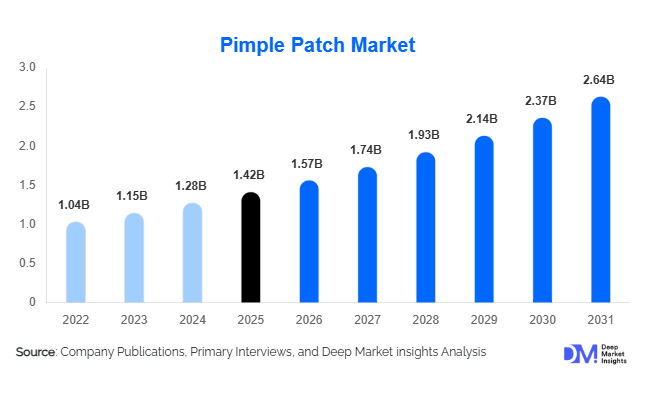
According to Deep Market Insights, the global pimple patch market size was valued at USD 1.42 billion in 2025 and is projected to grow from USD 1.57 billion in 2026 to reach USD 2.64 billion by 2031, expanding at a CAGR of 10.9% during the forecast period (2026–2031). The pimple patch market growth is primarily driven by rising acne prevalence among teenagers and adults, growing skincare awareness, increasing demand for non-invasive acne treatment solutions, and the strong influence of social-media-driven beauty trends.
Pimple patches have rapidly evolved from niche dermatology products into mainstream skincare essentials. Originally developed using hydrocolloid wound-healing technology, these patches are now widely adopted for acne extraction, inflammation reduction, scar prevention, and overnight spot treatment. The market has also expanded through advanced formulations incorporating salicylic acid, niacinamide, tea tree oil, sulfur, and microdart technologies capable of targeting deeper cystic acne.
Growing consumer preference for convenient and fast-acting skincare products continues to support market penetration globally. Social media platforms such as TikTok, Instagram, and YouTube have significantly accelerated product adoption through influencer-led skincare routines and user-generated beauty content. Decorative and fashion-oriented acne patches have further strengthened product appeal among Gen Z consumers, transforming pimple patches into both functional skincare products and lifestyle accessories.
Asia-Pacific, particularly South Korea and China, remains a global innovation hub for pimple patch manufacturing and exports, while North America continues to dominate premium skincare demand. Online retail channels, direct-to-consumer (DTC) business models, and dermatologist-backed product launches are reshaping competitive dynamics across the industry. Sustainability trends, including biodegradable packaging, vegan formulations, and clean-label skincare, are also expected to play a major role in future market expansion.
Key Market Insights
- Hydrocolloid pimple patches continue to dominate the market, accounting for the largest revenue share due to affordability, effectiveness, and broad consumer acceptance.
- Decorative and fashion-inspired acne patches are becoming mainstream, particularly among Gen Z consumers influenced by social media and celebrity-backed skincare trends.
- North America dominates the global market, supported by high skincare expenditure, strong e-commerce penetration, and rising adult acne treatment demand.
- Asia-Pacific is the fastest-growing regional market, driven by K-beauty innovation, increasing middle-class spending, and expanding online beauty retail channels.
- Microdart and medicated acne patches are gaining traction, especially for deep cystic acne treatment and premium dermatology-focused skincare applications.
- E-commerce and direct-to-consumer channels are reshaping distribution, enabling skincare brands to scale rapidly through influencer marketing and subscription-based sales models.
Pimple Patch Market Trends
Rise of Decorative and Fashion-Oriented Acne Patches
Pimple patches are increasingly evolving beyond traditional skincare products into fashion-forward beauty accessories. Decorative acne patches featuring colorful designs, stars, hearts, cartoon motifs, and celebrity collaborations are becoming highly popular among Gen Z consumers. Social media platforms such as TikTok and Instagram have accelerated this trend by normalizing visible acne care and encouraging self-expression through skincare. Brands are launching limited-edition collections and influencer partnerships to strengthen customer engagement and improve product differentiation. This shift is helping companies increase average selling prices while expanding the market beyond purely therapeutic skincare applications.
Growth of Advanced Microdart and Active Ingredient Technologies
Technological innovation is becoming a defining trend in the pimple patch industry. Companies are increasingly developing microneedle and microdart patches capable of delivering active ingredients deeper into the skin to treat cystic and hormonal acne. Advanced formulations incorporating salicylic acid, niacinamide, tea tree oil, retinol, and anti-inflammatory compounds are gaining popularity among consumers seeking clinically effective acne solutions. Brands are also focusing on ultra-thin invisible patches designed for daytime wear under makeup, improving consumer convenience and broadening usage frequency. The integration of dermatological science with cosmetic skincare continues to elevate the premium segment of the global pimple patch market.
Pimple Patch Market Drivers
Increasing Global Acne Prevalence
The rising prevalence of acne among teenagers and adults is one of the strongest drivers supporting pimple patch market growth. Urban pollution, hormonal imbalances, stress, unhealthy dietary habits, and increased cosmetic usage are contributing to higher acne incidence globally. Adult female acne has become particularly common in urban populations, expanding demand beyond the traditional teenage demographic. Pimple patches offer consumers a convenient, affordable, and non-invasive acne treatment option, making them increasingly popular within daily skincare routines.
Social Media and Influencer-Led Skincare Culture
Social media has significantly transformed consumer behavior within the skincare industry. Influencers, dermatologists, beauty bloggers, and skincare content creators regularly promote pimple patches through tutorials, overnight skincare routines, and acne transformation videos. Viral beauty trends have increased awareness regarding hydrocolloid technology and acne management solutions. Decorative acne patches have also helped normalize acne treatment visibility, especially among younger consumers. The ability of skincare brands to rapidly market products through TikTok and Instagram has accelerated customer acquisition and improved repeat-purchase rates across online channels.
Pimple Patch Market Restraints
High Market Competition and Product Commoditization
The pimple patch market is becoming increasingly competitive due to the entry of numerous private-label manufacturers and low-cost online sellers. Basic hydrocolloid patches are increasingly perceived as commoditized skincare products, creating pricing pressure for established brands. Intense competition across e-commerce marketplaces is limiting profit margins, especially within the mass-market segment. Counterfeit and low-quality products sold through third-party platforms also present reputational challenges for premium brands attempting to maintain consumer trust.
Limited Effectiveness for Severe Acne Conditions
Although pimple patches are highly effective for surface-level whiteheads and pustules, their effectiveness remains limited for severe cystic and hormonal acne conditions. Consumers with persistent acne often require prescription medication, dermatological procedures, or comprehensive skincare regimens beyond spot-treatment products. In addition, medicated patches containing active ingredients may trigger irritation among sensitive-skin consumers, creating formulation and regulatory challenges for manufacturers. These limitations may restrict market penetration within consumers seeking clinical-grade acne solutions.
Pimple Patch Market Opportunities
Expansion of Dermatology-Driven Premium Products
The growing consumer preference for clinically validated skincare products presents significant opportunities for premium pimple patch manufacturers. Companies investing in dermatologist-backed formulations, clinical trials, and advanced transdermal delivery technologies can command higher margins and improve brand loyalty. Microdart patches designed for cystic acne treatment, scar prevention, and inflammation reduction are expected to witness strong demand growth. Premium consumers increasingly prefer medically positioned skincare products with proven efficacy, creating opportunities for both established skincare brands and emerging dermatology startups.
Rapid Growth in Emerging Markets
Emerging economies such as India, Brazil, Indonesia, Vietnam, and the Middle East represent major untapped opportunities for pimple patch manufacturers. Rising disposable incomes, increasing beauty consciousness, worsening pollution-related skin concerns, and expanding e-commerce penetration are driving skincare demand in these regions. Younger populations and growing social-media engagement are also accelerating acne-care adoption among consumers. International brands are increasingly launching affordable product formats and localized marketing campaigns to capture market share in these high-growth economies.
Report Scope
| Report Metric | Details |
|---|---|
| Market Size in 2025 | USD 1.42 Billion |
| Market Size in 2026 | USD 1.57 Billion |
| Market Size in 2031 | USD 2.64 Billion |
| CAGR | 10.9% (2026-2031) |
| Base Year for Estimation | 2025 |
| Historical Data | 2022-2024 |
| Forecast Period | 2026-2031 |
| Report Coverage | Revenue Forecast, Competitive Landscape, Supply Chain Disruption, Growth Factors, Environment & Regulatory Landscape and Trends |
| Geographies Covered | North America, Europe, APAC, Middle East and Africa, LATAM |
| Countries Covered | U.S., Canada, U.K., Germany, France, Spain, Italy, Russia, Nordic, Benelux, Rest of Europe, China, Korea, Japan, India, Australia, Singapore, Taiwan, South East Asia, Rest of Asia-Pacific, UAE, Turky, Saudi Arabia, South Africa, Egypt, Nigeria, Rest of MEA, Brazil, Mexico, Argentina, Chile, Colombia, Rest of LATAM |
Explore more data points, trends and opportunities Download Free Sample Report
Product Type Insights
Hydrocolloid pimple patches dominate the market, accounting for the largest revenue share due to their affordability, effectiveness, and widespread consumer familiarity. These patches absorb pus and impurities while creating a protective healing barrier, making them highly popular among mass-market consumers. Active ingredient-infused patches containing salicylic acid, niacinamide, sulfur, and tea tree oil are rapidly gaining traction within premium skincare segments due to their targeted acne-treatment benefits. Microdart and microneedle patches represent one of the fastest-growing product categories as consumers increasingly seek solutions for deeper cystic acne. Decorative acne patches featuring fashionable designs and cosmetic aesthetics are also emerging as a high-growth niche segment, especially among younger demographics influenced by social-media beauty culture.
Application Insights
Whitehead and pustule treatment applications continue to dominate the pimple patch market because hydrocolloid technology is highly effective for surface-level acne extraction. Cystic acne treatment is rapidly emerging as a major application area due to advancements in microdart delivery systems capable of penetrating deeper skin layers. Post-acne wound healing and scar prevention applications are also witnessing increasing demand, particularly within dermatology clinics and medispas. Consumers are increasingly integrating pimple patches into overnight skincare routines, preventive acne management, and post-procedure healing applications following cosmetic treatments such as chemical peels and acne extraction procedures.
Distribution Channel Insights
E-commerce platforms dominate global pimple patch sales due to strong consumer preference for online skincare shopping and influencer-driven product discovery. Online marketplaces and direct-to-consumer brand websites allow companies to scale rapidly through targeted digital marketing campaigns, subscription-based models, and social-commerce integrations. Pharmacies and drug stores remain important distribution channels for mass-market and dermatologist-recommended products. Beauty specialty retailers continue to play a significant role in premium skincare positioning, particularly for Korean beauty brands and clinically focused acne-care products. Convenience stores and supermarkets are gradually expanding their acne-care product assortments, improving accessibility for impulse purchases and entry-level consumers.
Consumer Age Group Insights
Young adults aged 20–29 years account for the largest share of the global pimple patch market due to rising adult acne prevalence, high skincare spending, and strong engagement with social-media beauty trends. Teenagers remain a core consumer group because acne prevalence is highest within this demographic, driving recurring product purchases. Adults aged 30–45 years are increasingly contributing to market growth due to hormonal acne concerns and growing demand for premium dermatology-focused skincare solutions. Mature consumers above 45 years currently represent a smaller segment but are increasingly adopting pimple patches for occasional acne treatment and post-procedure skincare recovery.
Explore more data points, trends and opportunities Download Free Sample Report
Pimple Patch Market Segmentations
By Product Type
- Hydrocolloid Pimple Patches
- Active Ingredient-Infused Patches
- Microneedle / Microdart Acne Patches
- Decorative & Functional Acne Patches
- Natural & Clean-Label Patches
- Prescription / Clinical Acne Patches
By Material Composition
- Hydrocolloid-Based
- Silicone-Based
- Cellulose-Based
- Polyurethane Film-Based
- Biopolymer / Natural Fiber-Based
- Combination-Material Patches
By Application
- Whiteheads
- Blackheads
- Papules & Pustules
- Cystic Acne
- Hormonal Acne
- Post-Acne Healing & Scar Prevention
By Distribution Channel
- Pharmacies & Drug Stores
- Supermarkets & Hypermarkets
- Beauty Specialty Retailers
- Dermatology Clinics & Medispas
- E-commerce Marketplaces
- Direct-to-Consumer (DTC) Brand Websites
- Convenience Stores
By End Use
- Personal / Home Skincare
- Professional Dermatology Clinics
- Beauty Salons & Medispas
- Cosmetic Recovery Applications
- Influencer & Social Media Beauty Applications
Regional Insights
North America
North America remains the largest regional market for pimple patches, accounting for approximately 34% of global revenue in 2025. The United States dominates regional demand due to high skincare expenditure, strong social-media influence, widespread acne awareness, and growing adoption of premium skincare products. Consumers in the U.S. increasingly prefer invisible daytime patches, dermatologist-backed formulations, and medicated acne solutions. Canada is also witnessing rising demand for clean-label, vegan, and sensitive-skin-compatible pimple patches. Strong e-commerce penetration and influencer marketing continue to accelerate category growth across the region.
Europe
Europe represents a mature but steadily growing pimple patch market led by Germany, the United Kingdom, France, Italy, and Spain. European consumers increasingly prioritize sustainable packaging, cruelty-free formulations, and dermatologically tested skincare products. Korean beauty trends continue to influence consumer preferences, particularly among younger demographics seeking innovative acne-care solutions. Premium skincare retailers and pharmacy chains remain important distribution channels across Western Europe, while online beauty platforms continue expanding rapidly.
Asia-Pacific
Asia-Pacific is the fastest-growing regional market and accounted for nearly 32% of global revenue in 2025. South Korea remains the global innovation center for pimple patch technology and K-beauty product development. China is witnessing rapid demand growth due to rising beauty awareness, increasing disposable incomes, and expanding online retail penetration. India is emerging as one of the most attractive growth markets because of its large teenage population, worsening pollution-related acne concerns, and growing skincare awareness among urban consumers. Japan and Australia remain stable premium skincare markets focused on minimalist and sensitive-skin-compatible formulations.
Latin America
Latin America is gradually emerging as a promising market for pimple patches, particularly in Brazil and Mexico. Rising social-media influence, increasing beauty consciousness, and expanding access to global skincare brands are supporting regional demand growth. Brazilian consumers demonstrate strong interest in cosmetic skincare and acne-treatment products, while online retail channels are improving accessibility for international brands across the region.
Middle East & Africa
The Middle East & Africa region is witnessing growing adoption of premium skincare and acne-treatment solutions, particularly in the UAE and Saudi Arabia. Rising disposable income, increasing beauty spending, and strong demand for international skincare brands are supporting market growth. South Africa remains one of the key African markets due to growing pharmacy retail infrastructure and rising awareness regarding dermatological skincare products. Expanding beauty retail investments and digital commerce penetration are expected to further accelerate regional market expansion.
Key Players in the Pimple Patch Market
- Hero Cosmetics
- COSRX
- Rael
- Peace Out Skincare
- Starface
- Patchology
- Acropass
- Peach Slices
- PanOxyl
- Nexcare
- Some By Mi
- Olive Young
- Avarelle
- The Klog
- Mighty Patch