Pest Control Market Size
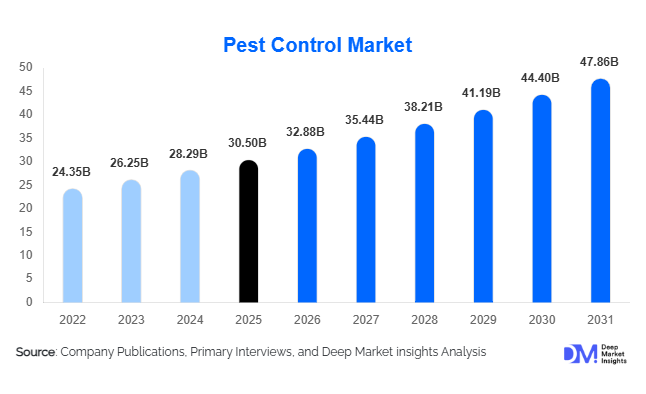
According to Deep Market Insights, the global pest control market was valued at USD 30.5 billion in 2025 and is projected to grow from USD 32.88 billion in 2026 to reach USD 48.0 billion by 2031, expanding at a CAGR of 7.8% during the forecast period (2026–2031). The market growth is driven by rising urbanization, increasing prevalence of vector-borne diseases, tightening food safety regulations, and growing adoption of integrated pest management solutions across residential, commercial, and industrial sectors worldwide.
Key Market Insights
- Integrated Pest Management (IPM) is becoming the dominant service model, replacing traditional chemical-heavy approaches across developed markets.
- Commercial pest control leads global demand, especially from food processing, hospitality, and healthcare industries requiring strict compliance standards.
- Asia-Pacific is the fastest-growing region, driven by urbanization, infrastructure expansion, and rising hygiene awareness.
- North America remains the largest market due to strong regulatory enforcement and high adoption of professional pest services.
- Digital pest control solutions are emerging rapidly, including IoT-based monitoring, AI-driven detection, and smart traps.
- Contract-based recurring services are replacing one-time treatments, improving revenue stability for service providers.
Pest Control Market Trends
Shift Toward Smart and Digital Pest Management
The pest control industry is undergoing a major transformation with the integration of digital technologies. IoT-enabled traps, AI-powered pest detection systems, and cloud-based monitoring platforms are enabling real-time tracking and predictive pest control. Commercial facilities such as warehouses, food storage units, and hospitality chains are increasingly adopting smart pest control ecosystems that reduce manual intervention and improve efficiency. These technologies are also helping companies comply with stringent audit requirements by maintaining digital records of pest activity and treatment cycles.
Growing Demand for Eco-Friendly Pest Solutions
Environmental regulations and consumer awareness are driving a strong shift toward eco-friendly pest control solutions. Biopesticides, pheromone traps, and organic treatment methods are gaining traction as alternatives to conventional chemical pesticides. Governments in North America and Europe are enforcing strict restrictions on toxic chemicals, pushing companies to innovate safer formulations. This trend is also being supported by residential consumers who prefer non-toxic, pet-safe, and environmentally responsible pest management services.
Pest Control Market Drivers
Rising Urbanization and Infrastructure Expansion
Rapid urbanization is a key driver of pest control demand, as densely populated cities create ideal conditions for pest infestations. Expansion of residential complexes, commercial buildings, airports, and metro systems has significantly increased the need for preventive pest management. Emerging economies such as India, China, and Brazil are witnessing strong infrastructure growth, directly fueling demand for professional pest control services across construction, maintenance, and facility management sectors.
Increasing Incidence of Vector-Borne Diseases
The rising prevalence of diseases such as dengue, malaria, Lyme disease, and rodent-borne infections is driving government-led pest control initiatives globally. Public health agencies are investing heavily in mosquito and rodent control programs, particularly in tropical and subtropical regions. This has led to increased adoption of both residential and municipal pest control services, especially during seasonal outbreak periods.
Stringent Food Safety and Hygiene Regulations
Industries such as food processing, hospitality, and pharmaceuticals are under strict regulatory pressure to maintain pest-free environments. Compliance with HACCP, ISO standards, and local food safety laws is driving continuous demand for scheduled pest control services. This has significantly boosted long-term contract-based service models, ensuring recurring revenue streams for industry participants.
Pest Control Market Restraints
Regulatory Restrictions on Chemical Pesticides
Growing environmental concerns have led to stricter regulations on chemical pesticides across several regions. Bans and limitations on toxic substances are increasing operational challenges for pest control providers. Companies are required to invest in R&D for safer alternatives, which increases costs and slows down product innovation cycles.
Labor Dependency and Service Quality Variability
The pest control industry remains highly labor-intensive, requiring skilled technicians for effective service delivery. Inconsistent training standards and labor shortages in developed markets often lead to variability in service quality. This impacts customer retention and creates challenges for scaling operations across multiple geographies.
Pest Control Market Opportunities
Expansion of Smart City and Infrastructure Projects
Global smart city initiatives present significant growth opportunities for pest control providers. Large-scale infrastructure projects require continuous pest management in residential complexes, transportation systems, and public facilities. Governments are increasingly integrating pest control into urban planning frameworks, creating long-term demand pipelines for service providers.
Growth of Subscription-Based Pest Control Models
The shift toward subscription-based service models is creating recurring revenue opportunities. Customers now prefer annual maintenance contracts instead of one-time treatments, ensuring continuous pest prevention. This model is especially popular in commercial and industrial sectors, where compliance requirements necessitate regular inspections and treatments.
Rising Demand for Sustainable and Biological Solutions
The transition toward sustainable pest management is opening new innovation opportunities. Biocontrol agents, microbial pesticides, and non-toxic traps are gaining acceptance across residential and commercial segments. Companies investing in green chemistry and sustainable pest solutions are expected to gain competitive advantage in the long term.
Report Scope
| Report Metric | Details |
|---|---|
| Market Size in 2025 | USD 30.5 Billion |
| Market Size in 2026 | USD 32.88 Billion |
| Market Size in 2031 | USD 47.86 Billion |
| CAGR | 7.8% (2026-2031) |
| Base Year for Estimation | 2025 |
| Historical Data | 2022-2024 |
| Forecast Period | 2026-2031 |
| Report Coverage | Revenue Forecast, Competitive Landscape, Supply Chain Disruption, Growth Factors, Environment & Regulatory Landscape and Trends |
| Geographies Covered | North America, Europe, APAC, Middle East and Africa, LATAM |
| Countries Covered | U.S., Canada, U.K., Germany, France, Spain, Italy, Russia, Nordic, Benelux, Rest of Europe, China, Korea, Japan, India, Australia, Singapore, Taiwan, South East Asia, Rest of Asia-Pacific, UAE, Turky, Saudi Arabia, South Africa, Egypt, Nigeria, Rest of MEA, Brazil, Mexico, Argentina, Chile, Colombia, Rest of LATAM |
Explore more data points, trends and opportunities Download Free Sample Report
Product Type Insights
Insect control dominates the global pest control market, accounting for approximately 41% of total market share in 2025. This leadership is primarily driven by the widespread prevalence of mosquitoes, cockroaches, termites, and ants across both developed and emerging economies. Rising concerns related to vector-borne diseases such as dengue, malaria, and Zika virus, along with increasing urban density, continue to strengthen demand for insect control solutions. Technological advancements in targeted spraying systems and eco-friendly insecticides are further enhancing efficiency and adoption globally.
Rodent control represents the second-largest segment, supported by its critical role in urban sanitation, food safety, and disease prevention. Rapid urbanization, waste accumulation, and expanding food storage facilities are key factors contributing to rodent infestations, particularly in metropolitan areas. Termite control remains highly significant in regions with wooden infrastructure exposure, especially in North America and parts of Asia-Pacific, where structural protection is a long-term requirement for residential and commercial buildings. Wildlife pest control, though relatively niche, is expanding steadily in suburban and rural regions due to increasing human-wildlife interaction and habitat disruption.
Integrated Pest Management (IPM) is emerging as the fastest-growing solution framework, driven by regulatory pressure to reduce chemical usage and increasing demand for sustainable pest control practices. IPM combines chemical, biological, and mechanical approaches, enabling long-term pest prevention rather than reactive extermination. This segment is particularly gaining traction in commercial and industrial sectors where compliance, sustainability, and cost efficiency are key priorities. The shift toward IPM is expected to redefine traditional pest control approaches over the forecast period.
Application Insights
Commercial applications dominate the pest control market, led by strong demand from food processing, hospitality, healthcare, and retail sectors. This dominance is primarily driven by strict regulatory compliance requirements, hygiene certifications, and zero-tolerance policies toward pest infestations. Industries such as food manufacturing and hospitality rely heavily on recurring pest management contracts to ensure operational safety and regulatory adherence.
Residential pest control is witnessing rapid expansion due to increasing urban housing density, rising disposable incomes, and growing awareness of health risks associated with pests. Consumers are increasingly adopting preventive pest control services rather than reactive treatments, supported by subscription-based service models. Industrial applications, particularly in logistics and warehousing, are growing significantly due to globalization of supply chains and rising risks of stored product pests.
Agricultural pest control continues to play a vital role in crop protection, yield optimization, and export compliance, especially in developing economies. Healthcare facilities represent a high-value niche segment, driven by strict infection control protocols and zero-contamination requirements, making pest management an essential operational necessity.
Distribution Channel Insights
Direct service providers remain the dominant distribution channel, leveraging on-site pest management operations and long-term contractual agreements. This model is particularly strong in commercial and industrial sectors where customized pest control programs are required. Online platforms and digital booking systems are rapidly gaining traction, enabling customers to compare services, access transparent pricing, and schedule treatments efficiently.
Franchise-based models are widely adopted by global pest control companies to expand geographic reach while maintaining service standardization. Corporate contracts remain the most stable and revenue-generating channel, especially in industries requiring regulatory compliance and continuous monitoring. Additionally, digital subscription platforms are emerging as a transformative channel in the residential segment, offering automated scheduling, recurring services, and customer engagement through mobile applications.
End-Use Industry Insights
The food and beverage industry is the largest end-use segment in the pest control market, driven by stringent hygiene regulations, export compliance requirements, and the need for contamination-free production environments. Hospitality and healthcare sectors also represent major contributors, as both operate under strict sanitation and pest-free mandates.
Residential housing is a rapidly growing end-use segment, fueled by urbanization, rising living standards, and increased awareness of health risks associated with pests. Warehousing and logistics are emerging as high-growth sectors due to global trade expansion and increased risks of stored product contamination. Agriculture remains a stable and essential demand base, particularly in developing economies where pest control is critical for food security, yield protection, and export competitiveness.
Explore more data points, trends and opportunities Download Free Sample Report
Pest Control Market Segmentations
By Product Type
- Insect Control
- Rodent Control
- Termite Control
- Wildlife Pest Control
- Integrated Pest Management
By Application
- Commercial Pest Control
- Residential Pest Control
- Industrial Pest Control
- Agricultural Pest Control
- Healthcare & Pharmaceutical Facilities
By Service Type / Delivery Model
- On-Demand Reactive Services
- Scheduled Preventive Services
- Contract-Based Recurring Services
- Digital & IoT-Enabled Monitoring Services
By Distribution Channel
- Direct Service Providers
- Franchise-Based Service Networks
- Online Booking Platforms / Digital Aggregators
- Corporate & Institutional Contracts
- Subscription-Based Pest Control Platforms
Regional Insights
North America
North America holds the largest share of the global pest control market at approximately 32%, driven by strong regulatory frameworks, high consumer awareness, and widespread adoption of professional pest management services. The United States leads the region, followed by Canada, with strong demand across residential, commercial, and industrial sectors.
Increasing prevalence of urban pest infestations, stringent food safety regulations (FDA and USDA standards), high adoption of smart pest control technologies, and strong presence of organized service providers. Additionally, rising concerns over public health and property protection continue to sustain long-term demand.
Europe
Europe accounts for around 25% of the global market, with key demand concentrated in Germany, the United Kingdom, and France. The region is characterized by strict environmental and chemical regulations, which are accelerating the adoption of eco-friendly and integrated pest management solutions.
Strong regulatory push for sustainable pest control, increasing demand for IPM-based services, rising urbanization, and growing awareness of food safety standards. The region is also witnessing increased adoption of biological pest control methods due to environmental concerns and carbon reduction goals.
Asia-Pacific
Asia-Pacific is the fastest-growing regional market, led by China, India, Japan, and Southeast Asia. Rapid urbanization, population expansion, and large-scale infrastructure development are significantly increasing pest infestation risks and driving service demand.
Rising disposable income, increasing awareness of hygiene and vector-borne diseases, expansion of residential and commercial construction, and government-led public health initiatives. Additionally, growing food export industries in China and India are strengthening demand for compliance-driven pest control services.
Latin America
Latin America is experiencing moderate but steady growth, led by Brazil and Mexico. The region’s tropical climate creates persistent pest challenges, particularly in agriculture and residential sectors.
Expansion of agricultural exports, increasing urbanization, rising tourism activity, and growing awareness of disease prevention. Additionally, demand is supported by increasing investments in food processing and hospitality infrastructure.
Middle East & Africa
The Middle East and Africa region is emerging as a high-potential market, driven by infrastructure development in the UAE, Saudi Arabia, and South Africa. The region benefits from rapid urban development and increasing investments in tourism and hospitality sectors.
Large-scale infrastructure projects, rising hospitality and tourism investments, climate conditions favorable to pest proliferation, and increasing government-led sanitation initiatives. Africa, in particular, presents long-term growth potential due to expanding urban populations and improving public health awareness.
Key Players in the Pest Control Market
- Rentokil Initial
- Rollins Inc.
- Anticimex
- Ecolab
- ServiceMaster Brands
- Bayer Environmental Science
- BASF SE
- Sumitomo Chemical
- FMC Corporation
- Massey Services
- Arrow Exterminators
- Rentokil (Global Operations)
- Killgerm Group
- Terminix (under Rentokil structure)
- Modern Pest Services