Paint Brush Set Market Size
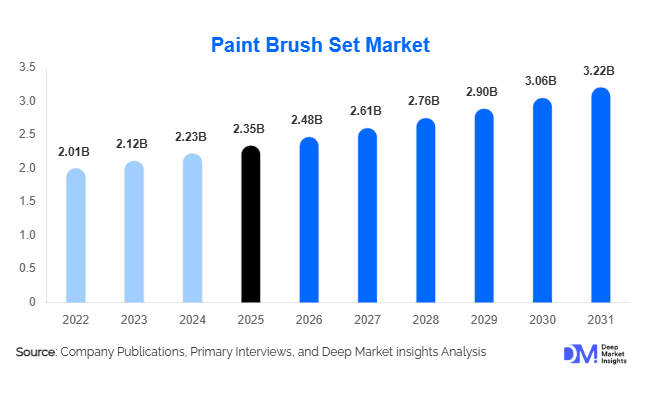
According to Deep Market Insights, the global paint brush set market size was valued at USD 2.35 billion in 2025 and is projected to grow from USD 2.48 billion in 2026 to reach USD 3.22 billion by 2031, expanding at a CAGR of 5.4% during the forecast period (2026–2031). The paint brush set market growth is being driven by rising global spending on home improvement activities, increasing participation in arts and crafts, expansion of construction and renovation projects, and growing demand for professional-grade painting tools across residential, commercial, and industrial applications. The market also benefits from the increasing adoption of high-performance synthetic bristles, advancements in ergonomic brush design, and growing e-commerce penetration that has improved product accessibility across developed and emerging economies.
Key Market Insights
- Synthetic bristle brush sets dominate the market, accounting for nearly 49% of global revenue due to their durability, affordability, and compatibility with multiple paint types.
- DIY consumers and hobbyists represent the largest end-user segment, contributing approximately 33% of global demand as home renovation and creative hobbies continue to gain popularity.
- Asia-Pacific leads the global market, holding nearly 39% market share, supported by strong manufacturing capabilities and rising domestic consumption in China and India.
- Online retail channels are rapidly transforming distribution, allowing manufacturers to expand global reach while offering broader product selections and competitive pricing.
- Premium artist-grade brush sets are experiencing accelerated growth, driven by increasing consumer willingness to invest in higher-quality tools for professional and recreational painting activities.
- Sustainability initiatives are influencing purchasing decisions, encouraging manufacturers to adopt recycled materials, eco-friendly packaging, and cruelty-free synthetic alternatives to natural bristles.
Paint Brush Set Market Trends
Growing Adoption of Advanced Synthetic Bristle Technologies
One of the most significant trends shaping the paint brush set market is the growing adoption of advanced synthetic filament technologies. Manufacturers are developing premium nylon and polyester blends capable of replicating the performance characteristics of natural bristles while offering superior durability, chemical resistance, and paint retention capabilities. These innovations are helping manufacturers reduce dependency on natural animal-derived fibers while addressing sustainability concerns. Professional painters, contractors, and artists increasingly prefer synthetic brush sets due to their consistent performance across acrylic, latex, and water-based paints. Furthermore, advancements in filament tapering and tip engineering are improving paint release, precision, and finish quality, enabling synthetic brushes to penetrate premium market segments previously dominated by natural hair brushes.
E-Commerce Expansion Reshaping Market Distribution
The rapid growth of e-commerce platforms is transforming how paint brush sets are marketed and sold globally. Consumers increasingly prefer online channels due to greater product variety, competitive pricing, customer reviews, and convenient delivery options. Manufacturers are expanding direct-to-consumer sales models through branded websites and digital marketplaces, reducing reliance on traditional retail networks. Social media marketing, influencer-driven product demonstrations, and online painting tutorials are further influencing consumer purchasing decisions. Subscription-based art supply services and bundled DIY project kits are also emerging as innovative distribution formats, creating recurring revenue opportunities for manufacturers while increasing customer engagement and retention.
Paint Brush Set Market Drivers
Rising Home Renovation and DIY Activities
The global DIY movement continues to be one of the strongest growth drivers for the paint brush set market. Consumers are increasingly undertaking home renovation, furniture restoration, decorative painting, and craft projects independently, driven by cost savings and the availability of digital learning resources. Social media platforms, video tutorials, and home improvement content creators have significantly expanded consumer awareness and confidence in DIY painting activities. As a result, demand for multi-purpose brush sets, premium decorative brushes, and furniture refinishing kits continues to rise across North America, Europe, and Asia-Pacific.
Expansion of Global Construction and Renovation Industries
Strong growth in residential construction, commercial infrastructure development, and urban renovation projects continues to support demand for professional painting tools. While spray systems and rollers have gained popularity for large-scale applications, paint brushes remain indispensable for finishing work, edge detailing, touch-ups, and specialty coatings. Infrastructure modernization programs across China, India, the Middle East, and Southeast Asia are generating sustained demand for contractor-grade paint brush sets. Additionally, increasing investments in commercial real estate, hospitality projects, and public infrastructure continue to create opportunities for professional painting contractors worldwide.
Paint Brush Set Market Restraints
Competition from Alternative Coating Technologies
The increasing adoption of paint sprayers, automated coating systems, and advanced roller technologies presents a challenge for traditional brush manufacturers. Industrial users, automotive refinishing companies, and large-scale contractors are increasingly adopting automated application methods to improve efficiency and reduce labor requirements. While paint brushes remain essential for detailed finishing applications, alternative technologies may limit volume growth in certain professional and industrial segments.
Raw Material Price Volatility
Manufacturers continue to face pricing pressures arising from fluctuations in raw material costs, including synthetic polymers, natural bristles, wood handles, ferrules, and packaging materials. Supply chain disruptions, transportation cost increases, and commodity market volatility can significantly impact production costs and profit margins. Smaller manufacturers are particularly vulnerable to these fluctuations due to limited purchasing power and reduced ability to absorb cost increases.
Paint Brush Set Market Opportunities
Premiumization Across Consumer and Professional Segments
The growing willingness of consumers and professionals to invest in higher-quality painting tools presents substantial opportunities for manufacturers. Premium brush sets featuring advanced synthetic filaments, ergonomic handles, and specialized brush shapes command higher margins and demonstrate stronger customer loyalty. As DIY consumers increasingly seek professional-grade finishes, manufacturers can capitalize by expanding premium product portfolios targeting home improvement enthusiasts and serious hobbyists.
Sustainable and Eco-Friendly Product Development
Environmental sustainability is becoming a key differentiator in the paint brush set market. Manufacturers that incorporate recycled plastics, bamboo handles, biodegradable packaging, and cruelty-free synthetic bristles are gaining competitive advantages, particularly in North America and Europe. Sustainability certifications and transparent sourcing practices are increasingly influencing procurement decisions among educational institutions, government buyers, and environmentally conscious consumers.
Report Scope
| Report Metric | Details |
|---|---|
| Market Size in 2025 | USD 2.35 Billion |
| Market Size in 2026 | USD 2.48 Billion |
| Market Size in 2031 | USD 3.22 Billion |
| CAGR | 5.4% (2026-2031) |
| Base Year for Estimation | 2025 |
| Historical Data | 2022-2024 |
| Forecast Period | 2026-2031 |
| Report Coverage | Revenue Forecast, Competitive Landscape, Supply Chain Disruption, Growth Factors, Environment & Regulatory Landscape and Trends |
| Geographies Covered | North America, Europe, APAC, Middle East and Africa, LATAM |
| Countries Covered | U.S., Canada, U.K., Germany, France, Spain, Italy, Russia, Nordic, Benelux, Rest of Europe, China, Korea, Japan, India, Australia, Singapore, Taiwan, South East Asia, Rest of Asia-Pacific, UAE, Turky, Saudi Arabia, South Africa, Egypt, Nigeria, Rest of MEA, Brazil, Mexico, Argentina, Chile, Colombia, Rest of LATAM |
Explore more data points, trends and opportunities Download Free Sample Report
Product Type Insights
Artist paint brush sets emerged as the leading product category, accounting for approximately 38% of global paint brush set market revenue in 2025. The segment's dominance is primarily driven by the growing global participation in fine arts, professional illustration, creative education programs, and recreational painting activities. Increasing enrollment in art schools, expanding demand for hobby-based creative activities, and the influence of digital platforms showcasing painting tutorials have significantly increased brush set consumption across both professional and amateur user groups. Watercolor, acrylic, and oil painting brush sets continue to witness robust demand due to the rising popularity of personalized artwork, commissioned paintings, and independent content creation. Furthermore, artist brush sets typically command higher average selling prices compared to standard decorative brushes, contributing disproportionately to market revenues.
Decorative and DIY paint brush sets represent the second-largest product category, supported by the continued expansion of home improvement and furniture restoration projects worldwide. Consumers increasingly undertake painting projects independently, driven by rising labor costs and the availability of online instructional content. Demand for multi-purpose brush kits, furniture refinishing brushes, and decorative wall painting tools has strengthened considerably across North America and Europe.
Professional contractor paint brush sets continue to benefit from growth in residential and commercial construction activity. Infrastructure development, urban renovation projects, and commercial real estate investments are supporting consistent demand for high-performance contractor-grade brushes. Meanwhile, industrial paint brush sets maintain stable demand in maintenance, repair, marine coatings, and specialty finishing applications where precision coating and touch-up work remain essential despite increasing automation in painting processes.
Bristle Material Insights
Synthetic bristle brush sets dominated the global market with approximately 49% revenue share in 2025, making them the most widely adopted brush material category worldwide. The segment's leadership is attributed to significant advancements in synthetic filament engineering, allowing manufacturers to replicate the paint retention, flexibility, and finish quality traditionally associated with natural bristles. Synthetic brushes offer superior durability, moisture resistance, easier cleaning, and longer operational lifespan while remaining substantially more affordable than premium natural-hair alternatives.
The increasing shift toward water-based paints and environmentally friendly coatings has further accelerated synthetic brush adoption, particularly across residential and commercial painting applications. Regulatory restrictions regarding animal-derived materials in several markets have also encouraged manufacturers and consumers to transition toward synthetic alternatives. In addition, synthetic fibers provide greater consistency in manufacturing, resulting in improved quality control and product standardization.
Natural bristle brush sets continue to maintain a strong presence within premium artist and specialty finishing applications, particularly in oil painting, varnishing, and decorative finishing projects where specific texture characteristics remain highly valued. Hybrid bristle technologies are emerging as a fast-growing niche segment, combining synthetic durability with the performance benefits of natural fibers, particularly among professional artists and premium DIY users seeking enhanced versatility.
Distribution Channel Insights
Online retail accounted for approximately 31% of global paint brush set sales in 2025, making it the largest and fastest-growing distribution channel. The segment's expansion is being driven by increasing internet penetration, growing consumer preference for digital shopping platforms, and the availability of extensive product assortments that are often unavailable through traditional retail stores. Online channels allow consumers to compare prices, evaluate product reviews, access expert recommendations, and purchase specialized brush sets from international manufacturers.
E-commerce platforms have become particularly important for premium artist brush manufacturers and niche specialty brands seeking global market access without extensive physical retail investments. The rise of direct-to-consumer business models has further strengthened online sales growth, allowing manufacturers to improve margins while establishing stronger customer relationships through targeted marketing campaigns and loyalty programs.
Specialty art supply retailers remain critical for premium and professional-grade brush sales, particularly among artists seeking expert guidance and product demonstrations. Home improvement retailers continue to dominate contractor and DIY product sales, benefiting from strong foot traffic associated with renovation projects. Meanwhile, wholesale and B2B distributors maintain substantial market presence across construction, industrial maintenance, educational institutions, and government procurement channels, where bulk purchasing remains common.
End-User Insights
DIY consumers and hobbyists represented the largest end-user segment, accounting for approximately 33% of global market demand in 2025. This leadership is largely attributed to the rapid expansion of home improvement culture, furniture restoration activities, decorative painting projects, and recreational arts and crafts participation. Social media platforms, online learning resources, and home renovation television programming have collectively increased consumer engagement in painting-related activities, creating sustained demand for versatile and affordable brush sets.
The segment has also benefited from growing consumer interest in personalization and handcrafted products. Increasing numbers of consumers are engaging in furniture upcycling, custom home décor creation, and artistic hobby projects, driving purchases of specialized brush kits designed for multiple applications.
Professional artists continue to generate a significant proportion of premium product revenues, particularly within watercolor, acrylic, and oil painting categories. Educational institutions provide a stable demand base through school art programs, universities, and private art academies. Professional painting contractors remain key purchasers of contractor-grade brush sets, supported by growth in residential housing construction, commercial property renovation, and infrastructure maintenance projects. Industrial maintenance teams contribute additional demand through applications involving corrosion protection, equipment refurbishment, marine coatings, and industrial facility upkeep.
Explore more data points, trends and opportunities Download Free Sample Report
Paint Brush Set Market Segmentations
By Product Type
- Artist Paint Brush Sets
- Decorative & DIY Paint Brush Sets
- Professional Contractor Paint Brush Sets
- Industrial Paint Brush Sets
By Bristle Material
- Synthetic Bristle Brush Sets
- Natural Bristle Brush Sets
- Hybrid Bristle Brush Sets
By Brush Shape
- Flat Brush Sets
- Round Brush Sets
- Filbert Brush Sets
- Angular Brush Sets
- Fan Brush Sets
- Specialty Mixed Shape Sets
By Distribution Channel
- Online Retail
- Specialty Art Stores
- Home Improvement Retailers
- Stationery & Craft Stores
- Wholesale/B2B Distribution
By End User
- Professional Artists
- Art Students & Educational Institutions
- DIY Consumers & Hobbyists
- Professional Painting Contractors
- Industrial Maintenance Teams
Regional Insights
North America
North America accounted for approximately 27% of global paint brush set revenue in 2025, with the United States representing nearly 22% of worldwide demand. The region's leadership is supported by one of the world's largest home improvement industries, high disposable household incomes, and a deeply established DIY culture. The growing popularity of home renovation television programs, social media-driven interior design trends, and increasing expenditure on residential remodeling projects continue to stimulate brush set demand.
The United States remains the region's primary growth engine due to strong construction activity, robust sales of premium painting tools, and a large community of hobby artists and creative professionals. Canada contributes additional growth through residential construction investments, rising participation in arts and crafts activities, and increasing adoption of premium artist supplies. Furthermore, strong e-commerce infrastructure and widespread availability of specialized painting products continue to support regional market expansion.
Europe
Europe accounted for approximately 24% of global market demand in 2025, supported by mature construction industries, strong artistic traditions, and increasing sustainability-focused purchasing behavior. Germany, the United Kingdom, France, Italy, and Spain collectively account for the majority of regional consumption.
One of the primary growth drivers in Europe is the increasing consumer preference for environmentally responsible products. Manufacturers offering sustainable brush materials, recycled packaging, and cruelty-free synthetic fibers are experiencing growing demand across the region. Additionally, Europe's extensive network of art schools, museums, cultural institutions, and professional artists continues to support demand for premium artist brush sets. Ongoing renovation activity across aging residential housing stock and historic building restoration projects also contributes significantly to contractor-grade brush consumption.
Asia-Pacific
Asia-Pacific dominates the global paint brush set market with approximately 39% market share and is expected to remain the fastest-growing regional market through 2031. China accounts for roughly 15% of global demand while also serving as the world's largest manufacturing hub for paint brushes and painting accessories.
The region's growth is driven by rapid urbanization, expanding middle-class populations, rising disposable incomes, and substantial investments in residential and commercial construction. India contributes approximately 7% of global demand and is witnessing strong growth due to increasing infrastructure development, expansion of educational institutions, rising participation in creative hobbies, and government-led manufacturing initiatives such as Make in India. Japan and South Korea continue to support demand for premium artist supplies and specialty painting tools, while Southeast Asian markets are benefiting from growing consumer spending and accelerated urban housing development.
Latin America
Latin America accounted for approximately 6% of global market revenue in 2025, led by Brazil, Mexico, and Argentina. Urbanization, residential housing expansion, and increasing home improvement expenditures remain the primary growth drivers throughout the region.
Growing middle-class populations are encouraging higher spending on decorative home improvement projects, DIY painting activities, and recreational arts and crafts. E-commerce adoption is expanding rapidly, improving access to international brands and premium painting products that were previously difficult to obtain through traditional retail channels. Additionally, government-supported housing programs and commercial infrastructure investments are creating opportunities for contractor-focused paint brush products.
Middle East & Africa
The Middle East and Africa collectively accounted for approximately 4% of global market demand in 2025, with Saudi Arabia, the United Arab Emirates, South Africa, and Egypt serving as the primary consumption centers.
The region's growth is largely driven by large-scale infrastructure investments, commercial real estate development, tourism projects, and urban modernization programs. Major initiatives such as Saudi Vision 2031, NEOM development projects, and extensive construction activity across the UAE are generating substantial demand for professional painting tools and finishing products. In Africa, rising urbanization, expanding residential construction, and increasing government investment in public infrastructure are supporting long-term market growth. Improving retail distribution networks and growing access to imported premium painting products are further contributing to market expansion across the region.
Key Players in the Paint Brush Set Market
- Winsor & Newton
- Da Vinci Brushes
- Princeton Artist Brush Co.
- Royal & Langnickel
- Escoda
- Raphael
- Dixon Ticonderoga
- The Wooster Brush Company
- Purdy
- Nespoli Group
- Richard Tools
- Gordon Brush
- Blick Art Materials
- Isabey
- Silver Brush Limited