Meditation Accessories Market Size
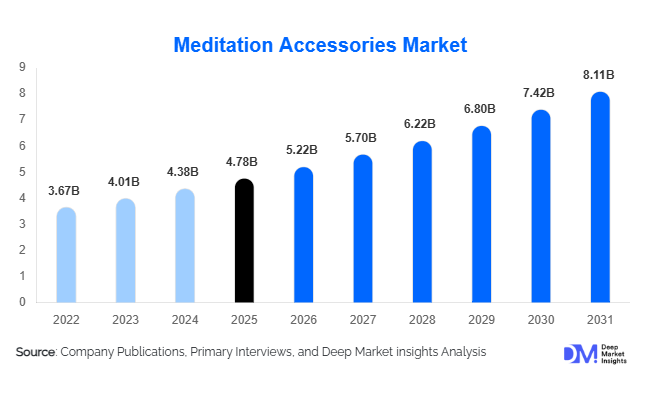
According to Deep Market Insights, the global meditation accessories market size was valued at USD 4.78 billion in 2025 and is projected to grow from USD 5.22 billion in 2026 to reach USD 8.11 billion by 2031, expanding at a CAGR of 9.2% during the forecast period (2026–2031). The meditation accessories market growth is primarily driven by rising awareness around mental wellness, increasing adoption of mindfulness practices, expanding corporate wellness programs, and growing consumer spending on home wellness ecosystems. Demand for meditation cushions, aromatherapy products, smart meditation devices, singing bowls, and premium wellness décor continues to accelerate as consumers increasingly prioritize stress management and emotional well-being.
Key Market Insights
- Meditation accessories are increasingly transitioning from niche spiritual products into mainstream wellness lifestyle products, supported by rising mental health awareness globally.
- Smart meditation devices and AI-enabled wellness technologies are witnessing rapid adoption, especially among younger consumers and urban professionals.
- North America dominates the global market, supported by strong wellness spending and widespread corporate mindfulness programs.
- Asia-Pacific is the fastest-growing region, driven by wellness tourism, rising disposable incomes, and cultural familiarity with meditation practices.
- Sustainable and eco-friendly meditation accessories are gaining substantial traction, particularly in Europe and North America.
- Digital wellness ecosystems and subscription-based mindfulness platforms are creating new recurring revenue opportunities for manufacturers and wellness brands.
Meditation Accessories Market Trends
Smart Meditation Technology Integration
The integration of advanced technologies into meditation accessories is becoming a major market trend globally. Smart meditation headbands, biofeedback systems, AI-guided breathing devices, and app-connected mindfulness tools are transforming traditional meditation experiences into data-driven wellness ecosystems. Consumers increasingly prefer devices capable of monitoring stress levels, heart rate variability, breathing patterns, and sleep quality. This trend is especially strong among younger demographics seeking personalized wellness solutions integrated with smartphones and wearable ecosystems. Wellness brands are also expanding subscription-based guided meditation content linked to physical devices, improving customer engagement and recurring revenue generation. Immersive audio systems, virtual reality meditation environments, and sleep-enhancing sound technologies are further strengthening the role of technology within the meditation accessories industry.
Rise of Sustainable and Premium Wellness Products
Consumers are increasingly prioritizing sustainability, ethical sourcing, and premium aesthetics when purchasing meditation accessories. Organic cotton cushions, bamboo meditation benches, recycled-material mats, natural incense products, and handcrafted décor items are experiencing strong global demand. Premiumization is becoming a defining trend as consumers seek products that combine wellness functionality with luxury interior design. Wellness-focused consumers are also willing to pay higher prices for eco-certified, biodegradable, and artisan-made meditation products. Luxury hospitality operators, wellness retreats, and high-end spas are increasingly incorporating sustainable meditation accessories into curated guest experiences, further supporting premium market growth.
Meditation Accessories Market Drivers
Growing Global Mental Wellness Awareness
Rising awareness regarding mental health, stress management, and emotional wellbeing is one of the primary drivers supporting growth in the meditation accessories market. Increasing cases of workplace burnout, anxiety disorders, sleep disturbances, and lifestyle-related stress have encouraged consumers to adopt mindfulness and meditation practices as part of daily wellness routines. Healthcare professionals, wellness coaches, and digital wellness platforms are increasingly promoting meditation for cognitive improvement, relaxation, and emotional regulation. This has significantly increased demand for meditation cushions, aromatherapy products, singing bowls, meditation mats, and breathing support devices. Corporate organizations are also integrating mindfulness programs into employee wellness strategies, creating additional demand for meditation accessories across institutional settings.
Expansion of Home Wellness Ecosystems
The rapid growth of home wellness environments is significantly accelerating demand for meditation accessories globally. Consumers are increasingly investing in dedicated home wellness spaces that combine meditation, yoga, relaxation, and stress management activities. Meditation cushions, floor mats, sound therapy systems, incense products, indoor fountains, and calming wellness décor are becoming common elements within residential wellness spaces. The shift toward remote work and hybrid lifestyles has further strengthened home-based wellness consumption patterns. Premium consumers are especially investing in aesthetically designed meditation products that integrate seamlessly with modern home interiors while delivering functional wellness benefits.
Meditation Accessories Market Restraints
High Market Fragmentation and Pricing Pressure
The meditation accessories market remains highly fragmented with the presence of numerous regional manufacturers, artisanal suppliers, wellness startups, and private-label participants. Low entry barriers in categories such as meditation cushions, incense products, and décor accessories intensify pricing competition and limit profit margins for established brands. The abundance of low-cost alternatives can also create product quality inconsistencies, impacting consumer trust and brand differentiation. Premium brands must continuously invest in innovation, sustainability certifications, packaging, and digital branding to maintain competitive positioning.
Dependence on Discretionary Consumer Spending
Meditation accessories are often categorized as discretionary wellness purchases, making market demand sensitive to macroeconomic fluctuations and consumer spending patterns. Economic uncertainty, inflationary pressures, and reduced household purchasing power can negatively impact sales of premium meditation furniture, smart wellness devices, and luxury aromatherapy products. High-end wellness purchases are particularly vulnerable during periods of financial instability, which can slow overall market expansion and affect profitability across premium product segments.
Meditation Accessories Market Opportunities
Corporate Wellness Program Expansion
The growing adoption of corporate wellness initiatives presents a major opportunity for meditation accessory manufacturers globally. Organizations are increasingly investing in employee wellness infrastructure to improve productivity, reduce stress-related absenteeism, and strengthen workforce retention. Meditation rooms, mindfulness pods, and workplace relaxation zones are becoming common across large enterprises, especially within technology, finance, consulting, and healthcare industries. This trend is creating strong institutional demand for meditation cushions, ergonomic seating products, aromatherapy systems, sound therapy equipment, and smart meditation technologies. Manufacturers capable of offering scalable B2B wellness solutions are expected to secure long-term growth opportunities through corporate partnerships and subscription-based wellness programs.
Growth of Wellness Tourism and Luxury Retreats
The rapid expansion of wellness tourism and luxury retreat experiences is creating substantial opportunities for premium meditation accessories globally. Hotels, resorts, spas, and wellness retreats are increasingly incorporating meditation spaces equipped with high-end cushions, singing bowls, sound systems, incense products, and Zen-inspired décor. Countries such as India, Thailand, Indonesia, the UAE, and Costa Rica are witnessing rising investments in wellness-centered hospitality infrastructure. Consumers increasingly seek immersive wellness experiences that combine mindfulness, relaxation, and luxury travel, encouraging hospitality operators to invest heavily in premium meditation products and customized wellness environments.
Report Scope
| Report Metric | Details |
|---|---|
| Market Size in 2025 | USD 4.78 Billion |
| Market Size in 2026 | USD 5.22 Billion |
| Market Size in 2031 | USD 8.11 Billion |
| CAGR | 9.2% (2026-2031) |
| Base Year for Estimation | 2025 |
| Historical Data | 2022-2024 |
| Forecast Period | 2026-2031 |
| Report Coverage | Revenue Forecast, Competitive Landscape, Supply Chain Disruption, Growth Factors, Environment & Regulatory Landscape and Trends |
| Geographies Covered | North America, Europe, APAC, Middle East and Africa, LATAM |
| Countries Covered | U.S., Canada, U.K., Germany, France, Spain, Italy, Russia, Nordic, Benelux, Rest of Europe, China, Korea, Japan, India, Australia, Singapore, Taiwan, South East Asia, Rest of Asia-Pacific, UAE, Turky, Saudi Arabia, South Africa, Egypt, Nigeria, Rest of MEA, Brazil, Mexico, Argentina, Chile, Colombia, Rest of LATAM |
Explore more data points, trends and opportunities Download Free Sample Report
Product Type Insights
Meditation cushions and pillows dominate the market, accounting for nearly 24% of global revenue in 2025 due to their affordability, widespread usage, and compatibility across multiple meditation practices. Ergonomic cushions filled with memory foam and organic buckwheat materials are witnessing strong demand among consumers prioritizing comfort and posture support. Singing bowls and sound therapy products represent one of the fastest-growing categories as sound healing gains popularity across wellness retreats, yoga studios, and home wellness environments. Smart meditation devices, including biofeedback headbands and breathing assistance systems, are also rapidly expanding due to growing consumer interest in technology-enabled mindfulness experiences. Aromatherapy products such as incense sticks, essential oil diffusers, and scented candles continue to generate substantial demand as consumers increasingly combine meditation with sensory relaxation experiences.
Application Insights
Residential and personal wellness applications remain the largest segment within the meditation accessories market, supported by growing adoption of home wellness routines and mindfulness practices. Consumers are increasingly creating dedicated meditation spaces within homes, driving strong demand for meditation mats, cushions, décor products, and sound therapy accessories. Corporate wellness applications are emerging rapidly as organizations integrate mindfulness programs into employee wellbeing initiatives. Hospitality and wellness tourism applications are also expanding significantly, with luxury resorts and wellness retreats incorporating meditation accessories into curated guest experiences. Healthcare and rehabilitation centers are increasingly using meditation products within stress management, sleep therapy, and mental wellness programs, reflecting broader integration of meditation into preventive healthcare systems.
Distribution Channel Insights
Online retail platforms dominate the meditation accessories market, accounting for approximately 52% of global sales in 2025. E-commerce marketplaces, direct-to-consumer brand websites, and wellness subscription platforms are driving strong digital sales growth due to convenience, product variety, and influencer-driven marketing strategies. Social media advertising and wellness content creators are playing a major role in shaping consumer purchasing decisions. Offline specialty wellness stores and yoga studios continue to maintain strong relevance for experiential purchases, particularly within premium product categories. Institutional procurement through corporate wellness providers, hospitality operators, and healthcare facilities is also becoming an increasingly important distribution channel globally.
Consumer Insights
Individual consumers represent the largest customer segment within the meditation accessories market, contributing nearly 58% of global demand. Beginners and intermediate meditation practitioners continue to drive mainstream product sales, particularly within affordable and mid-range product categories. Young professionals and urban consumers are increasingly adopting smart meditation devices and aesthetically designed wellness products aligned with modern lifestyle trends. Corporate wellness users represent one of the fastest-growing customer groups due to increasing organizational investment in employee mental health initiatives. Senior citizens are also emerging as a valuable consumer segment as meditation gains recognition for supporting relaxation, sleep improvement, and emotional wellbeing among aging populations.
Explore more data points, trends and opportunities Download Free Sample Report
Meditation Accessories Market Segmentations
By Product Type
- Meditation Cushions & Pillows
- Meditation Mats & Floor Support Products
- Meditation Benches & Seating Furniture
- Singing Bowls & Sound Therapy Accessories
- Aromatherapy & Sensory Relaxation Products
- Meditation Apparel & Wearables
- Digital Meditation Accessories
- Prayer Beads & Spiritual Accessories
- Home Meditation Décor & Space Enhancement Products
- Meditation Storage & Travel Accessories
By Material Type
- Organic & Natural Fibers
- Wood & Bamboo Materials
- Foam & Synthetic Materials
- Crystal & Mineral-Based Products
- Metal-Based Accessories
- Recycled & Sustainable Materials
By Application
- Residential & Personal Use
- Corporate Wellness Programs
- Hospitality & Wellness Tourism
- Healthcare & Therapeutic Centers
- Yoga Studios & Fitness Centers
- Educational Institutions
By Distribution Channel
- Online Retail (E-commerce & D2C)
- Specialty Wellness Stores
- Yoga & Meditation Centers
- Department & Lifestyle Stores
- Institutional & Corporate Procurement
By End User
- Individual Consumers
- Corporate Users
- Wellness Retreats & Resorts
- Healthcare Institutions
- Religious & Spiritual Organizations
Regional Insights
North America
North America accounts for approximately 36% of the global meditation accessories market, making it the leading regional market globally. The United States dominates regional demand due to high consumer spending on wellness products, rapid adoption of mindfulness applications, and strong corporate wellness integration. Premium meditation cushions, smart wellness devices, aromatherapy systems, and home meditation décor products are particularly popular among U.S. consumers. Canada is also witnessing increasing demand due to growing awareness regarding mental wellness and holistic health practices.
Europe
Europe represents nearly 27% of global market revenue, led by Germany, the United Kingdom, France, Italy, and the Netherlands. European consumers demonstrate strong preference for sustainable, ethically sourced, and eco-friendly meditation accessories. Germany remains the largest European market due to strong wellness culture and increasing adoption of preventive healthcare practices. The United Kingdom is experiencing rising corporate wellness spending and strong demand for digital mindfulness solutions. Premium artisanal products and organic materials perform particularly well across European markets.
Asia-Pacific
Asia-Pacific is the fastest-growing regional market and currently contributes approximately 24% of global demand. China, India, Japan, South Korea, Australia, Thailand, and Indonesia are major growth markets. India is emerging as one of the fastest-growing countries globally due to expanding wellness tourism, rising middle-class incomes, and strong cultural association with meditation practices. China is witnessing strong demand for smart wellness devices and premium home wellness products among urban consumers. Japan and South Korea continue to drive innovation in technologically integrated meditation systems and digital wellness ecosystems.
Latin America
Latin America accounts for nearly 6% of global market revenue, with Brazil and Mexico representing the largest regional markets. Rising urban stress levels, growing wellness awareness, and increasing popularity of yoga and mindfulness practices are supporting regional demand. Affordable meditation accessories and wellness décor products are particularly popular among middle-income consumers across major urban centers.
Middle East & Africa
The Middle East & Africa region contributes around 7% of global market revenue. The UAE and Saudi Arabia are emerging as key growth markets due to rising luxury wellness investments, hospitality expansion, and increasing demand for premium wellness experiences. Wellness resorts and luxury spas across the UAE are increasingly integrating meditation-focused facilities equipped with premium accessories. South Africa is also witnessing growing adoption of mindfulness practices among urban consumers and wellness-focused travelers.
Key Players in the Meditation Accessories Market
- Manduka LLC
- Gaiam
- Hugger Mugger Yoga Products
- Halfmoon Yoga Products Ltd.
- Shoyeido Inc.
- DharmaCrafts
- Florensi
- Muse (InteraXon Inc.)
- Calm.com Inc.
- Saje Natural Wellness
- Ajna Wellbeing
- Sound Oasis
- Node Fitness
- Tibet House US
- Zafu.net