Infrared Saunas Market Size
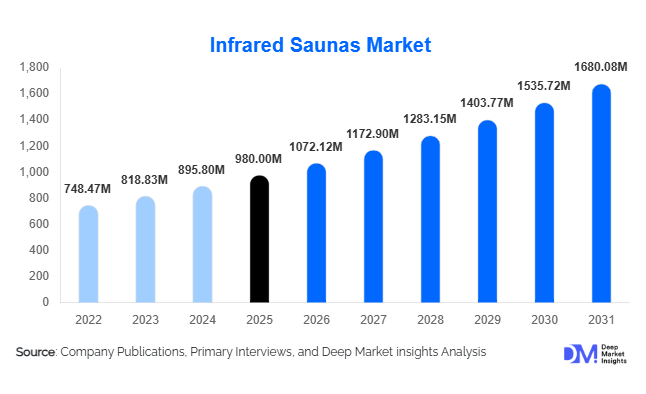
According to Deep Market Insights, the global infrared saunas market size was valued at USD 980 million in 2025 and is projected to grow from USD 1,072.12 million in 2026 to reach USD 1,680.08 million by 2031, expanding at a CAGR of 9.4% during the forecast period (2026–2031). The infrared saunas market growth is primarily driven by increasing consumer awareness regarding preventive healthcare, rising investments in home wellness infrastructure, and expanding adoption of therapeutic heat-based wellness solutions across residential, hospitality, fitness, and rehabilitation applications.
Key Market Insights
- Infrared saunas are increasingly becoming part of the global home wellness movement, driven by growing consumer preference for stress reduction, detoxification, recovery therapies, and preventive healthcare solutions.
- Full-spectrum infrared saunas are gaining significant popularity, offering combined near, mid, and far infrared wavelengths that provide broader wellness and therapeutic applications.
- North America dominates the infrared saunas market, supported by strong residential wellness spending, luxury home renovation trends, and high awareness regarding infrared therapy benefits.
- Asia-Pacific is the fastest-growing regional market, driven by expanding middle-class income levels, wellness tourism development, and rapid urban adoption of premium wellness technologies.
- Commercial wellness facilities and luxury hospitality projects are increasingly integrating infrared saunas, particularly across the Middle East, Europe, and Southeast Asia.
- Smart sauna technologies, including app-controlled systems, chromotherapy integration, AI-enabled wellness monitoring, and energy-efficient carbon heaters, are reshaping consumer expectations and competitive differentiation.
Infrared Saunas Market Trends
Smart Wellness Integration Transforming Consumer Experience
Manufacturers are increasingly integrating smart technologies into infrared sauna systems to improve user convenience, personalization, and energy efficiency. Modern infrared saunas now feature app-controlled temperature management, Bluetooth-enabled entertainment systems, chromotherapy lighting, voice-assisted controls, and AI-powered wellness tracking. These innovations are particularly attractive to affluent consumers seeking connected home wellness ecosystems. Smart-enabled saunas also support remote diagnostics, predictive maintenance alerts, and customized therapy programs based on user preferences and biometric data. As consumers increasingly prioritize integrated wellness technologies, manufacturers are positioning smart infrared saunas as premium lifestyle products rather than standalone heating equipment.
Residential Wellness Installations Expanding Rapidly
The residential infrared sauna segment is experiencing substantial growth as homeowners increasingly invest in personal wellness spaces. Post-pandemic lifestyle shifts accelerated demand for home-based health and recovery solutions, encouraging consumers to incorporate infrared saunas into home gyms, luxury bathrooms, and dedicated wellness rooms. Compact and modular sauna systems are gaining popularity among urban consumers with limited living space. Manufacturers are also introducing portable infrared sauna units targeted at younger demographics and first-time wellness buyers. This trend is further supported by rising luxury residential construction and increasing emphasis on wellness-oriented interior design across North America, Europe, Japan, South Korea, and emerging urban centers in Asia-Pacific.
Infrared Saunas Market Drivers
Rising Preventive Healthcare and Wellness Spending
Growing awareness regarding preventive healthcare is significantly driving infrared sauna adoption globally. Consumers increasingly seek non-invasive wellness therapies that support stress reduction, relaxation, cardiovascular health, detoxification, pain relief, and muscle recovery. Infrared saunas are gaining acceptance among wellness-focused consumers due to their lower operating temperatures compared to traditional saunas, making them more comfortable for extended sessions. The broader expansion of the global wellness economy is further supporting demand for home wellness equipment and therapeutic technologies. Rising disposable income and increasing prioritization of self-care routines among urban populations are accelerating infrared sauna market growth.
Expansion of Wellness Tourism and Luxury Hospitality
The rapid expansion of wellness tourism and luxury hospitality infrastructure is creating strong commercial demand for infrared sauna systems. Luxury resorts, destination spas, wellness retreats, and premium hotels are increasingly integrating infrared saunas into their wellness offerings to attract high-spending travelers. Infrared systems are preferred due to lower installation costs, energy efficiency, quicker heating capabilities, and easier maintenance compared to conventional steam saunas. Wellness-focused tourism developments across the UAE, Saudi Arabia, Thailand, Indonesia, and Mediterranean Europe are further supporting market expansion. Hospitality operators are also using wellness facilities as differentiating factors within competitive luxury tourism markets.
Infrared Saunas Market Restraints
High Initial Installation and Product Costs
Premium infrared sauna systems involve relatively high upfront costs associated with advanced heating technologies, premium wood materials, electrical infrastructure requirements, and installation services. Full-spectrum and smart-enabled sauna systems often exceed affordability thresholds for middle-income consumers in developing regions. Commercial installations additionally require customization, ventilation integration, and compliance with regional electrical safety standards, increasing overall project costs. These factors limit mass-market penetration and slow adoption across price-sensitive economies.
Regulatory and Clinical Validation Challenges
Although infrared saunas are widely marketed for wellness and therapeutic benefits, inconsistent clinical validation and varying regulatory frameworks across countries continue to create challenges for market participants. Some healthcare regulators remain cautious regarding therapeutic claims associated with infrared therapy, limiting adoption within hospitals and medically supervised rehabilitation environments. Manufacturers must also address concerns regarding electromagnetic field emissions, operational safety certifications, and energy efficiency standards. Regulatory fragmentation increases compliance costs and may delay market entry for international manufacturers.
Infrared Saunas Market Opportunities
Sports Recovery and Rehabilitation Applications
The growing sports recovery and rehabilitation industry presents substantial opportunities for infrared sauna manufacturers. Professional athletes, sports teams, fitness clubs, physiotherapy clinics, and rehabilitation centers are increasingly adopting infrared heat therapy to support muscle recovery, circulation improvement, pain management, and injury rehabilitation. As global participation in fitness and athletic activities continues to rise, demand for recovery-focused wellness technologies is expected to expand significantly. Manufacturers capable of developing medical-grade and sports-oriented infrared sauna solutions may benefit from long-term institutional demand and recurring commercial contracts.
Expansion of Portable and Compact Sauna Solutions
The increasing popularity of compact living spaces and apartment-based urban lifestyles is creating strong demand for portable and modular infrared sauna systems. Portable infrared saunas offer affordable entry points for younger consumers and first-time wellness buyers who may not have space for permanent installations. Manufacturers are increasingly focusing on foldable designs, lightweight structures, and plug-and-play installation models to improve accessibility. This opportunity is particularly significant in densely populated urban markets across Asia-Pacific and Europe where consumers seek space-efficient wellness products.
Report Scope
| Report Metric | Details |
|---|---|
| Market Size in 2025 | USD 980 Million |
| Market Size in 2026 | USD 1072.12 Million |
| Market Size in 2031 | USD 1680.08 Million |
| CAGR | 9.4% (2026-2031) |
| Base Year for Estimation | 2025 |
| Historical Data | 2022-2024 |
| Forecast Period | 2026-2031 |
| Report Coverage | Revenue Forecast, Competitive Landscape, Supply Chain Disruption, Growth Factors, Environment & Regulatory Landscape and Trends |
| Geographies Covered | North America, Europe, APAC, Middle East and Africa, LATAM |
| Countries Covered | U.S., Canada, U.K., Germany, France, Spain, Italy, Russia, Nordic, Benelux, Rest of Europe, China, Korea, Japan, India, Australia, Singapore, Taiwan, South East Asia, Rest of Asia-Pacific, UAE, Turky, Saudi Arabia, South Africa, Egypt, Nigeria, Rest of MEA, Brazil, Mexico, Argentina, Chile, Colombia, Rest of LATAM |
Explore more data points, trends and opportunities Download Free Sample Report
Product Type Insights
Full-spectrum infrared saunas dominate the market, accounting for a significant share of global revenue due to their ability to combine near, mid, and far infrared wavelengths within a single system. These saunas are increasingly preferred for their broader therapeutic applications, including detoxification, skin rejuvenation, pain relief, circulation improvement, and relaxation support. Far infrared saunas continue to maintain strong demand due to their affordability and energy efficiency, particularly within residential applications. Portable infrared saunas are gaining traction among urban consumers seeking flexible and lower-cost wellness solutions. Hybrid infrared saunas that combine traditional steam functionality with infrared heating technologies are also emerging as premium wellness offerings within luxury residential and hospitality projects.
Application Insights
Residential wellness applications represent the largest application segment within the infrared saunas market, driven by increasing investments in home-based health and wellness infrastructure. Consumers are integrating infrared saunas into home gyms, spa rooms, and luxury bathrooms as part of broader lifestyle and wellness upgrades. Commercial wellness and spa applications are experiencing rapid growth due to expanding wellness tourism and luxury hospitality developments globally. Fitness and sports recovery applications are emerging strongly, supported by rising awareness regarding muscle recovery and rehabilitation therapies. Medical and physiotherapy applications are also expanding steadily as integrative healthcare providers increasingly explore non-invasive heat-based therapies. Beauty and skincare applications linked to detoxification, anti-aging, and stress reduction are creating additional demand across premium wellness clinics.
Distribution Channel Insights
Direct-to-consumer online sales channels dominate the infrared saunas market, supported by increasing digital commerce adoption and growing consumer preference for online product comparison and customization. Manufacturers are investing heavily in branded e-commerce platforms, virtual showroom experiences, and direct digital marketing campaigns to improve margins and customer engagement. Specialty wellness retailers continue to play a critical role within premium product categories where consumers prefer in-person product demonstrations and consultation-based purchases. Commercial equipment distributors remain important for large hospitality, fitness, and rehabilitation projects. Subscription-based wellness equipment models and rental services are also emerging as innovative distribution approaches, particularly among younger consumers seeking affordable access to premium wellness technologies.
End User Insights
Individual households account for the largest share of the infrared saunas market, supported by increasing consumer spending on preventive healthcare and luxury home wellness infrastructure. Wellness centers and destination spas remain major commercial buyers as consumer demand for therapeutic and relaxation-focused services continues to expand globally. Hotels and luxury resorts are increasingly incorporating infrared saunas within wellness suites and premium spa facilities to differentiate guest experiences. Fitness clubs and sports recovery centers represent one of the fastest-growing end-user segments due to increasing emphasis on post-workout recovery solutions. Medical rehabilitation centers and physiotherapy clinics are gradually adopting infrared saunas for complementary therapy applications, while corporate wellness programs are emerging as new commercial opportunities for manufacturers.
Technology Insights
Carbon fiber heating technology dominates the infrared saunas market due to its superior heat distribution, energy efficiency, and lower operating temperatures compared to ceramic heaters. Smart-connected infrared sauna systems are among the fastest-growing technology categories, integrating app-based controls, wellness tracking features, AI-assisted temperature calibration, and personalized therapy settings. Chromotherapy-enabled systems are increasingly popular within luxury wellness environments due to their perceived relaxation and mood-enhancement benefits. Low-electromagnetic-field (low-EMF) infrared sauna technologies are also gaining traction as consumers become more conscious regarding product safety and long-duration exposure concerns. Manufacturers continue investing in advanced insulation materials, faster heating systems, and energy optimization technologies to improve product performance and operational efficiency.
Explore more data points, trends and opportunities Download Free Sample Report
Infrared Saunas Market Segmentations
By Product Type
- Far Infrared Saunas
- Near Infrared Saunas
- Full-Spectrum Infrared Saunas
- Carbon Fiber Heater Infrared Saunas
- Ceramic Heater Infrared Saunas
- Hybrid Infrared Saunas
- Portable Infrared Saunas
- Cabin/Fixed Infrared Saunas
- Modular Infrared Saunas
- Smart Connected Infrared Saunas
By Installation Type
- Indoor Infrared Saunas
- Outdoor Infrared Saunas
- Built-in/Customized Installations
- Freestanding Units
By Application
- Residential Wellness
- Commercial Wellness & Spa
- Fitness & Sports Recovery
- Physiotherapy & Rehabilitation
- Medical & Therapeutic Applications
- Hospitality & Luxury Tourism
- Beauty & Skincare Applications
- Weight Management & Detoxification
By End User
- Individual Households
- Wellness Centers & Spas
- Hotels & Resorts
- Fitness Clubs & Gyms
- Medical Rehabilitation Centers
- Sports Training Facilities
- Corporate Wellness Facilities
By Distribution Channel
- Direct-to-Consumer Online Sales
- Specialty Wellness Retailers
- Commercial Equipment Distributors
- Company-Owned Showrooms
- E-commerce Marketplaces
- Rental & Subscription Models
Regional Insights
North America
North America remains the largest regional market for infrared saunas, accounting for nearly 38% of global demand in 2025. The United States dominates regional consumption due to strong wellness spending, luxury residential renovation trends, and high awareness regarding infrared therapy benefits. Consumers increasingly view infrared saunas as long-term wellness investments integrated into home fitness and recovery routines. Canada also represents a strong market supported by established sauna culture and growing adoption of preventive wellness technologies. The region benefits from advanced distribution networks, high digital commerce penetration, and strong presence of premium sauna manufacturers.
Europe
Europe represents one of the most mature infrared sauna markets globally, supported by longstanding sauna traditions and high consumer awareness regarding wellness therapies. Finland, Germany, Sweden, and Norway remain key regional markets due to strong cultural acceptance of sauna use and premium wellness infrastructure. Germany is witnessing particularly strong growth within luxury residential and wellness hospitality applications. Sustainability and energy efficiency remain major purchasing considerations across Europe, encouraging adoption of eco-certified wood materials and low-energy infrared systems. Wellness tourism expansion across Mediterranean Europe is further supporting commercial sauna installations.
Asia-Pacific
Asia-Pacific is the fastest-growing regional market, projected to expand at a CAGR exceeding 11% through 2031. China, Japan, South Korea, and India are major growth contributors due to rising disposable income levels, increasing urban wellness adoption, and rapid expansion of premium fitness and hospitality infrastructure. Japan benefits from a deeply rooted bathing and wellness culture, while South Korea’s beauty and wellness industries are accelerating commercial infrared sauna adoption. China is witnessing rising luxury wellness consumption among affluent urban households. India is emerging as a promising growth market supported by expanding fitness culture, luxury real estate projects, and wellness tourism development.
Latin America
Latin America remains an emerging market for infrared saunas, with Brazil and Mexico representing the largest regional demand centers. Rising upper-middle-class spending on luxury wellness products and increasing penetration of premium fitness clubs are supporting market growth. Commercial adoption within hotels, wellness spas, and luxury residential developments is gradually increasing. However, relatively high product costs and import dependency continue to limit broader regional penetration.
Middle East & Africa
The Middle East & Africa region is gaining momentum due to substantial investments in luxury hospitality and wellness tourism infrastructure. The UAE and Saudi Arabia are leading regional demand supported by government-backed tourism diversification initiatives and rapid expansion of premium wellness resorts. Luxury residential developers across the Gulf region are increasingly incorporating infrared saunas into high-end property projects. South Africa also represents an important regional market due to growing wellness tourism activity and increasing adoption of premium spa infrastructure. Rising interest in preventive healthcare and wellness-focused lifestyles is expected to further support long-term regional market expansion.
Key Players in the Infrared Saunas Market
- Sunlighten
- Clearlight
- Health Mate
- Harvia
- TyloHelo
- Dynamic Saunas
- Golden Designs
- Sun Stream Saunas
- KLAFS
- Radiant Health Saunas
- JNH Lifestyles
- Finnleo
- Almost Heaven Saunas
- Sentiotec
- Sauna Works