Global Hass Avocado Market Size
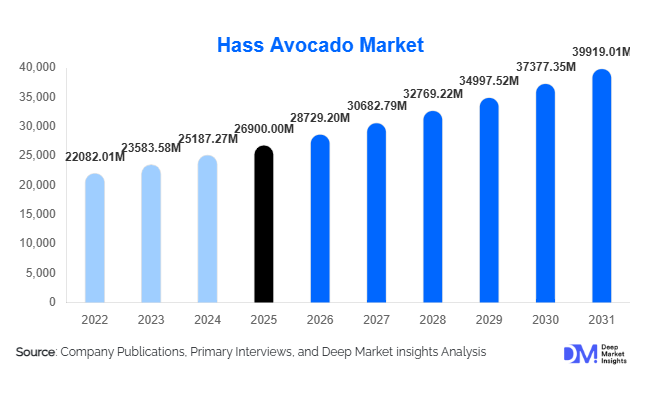
According to Deep Market Insights, the global Hass avocado market size was valued at USD 26,900 million in 2025 and is projected to grow from USD 28,729.20 million in 2026 to reach USD 39,919.01 million by 2031, expanding at a CAGR of 6.8% during the forecast period (2026–2031). The Hass avocado market growth is primarily driven by rising health-conscious consumption patterns, increasing demand for plant-based and functional foods, and expanding applications across foodservice, processed food, and personal care industries.
The market has evolved from a niche premium fruit category into a global mainstream superfood segment. Strong demand from North America and Europe continues to anchor consumption, while Latin America remains the dominant production hub. Meanwhile, Asia-Pacific is rapidly emerging as a high-growth demand center supported by rising disposable incomes, urbanization, and Western dietary influence. Continuous improvements in cold-chain logistics, global trade integration, and retail expansion have significantly enhanced avocado accessibility across non-producing regions.
Key Market Insights
- Fresh Hass avocados dominate global consumption, supported by strong retail penetration and household dietary integration.
- Supermarkets and hypermarkets remain the leading distribution channels, ensuring consistent availability of fresh produce globally.
- Latin America leads production and export supply chains, with Mexico acting as the largest global exporter.
- North America is the largest consumption region, driven by strong dietary adoption and year-round demand.
- Asia-Pacific is the fastest-growing demand region, fueled by increasing health awareness and evolving food habits.
- Processed avocado products such as oil and guacamole are gaining strong momentum due to convenience-driven consumption trends.
What are the latest trends in the Hass avocado market?
Expansion of Value-Added Avocado Products
The market is witnessing rapid diversification beyond fresh avocados into high-margin processed categories such as avocado oil, frozen pulp, guacamole, and functional food ingredients. These products address convenience-driven consumer lifestyles and reduce perishability constraints. Food manufacturers are increasingly incorporating avocado-based ingredients into bakery, snacks, and ready-to-eat meals, significantly expanding industrial demand. This shift is improving profitability across the value chain and reducing dependency on seasonal fresh fruit sales.
Rising Adoption in Personal Care and Nutraceuticals
Avocado oil is increasingly used in cosmetics, skincare, and dietary supplements due to its antioxidant and moisturizing properties. Nutraceutical companies are integrating avocado extracts into heart-health and wellness-focused formulations. This diversification into non-food industries is expanding the total addressable market and stabilizing demand beyond traditional retail cycles.
Supply Chain Digitalization and Sustainability Focus
Producers and exporters are adopting blockchain-based traceability systems, precision farming, and AI-driven yield forecasting. Sustainability certifications and organic farming practices are also becoming key differentiators, particularly in European and North American markets. These innovations are improving efficiency, reducing waste, and enhancing export competitiveness.
What are the key drivers in the Hass avocado market?
Rising Global Demand for Healthy and Functional Foods
Growing awareness of nutrition and preventive healthcare is a primary growth driver. Hass avocados, rich in healthy fats, fiber, and micronutrients, are increasingly replacing processed fats in diets. The shift toward plant-based and clean-label foods is accelerating household consumption globally.
Expansion of Foodservice and QSR Industry
Restaurants, cafés, and quick-service chains are integrating avocados into menus, including salads, sandwiches, smoothies, and toast-based offerings. This institutional demand has significantly boosted bulk procurement and stabilized year-round consumption patterns.
Growth of Vegan and Flexitarian Diets
The global rise in plant-based dietary adoption has positioned avocados as a staple ingredient. Flexitarian diets, in particular, are driving consistent demand across both developed and emerging economies.
What are the restraints for the global market?
Supply Volatility and Climate Sensitivity
Avocado production is highly dependent on climatic conditions, making yields vulnerable to droughts, temperature fluctuations, and seasonal variability. This leads to price instability and inconsistent supply availability in global markets.
High Logistics and Cold Chain Dependency
The perishable nature of avocados requires advanced cold-chain infrastructure. High transportation and storage costs limit penetration in price-sensitive and infrastructure-constrained regions, especially in developing economies.
What are the key opportunities in the Hass avocado industry?
Expansion in Asia-Pacific Markets
Countries such as China, India, Japan, and South Korea represent major untapped opportunities. Rising incomes and exposure to global cuisines are driving increasing avocado adoption. Localized distribution networks and marketing strategies can unlock significant future demand.
Growth of Organic and Premium Segments
Organic Hass avocados are gaining traction in premium retail segments, particularly in Europe and North America. Consumers are willing to pay higher prices for sustainably sourced and chemical-free produce, enabling higher margins for producers.
Technological Integration in Farming and Logistics
Precision agriculture, AI-based forecasting, and smart irrigation systems are improving yield efficiency and reducing wastage. These innovations are creating scalable opportunities for exporters and large-scale producers.
Report Scope
| Report Metric | Details |
|---|---|
| Market Size in 2025 | USD 26900.00 Million |
| Market Size in 2026 | USD 28729.20 Million |
| Market Size in 2031 | USD 39919.01 Million |
| CAGR | 6.8% (2026-2031) |
| Base Year for Estimation | 2025 |
| Historical Data | 2022-2024 |
| Forecast Period | 2026-2031 |
| Report Coverage | Revenue Forecast, Competitive Landscape, Supply Chain Disruption, Growth Factors, Environment & Regulatory Landscape and Trends |
| Geographies Covered | North America, Europe, APAC, Middle East and Africa, LATAM |
| Countries Covered | U.S., Canada, U.K., Germany, France, Spain, Italy, Russia, Nordic, Benelux, Rest of Europe, China, Korea, Japan, India, Australia, Singapore, Taiwan, South East Asia, Rest of Asia-Pacific, UAE, Turky, Saudi Arabia, South Africa, Egypt, Nigeria, Rest of MEA, Brazil, Mexico, Argentina, Chile, Colombia, Rest of LATAM |
Explore more data points, trends and opportunities Download Free Sample Report
Product Type Insights
The global avocado market is witnessing substantial expansion across multiple product categories, supported by rising consumer awareness regarding nutrition, healthy fats, and plant-based dietary patterns. Among all product categories, fresh Hass avocados continue to dominate the market, accounting for approximately 62% of the global market share in 2025. The dominance of the Hass variety is primarily attributed to its superior taste, creamy texture, extended shelf life, and strong compatibility with retail distribution systems. Fresh Hass avocados are highly preferred by households, restaurants, and foodservice operators due to their versatility in salads, sandwiches, smoothies, sushi, dips, and breakfast meals. Increasing consumer inclination toward nutrient-rich superfoods and clean-label fresh produce continues to strengthen the demand for fresh avocados globally.At the same time, the organic avocado segment is gaining remarkable momentum, particularly in premium urban markets across North America and Europe. Increasing consumer preference for pesticide-free produce, environmentally sustainable farming practices, and certified organic food products is driving the expansion of this category. Health-conscious consumers are increasingly willing to pay premium prices for organic avocados due to perceived nutritional and environmental benefits. Retailers are responding by expanding organic produce sections and partnering with certified growers to enhance product availability.The expansion of processed avocado products is also being driven by the foodservice and industrial sectors, which require products with longer shelf life and stable pricing. Frozen avocado and avocado puree are increasingly preferred by restaurants and food manufacturers because they minimize wastage and ensure year-round availability. Additionally, the cosmetics and personal care industries are increasing utilization of avocado oil in skincare, haircare, and wellness products due to its moisturizing and antioxidant properties. Growing consumer interest in natural beauty formulations and clean-label cosmetics is expected to further strengthen demand for avocado-derived ingredients over the forecast period.
Application Insights
Based on application, household consumption represents the leading segment in the global avocado market, accounting for approximately 52% of total demand. The dominance of household consumption is primarily driven by increasing awareness regarding the health benefits associated with avocados, including high fiber content, healthy fats, vitamins, and antioxidant properties. Consumers are increasingly integrating avocados into daily diets as part of wellness-focused eating habits, ketogenic diets, vegan lifestyles, and fitness-oriented nutrition plans. The widespread popularity of avocado toast, smoothies, salads, and homemade guacamole has significantly boosted retail consumption across urban households worldwide.The growth of household consumption is also strongly supported by social media influence, celebrity endorsements, and increasing exposure to global food trends. Younger consumers, particularly millennials and Gen Z populations, are showing strong preference for nutrient-rich fresh foods and premium fruit categories, further supporting segment expansion. Rising disposable incomes and increasing penetration of modern retail channels are also improving consumer access to avocados in emerging economies.The food processing industry is emerging as another significant application area, supported by rising demand for ready-to-eat and convenience-based food products. Food manufacturers are increasingly utilizing avocado ingredients in dips, sauces, frozen products, salad dressings, and snack formulations. Guacamole remains one of the most commercially successful avocado-based processed products globally, particularly in North America and Europe. Growing urbanization and busy consumer lifestyles are accelerating demand for packaged healthy food products, thereby supporting the expansion of avocado processing activities.Meanwhile, nutraceutical and cosmetic applications are gaining strong traction due to the increasing utilization of avocado oil in dietary supplements, skincare products, and wellness formulations. Avocado extracts are rich in vitamins E and C, healthy lipids, and bioactive compounds that support skin nourishment and anti-aging applications. Cosmetic brands are increasingly incorporating avocado ingredients into creams, serums, shampoos, and natural beauty products as consumers shift toward plant-based and chemical-free formulations. The expanding global wellness industry is expected to create substantial long-term opportunities for avocado-derived nutraceutical and cosmetic applications.
Distribution Channel Insights
Supermarkets and hypermarkets dominate the global avocado market, accounting for nearly 46% market share. The strong performance of this segment is largely attributed to extensive retail infrastructure, high consumer footfall, and the ability of large retailers to offer fresh produce in attractive packaging formats. Consumers prefer supermarkets and hypermarkets because they provide product variety, quality assurance, competitive pricing, and convenient shopping experiences. The availability of ripened avocados, organic variants, and value-added avocado products in modern retail stores further strengthens segment growth.The leading position of supermarkets and hypermarkets is also supported by advancements in cold-chain logistics and inventory management systems that help maintain product freshness. Large retail chains are increasingly entering long-term procurement partnerships with avocado exporters and producers to ensure stable year-round supply. Promotional campaigns, healthy food marketing strategies, and dedicated organic produce sections are also encouraging higher avocado sales through these channels.Specialty organic stores are gaining increasing traction in premium consumer segments, particularly across North America and Europe. These stores cater to health-conscious consumers seeking certified organic, sustainably sourced, and ethically produced avocados. Premium pricing strategies and consumer trust in specialty retail channels continue to support growth in this segment.Foodservice direct supply channels are also expanding steadily through institutional procurement contracts and business-to-business supply agreements. Restaurants, hotels, cafes, and catering operators increasingly source avocados directly from distributors and importers to ensure consistent quality and pricing stability. Growing demand from quick-service restaurant chains and international food franchises is expected to further strengthen direct supply chain networks globally.
Explore more data points, trends and opportunities Download Free Sample Report
Hass Avocado Market Segmentations
By Product Type
- Fresh Hass Avocados
- Avocado Oil
- Frozen Avocado Pulp & Puree
- Dehydrated Avocado Powder
- Value-Added Avocado Products
By Nature
- Conventional Hass Avocados
- Organic Hass Avocados
By Distribution Channel
- Supermarkets & Hypermarkets
- Online Retail / E-commerce Platforms
- Specialty Organic & Health Stores
- Convenience Stores
- Foodservice & HoReCa Supply
By End-Use Industry
- Household Consumption
- Foodservice Industry
- Food Processing Industry
- Nutraceuticals & Dietary Supplements
- Cosmetics & Personal Care
Regional Insights
North America
North America accounts for approximately 25% of global avocado demand, making it one of the largest consumption regions worldwide. The United States remains the dominant market within the region and is recognized as the world’s largest avocado importer. Strong consumer awareness regarding healthy eating habits, widespread integration of avocados into daily diets, and high popularity of Mexican cuisine continue to drive regional demand growth. Avocados have become a staple ingredient in salads, sandwiches, burgers, smoothies, and breakfast meals across the United States and Canada.The rapid expansion of foodservice chains, cafes, and healthy dining concepts is further accelerating avocado demand across the region. Increasing utilization of avocado-based products in processed foods, dips, sauces, and ready-to-eat meals also supports long-term market expansion. Canada is witnessing rising consumption due to growing multicultural food trends and increasing consumer spending on premium fresh produce.
Europe
Europe holds nearly 20% market share, with strong demand originating from countries including the United Kingdom, Germany, France, Spain, and the Netherlands. The European market is characterized by increasing consumer preference for sustainable, organic, and ethically sourced food products. Health-conscious consumption patterns and rising awareness regarding the nutritional benefits of avocados continue to drive market growth across the region.The popularity of vegan and flexitarian diets is another major factor supporting avocado consumption in Europe. Avocados are widely used as dairy alternatives, healthy spreads, and plant-based meal ingredients. Growing urbanization, rising disposable incomes, and increased exposure to international cuisines are further contributing to regional demand expansion. Additionally, Europe serves as a major avocado re-export hub through countries such as the Netherlands and Spain, strengthening regional trade activities.
Asia-Pacific
Asia-Pacific is projected to be the fastest-growing regional market during the forecast period, driven by rapidly increasing consumption in China, India, Japan, South Korea, and Australia. Rising middle-class populations, growing disposable incomes, and increasing exposure to Western dietary habits are significantly accelerating avocado demand across the region.The expansion of modern retail infrastructure and online grocery platforms is playing a crucial role in improving avocado accessibility in Asia-Pacific markets. Consumers are increasingly adopting healthier lifestyles and seeking nutrient-rich imported fruits, which is boosting avocado consumption in urban centers. Social media influence, international travel exposure, and growing popularity of fitness-oriented diets are also encouraging younger consumers to incorporate avocados into daily meal routines.The increasing presence of international restaurant chains and cafe culture is further contributing to market growth in Asia-Pacific. Foodservice operators are increasingly integrating avocados into salads, sushi, sandwiches, and healthy meal offerings to cater to evolving consumer preferences.
Latin America
Latin America dominates global avocado production, contributing approximately 45% of total global supply. Mexico remains the world’s largest avocado producer and exporter, supplying substantial volumes to North America, Europe, and Asia-Pacific markets. Peru, Colombia, and Chile are also major exporters playing critical roles in global avocado trade networks.The expansion of international trade agreements and growing global demand for avocados are encouraging producers to increase plantation areas and improve productivity levels. Technological advancements in irrigation systems, farming techniques, and post-harvest handling are also enhancing export competitiveness. Additionally, rising domestic consumption within Latin America is contributing to regional market growth as consumers increasingly recognize avocados as an affordable and nutritious dietary staple.
Middle East & Africa
The Middle East & Africa region is emerging as a promising avocado market, supported by increasing demand for premium imported fruits and expanding modern retail infrastructure. Countries such as the United Arab Emirates, Saudi Arabia, and South Africa are witnessing rising avocado consumption due to increasing health awareness and growing preference for international food products.South Africa plays a dual role as both a producer and consumer market, while Gulf countries remain heavily dependent on imports from Latin America and Africa. The growing hospitality sector, expanding tourism industry, and increasing popularity of healthy dining concepts are further supporting avocado demand growth. In addition, rising investments in cold-chain logistics and food import infrastructure are expected to improve regional supply efficiency and accelerate long-term market expansion.
Key Players in the Global Hass Avocado Market
- Mission Produce
- Calavo Growers
- Westfalia Fruit
- Del Rey Avocado
- Camposol
- Grupo Hass
- West Pak Avocado
- AvoKing
- Agroberries
- Freska Produce International
- Simplot
- Henry Avocado Corporation
- Salud Foodgroup
- Eurobanan Group
- Trofi Fresh