Hangover Cure Products Market Size
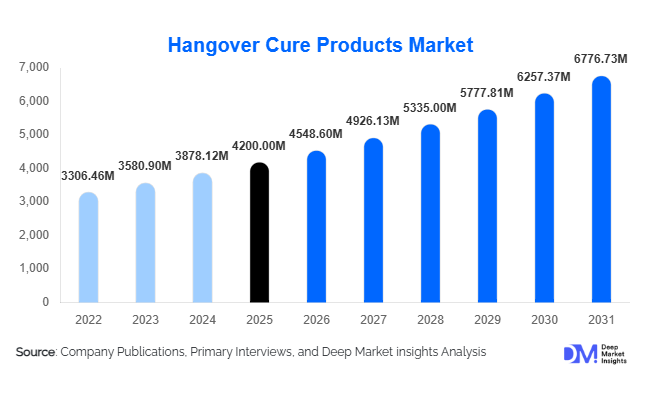
According to Deep Market Insights, the global hangover cure products market was valued at USD 4,200 million in 2025 and is projected to grow from USD 4,548.60 million in 2026 to reach USD 6,776.73 million by 2031, expanding at a CAGR of 8.3% during the forecast period (2026–2031). The market growth is primarily driven by rising global alcohol consumption among young adults, expanding nightlife culture, increasing demand for functional wellness and recovery products, and rapid innovation in nutraceutical and hydration-based formulations.
Key Market Insights
- Tablets and capsules dominate product demand due to convenience, accurate dosing, and strong pharmacy and online availability.
- E-commerce channels lead global distribution, supported by discreet purchasing behavior and strong D2C wellness brand growth.
- North America remains the largest market, driven by high alcohol consumption and strong nutraceutical adoption.
- Asia-Pacific is the fastest-growing region, supported by urbanization, rising disposable income, and nightlife expansion.
- Natural and herbal formulations are gaining strong traction, driven by clean-label and preventive wellness trends.
- Mid-range pricing segment dominates, balancing affordability and perceived effectiveness across mass consumers.
Hangover Cure Products Market Trends
Shift Toward Functional Wellness and Preventive Recovery
The market is witnessing a strong shift from traditional hangover remedies toward scientifically formulated wellness products. Consumers are increasingly seeking preventive recovery solutions that combine hydration, liver support, antioxidants, and vitamin complexes. Ingredients such as NAC, B-complex vitamins, electrolytes, and herbal extracts like milk thistle and ginger are becoming standard. This trend reflects the broader global movement toward functional nutrition, where consumers prefer multi-benefit supplements that support both immediate recovery and long-term health. Brands are also investing in clinically tested formulations to improve credibility and differentiate from generic herbal remedies.
E-Commerce and Direct-to-Consumer Brand Expansion
Digital transformation is reshaping product accessibility, with e-commerce emerging as the dominant sales channel. Direct-to-consumer brands are leveraging subscription models, influencer marketing, and targeted digital campaigns to capture younger demographics. Online platforms also allow discreet purchasing, which is a key behavioral driver for hangover-related products. Additionally, AI-driven personalization and recommendation engines are enhancing customer engagement by suggesting tailored recovery solutions based on lifestyle and consumption patterns. This digital-first ecosystem is significantly accelerating global market penetration.
Hangover Cure Products Market Drivers
Rising Alcohol Consumption and Nightlife Culture
The global expansion of urban nightlife, social drinking trends, and tourism-driven entertainment economies is a major growth driver. Young adult populations in both developed and emerging economies are increasingly engaging in social drinking occasions, driving demand for recovery products. Festivals, events, and travel-related alcohol consumption are further supporting repeat product usage. This behavioral shift has transformed hangover remedies into mainstream wellness products rather than niche solutions.
Growing Wellness and Nutraceutical Adoption
Consumers are increasingly integrating wellness products into daily routines, including recovery supplements. The expansion of the nutraceutical industry has normalized the use of functional supplements for hydration, detoxification, and liver health. This has significantly benefited hangover cure products, which are now positioned as part of broader wellness regimens rather than reactive treatments. Rising awareness of liver health and oxidative stress is further strengthening demand.
Product Innovation and Functional Ingredient Development
Advancements in formulation science are enabling faster absorption, improved bioavailability, and multi-functional recovery benefits. The inclusion of amino acid complexes, herbal adaptogens, and electrolyte blends is enhancing product efficacy. Innovation in delivery formats such as effervescent tablets, ready-to-drink beverages, and transdermal patches is also expanding consumer choice and improving convenience.
Hangover Cure Products Market Restraints
Regulatory Restrictions on Health Claims
Strict regulatory frameworks in regions such as North America and Europe limit the ability of manufacturers to make explicit health or cure-related claims. Companies must rely on scientifically validated evidence, increasing compliance costs and slowing product launches. This regulatory uncertainty can restrict marketing effectiveness and product differentiation.
Consumer Skepticism and Perceived Efficacy Issues
Despite growing popularity, many consumers remain skeptical about the actual effectiveness of hangover cure products. The perception that these products offer symptomatic relief rather than true prevention limits repeat purchases in some segments. This skepticism is particularly strong in price-sensitive markets where low-cost traditional remedies remain widely used.
Hangover Cure Products Market Opportunities
Expansion into Emerging Economies
Emerging markets such as India, Brazil, Mexico, Thailand, and South Africa present significant growth opportunities. Rising disposable incomes, expanding urban nightlife, and increasing exposure to global wellness trends are driving demand. These regions also offer strong potential for mid-range and economy product segments, enabling broader market penetration.
Hospitality and Travel Industry Integration
The hospitality sector presents a growing opportunity, with hotels, airlines, and nightlife venues increasingly offering recovery kits as premium add-ons. This B2B demand channel enables bulk procurement and brand partnerships. Travel-related alcohol consumption is also driving demand for on-the-go hydration and recovery solutions.
Scientific Personalization and Smart Wellness Products
Personalized nutrition and AI-driven wellness recommendations are emerging as a major opportunity. Future products are expected to be tailored based on metabolism, alcohol tolerance, and lifestyle patterns. This shift toward personalized recovery solutions is likely to create premium pricing opportunities and increase consumer retention.
Report Scope
| Report Metric | Details |
|---|---|
| Market Size in 2025 | USD 4200 Million |
| Market Size in 2026 | USD 4548.60 Million |
| Market Size in 2031 | USD 6776.73 Million |
| CAGR | 8.3% (2026-2031) |
| Base Year for Estimation | 2025 |
| Historical Data | 2022-2024 |
| Forecast Period | 2026-2031 |
| Report Coverage | Revenue Forecast, Competitive Landscape, Supply Chain Disruption, Growth Factors, Environment & Regulatory Landscape and Trends |
| Geographies Covered | North America, Europe, APAC, Middle East and Africa, LATAM |
| Countries Covered | U.S., Canada, U.K., Germany, France, Spain, Italy, Russia, Nordic, Benelux, Rest of Europe, China, Korea, Japan, India, Australia, Singapore, Taiwan, South East Asia, Rest of Asia-Pacific, UAE, Turky, Saudi Arabia, South Africa, Egypt, Nigeria, Rest of MEA, Brazil, Mexico, Argentina, Chile, Colombia, Rest of LATAM |
Explore more data points, trends and opportunities Download Free Sample Report
Product Type Insights
Tablets and capsules dominate the hangover cure products market due to their high convenience, portability, and precise dosage formulation. These formats are widely preferred in both pharmacy and e-commerce channels as they allow easy integration into daily wellness routines and provide consistent efficacy through standardized nutraceutical blends. Their leadership is further supported by strong brand availability and higher consumer trust in ingestible supplement formats, making them the most scalable product type globally.
Functional beverages are emerging as the fastest-growing product format, driven by increasing demand for immediate hydration and rapid recovery solutions. These ready-to-drink formulations combine electrolytes, vitamins, and herbal extracts, making them highly appealing to on-the-go consumers, particularly in nightlife and travel settings. Herbal and natural formulations are also expanding rapidly as consumers shift toward clean-label, plant-based wellness products, with ingredients such as milk thistle, ginger, and turmeric gaining strong acceptance due to perceived safety and holistic health benefits. Transdermal patches and gels remain a niche but innovative category, offering controlled release mechanisms and rapid absorption advantages, particularly for premium and experimental product segments.
Application Insights
Individual consumers represent the largest application segment, accounting for the majority of global demand due to widespread social drinking patterns, urban nightlife culture, and increasing adoption of preventive wellness habits. This segment benefits significantly from direct-to-consumer marketing strategies and strong e-commerce penetration, making it the core revenue driver for most brands in the market.
Hospitality and nightlife establishments are emerging as a high-growth application segment, as bars, clubs, hotels, and event organizers increasingly integrate hangover recovery products into premium guest services and post-consumption recovery kits. Corporate wellness programs are also beginning to explore these products as part of broader employee productivity and fatigue management initiatives, particularly in high-stress industries. Additionally, travel and aviation-related applications are expanding, driven by demand for hydration and fatigue recovery solutions among long-haul travelers and frequent flyers.
Distribution Channel Insights
E-commerce platforms dominate global distribution, supported by direct-to-consumer business models, influencer-led marketing, and discreet purchasing behavior among consumers. Online channels also benefit from subscription-based offerings and personalized product recommendations, which significantly improve customer retention and repeat purchases.
Pharmacies and drugstores continue to hold a strong position due to consumer trust in over-the-counter wellness and supplement products. Supermarkets and convenience stores contribute significantly to impulse purchases, particularly in urban nightlife districts where immediate availability is a key purchasing factor. Specialty wellness stores are expanding in premium markets, offering curated functional health solutions and advisory-based purchasing experiences.
Explore more data points, trends and opportunities Download Free Sample Report
Hangover Cure Products Market Segmentations
By Product Type
- Tablets & Capsules
- Functional Beverages (RTD Recovery Drinks)
- Herbal & Natural Formulations
- Effervescent Powders
- Transdermal Patches & Gels
By Application
- Individual Consumers
- Hospitality & Nightlife Industry
- Corporate Wellness Programs
- Travel & Aviation Sector
- Healthcare & Preventive Wellness Use
By Distribution Channel
- E-commerce & D2C Platforms
- Pharmacies & Drugstores
- Supermarkets & Convenience Stores
- Specialty Wellness Stores
- Hospitality & Institutional Sales Channels
By Formulation Type
- Synthetic Nutraceutical Blends
- Herbal / Plant-Based Formulations
- Hybrid (Synthetic + Natural) Formulations
By Price Range
- Premium Segment
- Mid-Range Segment
- Economy Segment
Regional Insights
North America
North America accounts for approximately 35% of the global market in 2025, making it the largest regional market. The region’s dominance is driven by high alcohol consumption rates, strong consumer awareness of wellness and nutraceutical products, and the widespread availability of premium hangover recovery brands. The United States leads demand, supported by a mature e-commerce ecosystem and strong penetration of direct-to-consumer wellness companies.
Key growth drivers in North America include rising adoption of functional nutrition, increasing demand for scientifically formulated recovery products, and strong marketing influence from lifestyle and wellness branding.
Europe
Europe holds around 28% market share, with strong contributions from the United Kingdom, Germany, France, and Spain. Demand is primarily driven by nightlife tourism, a well-established supplement industry, and high acceptance of herbal and natural wellness products. The region also shows strong consumer preference for clean-label, sustainable, and ethically sourced formulations.
Growth in Europe is supported by increasing demand for sustainable wellness products, rising experiential tourism, and strong regulatory frameworks that enhance consumer trust in clinically validated supplements.
Asia-Pacific
Asia-Pacific is the fastest-growing region, supported by rapid urbanization, rising disposable incomes, and expanding nightlife economies in countries such as China, India, Japan, and South Korea. The region is witnessing strong adoption of mid-range and herbal formulations, particularly among younger consumers influenced by global wellness trends and digital marketing.
Regional growth is driven by expanding urban consumer bases, increasing penetration of e-commerce wellness platforms, and growing awareness of preventive health and liver care solutions.
Latin America
Latin America is emerging steadily, led by Brazil, Mexico, and Argentina. Growth is supported by increasing participation in urban nightlife, rising disposable incomes, and gradual adoption of functional wellness products. Demand is primarily concentrated in mid-range and economy segments, making affordability a key market driver.
Key growth drivers include expanding urban entertainment economies, rising wellness awareness among younger populations, and increasing availability of imported nutraceutical products through online channels.
Middle East & Africa
The Middle East and Africa region is experiencing gradual growth driven by tourism expansion, increasing expatriate populations, and rising high-income consumer segments in countries such as the UAE and Saudi Arabia. Africa is also witnessing steady growth due to urbanization and increasing social drinking culture in key metropolitan areas.
Growth in this region is driven by expanding luxury hospitality sectors, rising demand from tourism-driven consumption, and increasing adoption of premium wellness and hydration-based recovery solutions.
Key Players in the Hangover Cure Products Market
- No Days Wasted
- ZBiotics Company
- Cheers Health Inc.
- Flyby Recovery
- Drink Ade
- Morning Recovery
- Liquid I.V.
- Hydralyte
- AfterDrink
- DHM Detox
- Rescue Beverage
- The Plug Drink
- Upside Hangover
- Reframe Health Labs