Hair Styling Tools Market Size
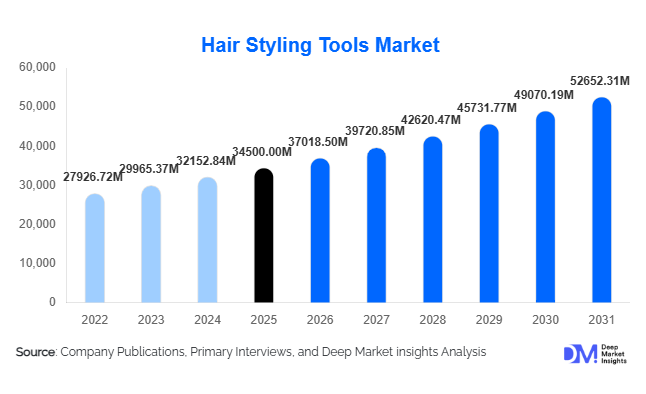
According to Deep Market Insights, the global hair styling tools market size was valued at USD 34,500 million in 2025 and is projected to grow from USD 37,018.50 million in 2026 to reach USD 52,652.31 million by 2031, expanding at a CAGR of 7.3% during the forecast period (2026–2031). The hair styling tools market growth is primarily driven by increasing consumer focus on personal grooming, rising disposable incomes, and rapid technological advancements in styling devices. The growing influence of social media, beauty trends, and the expansion of professional salon services are further fueling global market demand.
Key Market Insights
- Consumers are increasingly shifting toward premium and multifunctional styling tools, driven by demand for salon-quality results at home.
- Technological innovations such as ionic, ceramic, and AI-enabled tools are enhancing product performance and reducing hair damage.
- Asia-Pacific dominates the global market, supported by large population bases, rising middle-class income, and strong manufacturing ecosystems.
- Online retail channels are expanding rapidly, offering convenience, competitive pricing, and wider product availability.
- Professional salon demand is growing steadily, particularly in urban markets with increasing beauty service consumption.
- Sustainability and energy-efficient products are gaining traction, especially in Europe and North America.
What are the latest trends in the hair styling tools market?
Smart and AI-Enabled Styling Tools
The integration of smart technologies into hair styling tools is transforming the market landscape. AI-powered devices capable of automatically adjusting temperature and airflow based on hair type are gaining popularity among consumers seeking safer and more efficient styling solutions. These innovations reduce heat damage and improve user convenience, making them particularly appealing in premium segments. Connectivity features, including app-based controls and usage tracking, are further enhancing the consumer experience. Manufacturers are investing heavily in R&D to develop intelligent styling systems that combine automation with personalization, thereby strengthening product differentiation and driving higher margins.
Shift Toward Cordless and Portable Devices
The demand for cordless and rechargeable styling tools is increasing due to rising consumer preference for convenience and mobility. These tools are especially popular among frequent travelers and professionals who require flexible usage without dependence on fixed power sources. Advances in battery technology have improved performance and usage time, addressing earlier limitations associated with cordless devices. This trend is also supported by compact product designs and lightweight materials, making styling tools more user-friendly. As portability becomes a key purchasing factor, manufacturers are expanding their cordless product portfolios to capture this growing segment.
What are the key drivers in the hair styling tools market?
Rising Personal Grooming Awareness
The increasing emphasis on personal appearance and grooming is a major driver of the hair styling tools market. Social media platforms, influencer marketing, and evolving beauty standards are encouraging consumers to invest in high-quality styling devices. The trend is particularly strong among younger demographics and urban populations, where daily styling routines are becoming more common. This shift is driving consistent demand across both premium and mid-range product categories, supporting overall market growth.
Technological Advancements in Styling Devices
Continuous innovation in hair styling technologies is significantly boosting market expansion. Features such as ionic conditioning, ceramic heating, and infrared technology are improving product efficiency while minimizing hair damage. These advancements are enhancing user confidence and encouraging repeat purchases. Additionally, the introduction of multifunctional devices that combine drying, straightening, and curling capabilities is increasing product value and driving adoption across diverse consumer segments.
What are the restraints for the global market?
High Cost of Premium Products
The high price of advanced hair styling tools remains a key restraint, particularly in price-sensitive markets. Premium devices with smart features and high-performance components are often unaffordable for a large segment of consumers, limiting their adoption. This creates a gap between demand for advanced features and affordability, especially in emerging economies where consumers prioritize cost-effective alternatives.
Concerns Related to Hair Damage and Safety
Despite technological improvements, concerns regarding heat-induced hair damage and product safety persist. Improper usage and lack of awareness about correct styling techniques can lead to negative consumer experiences, impacting brand perception. Manufacturers must focus on education, safety features, and product certifications to address these challenges and maintain consumer trust.
What are the key opportunities in the hair styling tools industry?
Expansion in Emerging Markets
Emerging economies such as India, Indonesia, and Brazil present significant growth opportunities due to rising disposable incomes and increasing urbanization. The growing middle-class population in these regions is driving demand for personal care appliances, including hair styling tools. Companies can leverage localized pricing strategies and region-specific product offerings to penetrate these high-potential markets and expand their customer base.
Sustainable and Energy-Efficient Product Development
The growing focus on environmental sustainability is creating opportunities for manufacturers to develop energy-efficient and eco-friendly styling tools. Consumers are increasingly prioritizing products with lower energy consumption, recyclable materials, and extended product lifespans. This trend is particularly strong in developed regions, where regulatory frameworks and consumer awareness are driving demand for sustainable solutions. Companies adopting green manufacturing practices can gain a competitive advantage and strengthen brand loyalty.
Report Scope
| Report Metric | Details |
|---|---|
| Market Size in 2025 | USD 34500 Million |
| Market Size in 2026 | USD 37018.50 Million |
| Market Size in 2031 | USD 52652.31 Million |
| CAGR | 7.3% (2026-2031) |
| Base Year for Estimation | 2025 |
| Historical Data | 2022-2024 |
| Forecast Period | 2026-2031 |
| Report Coverage | Revenue Forecast, Competitive Landscape, Supply Chain Disruption, Growth Factors, Environment & Regulatory Landscape and Trends |
| Geographies Covered | North America, Europe, APAC, Middle East and Africa, LATAM |
| Countries Covered | U.S., Canada, U.K., Germany, France, Spain, Italy, Russia, Nordic, Benelux, Rest of Europe, China, Korea, Japan, India, Australia, Singapore, Taiwan, South East Asia, Rest of Asia-Pacific, UAE, Turky, Saudi Arabia, South Africa, Egypt, Nigeria, Rest of MEA, Brazil, Mexico, Argentina, Chile, Colombia, Rest of LATAM |
Explore more data points, trends and opportunities Download Free Sample Report
Product Type Insights
Hair dryers continue to dominate the global hair styling tools market, accounting for approximately 32% of the market in 2025. Their essential role in daily grooming routines, combined with widespread household and professional usage, ensures consistent demand. The leadership of this segment is further reinforced by continuous innovation in high-speed motors, lightweight ergonomics, and heat protection technologies, which enhance user convenience and reduce hair damage. The rising influence of social media and fashion trends is driving styling-conscious consumers toward versatile tools, boosting demand for hair straighteners and curling devices, which follow closely behind in market share. Additionally, multi-styling devices are gaining traction due to their all-in-one functionality, offering consumers the convenience of drying, straightening, and curling in a single product, making them particularly attractive to tech-savvy and time-conscious users. The key driver for this segment is the increasing consumer preference for multifunctional, time-saving styling solutions that combine performance, protection, and convenience.
End-Use Insights
The household segment represents the largest end-use category, contributing around 68% of the global market in 2025. Growth in this segment is primarily fueled by the increasing adoption of at-home grooming routines, driven by the rise of social media tutorials, influencer trends, and DIY beauty culture. Consumers are investing in user-friendly, durable, and multifunctional styling devices that allow them to achieve salon-like results at home. On the other hand, the professional segment, including salons and spas, is the fastest-growing end-use segment. Demand in this segment is driven by premium grooming services, where professional stylists require high-performance tools that offer precision, durability, and advanced technology. The expansion of the global salon industry, particularly in urban and semi-urban regions, coupled with rising disposable incomes and the proliferation of beauty and fashion services, further fuels growth. Export-oriented demand is also contributing, as professional-grade devices produced in manufacturing hubs like China and South Korea are shipped to salons worldwide.
Distribution Channel Insights
Online retail channels account for approximately 44% of the hair styling tools market, driven by the convenience of shopping from home, access to competitive pricing, and a wide variety of brands and product models. E-commerce platforms, including global marketplaces and brand-owned websites, facilitate direct-to-consumer sales, enhancing accessibility and enabling personalized promotions and loyalty programs. The rise of digital marketing, social media campaigns, and influencer partnerships has further strengthened online sales. Offline channels, including specialty stores, supermarkets, and professional salon supply stores, continue to play a significant role, especially in regions where consumers prefer tactile experience and in-person product demonstrations before purchasing. The dual-channel approach ensures comprehensive market coverage, with offline stores remaining essential for premium and professional segments, while online platforms dominate mass-market penetration.
Explore more data points, trends and opportunities Download Free Sample Report
Hair Styling Tools Market Segmentations
By Product Type
- Hair Dryers
- Hair Straighteners / Flat Irons
- Curling Irons / Curlers
- Multi-Styling Devices
- Hair Brushes & Hot Air Stylers
End-Use
- Household / Personal Use
- Professional / Salon & Spa
By Distribution Channel
- Online Retail
- Specialty Stores
- Department Stores
- Supermarkets & Hypermarkets
- Professional Salon Supply Stores
Regional Insights
Asia-Pacific
Asia-Pacific holds the largest share of the global hair styling tools market, approximately 38% in 2025, and is also the fastest-growing region, with a CAGR exceeding 8%. Key contributors include China, India, Japan, and South Korea. Growth is fueled by the region’s large population base, rising disposable incomes, and increasing urbanization. China leads in both production and export of hair styling tools, benefiting from a well-established manufacturing infrastructure and competitive pricing, which drives global supply. India is emerging as a high-growth consumption market, supported by rising beauty consciousness, social media influence, and expanding middle-class wealth. Japan and South Korea are mature markets with strong consumer demand for technologically advanced, high-quality, and professional-grade devices. Drivers for regional growth include increasing adoption of multifunctional styling tools, e-commerce expansion, and the popularity of premium and smart devices among urban consumers.
North America
North America accounts for around 26% of the global market, with the United States leading demand. The region benefits from high consumer spending power, strong presence of professional salons, and widespread preference for premium and technologically advanced hair styling tools. Drivers of growth include the increasing popularity of at-home grooming, DIY styling trends, and the rise of influencer-led beauty tutorials. Sustainability and energy-efficient product adoption are further boosting demand, as consumers increasingly seek eco-friendly styling devices. High smartphone and internet penetration facilitate online retail growth, enhancing accessibility and offering personalized shopping experiences.
Europe
Europe holds approximately 22% of the global market, with major contributions from Germany, the U.K., and France. Market growth is driven by strong consumer awareness of eco-friendly and energy-efficient products, supported by stringent regulatory standards on product safety, energy consumption, and sustainability. Increasing disposable incomes, urban lifestyles, and a high preference for premium and multifunctional devices fuel market adoption. Additionally, the professional segment benefits from a well-established salon and spa industry. Consumer demand for smart and connected styling devices is gradually rising, driven by fashion-conscious and tech-savvy populations in Western Europe.
Latin America
Latin America accounts for about 7% of the global market, with Brazil and Mexico being the largest contributors. Regional growth is driven by rising urbanization, increasing disposable income, and heightened beauty awareness. Consumers are gravitating toward affordable yet multifunctional styling devices, while premium products are gradually gaining traction among affluent urban populations. E-commerce adoption, particularly in Brazil and Mexico, is expanding access to international brands, driving market penetration and supporting overall growth.
Middle East & Africa
The Middle East & Africa region accounts for approximately 7% of the global market, with the UAE and South Africa as key contributors. Demand is fueled by rising disposable incomes, evolving lifestyle preferences, and increased beauty consciousness. The region is witnessing growing adoption of premium and technologically advanced styling devices in both household and professional segments. Urbanization, increased salon services, and exposure to international beauty trends are key drivers of growth. In Africa, professional grooming demand is expanding in major cities, while in the Middle East, high-income populations favor luxury and multifunctional styling tools, further propelling market growth.