Hair Styling Products Market Size
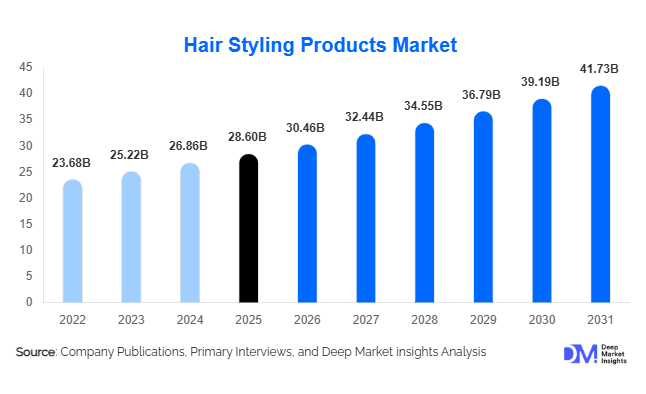
According to Deep Market Insights, the global hair styling products market size was valued at USD 28.6 billion in 2025 and is projected to grow from USD 30.46 billion in 2026 to reach USD 41.73 billion by 2031, expanding at a CAGR of 6.5% during the forecast period (2026–2031). The hair styling products market growth is primarily driven by rising consumer focus on personal grooming, increasing premiumization in beauty and personal care products, and growing demand for multifunctional styling solutions that combine cosmetic performance with hair nourishment and scalp protection.
Key Market Insights
- Clean-label and sustainable styling products are rapidly gaining traction, with consumers increasingly preferring sulfate-free, vegan, cruelty-free, and botanical-based formulations.
- Premium salon-grade styling products are witnessing strong demand globally, particularly among millennials and Gen Z consumers seeking professional-quality styling outcomes at home.
- Asia-Pacific dominates the global market, supported by rising urbanization, increasing disposable income, and strong beauty product adoption across China, India, Japan, and South Korea.
- North America remains a major innovation hub, driven by strong demand for scalp-health-focused styling products, texture-specific formulations, and premium hair-care solutions.
- Men’s grooming is emerging as a high-growth category, particularly in hair waxes, pomades, styling gels, and texture-enhancing products.
- Digital commerce and influencer-led marketing are reshaping purchasing behavior, with social commerce platforms and direct-to-consumer brands significantly influencing product discovery and customer engagement.
Hair Styling Products Market Trends
Clean Beauty and Scalp-Health Styling Products Gaining Momentum
The hair styling products market is increasingly shifting toward clean beauty and scalp-health-focused formulations. Consumers are demanding products that not only provide styling performance but also improve hair texture, scalp health, and long-term hair strength. Ingredients such as keratin, biotin, peptides, argan oil, collagen, niacinamide, and botanical extracts are becoming mainstream across styling sprays, creams, serums, and gels. Brands are also reformulating products to eliminate sulfates, silicones, parabens, and harsh alcohols to address growing consumer concerns regarding scalp sensitivity and hair damage. Sustainable packaging adoption, including recyclable aerosol cans and refillable containers, is also becoming a major differentiator among premium brands. The clean-label trend is particularly strong across North America and Europe, where environmentally conscious consumers increasingly prioritize ingredient transparency and ethical beauty products.
Digital and Influencer-Driven Styling Culture
Social media platforms such as TikTok, Instagram, and YouTube are playing a transformative role in shaping hair styling trends globally. Consumers increasingly discover products through influencer tutorials, celebrity hairstylists, livestream shopping, and short-form beauty content. Viral hairstyle trends, heatless styling techniques, curl-definition routines, and salon-inspired tutorials are accelerating demand for specialized styling products. Beauty brands are investing heavily in AI-powered product recommendations, virtual hair consultations, and direct-to-consumer digital platforms to improve customer engagement. Social commerce integration is particularly strong in Asia-Pacific markets, where livestream beauty commerce significantly influences purchasing behavior. The rise of personalized beauty ecosystems is expected to further strengthen digital-first product adoption over the coming years.
Hair Styling Products Market Drivers
Growing Global Grooming and Beauty Consciousness
Rising beauty awareness and increasing emphasis on personal appearance are major growth drivers for the hair styling products market. Consumers across all demographics are spending more on grooming routines as hairstyling becomes integrated into daily lifestyle habits and social identity. The growing influence of social media, celebrity beauty trends, and workplace grooming standards is encouraging consumers to adopt more advanced styling routines. Urban populations, particularly millennials and Gen Z consumers, are increasingly experimenting with hairstyles, colors, and textures, driving demand for versatile styling products. The increasing popularity of at-home salon experiences and DIY hairstyling routines has further accelerated market expansion globally.
Premiumization and Multifunctional Product Innovation
Consumers are rapidly shifting from basic styling products toward premium and multifunctional formulations offering styling, nourishment, repair, hydration, and heat protection simultaneously. Premium styling creams, thermal protection sprays, anti-frizz serums, and scalp-repair styling products are witnessing particularly strong demand. Consumers increasingly associate premium products with superior ingredients, salon-grade performance, and healthier formulations. This trend is especially prominent in developed markets such as the United States, Japan, Germany, South Korea, and France. Beauty manufacturers are also investing heavily in biotechnology-driven ingredients and dermatologically tested formulations to improve product differentiation and premium positioning.
Hair Styling Products Market Restraints
Regulatory Pressure on Chemical Ingredients and Aerosols
The hair styling products market faces increasing regulatory scrutiny regarding chemical ingredients, aerosol emissions, and packaging sustainability. Traditional styling formulations containing volatile organic compounds (VOCs), sulfates, synthetic preservatives, and petrochemical derivatives are increasingly subject to stricter regulations across Europe and North America. Compliance costs associated with reformulation, ingredient testing, sustainable packaging transitions, and environmental standards are rising significantly. These regulations create operational challenges for manufacturers, particularly smaller brands with limited R&D capabilities and supply-chain flexibility.
Raw Material Price Volatility and Supply Chain Disruptions
Fluctuations in raw material prices remain a major challenge for market participants. Key inputs such as specialty polymers, silicones, fragrances, botanical oils, aluminum packaging materials, and petrochemical derivatives are vulnerable to inflationary pressure and supply-chain disruptions. Rising logistics costs and geopolitical uncertainties have also impacted production efficiency and operating margins across the industry. Manufacturers are increasingly under pressure to balance premium product quality, sustainability goals, and competitive pricing, particularly in mass-market product categories.
Hair Styling Products Market Opportunities
Expansion of Personalized and Texture-Specific Styling Solutions
The growing emphasis on inclusivity and personalized beauty presents significant opportunities within the hair styling products market. Consumers increasingly seek products tailored to specific hair textures, scalp conditions, climate environments, and styling preferences. Curly, coily, textured, chemically treated, and color-treated hair products are experiencing strong global demand, particularly in multicultural consumer markets such as the United States, Brazil, South Africa, and Western Europe. Companies investing in AI-based scalp diagnostics, personalized styling recommendations, and hair-type-specific formulations are expected to gain substantial competitive advantages. The increasing popularity of curl-definition products, anti-humidity formulations, and scalp-sensitive styling solutions further expands innovation opportunities.
Growth of Sustainable and Eco-Friendly Beauty Products
Sustainability-focused beauty products are creating major long-term growth opportunities across the market. Consumers are increasingly favoring vegan formulations, cruelty-free products, biodegradable packaging, refillable systems, and environmentally responsible sourcing practices. Governments and retailers are also encouraging sustainable beauty standards through packaging regulations and green product initiatives. Brands capable of combining high styling performance with sustainability positioning are expected to benefit from premium pricing and stronger consumer loyalty. Emerging markets are also witnessing rising awareness regarding eco-friendly personal care products, further supporting global market expansion.
Report Scope
| Report Metric | Details |
|---|---|
| Market Size in 2025 | USD 28.6 Billion |
| Market Size in 2026 | USD 30.46 Billion |
| Market Size in 2031 | USD 41.73 Billion |
| CAGR | 6.5% (2026-2031) |
| Base Year for Estimation | 2025 |
| Historical Data | 2022-2024 |
| Forecast Period | 2026-2031 |
| Report Coverage | Revenue Forecast, Competitive Landscape, Supply Chain Disruption, Growth Factors, Environment & Regulatory Landscape and Trends |
| Geographies Covered | North America, Europe, APAC, Middle East and Africa, LATAM |
| Countries Covered | U.S., Canada, U.K., Germany, France, Spain, Italy, Russia, Nordic, Benelux, Rest of Europe, China, Korea, Japan, India, Australia, Singapore, Taiwan, South East Asia, Rest of Asia-Pacific, UAE, Turky, Saudi Arabia, South Africa, Egypt, Nigeria, Rest of MEA, Brazil, Mexico, Argentina, Chile, Colombia, Rest of LATAM |
Explore more data points, trends and opportunities Download Free Sample Report
Product Type Insights
Hair sprays continue to dominate the global hair styling products market, accounting for nearly 30% of total market revenue in 2025. The segment benefits from widespread salon usage, strong consumer familiarity, and increasing demand for flexible-hold and humidity-resistant formulations. Hair waxes and pomades are experiencing rapid growth due to rising male grooming trends and textured hairstyle popularity. Styling creams and multifunctional serums are also gaining significant traction, particularly among consumers seeking anti-frizz performance, heat protection, and hair nourishment benefits. Clean-label styling products incorporating botanical extracts and scalp-care ingredients are rapidly expanding within premium categories. Specialty styling products, including vegan, sulfate-free, and color-safe formulations, are emerging as important high-growth subsegments driven by consumer preference for healthier and sustainable beauty routines.
Consumer Group Insights
Women represent the largest consumer segment within the hair styling products market, accounting for approximately 56% of global demand in 2025. Female consumers generally exhibit higher product consumption frequency, stronger styling experimentation, and greater spending on premium salon-quality products. However, the men’s grooming segment is witnessing faster growth globally, particularly in pomades, styling waxes, texture sprays, and matte-finish products. Younger male consumers increasingly view hairstyling as part of personal branding and professional appearance, driving product adoption across emerging and developed markets alike. Gender-neutral styling products are also gaining popularity among younger consumers seeking inclusive beauty solutions and minimalist grooming routines.
Distribution Channel Insights
Offline retail channels continue to dominate the hair styling products market, accounting for approximately 62% of total sales in 2025. Supermarkets, hypermarkets, salon retail outlets, pharmacies, and beauty specialty stores remain important distribution channels due to widespread accessibility and strong consumer trust. However, online retail is the fastest-growing distribution segment globally. E-commerce platforms, direct-to-consumer websites, social commerce channels, and beauty subscription services are transforming consumer purchasing behavior. Influencer-driven product recommendations, livestream shopping, and personalized beauty algorithms are significantly improving online conversion rates. Digital-first brands are increasingly leveraging social media engagement and targeted advertising strategies to compete with established multinational companies.
End-Use Insights
Individual home consumers remain the largest end-use segment within the hair styling products market due to rising daily grooming routines and growing beauty consciousness. Consumers increasingly seek salon-grade styling outcomes from home-based products, driving demand for premium styling creams, thermal protection sprays, and anti-frizz solutions. Professional salons and barbershops continue to represent a critical high-value segment, particularly for premium styling products and specialized treatments. Salon professionals strongly influence product adoption trends and brand loyalty among consumers. The entertainment and fashion industries are also emerging as important commercial users due to rising demand for professional hairstyling products within media production, influencer content creation, fashion events, and celebrity branding activities.
Ingredient Composition Insights
Conventional synthetic formulations continue to hold a major share of the global market due to affordability and strong styling performance. However, natural, organic, and clean-label formulations are expanding rapidly and account for approximately 34% of global market demand. Botanical ingredient-based products featuring argan oil, aloe vera, shea butter, coconut oil, and herbal extracts are witnessing particularly strong growth among environmentally conscious consumers. Protein and keratin-based styling products are also gaining popularity due to increasing demand for repair-oriented and strengthening formulations. Consumers increasingly prioritize ingredient transparency, scalp safety, and multifunctional benefits, encouraging manufacturers to develop healthier and more sustainable styling solutions.
Explore more data points, trends and opportunities Download Free Sample Report
Hair Styling Products Market Segmentations
By Product Type
- Hair Sprays
- Hair Gels
- Hair Waxes
- Hair Mousses & Foams
- Pomades
- Hair Creams & Styling Lotions
- Texturizers & Styling Powders
- Serums & Finishing Products
- Specialty Styling Products
By Consumer Group
- Men
- Women
- Gender-Neutral/Unisex Consumers
- Children & Teens
By Distribution Channel
- Hypermarkets & Supermarkets
- Beauty Specialty Stores
- Pharmacies & Drug Stores
- Salon Retail Outlets
- Department Stores
- Brand-Owned Websites
- E-commerce Marketplaces
- Social Commerce Channels
By End User
- Individual/Home Consumers
- Professional Salons
- Barbershops
- Spa & Wellness Centers
- Fashion & Entertainment Industry
Regional Insights
North America
North America accounts for approximately 24% of the global hair styling products market in 2025, with the United States representing the dominant regional contributor. Strong premium beauty consumption, advanced salon infrastructure, and widespread adoption of professional hair-care products support regional growth. Consumers increasingly demand clean-label formulations, scalp-health-focused styling products, and texture-specific solutions designed for curly and multicultural hair types. Canada also demonstrates growing demand for sustainable and dermatologist-tested styling products. The region continues leading innovation in premium salon brands, AI-driven personalization, and direct-to-consumer beauty ecosystems.
Europe
Europe represents nearly 27% of the global hair styling products market, driven by strong demand from Germany, France, the United Kingdom, Italy, and Spain. European consumers strongly prioritize sustainable packaging, cruelty-free products, and organic beauty formulations. Germany remains the largest regional market due to its advanced retail infrastructure and strong premium beauty spending. France continues serving as a major innovation hub due to the presence of several multinational beauty companies and luxury salon brands. The United Kingdom is experiencing rapid growth in men’s grooming products and texture-specific styling solutions driven by evolving fashion and grooming trends.
Asia-Pacific
Asia-Pacific dominates the global market with approximately 34% market share in 2025. China remains the largest market within the region due to rapid urbanization, rising disposable income, and strong digital beauty commerce penetration. India is among the fastest-growing markets globally, supported by a young population, rising social media influence, expanding salon culture, and increasing premiumization of beauty products. South Korea and Japan continue leading innovation in scalp-health styling formulations, multifunctional products, and clean beauty technologies. Strong e-commerce ecosystems and influencer-driven beauty trends are further accelerating regional market growth.
Latin America
Latin America contributes nearly 7% of the global market revenue, with Brazil serving as the dominant regional market. Strong beauty-conscious consumer culture and high spending on hair-care products support regional growth. Curly-hair styling products, anti-humidity formulations, and salon-grade treatments are particularly popular across Brazil due to climate conditions and styling preferences. Mexico and Argentina are also emerging as important regional markets due to rising urbanization and increasing premium beauty product adoption.
Middle East & Africa
The Middle East & Africa region accounts for approximately 8% of global demand and is witnessing strong premium product growth. Gulf countries, including the UAE and Saudi Arabia, are experiencing rising demand for luxury styling products due to high disposable income, strong salon culture, and premium beauty spending. South Africa remains the leading African market, driven by increasing demand for textured-hair and protective styling products. Growing urbanization and expanding beauty retail infrastructure across the region continue supporting long-term market development.
Key Players in the Hair Styling Products Market
- L’Oréal Group
- Procter & Gamble
- Unilever
- Henkel AG & Co. KGaA
- Kao Corporation
- Shiseido Company Limited
- Revlon Inc.
- Coty Inc.
- Amorepacific Corporation
- Johnson & Johnson
- Mandom Corporation
- Estée Lauder Companies
- Oribe Hair Care
- Olaplex Holdings
- Church & Dwight Co., Inc.