Electric Fan Regulator Market Size
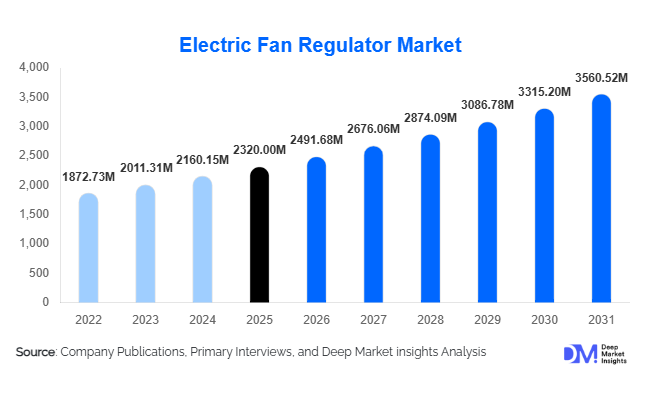
According to Deep Market Insights, the global electric fan regulator market size was valued at USD 2,320 million in 2025 and is projected to grow from USD 2,491.68 million in 2026 to reach USD 3,560.52 million by 2031, expanding at a CAGR of 7.4% during the forecast period (2026–2031). The electric fan regulator market growth is primarily driven by the expansion of residential construction, increasing adoption of modular electrical switchgear systems, and rising demand for energy-efficient electronic regulators.
Electric fan regulators are essential electrical accessories used to control the speed of ceiling and ventilation fans by regulating voltage supplied to the motor. These devices are widely used in residential, commercial, and industrial environments, particularly in regions with warm climates where fans remain one of the most affordable cooling solutions. Emerging markets across Asia, Africa, and Latin America continue to drive significant demand due to rapid urbanization, growing electrification rates, and expanding housing projects.
Additionally, the market is witnessing a transition from traditional coil-based regulators to electronic and smart regulators that offer improved efficiency, smoother speed control, and reduced power losses. Increasing consumer preference for modular switchboards and aesthetically designed electrical accessories is also supporting the growth of advanced regulators. Smart regulators integrated with home automation systems and remote control functionality are gradually gaining traction in developed markets, further expanding the scope of innovation in the electric fan regulator market.
Key Market Insights
- Electronic fan regulators are replacing traditional resistive models due to improved energy efficiency, smoother speed control, and reduced heat generation.
- Asia-Pacific dominates the electric fan regulator market, driven by high ceiling fan adoption in countries such as India, China, and Indonesia.
- Residential buildings represent the largest end-use sector, accounting for more than 60% of total installations globally.
- Modular electrical switchboards are accelerating demand for compact and aesthetically integrated fan regulators.
- Smart regulators with Wi-Fi or Bluetooth connectivity are emerging as a premium product category within modern smart homes.
- Replacement demand for energy-efficient regulators is creating strong aftermarket opportunities in emerging economies.
What are the latest trends in the electric fan regulator market?
Shift Toward Electronic and Smart Regulators
One of the most prominent trends shaping the electric fan regulator market is the growing transition from conventional resistive regulators to electronic and smart regulators. Traditional regulators rely on coil-based systems that dissipate energy as heat, making them less efficient. Electronic regulators use semiconductor components to control voltage more efficiently, reducing energy loss and improving performance.
Consumers are increasingly choosing electronic regulators due to their smoother speed control, lower noise levels, and improved durability. Manufacturers are also introducing smart regulators equipped with Wi-Fi or Bluetooth connectivity that enable users to control fan speeds using mobile applications or voice assistants. As smart home adoption expands globally, the demand for connected electrical accessories—including smart fan regulators—is expected to increase steadily.
Growing Popularity of Modular Electrical Accessories
The global shift toward modular electrical switchboards is significantly influencing the electric fan regulator market. Modular electrical accessories combine switches, sockets, and regulators into aesthetically designed panels that enhance interior design and functionality.
Modern residential and commercial construction projects increasingly favor modular switchboards due to their sleek design, ease of installation, and compatibility with contemporary interior styles. Fan regulator manufacturers are therefore designing compact modular regulators that fit seamlessly within these systems. This trend is particularly strong in urban housing developments, premium residential buildings, and commercial infrastructure projects where electrical aesthetics and space efficiency are prioritized.
What are the key drivers in the electric fan regulator market?
Expansion of Residential Construction and Urban Housing
The rapid growth of residential housing construction is a major driver of the electric fan regulator market. New housing developments across emerging economies require large volumes of electrical accessories including switches, sockets, and regulators. Ceiling fans remain one of the most widely installed cooling appliances in homes, particularly in tropical regions.
Urbanization in countries such as India, Indonesia, Nigeria, and Brazil has led to large-scale apartment construction and government-backed housing programs. Each housing unit typically includes multiple fan installations, directly increasing demand for regulators. As global housing demand continues to expand, the regulator market is expected to benefit from steady installation volumes.
Increasing Demand for Energy-Efficient Electrical Equipment
Rising awareness of energy conservation and electricity cost savings is driving the adoption of energy-efficient electrical accessories. Electronic fan regulators reduce energy loss compared to traditional resistive regulators and are therefore increasingly preferred by consumers and building developers.
Governments and energy efficiency organizations are also encouraging the adoption of power-saving appliances and components. As households and businesses seek to reduce electricity consumption, the transition toward electronic regulators is expected to accelerate, contributing to sustained market growth.
What are the restraints for the global market?
Price Sensitivity in Emerging Economies
Despite technological advancements, a significant portion of the electric fan regulator market remains highly price-sensitive. Conventional coil-based regulators are cheaper to manufacture and purchase compared to electronic or smart regulators. As a result, many consumers in developing countries continue to prefer low-cost traditional regulators.
This price sensitivity can slow the adoption of advanced regulator technologies, particularly in rural and low-income markets where affordability remains a key purchasing factor.
Growing Adoption of Integrated Fan Control Systems
The increasing popularity of ceiling fans with built-in remote control systems presents another challenge for the standalone regulator market. Many modern fans incorporate integrated electronic controllers that eliminate the need for a separate wall-mounted regulator.
As fan manufacturers introduce more remote-controlled and smart fan models, the demand for external regulators in premium product segments may experience moderate pressure.
What are the key opportunities in the electric fan regulator industry?
Growth of Smart Home Integration
The global expansion of smart homes presents a major opportunity for fan regulator manufacturers. Smart regulators that connect with home automation systems enable users to control fan speeds remotely through smartphone applications or voice assistants.
Urban households increasingly prefer centralized control over lighting, fans, and appliances. Manufacturers that develop regulators compatible with smart home platforms can tap into a rapidly growing premium product segment. As connected homes become more common, smart regulators are expected to witness significantly higher growth rates compared to conventional models.
Infrastructure Development in Emerging Economies
Large-scale infrastructure development projects across emerging economies are creating significant opportunities for the electric fan regulator market. Government investments in affordable housing, urban development, and commercial construction are increasing demand for electrical accessories.
Countries across Asia, Africa, and the Middle East are implementing large housing initiatives and electrification programs. These projects require extensive installation of electrical fittings, including fan regulators. Manufacturers that establish strong supply partnerships with construction contractors and electrical distributors can benefit from large-scale procurement contracts.
Report Scope
| Report Metric | Details |
|---|---|
| Market Size in 2025 | USD 2320 Million |
| Market Size in 2026 | USD 2491.68 Million |
| Market Size in 2031 | USD 3560.52 Million |
| CAGR | 7.4% (2026-2031) |
| Base Year for Estimation | 2025 |
| Historical Data | 2022-2024 |
| Forecast Period | 2026-2031 |
| Report Coverage | Revenue Forecast, Competitive Landscape, Supply Chain Disruption, Growth Factors, Environment & Regulatory Landscape and Trends |
| Geographies Covered | North America, Europe, APAC, Middle East and Africa, LATAM |
| Countries Covered | U.S., Canada, U.K., Germany, France, Spain, Italy, Russia, Nordic, Benelux, Rest of Europe, China, Korea, Japan, India, Australia, Singapore, Taiwan, South East Asia, Rest of Asia-Pacific, UAE, Turky, Saudi Arabia, South Africa, Egypt, Nigeria, Rest of MEA, Brazil, Mexico, Argentina, Chile, Colombia, Rest of LATAM |
Explore more data points, trends and opportunities Download Free Sample Report
Product Type Insights
The electric fan regulator market is segmented by product type into electronic regulators, resistive regulators, digital regulators, and smart regulators. Among these, electronic fan regulators represent the leading product category and account for approximately 38% of global demand. Their dominance is primarily attributed to their superior energy efficiency, precise speed control, and lower heat generation compared to traditional coil-based regulators. Unlike resistive regulators that dissipate excess energy as heat, electronic regulators use advanced circuitry that minimizes energy loss while delivering smoother fan speed control. This efficiency advantage has made them increasingly popular in residential and commercial buildings where energy-saving electrical accessories are becoming a priority. Additionally, the rapid expansion of modular switchboards in modern construction projects has further strengthened the adoption of electronic regulators.
Resistive regulators continue to maintain a notable presence in the market, particularly in price-sensitive regions and rural areas of developing economies. Their relatively simple design and low manufacturing cost make them an attractive option for consumers seeking affordable electrical accessories. Despite their lower efficiency compared to electronic regulators, their reliability and ease of installation ensure continued demand in markets where cost considerations remain a primary purchasing factor. In many emerging economies, resistive regulators are still widely used in basic residential housing projects and smaller commercial establishments.
Digital regulators featuring push-button or touch controls are gaining increasing traction in the premium residential segment. These products offer improved convenience, modern aesthetics, and enhanced compatibility with modular electrical fittings that are commonly used in contemporary homes and apartments. Homeowners increasingly prefer digital regulators as they align with modern interior design trends while offering precise control over fan speed settings. The growing popularity of premium housing developments and smart interior solutions has significantly supported the adoption of digital fan regulators in urban markets.
Smart regulators represent an emerging high-value product category within the electric fan regulator market. These regulators are equipped with wireless connectivity features such as Wi-Fi or Bluetooth that allow users to control fan speeds through smartphone applications or integrated home automation systems. The growing adoption of smart home technologies and connected electrical devices in developed economies is driving demand for these advanced regulators. As consumers increasingly seek convenience, automation, and energy monitoring capabilities in household appliances, smart fan regulators are expected to witness strong growth during the forecast period.
Application Insights
The electric fan regulator market is segmented by application into residential, commercial, industrial, and public infrastructure sectors. Residential applications dominate the market and account for nearly two-thirds of total installations worldwide. The leading position of this segment is primarily driven by the widespread use of ceiling fans in homes across tropical and subtropical regions where fans serve as a cost-effective cooling solution. Compared to air conditioning systems, ceiling fans consume significantly less electricity and are therefore widely used in middle-income households and regions with high energy costs. The continuous expansion of housing construction, particularly in emerging economies, is further increasing the demand for fan regulators used in residential electrical systems.
Commercial buildings represent another important application segment for electric fan regulators. Offices, retail spaces, hotels, restaurants, and educational institutions require multiple ceiling or wall-mounted fans to maintain adequate air circulation across large indoor areas. In many commercial spaces, fan regulators are integrated with modular electrical fittings to ensure convenient control and energy management. The expansion of commercial real estate development, particularly in rapidly urbanizing cities, is supporting sustained demand for fan regulators in this segment.
Industrial facilities also contribute to market demand, particularly in manufacturing plants, warehouses, and logistics centers where ventilation fans are used to maintain airflow and improve worker comfort. Industrial environments often require durable and reliable regulators that can handle continuous operation. As industrial infrastructure expands in emerging economies and manufacturing hubs, the demand for robust ventilation control systems, including fan regulators, continues to grow.
Public infrastructure projects represent another important application area for electric fan regulators. Hospitals, government offices, transportation terminals, schools, and community centers require extensive electrical installations that include ceiling fans and ventilation systems. Governments in many countries are investing heavily in public infrastructure development to support urban population growth and improve access to essential services. These initiatives are creating additional demand for fan regulators as part of electrical installations in public facilities.
Distribution Channel Insights
The electric fan regulator market is distributed through several channels, including electrical wholesalers and distributors, retail hardware stores, online platforms, and direct supply to original equipment manufacturers. Electrical wholesalers and distributors represent the dominant distribution channel in the market. Contractors, electricians, and construction companies rely heavily on these distributors for bulk procurement of electrical accessories required for residential and commercial construction projects. Distributors maintain extensive product inventories and provide technical guidance to professionals involved in building installations, which strengthens their role as the primary supply channel for fan regulators.
Retail hardware stores also play a critical role in the distribution of fan regulators, particularly for individual consumers and small contractors involved in home renovation or maintenance projects. These stores provide easy access to a wide variety of electrical accessories and serve as an important point of sale for replacement regulators. In many developing economies, local hardware stores remain the preferred purchasing channel for electrical components due to their accessibility and personalized service.
Online sales channels are gradually gaining popularity as digital commerce platforms expand globally. E-commerce websites provide consumers with access to a broader range of regulator models, including premium electronic and smart regulators that may not always be available in local retail stores. Online platforms also enable manufacturers to directly reach end users while offering competitive pricing and product comparisons. The increasing penetration of internet connectivity and the growing adoption of digital shopping platforms are expected to further support the growth of online distribution channels.
Direct supply agreements with fan manufacturers represent another important distribution channel within the market. Some fan regulators are supplied directly to original equipment manufacturers for integration into ceiling fan systems before they reach the end consumer. This OEM supply model allows fan manufacturers to ensure compatibility between fans and regulators while streamlining installation processes for customers. As fan manufacturers continue to expand their product offerings and integrate advanced control technologies, partnerships with regulator manufacturers are becoming increasingly common.
End-Use Insights
The electric fan regulator market is segmented by end-use into residential, commercial, industrial, and public infrastructure sectors. The residential sector represents the largest end-use segment and accounts for approximately 64% of total market demand. The leading position of this segment is primarily driven by the widespread adoption of ceiling fans in households across Asia, Latin America, and parts of Africa where fans provide an affordable and energy-efficient cooling solution. Rapid population growth, increasing housing construction, and replacement demand for outdated electrical fittings in existing homes are key factors supporting continued growth in this segment.
The commercial sector is one of the fastest-growing end-use segments in the market. Offices, shopping centers, hotels, restaurants, and educational institutions require multiple fan installations to maintain adequate air circulation and thermal comfort for occupants. As commercial infrastructure development accelerates in emerging economies and urban business districts continue to expand, the demand for fan regulators used in these buildings is expected to increase significantly. Modern commercial buildings also increasingly incorporate modular electrical systems that utilize advanced electronic regulators for improved performance and aesthetics.
Industrial end users also contribute to the demand for fan regulators, particularly in facilities that require ventilation systems for temperature regulation and air circulation. Factories, warehouses, and manufacturing plants use large ventilation fans to maintain safe and comfortable working environments for employees. Industrial regulators are often designed for durability and continuous operation, ensuring reliable performance in demanding industrial environments. The expansion of manufacturing sectors in developing economies is expected to support steady growth in this segment.
Public infrastructure projects represent another important end-use category within the electric fan regulator market. Government buildings, hospitals, transportation hubs, and educational institutions require large-scale electrical installations that include ceiling fans and ventilation systems. Increasing government investments in public infrastructure development, particularly in emerging economies, are creating additional demand for fan regulators used in these facilities.
Explore more data points, trends and opportunities Download Free Sample Report
Electric Fan Regulator Market Segmentations
By Product Type
- Resistive (Conventional) Fan Regulators
- Electronic Fan Regulators
- Digital Fan Regulators
- Smart Fan Regulators
By Installation Type
- Wall-Mounted Regulators
- Modular Switchboard Regulators
- Remote-Controlled Regulators
- Integrated Fan Regulators
By End-Use Industry
- Residential Buildings
- Commercial Buildings
- Industrial Facilities
- Public Infrastructure
By Distribution Channel
- Electrical Wholesalers and Distributors
- Retail Hardware Stores
- Online Marketplaces
- OEM Supply to Fan Manufacturers
- Direct Construction Procurement
Regional Insights
Asia-Pacific
Asia-Pacific dominates the global electric fan regulator market and accounts for approximately 48% of total market share. The region’s leadership is primarily driven by the extensive use of ceiling fans across residential and commercial buildings in tropical and subtropical climates. Countries such as India, China, and Indonesia represent the largest contributors to regional demand due to their large populations and high household adoption of ceiling fans. India represents the single largest national market within the region, as ceiling fans remain one of the most widely used cooling appliances across both urban and rural households due to their affordability and low electricity consumption.
Several factors are driving the strong growth of the electric fan regulator market in Asia-Pacific. Rapid urbanization is leading to increased construction of residential apartments, commercial buildings, and public infrastructure projects that require extensive electrical installations. Government electrification programs in developing countries are also expanding electricity access to rural areas, creating new demand for household electrical appliances including fans and regulators. Additionally, rising disposable incomes and the increasing adoption of modular electrical fittings in modern homes are encouraging consumers to replace traditional regulators with more efficient electronic and digital models.
North America
North America accounts for approximately 15% of the global electric fan regulator market. The United States represents the largest market within the region, supported by strong demand for advanced electrical accessories and smart home technologies. Unlike many emerging markets where regulators are primarily driven by new installations, the North American market is largely influenced by replacement demand and renovation activities in existing residential properties.
The increasing adoption of home automation systems is a key driver supporting market growth in the region. Consumers are increasingly integrating smart regulators with connected home platforms that allow remote control of lighting, temperature, and ventilation systems through mobile applications or voice assistants. Additionally, modern residential construction projects increasingly incorporate modular electrical systems that favor electronic and digital regulators over traditional coil-based alternatives. Growing awareness of energy efficiency and the rising popularity of smart home ecosystems are expected to further strengthen market expansion in North America.
Europe
Europe accounts for approximately 17% of the global electric fan regulator market. Demand within the region is particularly strong in southern European countries such as Spain, Italy, and Greece where warmer climates increase the need for ventilation and cooling solutions. Ceiling fans are commonly used in residential and hospitality settings across these regions as an energy-efficient complement to air conditioning systems.
The growing emphasis on energy efficiency and sustainable building technologies is one of the key drivers supporting the adoption of advanced fan regulators in Europe. Governments across the region are encouraging the use of energy-efficient electrical appliances and smart building systems to reduce overall energy consumption. As a result, electronic and digital regulators are increasingly being installed in modern residential and commercial buildings. Additionally, the renovation of older buildings across Europe is creating replacement demand for updated electrical fittings, further supporting market growth.
Latin America
Latin America accounts for approximately 8% of the global electric fan regulator market, with Brazil and Mexico representing the largest national markets in the region. The widespread use of ceiling fans in residential homes, particularly in warm and humid climates, continues to support steady demand for fan regulators. Ceiling fans remain a preferred cooling solution in many households due to their affordability and relatively low energy consumption compared to air conditioning systems.
Urbanization and population growth are key drivers supporting market expansion in Latin America. As cities continue to grow and new housing developments are constructed, the demand for electrical accessories including fan regulators increases accordingly. Government initiatives aimed at improving housing infrastructure and expanding electrification in underserved communities are also contributing to market growth. Additionally, the expansion of commercial establishments such as retail stores, hotels, and office buildings is further strengthening demand for fan regulators in the region.
Middle East & Africa
The Middle East and Africa region accounts for approximately 12% of global demand for electric fan regulators and is expected to experience significant growth over the coming years. Hot climatic conditions in many countries across the region create strong demand for ventilation and cooling appliances, making ceiling fans an important component of residential and commercial buildings.
Infrastructure development and rapid urban expansion are key drivers supporting market growth in the region. Countries such as Saudi Arabia and the United Arab Emirates are investing heavily in large-scale residential, commercial, and tourism infrastructure projects that require extensive electrical installations. At the same time, several African countries are implementing electrification programs aimed at expanding access to electricity in rural areas. These initiatives are increasing the adoption of household electrical appliances including ceiling fans and associated regulators. As urbanization and infrastructure investments continue to accelerate across the Middle East and Africa, demand for electric fan regulators is expected to grow steadily.