Egg Boiler Market Size
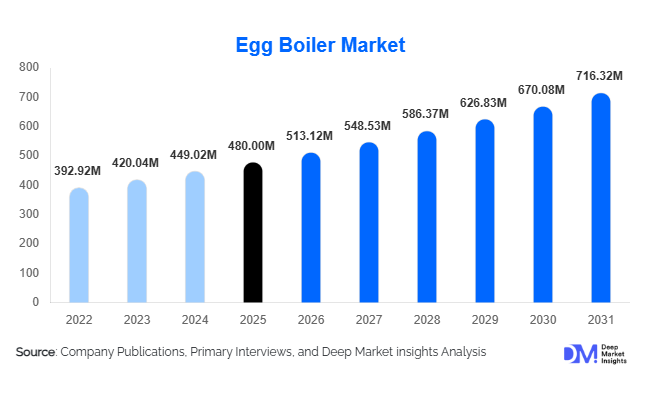
According to Deep Market Insights, the global egg boiler market size was valued at USD 480 million in 2025 and is projected to grow from USD 513.12 million in 2026 to reach USD 716.32 million by 2031, expanding at a CAGR of 6.9% during the forecast period (2026–2031). The egg boiler market growth is primarily driven by the rising adoption of compact kitchen appliances, increasing consumer preference for convenient breakfast preparation solutions, and the growing global consumption of protein-rich foods such as eggs.
Egg boilers, also known as egg cookers, have gained traction as convenient countertop appliances that simplify egg preparation by automating temperature control and cooking duration. These appliances are particularly popular among urban households, working professionals, and students who prefer quick meal preparation with minimal effort. The ability to cook eggs consistently without monitoring the stove has made egg boilers a practical addition to modern kitchens. Rapid urbanization, growing disposable incomes, and the expansion of e-commerce retail channels are also supporting market expansion. Manufacturers are increasingly launching advanced models with digital displays, automatic shut-off functions, and multi-egg cooking capacity to enhance consumer convenience. The introduction of smart kitchen appliances with app connectivity and programmable settings is further strengthening product appeal in developed markets.
Asia-Pacific currently dominates the global egg boiler market due to strong demand from countries such as China and India, where egg consumption is high and affordable kitchen appliances are widely adopted. Meanwhile, North America and Europe are witnessing increased demand for premium egg cookers with enhanced design aesthetics and multifunctional capabilities.
Key Market Insights
- Electric egg boilers dominate the market, accounting for over 70% of global demand due to their convenience, automatic shut-off functionality, and consistent cooking performance.
- Residential households represent the largest end-use segment, driven by rising demand for convenient breakfast appliances in urban homes.
- Asia-Pacific holds the largest market share, supported by strong appliance manufacturing ecosystems and high egg consumption levels.
- E-commerce channels are expanding rapidly, enabling global consumers to access a wide range of affordable egg boiler models.
- Commercial foodservice demand is rising, particularly in hotels, restaurants, and institutional kitchens requiring bulk egg preparation.
- Technological innovation, including digital timers, IoT connectivity, and multi-functional cooking capabilities, is reshaping the egg boiler product landscape.
What are the latest trends in the egg boiler market?
Growing Popularity of Smart Kitchen Appliances
The emergence of smart kitchen ecosystems has encouraged manufacturers to introduce technologically advanced egg boilers equipped with digital displays, programmable cooking settings, and mobile app connectivity. Consumers increasingly prefer appliances that integrate seamlessly with smart home systems and enable remote operation. Premium egg boiler models now feature Bluetooth or Wi-Fi connectivity, allowing users to monitor cooking progress and customize boiling levels directly from their smartphones.
Voice assistant integration and automated cooking presets are also becoming common features in advanced models. These innovations appeal to tech-savvy consumers seeking convenience and automation in everyday cooking tasks. As smart kitchen adoption expands globally, the demand for intelligent egg boilers is expected to increase significantly.
Expansion of Multi-Functional Cooking Appliances
Manufacturers are increasingly designing egg boilers that serve multiple cooking purposes beyond boiling eggs. Modern appliances now support functions such as poaching eggs, steaming vegetables, and preparing omelets. This multi-functionality enhances product value and reduces the need for multiple kitchen gadgets.
The trend is particularly strong in compact urban kitchens where consumers prioritize space-saving appliances. Multi-functional egg cookers offer flexibility while maintaining compact form factors, making them attractive to apartment dwellers and small households. Manufacturers are also incorporating removable trays, adjustable cooking racks, and modular accessories to support different cooking styles.
What are the key drivers in the egg boiler market?
Rising Demand for Convenience Cooking
Modern consumers increasingly prefer appliances that simplify cooking processes and reduce preparation time. Egg boilers enable quick and consistent egg preparation without the need for manual monitoring. This convenience factor has driven strong adoption among working professionals, students, and small households that prioritize efficiency in meal preparation.
Breakfast routines are also evolving, with many consumers seeking quick yet nutritious meal options. Egg boilers enable users to prepare boiled eggs within minutes, supporting busy lifestyles and growing demand for ready-to-eat protein-rich foods.
Increasing Health Awareness and Protein Consumption
Eggs are widely recognized as a nutritious and affordable protein source. Growing awareness of healthy diets and fitness trends has increased global egg consumption, particularly among health-conscious consumers. Boiled eggs are commonly included in high-protein diets due to their nutritional value and low calorie content.
Egg boilers provide a convenient way to prepare eggs without additional oils or fats, making them attractive to consumers seeking healthier cooking methods. This alignment with health and nutrition trends is expected to continue driving market growth.
What are the restraints for the global market?
Availability of Traditional Cooking Methods
Despite the convenience offered by egg boilers, many consumers still rely on traditional stovetop boiling methods. Since eggs can easily be cooked using regular cookware, some consumers perceive egg boilers as non-essential kitchen appliances. This perception can limit market adoption, particularly among price-sensitive buyers.
Product Quality and Durability Concerns
Low-cost egg boilers manufactured using inexpensive materials may experience durability issues such as heating element failures or plastic degradation. Negative consumer experiences with poor-quality products can affect brand reputation and reduce consumer trust. Manufacturers must focus on improving product quality, safety standards, and long-term reliability to address these concerns.
What are the key opportunities in the egg boiler industry?
Expansion into Emerging Markets
Emerging economies such as India, Brazil, Indonesia, and Vietnam present significant growth opportunities for egg boiler manufacturers. Rising disposable incomes, expanding middle-class populations, and increasing adoption of small kitchen appliances are supporting demand in these markets.
Affordable entry-level egg boilers priced below USD 20 are gaining traction among first-time buyers in these regions. Government initiatives promoting protein consumption through egg-based nutrition programs are also indirectly supporting demand for egg cooking appliances.
Growth of Commercial Foodservice Applications
The hospitality and foodservice sectors are emerging as key growth areas for egg boiler manufacturers. Hotels, restaurants, and institutional cafeterias frequently serve boiled eggs as part of breakfast menus and buffet offerings. Large-capacity egg boilers capable of preparing dozens of eggs simultaneously are particularly useful in these environments.
As global tourism and hospitality industries expand, the demand for professional-grade egg boilers with higher capacity and durable construction is expected to increase significantly.
Report Scope
| Report Metric | Details |
|---|---|
| Market Size in 2025 | USD 480 Million |
| Market Size in 2026 | USD 513.12 Million |
| Market Size in 2031 | USD 716.32 Million |
| CAGR | 6.9% (2026-2031) |
| Base Year for Estimation | 2025 |
| Historical Data | 2022-2024 |
| Forecast Period | 2026-2031 |
| Report Coverage | Revenue Forecast, Competitive Landscape, Supply Chain Disruption, Growth Factors, Environment & Regulatory Landscape and Trends |
| Geographies Covered | North America, Europe, APAC, Middle East and Africa, LATAM |
| Countries Covered | U.S., Canada, U.K., Germany, France, Spain, Italy, Russia, Nordic, Benelux, Rest of Europe, China, Korea, Japan, India, Australia, Singapore, Taiwan, South East Asia, Rest of Asia-Pacific, UAE, Turky, Saudi Arabia, South Africa, Egypt, Nigeria, Rest of MEA, Brazil, Mexico, Argentina, Chile, Colombia, Rest of LATAM |
Explore more data points, trends and opportunities Download Free Sample Report
Product Type Insights
Electric egg boilers dominate the global egg boiler market, accounting for approximately 72% of total market revenue in 2025. The strong adoption of electric egg boilers is primarily driven by their convenience, automation, and ability to deliver consistent cooking results without constant supervision. These appliances are designed with built-in heating plates, measuring cups for precise water levels, and automatic shut-off mechanisms that prevent overcooking. In addition, many electric egg boilers offer adjustable cooking settings that allow users to prepare soft-boiled, medium-boiled, and hard-boiled eggs with minimal effort. This level of automation has made electric egg boilers particularly attractive to busy urban consumers, students, and working professionals who seek efficient breakfast preparation solutions.
Another key driver supporting the growth of electric egg boilers is the increasing demand for compact kitchen appliances that simplify everyday cooking tasks. Urban households with limited kitchen space are increasingly investing in multifunctional countertop appliances that offer convenience and time savings. Manufacturers are also introducing upgraded electric egg boilers equipped with digital displays, programmable timers, multi-layer trays, and energy-efficient heating elements, which further enhance product functionality and consumer appeal. Microwave egg boilers and stovetop egg boilers represent smaller segments of the market but continue to attract budget-conscious consumers who prefer simple and portable cooking solutions. These products are typically more affordable and require minimal technological features, making them popular in developing markets where consumers prioritize cost efficiency. Meanwhile, smart egg boilers equipped with digital controls, touch interfaces, and smartphone connectivity are emerging as a fast-growing niche within the premium appliance segment. As smart kitchen ecosystems expand globally, the adoption of connected egg cookers with app-based control and programmable cooking presets is expected to accelerate, particularly in developed markets.
Application Insights
The residential household segment dominates the egg boiler market, accounting for approximately 68% of total global demand. The growth of this segment is largely driven by the increasing adoption of compact kitchen appliances that enhance convenience in everyday meal preparation. Urban households are increasingly seeking appliances that simplify breakfast preparation, and egg boilers provide a reliable solution by enabling users to prepare eggs quickly without monitoring stovetop cooking. The rising number of nuclear families, smaller apartment living spaces, and busy work schedules are also encouraging consumers to adopt automated kitchen appliances that reduce cooking time and effort. Another major factor driving residential demand is the increasing focus on healthy eating habits. Eggs are widely recognized as a nutritious and affordable source of protein, making boiled eggs a popular breakfast option among health-conscious consumers. Fitness enthusiasts, athletes, and individuals following high-protein diets frequently include boiled eggs in their daily meal plans, further boosting demand for egg boilers in the household segment.
The foodservice and hospitality sector accounts for roughly 22% of total market demand. Hotels, restaurants, cafes, and catering services commonly serve boiled eggs as part of breakfast menus and buffet offerings. In such environments, large-capacity egg boilers capable of cooking multiple eggs simultaneously significantly improve kitchen efficiency and reduce manual cooking labor. The continued expansion of the global hospitality industry, along with the increasing popularity of breakfast buffets in hotels, is expected to drive steady demand for commercial egg boilers. Institutional users such as hospitals, educational institutions, and corporate cafeterias represent approximately 10% of global demand. These organizations often require standardized food preparation processes to ensure consistent quality and hygiene standards. Automated egg boilers help institutions prepare large quantities of boiled eggs efficiently while maintaining uniform cooking results, making them valuable appliances in institutional kitchens.
Distribution Channel Insights
Offline retail channels continue to dominate egg boiler distribution globally, accounting for approximately 62% of total market sales in 2025. Consumers frequently prefer purchasing small kitchen appliances from physical retail stores where they can evaluate product quality, inspect materials, and compare features across multiple brands before making a purchase. Hypermarkets, supermarkets, electronics stores, and specialty kitchen appliance retailers remain the primary offline sales channels for egg boilers. In emerging markets, particularly, offline retail outlets still play a critical role in influencing purchasing decisions due to the trust consumers place in physical product inspection.
However, the rapid expansion of e-commerce platforms has significantly transformed the appliance retail landscape. Online retail channels are witnessing strong growth due to their ability to provide extensive product selections, competitive pricing, and convenient home delivery. E-commerce platforms allow consumers to compare different egg boiler models, access user reviews, and benefit from seasonal discounts and promotional offers. The increasing penetration of smartphones and digital payment systems has further accelerated online appliance sales globally. Direct-to-consumer brand websites are also becoming increasingly important distribution channels as appliance manufacturers strengthen their digital presence. Many companies now offer exclusive online product launches, extended warranties, and bundled accessories through their official websites. As online shopping continues to gain popularity worldwide, e-commerce is expected to represent one of the fastest-growing distribution channels within the egg boiler market.
Explore more data points, trends and opportunities Download Free Sample Report
Egg Boiler Market Segmentations
By Product Type
- Electric Egg Boilers
- Microwave Egg Boilers
- Stovetop Egg Boilers
- Smart / App-Controlled Egg Boilers
By Application
- Residential / Household
- Foodservice & Hospitality
- Institutional Use
By Distribution Channel
- Online Retail
- Hypermarkets & Supermarkets
- Electronics & Specialty Appliance Stores
- Multi-brand Retail Stores
- Direct-to-Consumer Brand Websites
Regional Insights
Asia-Pacific
Asia-Pacific dominates the global egg boiler market, accounting for approximately 54% of total market demand in 2025. The region’s leadership is driven primarily by high egg consumption, rapid urbanization, and strong consumer appliance manufacturing ecosystems. Countries such as China, India, Japan, and South Korea represent the largest demand centers within the region. China plays a crucial role in both the production and consumption of egg boilers. The country hosts a large number of small kitchen appliance manufacturers and serves as the largest global exporter of egg boilers. Chinese manufacturers benefit from cost-efficient production, advanced electronics supply chains, and strong export networks that enable them to supply products to North America, Europe, and emerging markets worldwide.
India represents one of the fastest-growing markets within Asia-Pacific due to rising disposable incomes, expanding urban middle-class populations, and increasing penetration of e-commerce platforms. Government initiatives supporting domestic appliance manufacturing, such as the “Make in India” program, are also encouraging local production and innovation. Additionally, increasing awareness of protein-rich diets and the growing popularity of convenient breakfast appliances are further supporting demand growth in the Indian market.
North America
North America accounts for approximately 20% of the global egg boiler market, with the United States representing the largest contributor to regional demand. High consumer spending on household appliances, strong adoption of modern kitchen technologies, and a growing preference for convenient breakfast solutions are key factors supporting market growth in this region.
Consumers in North America show strong interest in premium and multifunctional egg cookers capable of preparing omelets, poached eggs, and steamed vegetables in addition to boiling eggs. The popularity of smart home appliances and connected kitchen ecosystems is also driving demand for advanced egg boilers with digital interfaces and programmable cooking functions. Canada represents a smaller but stable market, with demand largely concentrated in urban households and hospitality establishments.
Europe
Europe accounts for approximately 17% of global egg boiler demand, with Germany, the United Kingdom, and France representing the largest regional markets. European consumers place strong emphasis on energy efficiency, product durability, and high-quality design when purchasing kitchen appliances. As a result, premium egg boilers with stainless steel construction, safety certifications, and energy-efficient heating systems are particularly popular in this region. The growth of the European egg boiler market is also supported by increasing demand for compact kitchen appliances in urban apartments, particularly in cities with limited living space. In addition, strong consumer awareness of healthy eating habits and protein-rich diets is contributing to higher consumption of boiled eggs, which indirectly drives demand for egg cooking appliances.
Latin America
Latin America represents an emerging growth market for egg boilers, with Brazil and Mexico serving as the largest regional demand centers. Rising disposable incomes, expanding middle-class populations, and increasing adoption of modern kitchen appliances are supporting demand growth across the region. Urbanization and the growing influence of global retail chains are also contributing to higher sales of small kitchen appliances in Latin American countries. E-commerce platforms are gradually expanding across the region, improving product accessibility for consumers and enabling international brands to enter previously underserved markets.
Middle East & Africa
The Middle East and Africa represent a relatively small but rapidly expanding market for egg boilers. Countries such as the United Arab Emirates, Saudi Arabia, and South Africa are witnessing increasing demand due to rising urbanization, improving household incomes, and the expansion of the hospitality sector. The growth of tourism in Gulf Cooperation Council (GCC) countries has significantly increased demand for commercial kitchen appliances in hotels and restaurants. Breakfast buffets in hotels frequently include boiled eggs, creating steady demand for high-capacity egg boilers in commercial kitchens. Additionally, the increasing availability of international appliance brands through modern retail chains and online marketplaces is helping expand product penetration across the region.
Key Players in the Egg Boiler Market
- Philips
- Cuisinart
- Hamilton Beach Brands
- Panasonic
- Midea Group
- Breville Group
- Tefal
- Zojirushi Corporation
- Glen Appliances
- Kent RO Systems
- AGARO
- Chefman
- Krups
- Dash
- Severin