Edible Bird’s Nest Market Size
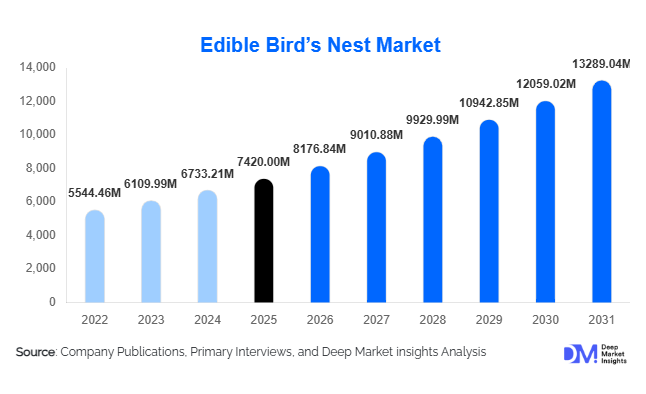
According to Deep Market Insights, the global edible bird’s nest market size was valued at USD 7,420 million in 2025 and is projected to grow from USD 8,176.84 million in 2026 to reach approximately USD 13,289.04 million by 2031, expanding at a CAGR of 10.2% during the forecast period (2026–2031). The edible bird’s nest market growth is primarily supported by rising health awareness across Asia-Pacific, increasing premium food consumption, and expanding use of functional nutrition products derived from traditional medicinal ingredients. Edible bird’s nest, historically consumed as a luxury health delicacy, is increasingly transitioning into mainstream wellness and nutraceutical categories due to its perceived immunity-boosting, anti-aging, and collagen-enhancing properties.
Demand remains heavily concentrated in China and Southeast Asia; however, globalization of traditional Chinese medicine (TCM) products and cross-border e-commerce platforms are accelerating adoption in North America and Europe. Product innovation, including ready-to-drink bird’s nest beverages, powdered supplements, and cosmetic-grade extracts, is reshaping consumption patterns and widening consumer demographics beyond older luxury buyers to younger wellness-focused consumers. Growing disposable income among middle-class populations in China, Vietnam, and Indonesia has significantly expanded the consumer base.
Supply dynamics remain closely tied to Southeast Asian harvesting hubs such as Indonesia, Malaysia, Thailand, and Vietnam, where swiftlet farming has evolved into a structured agro-industrial activity. Governments are increasingly formalizing harvesting standards, traceability systems, and export certifications, improving product authenticity and supporting global trade expansion. With rising investments in automated cleaning technologies, grading systems, and standardized processing, the edible bird’s nest market is transitioning from a traditional niche trade into a regulated premium functional food industry with strong long-term growth potential.
Key Market Insights
- Asia-Pacific dominates global consumption, accounting for over 78% of demand driven by Chinese consumers.
- Ready-to-consume bird’s nest beverages are the fastest-growing product category, expanding accessibility among younger consumers.
- Indonesia leads global production, contributing nearly 65% of global raw nest supply.
- Cross-border e-commerce platforms are accelerating premium product penetration into Western markets.
- Traceability and authentication technologies are becoming critical competitive differentiators.
- Functional nutrition and beauty-from-within trends are expanding applications beyond traditional consumption.
What are the latest trends in the edible bird’s nest market?
Functional Wellness Integration
The edible bird’s nest industry is evolving from a heritage delicacy toward a scientifically marketed functional nutrition product. Manufacturers are increasingly highlighting bioactive glycoproteins, amino acids, and epidermal growth factor (EGF) content to position bird’s nest as an immunity and skin-health enhancer. This shift aligns with global wellness consumption trends, where consumers prioritize preventive healthcare and natural supplements. Companies are investing in clinical validation studies and standardized nutrient profiling to strengthen credibility among international consumers.
Premiumization Through Ready-to-Drink Products
Convenience-based formats such as bottled bird’s nest drinks, instant soups, and single-serve packs are transforming consumption behavior. Traditionally requiring lengthy preparation, edible bird’s nest products are now marketed as lifestyle beverages targeting urban professionals. Premium packaging, cold-chain logistics, and luxury gifting culture in China are further strengthening this trend, making ready-to-consume formats a major revenue contributor.
What are the key drivers in the edible bird’s nest market?
Rising Health and Longevity Awareness
Increasing consumer focus on immunity, anti-aging, and nutritional supplementation has significantly boosted edible bird’s nest consumption. Aging populations across East Asia, particularly in China, Japan, and Singapore, are driving sustained demand for traditional health foods perceived to improve vitality and recovery.
Expansion of Swiftlet Farming Infrastructure
Technological advancements in swiftlet house construction, sound attraction systems, and climate-controlled nesting environments have stabilized supply. Countries such as Indonesia and Malaysia have industrialized birdhouse farming, increasing production volumes while improving consistency and grading quality.
Digital Commerce and Cross-Border Trade Growth
E-commerce ecosystems allow producers to directly access Chinese consumers, reducing dependency on intermediaries. Digital authentication labels and QR-based origin verification have enhanced consumer trust and boosted premium product sales globally.
What are the restraints for the global market?
High Product Prices and Limited Accessibility
Edible bird’s nest remains a premium-priced product due to labor-intensive harvesting and processing. High retail costs limit adoption outside affluent consumer groups, particularly in Western markets unfamiliar with traditional consumption practices.
Regulatory and Authenticity Challenges
Adulteration concerns and inconsistent export regulations have historically affected consumer confidence. Differences in import standards between China, the U.S., and the EU create compliance complexities for exporters.
What are the key opportunities in the edible bird’s nest industry?
Expansion into Beauty and Cosmetic Nutraceuticals
The convergence of food and beauty industries presents a major opportunity. Bird’s nest extracts are increasingly used in collagen beverages, skincare supplements, and ingestible beauty products targeting younger consumers seeking skin-health benefits. Cosmetic partnerships are opening new premium revenue channels beyond traditional food consumption.
Government-Led Export Formalization
Countries such as Indonesia and Malaysia are introducing certification programs, export quotas, and standardized processing hubs to formalize global trade. Regulatory alignment with China’s import requirements is enabling smoother export flows and reducing illegal trade activity.
Emerging Demand Beyond Asia
Growing Asian diaspora populations in North America and Europe are driving niche demand growth. Wellness-focused retailers and luxury health stores are introducing bird’s nest beverages and supplements, creating new geographic revenue streams.
Report Scope
| Report Metric | Details |
|---|---|
| Market Size in 2025 | USD 7420 Million |
| Market Size in 2026 | USD 8176.84 Million |
| Market Size in 2031 | USD 13289.04 Million |
| CAGR | 10.2% (2026-2031) |
| Base Year for Estimation | 2025 |
| Historical Data | 2022-2024 |
| Forecast Period | 2026-2031 |
| Report Coverage | Revenue Forecast, Competitive Landscape, Supply Chain Disruption, Growth Factors, Environment & Regulatory Landscape and Trends |
| Geographies Covered | North America, Europe, APAC, Middle East and Africa, LATAM |
| Countries Covered | U.S., Canada, U.K., Germany, France, Spain, Italy, Russia, Nordic, Benelux, Rest of Europe, China, Korea, Japan, India, Australia, Singapore, Taiwan, South East Asia, Rest of Asia-Pacific, UAE, Turky, Saudi Arabia, South Africa, Egypt, Nigeria, Rest of MEA, Brazil, Mexico, Argentina, Chile, Colombia, Rest of LATAM |
Explore more data points, trends and opportunities Download Free Sample Report
Product Type Insights
The global edible bird’s nest market demonstrates strong segmentation dynamics shaped by consumer traditions, evolving lifestyle patterns, and innovation in product processing technologies. Among all product categories, raw cleaned bird’s nest continues to dominate the global market landscape, accounting for approximately 46% of total revenue share in 2025. The leadership of this segment is primarily supported by long-standing cultural consumption habits, particularly across East and Southeast Asia, where consumers associate raw nests with authenticity, purity, and superior nutritional value. Traditional consumers strongly prefer preparing bird’s nest at home, believing that manual preparation preserves bioactive compounds and ensures product freshness. This perception of authenticity, combined with premium pricing potential and gifting significance, positions raw cleaned nests as the benchmark product within the industry.The leading driver behind the dominance of raw cleaned bird’s nests lies in rising consumer emphasis on natural and minimally processed functional foods. High-income households and health-conscious consumers increasingly prioritize traceability and quality assurance, encouraging suppliers to invest in grading systems, cleaning technologies, and certification programs. Additionally, premiumization trends in Asian luxury food markets continue to reinforce demand for high-grade nests, especially during cultural celebrations, weddings, and corporate gifting seasons. The strong emotional and cultural value attached to traditional consumption further stabilizes demand even during economic fluctuations, making this segment structurally resilient.Powdered and extract-based bird’s nest formats are gaining substantial traction within the nutraceutical and functional ingredient industries. These formats enable standardized dosing, extended shelf life, and easier incorporation into capsules, sachets, and wellness beverages. The growing global supplement industry is driving demand for concentrated bird’s nest extracts, particularly among manufacturers seeking premium marine and animal-derived bioactive ingredients. Technological advancements in freeze-drying and enzymatic extraction processes are further improving product consistency and scalability, enabling broader commercialization.Premium cup nests continue to play a significant role within luxury retail channels. These products are pre-shaped and aesthetically presented, catering primarily to high-end gifting markets. Seasonal demand peaks during major festivals such as Lunar New Year, when bird’s nest products symbolize prosperity and health. The luxury positioning of cup nests allows brands to command higher margins while strengthening brand prestige and exclusivity.
Application Insights
From an application perspective, health and wellness consumption remains the dominant segment, accounting for nearly 58% of global demand. The leading driver supporting this segment is the rising global focus on preventive healthcare and immunity enhancement. Consumers increasingly seek natural products believed to support respiratory health, skin rejuvenation, and post-illness recovery. Bird’s nest products are widely perceived as nutrient-rich functional foods containing glycoproteins and amino acids that contribute to overall vitality, reinforcing their position within wellness-oriented dietary practices.The expansion of functional beverages represents a major growth catalyst within application segments. Younger demographics, particularly urban professionals, are embracing functional drinks that combine traditional ingredients with modern convenience. Beverage manufacturers are actively reformulating bird’s nest products with reduced sugar content and added botanical extracts to align with evolving health preferences. Marketing strategies emphasizing beauty-from-within and holistic wellness concepts are further attracting millennial and Gen Z consumers.Cosmetic and personal care applications are emerging as a high-margin niche within the industry. Bird’s nest extracts are increasingly incorporated into premium skincare formulations due to their perceived collagen-boosting and anti-aging properties. Luxury beauty brands are positioning bird’s nest ingredients as exclusive bioactive components, particularly in Asian beauty markets where traditional remedies strongly influence purchasing behavior. Scientific research exploring regenerative and moisturizing properties is expected to further strengthen adoption within cosmeceuticals.Traditional medicinal applications continue to provide a stable consumption base across Asia. Despite modernization, many consumers maintain long-standing beliefs regarding bird’s nest’s restorative benefits, particularly for elderly individuals, postpartum recovery, and respiratory health support. This cultural continuity ensures consistent baseline demand even as newer applications expand market reach.
Distribution Channel Insights
Distribution dynamics within the edible bird’s nest market reflect the importance of consumer trust, authenticity verification, and evolving digital commerce ecosystems. Offline specialty stores and traditional medicine retailers currently account for approximately 52% market share, maintaining leadership due to consumer preference for physical product inspection and expert consultation. Authenticity remains a critical purchasing factor because of historical concerns regarding adulteration and counterfeit products. Retailers specializing in traditional health products often provide certification documentation and origin verification, strengthening buyer confidence.The primary driver sustaining offline dominance is the premium nature of bird’s nest products. Consumers purchasing high-value nests frequently prefer in-person evaluation to assess color, texture, and grading quality. In many Asian markets, trusted retailer relationships play a decisive role in purchasing decisions, reinforcing the continued importance of brick-and-mortar distribution channels.However, online direct-to-consumer channels are expanding rapidly and reshaping competitive dynamics. Cross-border e-commerce platforms allow producers from Southeast Asia to directly access consumers in China, North America, and Europe. Digital platforms enable transparent storytelling around sourcing, sustainability, and processing standards, enhancing brand differentiation. The growing adoption of livestream commerce and influencer marketing is accelerating consumer education and driving impulse purchases during promotional events.Luxury gifting channels remain highly influential, particularly during festive periods. Department stores, premium supermarkets, and boutique gift retailers curate bird’s nest collections packaged in decorative boxes, targeting corporate and ceremonial gifting markets. The emotional and symbolic value associated with gifting continues to drive seasonal demand spikes.
Source Insights
Based on sourcing methods, house-farmed swiftlet nests dominate global supply, accounting for nearly 72% of production share. The leading driver behind this dominance is the scalability and consistency enabled by controlled farming environments. Swiftlet house farming allows producers to monitor nesting conditions, maintain hygiene standards, and ensure predictable harvest cycles compared to traditional cave harvesting.Increasing regulatory scrutiny and sustainability concerns are accelerating the transition toward managed swiftlet houses. Governments across Southeast Asia are implementing licensing systems and traceability requirements to ensure ethical harvesting practices and export compliance. House farming reduces ecological disruption while improving worker safety, making it more acceptable to international buyers focused on sustainable sourcing.Technological innovation is further enhancing productivity within farmed environments. Acoustic attraction systems, humidity monitoring, and automated cleaning processes are improving yield quality while reducing contamination risks. These advancements allow producers to meet strict import standards imposed by major consuming countries, particularly China.Although cave-harvested nests retain premium perception due to rarity, supply limitations and environmental challenges restrict large-scale expansion. As global demand rises, farmed nests are expected to remain the backbone of industry supply chains, ensuring long-term market stability.
End-Use Insights
The food and beverage industry represents the largest end-use segment within the edible bird’s nest market, supported by expanding innovation in ready-to-drink formulations and functional nutrition products. The primary driver behind this segment’s leadership is the growing convergence between traditional health foods and modern convenience consumption. Beverage manufacturers are investing heavily in product diversification, introducing flavored variants and fortified formulations tailored to younger consumers.Nutraceutical applications are projected to register the fastest growth, expected to exceed a 12% CAGR during the forecast period. Rising global supplement consumption, aging populations, and increasing awareness of preventive healthcare are encouraging manufacturers to integrate bird’s nest extracts into capsules, powders, and wellness blends. Standardization technologies enable consistent bioactive concentration, making bird’s nest ingredients more compatible with modern supplement manufacturing requirements.The cosmetic and personal care sector is increasingly adopting bird’s nest derivatives in premium skincare products. Brands are leveraging traditional heritage narratives alongside scientific validation to position bird’s nest formulations as luxury anti-aging solutions. Growing consumer spending on premium beauty products across Asia and the Middle East further supports expansion in this segment.Export-driven demand remains a critical pillar of industry growth. China accounts for the majority of global imports, supporting extensive processing and packaging industries across Southeast Asia. Export regulations, quality certifications, and bilateral trade agreements significantly influence supply chain dynamics and pricing structures worldwide.
Explore more data points, trends and opportunities Download Free Sample Report
Edible Bird’s Nest Market Segmentations
By Product Type
- White Edible Bird’s Nest
- Red Bird’s Nest
- Golden Bird’s Nest
- Processed & Value-Added Bird’s Nest Products
By Form
- Raw/Cleaned Bird’s Nest
- Bird’s Nest Powder
- Ready-to-Drink Bird’s Nest Beverages
- Capsules & Extract-Based Supplements
By Application
- Food & Beverage
- Nutraceuticals & Dietary Supplements
- Traditional Medicine
- Cosmetics & Personal Care
By Distribution Channel
- Online Retail & E-commerce Platforms
- Specialty Health & Traditional Medicine Stores
- Supermarkets & Hypermarkets
- Pharmacies & Wellness Chains
- Direct Sales & Premium Boutiques
By End Use
- Household Consumption
- Health & Wellness Industry
- Foodservice & Hospitality
- Cosmetic & Beauty Manufacturers
Regional Insights
Asia-Pacific
Asia-Pacific dominates the global edible bird’s nest market, accounting for approximately 78% market share in 2025. The region’s leadership is fundamentally driven by deeply rooted cultural consumption traditions, strong gifting customs, and established supply chains connecting producing and consuming nations. China represents the largest consuming market globally, where bird’s nest products are widely associated with health preservation, longevity, and social prestige. Rising disposable incomes and expanding middle-class populations continue to elevate premium food consumption across urban centers.Indonesia leads global production, supplying nearly two-thirds of exported nests due to favorable climatic conditions and large-scale swiftlet farming infrastructure. Malaysia and Vietnam are rapidly expanding processing capabilities to comply with Chinese import requirements, positioning themselves as major value-added exporters rather than raw material suppliers. Additionally, regional tourism recovery is boosting luxury retail sales, as travelers purchase bird’s nest products as premium souvenirs and gifts.Growing awareness of functional nutrition across Southeast Asia is also stimulating domestic consumption markets, reducing dependence solely on exports. The combination of cultural acceptance, strong supply availability, and rising health awareness ensures Asia-Pacific will remain the core growth engine of the global industry.
North America
North America accounts for approximately 7% of global demand, with growth primarily supported by expanding Asian diaspora populations in the United States and Canada. Cultural continuity among immigrant communities sustains consistent baseline consumption, particularly through specialty Asian retailers and traditional medicine stores.The leading regional growth driver is increasing consumer interest in functional superfoods and collagen-based wellness products. As awareness of alternative health ingredients expands, bird’s nest products are gradually entering mainstream wellness discussions. Premium positioning and storytelling around heritage and nutritional benefits resonate strongly with affluent consumers seeking exclusive health products.E-commerce platforms play a crucial role in market expansion, allowing direct imports and niche brand visibility without extensive physical retail infrastructure. Regulatory clarity and improved labeling standards are also encouraging broader market participation by international suppliers.
Europe
Europe represents approximately 6% of global market share, led by the United Kingdom, Germany, and France. Regional growth is primarily driven by increasing consumer focus on holistic wellness, clean-label nutrition, and premium nutraceutical products. European consumers demonstrate growing curiosity toward traditional Asian superfoods, creating opportunities for market penetration.The leading growth driver in Europe is the expansion of high-end nutraceutical retail channels and specialty wellness boutiques. Consumers are willing to experiment with novel functional ingredients perceived as natural and heritage-based. However, stringent food safety regulations and novel food approval processes create entry barriers that moderate growth speed while ensuring product quality and safety.Marketing strategies emphasizing scientific validation and sustainability credentials are particularly effective within European markets, where transparency and ethical sourcing strongly influence purchasing decisions.
Middle East & Africa
The Middle East and Africa region is emerging as a promising luxury consumption hub, particularly in the United Arab Emirates and Saudi Arabia. High disposable income levels and strong gifting traditions are key drivers supporting premium bird’s nest product adoption. Consumers increasingly associate bird’s nest products with exclusivity, wellness, and prestige.The leading regional growth driver is the rapid expansion of luxury retail infrastructure, including premium malls, high-end supermarkets, and specialty wellness stores. Tourism growth and rising expatriate populations further stimulate demand for imported Asian health products. Brands are increasingly tailoring packaging and branding strategies to align with luxury gifting preferences prevalent in the region.
Latin America
Latin America remains an emerging market led by Brazil and Mexico, where awareness of bird’s nest products is gradually increasing through specialty wellness retailers and online imports. Rising middle-class populations and growing exposure to global health trends are encouraging experimentation with functional foods.The primary growth driver within the region is expanding digital commerce accessibility, which enables consumers to purchase niche imported wellness products previously unavailable through traditional retail channels. Influencer-driven health awareness and increasing interest in collagen supplements are also contributing to early-stage demand growth. Although market penetration remains limited compared to Asia-Pacific, improving distribution networks and rising health consciousness indicate strong long-term potential.
Key Players in the Edible Bird’s Nest Market
- Yan Palace Bird’s Nest
- Eu Yan Sang International Ltd.
- Dragon Brand Bird’s Nest
- Hockhua Tonic
- Lo Hong Ka
- Kim Hing Bird’s Nest
- Imperial Bird’s Nest
- Golden Nest Inc.
- Thai Royal Nest
- Guan Heong Bird’s Nest
- PT Esta Indonesia
- Xiamen Yan Zhi Wu
- Kyung Nam Bird Nest Co.
- WoKang Biological Technology
- Hainan Zhoujiwu Food Co., Ltd.