Cosmetics Microneedle Patches Market Size
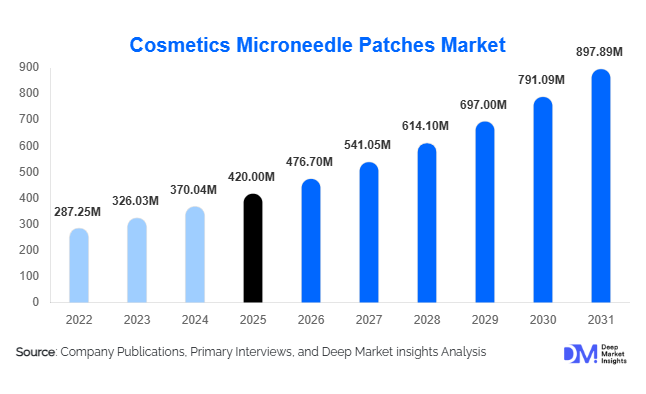
According to Deep Market Insights, the global cosmetics microneedle patches market size was valued at USD 420.0 million in 2025 and is projected to grow from USD 476.70 million in 2026 to reach USD 897.89 million by 2031, expanding at a CAGR of 13.5% during the forecast period (2026–2031). The cosmetics microneedle patches market growth is primarily driven by rising consumer demand for minimally invasive skincare solutions, increasing prevalence of acne and early-onset aging concerns, and rapid adoption of advanced transdermal delivery systems in cosmetic dermatology.
Microneedle patch technology is transforming the skincare industry by enabling direct delivery of active ingredients such as hyaluronic acid, peptides, and brightening agents into the epidermis, significantly improving absorption efficiency compared to conventional topical formulations. The market is witnessing strong traction across premium skincare brands, dermatology clinics, and direct-to-consumer (DTC) beauty platforms, particularly as consumers shift toward science-backed, high-performance skincare solutions.
Asia-Pacific remains the innovation and consumption hub, led by South Korea, Japan, and China, while North America and Europe continue to expand through clinical skincare adoption and premium beauty product penetration. With increasing integration of biotech materials, dissolvable microneedle systems, and personalized skincare solutions, the market is rapidly evolving from a niche dermatological innovation into a mainstream global skincare category.
Key Market Insights
- Acne treatment and anti-aging applications dominate global demand, accounting for a major share of consumer usage due to rising skin concerns among Gen Z and millennials.
- Dissolving microneedle technology leads the market due to its painless application, improved safety, and high consumer acceptance in at-home skincare routines.
- Asia-Pacific holds the largest market share, driven by strong K-beauty innovation, high skincare awareness, and rapid e-commerce penetration.
- Online distribution channels are expanding rapidly, supported by influencer marketing, DTC skincare brands, and subscription-based beauty models.
- Hyaluronic acid-based formulations dominate material usage due to superior hydration benefits and biocompatibility with skin tissue.
- Women consumers remain the primary end-user group, although male grooming and gender-neutral skincare adoption is steadily increasing.
What are the latest trends in the cosmetics microneedle patches market?
Integration of Personalized Skincare and Beauty Tech
One of the most significant trends in the cosmetics microneedle patches market is the integration of personalized skincare solutions powered by AI and skin diagnostics. Brands are increasingly offering customized microneedle patches tailored to individual skin conditions such as acne severity, pigmentation levels, hydration deficiency, and aging patterns. This personalization trend is enhancing product efficacy and consumer satisfaction, while enabling premium pricing strategies. The convergence of biotechnology and digital beauty platforms is reshaping how consumers interact with skincare products, making treatments more precise, data-driven, and results-oriented.
Growth of At-Home Dermatology and Self-Care Solutions
The shift toward at-home dermatological care is accelerating adoption of microneedle patches. Consumers are increasingly preferring non-invasive, easy-to-use skincare solutions that replicate clinical treatment outcomes without visiting dermatology clinics. This trend has been reinforced by post-pandemic self-care habits and the rise of DTC beauty brands. Subscription-based skincare kits and monthly patch delivery models are gaining traction, especially among urban populations. The convenience of at-home treatment combined with clinically validated results is significantly expanding the consumer base for microneedle-based products.
Sustainability and Biodegradable Biomaterial Innovation
Sustainability is becoming a core innovation driver, with manufacturers focusing on biodegradable polymers and plant-based bioactive materials. Dissolving microneedles made from hyaluronic acid, PVA, and other biocompatible materials are replacing traditional synthetic systems. Consumers are increasingly favoring eco-friendly skincare products, pushing companies to reduce plastic usage and improve environmental compliance. This trend is also influencing regulatory frameworks, encouraging the adoption of safer and greener cosmetic formulations globally.
What are the key drivers in the cosmetics microneedle patches market?
Rising Prevalence of Skin Disorders and Aging Concerns
The increasing incidence of acne, hyperpigmentation, and early aging signs is a major growth driver for the market. Younger demographics, particularly Gen Z and millennials, are experiencing higher levels of acne due to lifestyle changes, pollution, and hormonal factors. This has significantly increased demand for targeted skincare solutions that deliver visible and fast results. Microneedle patches provide enhanced penetration of active ingredients, making them more effective than traditional topical creams.
Advancements in Microneedle and Transdermal Delivery Technology
Continuous innovation in dissolvable microneedles, polymer-based systems, and bioactive ingredient delivery has significantly improved product safety and effectiveness. The development of painless, self-dissolving patches has eliminated major adoption barriers, enabling widespread use in at-home skincare. These technological advancements are also allowing cosmetic companies to expand product portfolios into anti-aging, acne treatment, and skin repair segments.
Expansion of Premium Skincare and DTC Beauty Brands
The rapid growth of premium skincare brands and direct-to-consumer distribution models is driving market expansion. Social media marketing, influencer-led campaigns, and digital-first beauty brands are increasing consumer awareness and adoption. Premiumization of skincare has also led to higher willingness to pay for advanced solutions like microneedle patches, supporting strong revenue growth across developed and emerging markets.
What are the restraints for the global market?
High Product Cost and Limited Mass Adoption
Microneedle patches are significantly more expensive than traditional skincare products due to advanced manufacturing processes and high-quality bioactive materials. This limits adoption in price-sensitive markets and restricts penetration to premium consumer segments. While prices are gradually declining with scale, affordability remains a key challenge for widespread global adoption.
Regulatory Complexity and Classification Challenges
Cosmetics microneedle patches often fall between cosmetic and medical device classifications in various regions, creating regulatory uncertainty. This results in longer approval timelines, complex compliance requirements, and variations in market entry rules across countries. Such inconsistencies can delay product launches and increase operational costs for manufacturers.
What are the key opportunities in the cosmetics microneedle patches industry?
Expansion in Emerging Markets
Rapid urbanization, rising disposable incomes, and increasing beauty awareness in regions such as Asia-Pacific, Latin America, and the Middle East present significant growth opportunities. Countries like India, China, Brazil, and the UAE are witnessing strong demand for premium skincare products. E-commerce expansion is further enabling global brands to penetrate these markets without extensive retail infrastructure.
Integration with Clinical Dermatology and Aesthetic Treatments
Microneedle patches are increasingly being used as post-procedure skincare solutions in dermatology clinics following treatments such as laser therapy, chemical peels, and microdermabrasion. This integration enhances healing and improves treatment outcomes, creating a strong collaboration opportunity between cosmetic manufacturers and clinical dermatology providers.
AI-Driven Personalized Skincare Systems
The combination of artificial intelligence and skincare is creating new opportunities for customized microneedle patch formulations. AI-based skin analysis tools can recommend specific patches based on real-time skin condition monitoring. This enables highly targeted treatments, improving effectiveness and strengthening customer loyalty through personalized skincare ecosystems.
Report Scope
| Report Metric | Details |
|---|---|
| Market Size in 2025 | USD 420 Million |
| Market Size in 2026 | USD 476.70 Million |
| Market Size in 2031 | USD 897.89 Million |
| CAGR | 13.5% (2026-2031) |
| Base Year for Estimation | 2025 |
| Historical Data | 2022-2024 |
| Forecast Period | 2026-2031 |
| Report Coverage | Revenue Forecast, Competitive Landscape, Supply Chain Disruption, Growth Factors, Environment & Regulatory Landscape and Trends |
| Geographies Covered | North America, Europe, APAC, Middle East and Africa, LATAM |
| Countries Covered | U.S., Canada, U.K., Germany, France, Spain, Italy, Russia, Nordic, Benelux, Rest of Europe, China, Korea, Japan, India, Australia, Singapore, Taiwan, South East Asia, Rest of Asia-Pacific, UAE, Turky, Saudi Arabia, South Africa, Egypt, Nigeria, Rest of MEA, Brazil, Mexico, Argentina, Chile, Colombia, Rest of LATAM |
Explore more data points, trends and opportunities Download Free Sample Report
Product Type Insights
Acne treatment microneedle patches dominate the global cosmetics microneedle patches market, accounting for approximately 34% share of the total market in 2025. The leadership of this segment is primarily driven by the rising global prevalence of acne among teenagers, young adults, and urban working populations exposed to stress, pollution, and hormonal imbalances. Consumers are increasingly shifting toward fast-acting and targeted skincare solutions that provide visible results without the side effects associated with oral medications or harsh topical creams. Microneedle-based acne patches offer enhanced transdermal delivery of ingredients such as salicylic acid, niacinamide, tea tree extract, and hyaluronic acid directly into affected skin layers, significantly improving efficacy. The growing popularity of K-beauty skincare routines and social media-driven awareness around acne care products are further accelerating segment growth globally.
Anti-aging microneedle patches represent the fastest-growing product category, supported by increasing consumer focus on preventive skincare and age-delaying cosmetic solutions. Millennials and middle-aged consumers are increasingly adopting wrinkle reduction, collagen-boosting, and fine-line treatment patches as part of regular skincare routines. Ingredients such as peptides, retinol, and collagen-enhancing compounds are increasingly incorporated into dissolving microneedle systems to improve skin elasticity and hydration. Rising demand for non-invasive anti-aging alternatives to cosmetic procedures is significantly contributing to the expansion of this segment.
Hydration and skin-brightening patches are witnessing strong adoption across Asia-Pacific markets, particularly in South Korea, China, and Japan, where skincare routines emphasizing glowing and even-toned skin remain deeply embedded in consumer culture. Brightening formulations containing vitamin C, glutathione, and niacinamide are gaining traction among younger consumers seeking preventive skin maintenance products. Specialty microneedle patches, including under-eye, lip care, scar reduction, and pigmentation-correction patches, are also emerging as premium niche categories with high-margin potential. The diversification of product portfolios is enabling manufacturers to address multiple skincare concerns while increasing average consumer spending per skincare routine.
Application Insights
Acne treatment remains the leading application segment in the cosmetics microneedle patches market, supported by increasing global incidence of acne-related skin disorders and growing consumer preference for targeted skincare therapies. The segment benefits from strong repeat purchase behavior, particularly among younger consumers seeking rapid blemish reduction and inflammation control. The convenience of overnight acne patches and the growing influence of social media skincare trends are further supporting sustained demand growth. In addition, the expansion of dermatologist-recommended acne treatment products is strengthening consumer trust in microneedle patch technology.
Anti-aging applications are emerging as one of the fastest-growing segments, driven by rising awareness regarding preventive skincare among millennials and aging populations. Consumers are increasingly incorporating microneedle patches into daily skincare regimens to reduce wrinkles, improve hydration, and enhance collagen production. Compared to traditional anti-aging creams and serums, microneedle systems provide superior penetration of active ingredients into deeper skin layers, improving treatment outcomes. This has positioned anti-aging patches as a premium skincare category globally.
Skin brightening and pigmentation correction applications are also gaining momentum, particularly across Asia-Pacific and Middle Eastern markets where demand for skin-evening and glow-enhancing products remains high. Additionally, post-treatment dermatological care has emerged as an important application area, with dermatology clinics and aesthetic centers increasingly using microneedle patches to support healing following laser treatments, chemical peels, and minimally invasive cosmetic procedures. Emerging applications such as scar correction, dark spot reduction, and targeted under-eye treatment are broadening the market scope and enabling companies to create highly specialized skincare solutions for different consumer demographics.
Distribution Channel Insights
Online distribution channels dominate the cosmetics microneedle patches market, accounting for nearly 46% share of global revenue in 2025. The rapid expansion of e-commerce platforms, direct-to-consumer (DTC) skincare brands, and social commerce ecosystems has fundamentally transformed product accessibility and consumer purchasing behavior. The dominance of online channels is strongly supported by influencer-driven marketing campaigns, beauty tutorials, subscription-based skincare models, and targeted digital advertising strategies. Consumers increasingly prefer purchasing advanced skincare products online due to wider product availability, competitive pricing, customer reviews, and convenience. The rise of TikTok-driven beauty trends and Instagram skincare influencers has further accelerated product discovery and adoption among younger demographics.
Pharmacies and drugstores continue to hold a substantial market share, particularly in North America and Europe, where consumers prioritize clinically validated and dermatologist-recommended skincare products. These channels provide greater consumer confidence through pharmacist consultation and product authenticity assurance. Dermatology clinics and aesthetic centers represent a high-value distribution segment due to professional recommendation-based purchasing behavior. Clinics increasingly integrate microneedle patches into post-procedure skincare protocols, creating strong recurring demand for premium products.
Specialty beauty retail stores also contribute significantly to market growth, especially across Asia-Pacific countries where premium skincare retail culture is highly developed. Luxury beauty retailers and branded skincare boutiques are expanding shelf space for advanced microneedle skincare products as consumer demand for high-performance cosmetic treatments continues to rise. The growing shift toward omnichannel retail strategies is enabling companies to integrate physical retail experiences with digital engagement, improving brand visibility and customer retention.
End-User Insights
Women consumers dominate the cosmetics microneedle patches market, accounting for approximately 62% of global demand in 2025. This dominance is primarily driven by higher spending on skincare products, greater awareness of preventive skincare routines, and stronger engagement with beauty and wellness trends. Female consumers are increasingly adopting premium skincare regimens that include anti-aging, hydration, brightening, and acne treatment patches as part of daily self-care routines. The growing popularity of Korean and Japanese skincare philosophies emphasizing layered skincare routines has further strengthened female consumer adoption globally.
Millennials and Gen Z represent the fastest-growing consumer demographics due to their high engagement with social media beauty trends, influencer-led product discovery, and preference for science-backed skincare solutions. Younger consumers are particularly attracted to microneedle patches because of their convenience, portability, and visible short-term results. Preventive skincare is becoming increasingly important among these demographics, contributing to strong recurring product demand.
Male grooming is also emerging as a rapidly growing market segment, particularly in urban regions across North America, Asia-Pacific, and the Middle East. Men are increasingly adopting targeted skincare products for acne treatment, under-eye care, and anti-aging concerns, supported by changing grooming norms and increasing awareness around skincare maintenance. Professional users, including dermatologists, aesthetic clinics, and cosmetic treatment centers, continue to contribute significantly to market demand through clinical and post-procedure applications. The expansion of gender-neutral skincare products is further diversifying the end-user landscape and enabling broader consumer market penetration.
Explore more data points, trends and opportunities Download Free Sample Report
Cosmetics Microneedle Patches Market Segmentations
By Product Type
- Acne Treatment Microneedle Patches
- Anti-Aging Microneedle Patches
- Hydration & Skin Brightening Patches
- Scar & Spot Correction Patches
- Specialty Microneedle Patches
By Technology
- Dissolving Microneedle Technology
- Coated Microneedle Technology
- Hydrogel-Infused Microneedle Patches
- Hollow Microneedle Delivery Systems
By Application
- Acne Treatment
- Anti-Aging & Wrinkle Reduction
- Skin Brightening & Pigmentation Control
- Post-Treatment Dermatological Care
By Distribution Channel
- Online Retail & E-Commerce Platforms
- Pharmacies & Drugstores
- Dermatology Clinics & Aesthetic Centers
- Specialty Beauty Stores
By End-User
- Women Consumers
- Men Consumers
- Professional Dermatology & Aesthetic Users
- Gender-Neutral Premium Skincare Consumers
Regional Insights
North America
North America accounts for approximately 29% of the global cosmetics microneedle patches market in 2025, led primarily by the United States and Canada. The region benefits from high consumer awareness regarding advanced skincare technologies, strong purchasing power, and widespread adoption of premium cosmetic products. Demand is particularly strong for anti-aging and dermatologist-recommended skincare solutions, driven by increasing consumer preference for clinically validated and science-backed products. The presence of major cosmetic companies, advanced dermatology infrastructure, and a highly developed e-commerce ecosystem continues to support market expansion.
Growth in North America is further driven by increasing male grooming trends, rising spending on preventive skincare among millennials, and strong social media influence on beauty purchasing behavior. In the United States, high consumer willingness to spend on luxury skincare and aesthetic wellness products is accelerating adoption of microneedle technologies. Canada is also witnessing growing demand due to rising awareness of minimally invasive skincare treatments and expanding premium beauty retail networks.
Europe
Europe holds around 22% share of the global market, supported by strong demand from Germany, the United Kingdom, France, Italy, and Spain. The region is characterized by high preference for dermatologically tested, sustainable, and clean-label skincare products. European consumers increasingly prioritize product safety, ingredient transparency, and environmentally friendly formulations, which is driving demand for biodegradable and dissolving microneedle systems.
Regional growth is supported by stringent cosmetic regulations that encourage innovation in high-quality skincare products. Germany remains one of the leading markets due to strong pharmaceutical and dermatology integration within the skincare industry. France continues to drive premium skincare demand through luxury beauty culture and strong cosmetic manufacturing presence. The UK market is expanding rapidly due to increasing adoption of personalized skincare and online beauty retail channels. The growing popularity of vegan, cruelty-free, and organic cosmetic formulations is also positively influencing microneedle patch adoption across Europe.
Asia-Pacific
Asia-Pacific dominates the global cosmetics microneedle patches market with approximately 38% market share in 2025, led by South Korea, China, Japan, and increasingly India. The region serves as the global innovation hub for advanced skincare technologies, particularly dissolving microneedle systems developed through K-beauty and J-beauty product innovation ecosystems. South Korea remains a key market leader due to its strong cosmetic R&D capabilities, highly skincare-conscious population, and rapid commercialization of beauty-tech innovations.
China represents one of the fastest-growing markets globally, supported by rising middle-class spending, booming e-commerce beauty sales, and increasing consumer preference for premium skincare solutions. Livestream commerce, influencer marketing, and digital beauty platforms are significantly accelerating product penetration across urban Chinese consumers. Japan maintains stable growth due to strong demand for anti-aging and sensitive skin care products supported by aging demographics and high skincare spending.
India is emerging as a high-growth market driven by expanding urbanization, rising disposable incomes, and increasing beauty awareness among younger populations. The rapid growth of online skincare retail and increasing penetration of Korean skincare products are supporting long-term regional demand expansion. Across Asia-Pacific, cultural emphasis on flawless skin appearance and preventive skincare routines continues to serve as a major growth driver.
Latin America
Latin America is witnessing steady growth in the cosmetics microneedle patches market, led by Brazil, Mexico, and Argentina. Rising beauty consciousness, increasing disposable incomes, and expanding access to premium skincare products are supporting regional market expansion. Brazil remains the largest skincare market in the region due to strong cosmetic consumption culture and increasing consumer focus on appearance-enhancing products.
Regional growth is further supported by rising social media influence, growing online beauty retail platforms, and increasing penetration of international skincare brands. Consumers in Latin America are increasingly adopting acne treatment and skin-brightening patches as awareness regarding advanced skincare technologies improves. The gradual expansion of dermatology clinics and aesthetic treatment centers is also contributing to growing market demand.
Middle East & Africa
The Middle East & Africa region is emerging as a high-potential growth market for cosmetics microneedle patches, particularly in the UAE, Saudi Arabia, and South Africa. High disposable incomes, luxury beauty spending, and strong preference for premium skincare products are major growth drivers across Gulf Cooperation Council (GCC) countries. Consumers in the Middle East are increasingly seeking advanced anti-aging, hydration, and pigmentation correction products suited for harsh climatic conditions and high UV exposure.
The UAE and Saudi Arabia are witnessing rising adoption of luxury skincare technologies due to strong beauty retail infrastructure, medical tourism growth, and increasing influence of international cosmetic brands. South Africa is also emerging as a developing skincare market driven by urbanization and rising consumer awareness around dermatological skincare solutions. Across Africa, gradual expansion of e-commerce accessibility and increasing beauty product penetration are expected to create long-term growth opportunities for global skincare brands.
Key Players in the Cosmetics Microneedle Patches Market
- L’Oréal Group
- Procter & Gamble
- Estée Lauder Companies
- Johnson & Johnson
- Shiseido Company
- Amorepacific Corporation
- Beiersdorf AG
- Unilever PLC
- LG Household & Health Care
- Kao Corporation