Conference Microphone Market Size
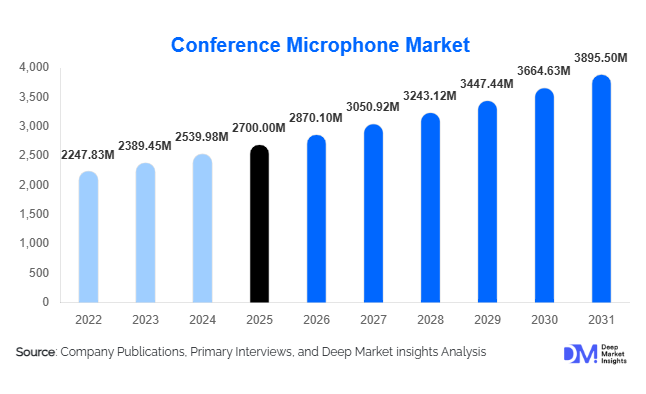
According to Deep Market Insights, the global conference microphone market size was valued at USD 2,700 million in 2025 and is projected to grow from USD 2,870.10 million in 2026 to reach USD 3,895.50 million by 2031, expanding at a CAGR of 6.3% during the forecast period (2026–2031). The conference microphone market growth is primarily driven by the rapid expansion of hybrid work environments, increasing adoption of unified communication technologies, and rising investments in modern audio-visual collaboration infrastructure across corporate offices, government institutions, and educational campuses.
Conference microphones are a critical component of professional communication systems, enabling clear voice capture and seamless interaction during meetings, conferences, and public discussions. With organizations transitioning toward digital collaboration ecosystems, the demand for advanced microphones equipped with beamforming technology, AI-powered noise suppression, and network connectivity has increased significantly.
In addition to corporate environments, the market is experiencing strong adoption across legislative assemblies, courtrooms, convention centers, and higher education institutions where reliable audio communication is essential for documentation, discussion, and decision-making processes. The integration of conference microphones with video conferencing platforms and cloud collaboration tools is further transforming meeting environments into intelligent, connected communication spaces. Technological advancements in digital signal processing, wireless connectivity, and integrated AV control systems are enabling manufacturers to deliver more sophisticated conference audio solutions. As enterprises and governments continue to modernize communication infrastructure, conference microphones will remain a core component of the global professional audio ecosystem.
Key Market Insights
- Hybrid and remote work models are accelerating demand for advanced conference microphones, particularly systems capable of capturing high-quality audio in mixed in-person and virtual meeting environments.
- Digital and network-enabled microphones are replacing traditional analog systems, enabling integration with unified communication platforms and smart meeting room technologies.
- North America dominates the market due to high enterprise adoption of collaboration technologies and strong investment in corporate communication infrastructure.
- Asia-Pacific is the fastest-growing regional market, driven by expanding corporate offices, government modernization projects, and rapid technology adoption.
- Beamforming microphone arrays and AI-powered noise suppression technologies are emerging as key innovations shaping product development.
- Government and institutional infrastructure investments, including parliamentary chambers, courtrooms, and convention centers, are creating significant demand for professional conference microphone systems.
What are the latest trends in the conference microphone market?
Smart Meeting Room Integration
The rapid adoption of smart meeting rooms is transforming the conference microphone market. Enterprises are increasingly deploying integrated communication environments where microphones, cameras, displays, and collaboration software function as a unified system. These intelligent meeting rooms rely on advanced conference microphones capable of automatic speaker detection, beamforming audio capture, and real-time noise suppression. Integration with building automation systems and AV control platforms allows microphones to automatically adjust audio levels based on room acoustics and participant location.
Manufacturers are responding by developing network-enabled microphones that support IP connectivity and seamless compatibility with collaboration platforms. These solutions enable organizations to manage audio infrastructure remotely, conduct firmware updates, and monitor device performance through centralized control systems. As companies redesign office spaces to support hybrid collaboration, the demand for intelligent conference microphone solutions is expected to grow significantly.
AI-Enhanced Audio Processing
Artificial intelligence is increasingly being integrated into conference microphone systems to improve audio clarity and communication efficiency. AI-based algorithms can isolate voices, eliminate background noise, and automatically balance audio levels among participants. This capability is particularly valuable in hybrid meetings where remote participants rely heavily on clear audio transmission.
Beamforming microphone arrays equipped with AI processing can track active speakers and dynamically adjust pickup patterns to focus on the person speaking. These systems also minimize echo and reverberation in large conference rooms, improving speech intelligibility. As AI technologies continue to evolve, conference microphones are expected to become more autonomous, enabling fully automated meeting environments that require minimal manual audio configuration.
What are the key drivers in the conference microphone market?
Expansion of Hybrid Work Environments
The global shift toward hybrid work has significantly increased demand for advanced conferencing technologies. Organizations now require meeting rooms capable of supporting both in-person and remote participants simultaneously. Conference microphones equipped with beamforming and multi-directional pickup capabilities enable clear audio capture even when multiple participants are speaking across large meeting spaces.
As companies continue to adopt flexible workplace strategies, investments in professional audio solutions have become a priority. Modern conference microphones ensure that remote employees can participate effectively in meetings, making them an essential component of hybrid collaboration infrastructure.
Rising Adoption of Unified Communication Platforms
The rapid expansion of unified communication platforms has created a strong demand for hardware solutions that integrate seamlessly with digital collaboration ecosystems. Conference microphones designed for compatibility with cloud-based meeting platforms allow organizations to deliver consistent audio experiences across distributed teams.
Businesses are increasingly deploying integrated AV systems that combine microphones, cameras, speakers, and collaboration software within a single communication platform. This trend is accelerating the adoption of digital conference microphones capable of supporting advanced audio processing and network connectivity.
What are the restraints for the global market?
High Installation and Integration Costs
Professional conference microphone systems often require significant investment in AV infrastructure, including digital signal processors, amplifiers, and control systems. The cost of deploying integrated audio solutions can be substantial, particularly for large conference facilities and corporate campuses. Small and medium-sized enterprises may face challenges in allocating budgets for advanced conferencing infrastructure, which can limit market expansion.
Compatibility and Integration Challenges
Conference microphones must operate within complex AV ecosystems that include collaboration platforms, cameras, and room control systems. Compatibility issues between hardware and software vendors can complicate installation and system integration. Organizations often rely on specialized AV integrators to configure these systems, increasing deployment time and costs.
What are the key opportunities in the conference microphone industry?
Expansion of Government and Institutional Infrastructure
Government institutions and public sector organizations are increasingly investing in modern communication infrastructure. Legislative assemblies, courtrooms, and municipal councils require advanced conference microphone systems capable of supporting multi-speaker discussions and reliable audio documentation. Infrastructure modernization initiatives across emerging economies are expected to create strong demand for professional conference microphone solutions.
Growth of Convention Centers and Global Events
The expansion of international conferences, trade exhibitions, and large corporate events is creating new opportunities for conference microphone manufacturers. Event venues require flexible microphone systems that can accommodate panel discussions, keynote speeches, and interactive sessions involving multiple speakers. Wireless conference microphones and portable audio systems are particularly popular in large venues where speaker mobility is important.
Report Scope
| Report Metric | Details |
|---|---|
| Market Size in 2025 | USD 2700 Million |
| Market Size in 2026 | USD 2870.10 Million |
| Market Size in 2031 | USD 3895.50 Million |
| CAGR | 6.3% (2026-2031) |
| Base Year for Estimation | 2025 |
| Historical Data | 2022-2024 |
| Forecast Period | 2026-2031 |
| Report Coverage | Revenue Forecast, Competitive Landscape, Supply Chain Disruption, Growth Factors, Environment & Regulatory Landscape and Trends |
| Geographies Covered | North America, Europe, APAC, Middle East and Africa, LATAM |
| Countries Covered | U.S., Canada, U.K., Germany, France, Spain, Italy, Russia, Nordic, Benelux, Rest of Europe, China, Korea, Japan, India, Australia, Singapore, Taiwan, South East Asia, Rest of Asia-Pacific, UAE, Turky, Saudi Arabia, South Africa, Egypt, Nigeria, Rest of MEA, Brazil, Mexico, Argentina, Chile, Colombia, Rest of LATAM |
Explore more data points, trends and opportunities Download Free Sample Report
Product Type Insights
Wired conference microphones remain the dominant product category, accounting for approximately 54% of global market revenue in 2025. These microphones continue to hold the largest share primarily due to their superior reliability, consistent audio quality, and immunity from wireless interference. Wired systems are widely deployed in government institutions, legislative assemblies, corporate boardrooms, and judicial courts where uninterrupted audio transmission is critical for formal discussions, decision-making, and legal documentation.
The dominance of wired microphones is further supported by their compatibility with fixed conference infrastructures and integrated audio systems. Many organizations operating large meeting rooms prefer wired systems because they offer stable signal transmission, low latency, and minimal maintenance requirements. These systems also integrate seamlessly with digital signal processors, audio mixers, and centralized control systems used in professional AV environments. In contrast, wireless conference microphones are witnessing steady growth as organizations increasingly seek flexible meeting environments. Wireless systems enable speaker mobility and faster meeting setup, making them ideal for conference venues, training facilities, and collaborative workspaces. Advances in RF spectrum management, battery efficiency, and digital transmission protocols are improving wireless reliability, allowing manufacturers to expand their adoption in corporate and event-driven environments.
Installation Type Insights
Tabletop and desktop conference microphones represent the largest installation segment, accounting for nearly 46% of the global market. These microphones are widely used in boardrooms, conference halls, and council chambers where individual participants require dedicated audio capture for discussions and presentations. Their popularity stems from ease of installation, scalability for large meetings, and their ability to deliver high voice clarity for each participant seated around a conference table. The leadership of tabletop microphones is driven by the continued expansion of enterprise meeting rooms and formal conference environments. Organizations prefer tabletop systems because they allow clear speaker identification and enable integration with voting systems, delegate units, and meeting management platforms commonly used in government and institutional settings.
Meanwhile, ceiling-mounted microphone arrays are gaining significant traction in modern smart meeting rooms. These systems offer unobtrusive installation and support advanced beamforming technology that automatically detects and tracks active speakers within a room. Ceiling-mounted microphones also reduce visual clutter on conference tables and allow organizations to create more flexible and aesthetically optimized meeting spaces, which is increasingly important in modern corporate offices.
Application Insights
Corporate meeting rooms represent the largest application segment, contributing approximately 38% of total market demand. The dominance of this segment is largely attributed to the global shift toward hybrid work models, which require advanced collaboration technologies capable of supporting both in-person and remote participants. Enterprises are investing heavily in digital communication infrastructure, including conference microphones, video conferencing systems, and integrated AV platforms, to enable seamless collaboration among distributed teams. Modern meeting rooms now require high-quality audio capture to ensure that remote participants can clearly hear discussions occurring in physical meeting spaces. Conference microphones equipped with beamforming arrays, AI noise suppression, and echo cancellation technologies are increasingly deployed to improve speech intelligibility and overall meeting productivity.
In addition to corporate environments, government institutions and legislative chambers represent a significant share of the market. These environments require professional conference microphone systems for parliamentary debates, council meetings, and voting procedures where accurate voice capture and recording are essential. Similarly, judicial courts rely on conference microphones to ensure reliable documentation of legal proceedings and testimonies.
Distribution Channel Insights
Direct sales and AV system integrator networks dominate the distribution of conference microphones globally. Large enterprises, government agencies, and institutional customers typically procure conference audio systems through specialized AV integrators that design, install, and maintain customized communication infrastructure. These integrators provide end-to-end solutions that include microphones, cameras, control systems, and software platforms, ensuring seamless interoperability between different components. The dominance of system integrators is driven by the complexity of modern conference room installations. Large meeting facilities require carefully designed acoustic environments and integrated control systems to deliver optimal audio performance. AV integrators, therefore, play a critical role in specifying equipment, configuring signal processing systems, and providing post-installation support.
However, e-commerce platforms and electronics retailers are gradually emerging as alternative distribution channels. Smaller conference microphone systems designed for small businesses, educational institutions, and remote meeting setups are increasingly sold through online marketplaces. This trend is expanding market accessibility and enabling manufacturers to reach a broader customer base.
End-Use Industry Insights
The corporate sector is the largest end-use industry for conference microphones, accounting for approximately 38% of global demand. Enterprises worldwide are investing heavily in modern communication infrastructure as hybrid and remote work models become permanent workplace strategies. Conference microphones play a crucial role in enabling effective communication within distributed teams, particularly during large meetings involving both physical and remote participants. The education sector is among the fastest-growing end-use segments. Universities, training centers, and research institutions are increasingly adopting digital learning environments and hybrid classroom technologies. Lecture halls, seminar rooms, and distance learning studios require reliable microphone systems to support interactive teaching and virtual participation.
Government institutions and judicial courts also represent a substantial market segment. Parliamentary chambers, council halls, and courtrooms rely on conference microphones for formal discussions, legislative debates, and legal proceedings. These systems ensure accurate documentation and support simultaneous interpretation in multilingual meetings. Additionally, the hospitality and events industry is contributing to market growth as hotels, convention centers, and exhibition venues expand their conference facilities. The increasing number of international conferences, corporate seminars, and industry trade shows is driving demand for high-quality professional audio equipment.
Explore more data points, trends and opportunities Download Free Sample Report
Conference Microphone Market Segmentations
By Product Type
- Wired Conference Microphones
- Wireless Conference Microphones
- RF Wireless Microphones
- Bluetooth Conference Microphones
- Wi-Fi / Network-Enabled Conference Microphones
By Installation Type
- Tabletop / Desktop Microphones
- Ceiling-Mounted Microphone Arrays
- Wall-Mounted Microphones
- Gooseneck Podium Microphones
- Integrated Conference Microphone Systems
By Application
- Corporate Meeting Rooms
- Government and Legislative Chambers
- Education and Lecture Halls
- Convention Centers and Event Venues
- Judicial Courts and Public Institutions
By Distribution Channel
- Direct Sales
- AV System Integrators
- Online Retail
- Electronics and Professional Audio Stores
By End-Use Industry
- Corporate and Enterprise Sector
- Government and Public Sector
- Education and Research Institutions
- Hospitality and Events Industry
- Media and Broadcasting
Regional Insights
North America
North America dominates the conference microphone market with approximately 35% global market share. The United States accounts for nearly 26% of global demand, supported by strong enterprise technology adoption and extensive deployment of smart meeting rooms. Major corporations across sectors such as technology, finance, and consulting continue to invest heavily in unified communication systems that integrate audio, video, and collaboration software.
Another key driver for regional growth is the presence of a large number of global corporate headquarters and advanced office infrastructure. Companies in North America are early adopters of hybrid work technologies, leading to widespread upgrades of conference room audio systems. Additionally, the region hosts numerous international conferences and industry events, further supporting demand for professional conference audio equipment.
Europe
Europe represents approximately 24% of the global market, driven by strong demand from corporate offices, government institutions, and international conference venues. Countries such as Germany, the United Kingdom, and France are major markets due to their large corporate sectors, advanced infrastructure, and high adoption of professional audio equipment.
Regional growth is also supported by the presence of several international organizations and governmental institutions that require sophisticated conference communication systems. The European Union’s parliamentary and administrative bodies, along with various multinational organizations headquartered in Europe, frequently deploy advanced conference microphone systems to support multilingual discussions and large-scale meetings. Furthermore, Europe hosts numerous global trade exhibitions, academic conferences, and industry summits, which generate consistent demand for professional conference audio equipment.
Asia-Pacific
Asia-Pacific accounts for roughly 29% of global demand and represents the fastest-growing regional market. Rapid economic growth, expanding corporate sectors, and increasing investments in digital workplace infrastructure are key factors driving regional market expansion. China holds around 14% of the global market, supported by large-scale corporate expansion and government investments in smart infrastructure projects. Enterprises across industries are upgrading meeting facilities with modern audio-visual technologies to enhance communication efficiency. India is emerging as one of the fastest-growing markets due to the rapid expansion of IT companies, startup ecosystems, and multinational corporate offices. Increasing adoption of hybrid work models and rising investments in smart office environments are accelerating demand for conference microphone systems across the country.
Latin America
Latin America accounts for nearly 6% of the global market, with Brazil and Mexico representing the largest demand centers. The region is witnessing gradual growth as organizations modernize their communication infrastructure and adopt digital collaboration tools. Corporate modernization initiatives, expanding multinational operations, and increasing international conferences are driving regional adoption of professional conferencing equipment. Additionally, the hospitality sector is expanding conference facilities in major business hubs such as São Paulo, Mexico City, and Santiago, which is contributing to rising demand for conference microphone systems.
Middle East & Africa
The Middle East and Africa region is experiencing steady growth in the conference microphone market, supported by large-scale infrastructure investments and the development of international conference venues. Countries such as the United Arab Emirates and Saudi Arabia are actively investing in smart cities, government modernization programs, and global business events. Major cities including Dubai, Riyadh, and Doha, are developing large convention centers and advanced corporate office complexes equipped with modern AV communication systems. These developments are creating strong demand for professional conference microphone solutions. Additionally, government institutions across the region are adopting advanced communication technologies to improve administrative efficiency and support large-scale decision-making processes. The growing number of international exhibitions and business summits hosted in the Middle East is further accelerating regional demand for conference audio systems.
Key Players in the Conference Microphone Market
- Shure Incorporated
- Sennheiser Electronic GmbH
- Audio-Technica Corporation
- Bosch Security Systems
- Yamaha Corporation
- Sony Corporation
- TOA Corporation
- Beyerdynamic GmbH
- AKG Acoustics (Harman International)
- Televic Group
- ClearOne Inc.
- Taiden Industrial Co.
- Clockaudio Ltd.
- MIPRO Electronics
- Revolabs