Body Mist Market Size
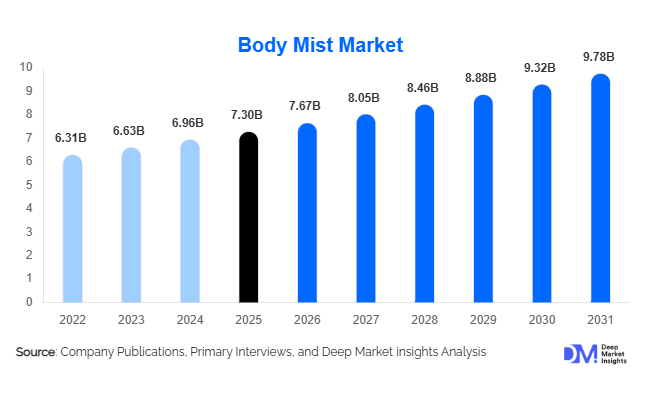
According to Deep Market Insights, the global body mist market size was valued at USD 7.3 billion in 2025 and is projected to grow from USD 7.67 billion in 2026 to reach USD 9.78 billion by 2031, expanding at a CAGR of 5.0% during the forecast period (2026–2031). The body mist market growth is primarily driven by increasing consumer focus on personal grooming, rising demand for affordable fragrance products, and the growing popularity of lightweight daily-use scents among Gen Z and millennial consumers. The expansion of organized beauty retail, influencer-led marketing campaigns, and premiumization trends within the personal care industry are further accelerating global demand for body mists.
Key Market Insights
- Body mists are increasingly positioned as affordable luxury fragrance products, bridging the gap between deodorants and premium perfumes for younger consumers.
- Natural, vegan, and clean-label body mists are witnessing rapid adoption, particularly across North America and Europe due to rising sustainability awareness.
- Europe dominates the global body mist market, supported by strong fragrance consumption culture and premium beauty product demand.
- Asia-Pacific is the fastest-growing regional market, led by rising disposable income, expanding beauty retail infrastructure, and growing youth demographics in China and India.
- E-commerce and social commerce channels are reshaping purchasing behavior, enabling direct-to-consumer fragrance brands to expand globally.
- Hydrating and multifunctional body mists are emerging as key innovation categories, integrating skincare benefits with fragrance applications.
Body Mist Market Trends
Clean Beauty and Sustainable Fragrance Trends Accelerating
The body mist market is increasingly shifting toward clean-label, vegan, and environmentally sustainable products. Consumers are becoming more conscious regarding ingredient transparency, cruelty-free certifications, and recyclable packaging solutions. Manufacturers are responding by introducing alcohol-free formulations, botanical fragrance extracts, and refillable packaging systems designed to reduce plastic waste. Premium brands are investing heavily in biodegradable materials and eco-friendly manufacturing processes to strengthen sustainability credentials. This trend is particularly prominent in Europe and North America, where environmentally conscious purchasing behavior is significantly influencing fragrance product development and marketing strategies.
Digital Commerce and Influencer-Led Fragrance Marketing
The rapid growth of e-commerce and social media platforms is transforming the global body mist industry. Beauty influencers, celebrity collaborations, and TikTok-driven fragrance trends are significantly shaping consumer purchasing decisions, especially among Gen Z consumers. Online retail platforms allow brands to launch limited-edition collections, personalized fragrance recommendations, and subscription-based beauty services that improve customer retention. AI-powered fragrance quizzes and virtual scent profiling tools are also gaining popularity as companies attempt to replicate in-store fragrance discovery experiences online. Social commerce integration is expected to remain one of the strongest growth catalysts for body mist brands globally.
Body Mist Market Drivers
Growing Consumer Focus on Personal Grooming and Wellness
Rising awareness regarding personal grooming, hygiene, and self-care routines is significantly driving demand for body mists worldwide. Consumers increasingly prefer lightweight fragrances suitable for daily application in offices, gyms, travel environments, and casual social settings. Compared to traditional perfumes, body mists offer refreshing fragrance experiences with lower scent concentration and more affordable pricing, making them highly attractive among younger demographics. The growing influence of wellness-oriented lifestyles and beauty-conscious consumers is further supporting market expansion.
Expansion of Affordable Luxury Beauty Products
The growing demand for affordable luxury personal care products has emerged as a major growth driver for the body mist market. Consumers in emerging economies such as India, Indonesia, Brazil, and Vietnam are increasingly purchasing aspirational beauty products positioned between mass-market deodorants and premium perfumes. International fragrance brands are launching accessible luxury collections with premium packaging, celebrity endorsements, and skincare-enhanced formulations. This strategy enables brands to attract younger consumers seeking prestige fragrances at comparatively lower prices.
Body Mist Market Restraints
Intense Competition from Alternative Fragrance Products
The body mist market faces strong competition from perfumes, deodorants, antiperspirants, and scented skincare products. Premium perfumes continue to dominate aspirational fragrance spending in developed markets, while deodorants remain preferred among price-sensitive consumers in emerging economies due to their odor-control functionality. This overlapping product positioning creates pricing pressure and limits differentiation opportunities for body mist manufacturers.
Volatility in Raw Material and Packaging Costs
Fluctuations in essential oil prices, alcohol derivatives, packaging plastics, and imported fragrance compounds continue to affect profitability within the industry. Global supply chain disruptions and rising transportation costs have increased operational expenses for manufacturers. In addition, stringent cosmetic regulations related to allergen disclosures, sustainability compliance, and chemical safety standards in Europe and North America are increasing compliance costs for market participants.
Body Mist Market Opportunities
Skincare-Integrated and Functional Body Mists
The increasing consumer preference for multifunctional beauty products presents major growth opportunities for the body mist market. Manufacturers are introducing hydrating body mists enriched with aloe vera, vitamin E, hyaluronic acid, botanical extracts, and cooling agents that provide skincare benefits alongside fragrance application. Aromatherapy-focused body mists designed for relaxation, stress relief, and wellness applications are also gaining traction among consumers seeking holistic self-care experiences. Functional innovation is expected to create premium pricing opportunities while expanding the consumer base beyond traditional fragrance users.
Expansion of Direct-to-Consumer and Personalized Fragrance Models
Direct-to-consumer fragrance retailing is creating substantial opportunities for both established brands and emerging players. Companies are increasingly leveraging AI-powered recommendation engines, customized scent profiling, subscription-based fragrance boxes, and social commerce integrations to improve customer engagement and retention. Personalized fragrance experiences allow brands to collect consumer preference data while reducing dependence on traditional retail intermediaries. This trend is expected to support faster product launches, higher operating margins, and stronger global expansion for digitally focused fragrance companies.
Report Scope
| Report Metric | Details |
|---|---|
| Market Size in 2025 | USD 7.3 Billion |
| Market Size in 2026 | USD 7.67 Billion |
| Market Size in 2031 | USD 9.78 Billion |
| CAGR | 5.0% (2026-2031) |
| Base Year for Estimation | 2025 |
| Historical Data | 2022-2024 |
| Forecast Period | 2026-2031 |
| Report Coverage | Revenue Forecast, Competitive Landscape, Supply Chain Disruption, Growth Factors, Environment & Regulatory Landscape and Trends |
| Geographies Covered | North America, Europe, APAC, Middle East and Africa, LATAM |
| Countries Covered | U.S., Canada, U.K., Germany, France, Spain, Italy, Russia, Nordic, Benelux, Rest of Europe, China, Korea, Japan, India, Australia, Singapore, Taiwan, South East Asia, Rest of Asia-Pacific, UAE, Turky, Saudi Arabia, South Africa, Egypt, Nigeria, Rest of MEA, Brazil, Mexico, Argentina, Chile, Colombia, Rest of LATAM |
Explore more data points, trends and opportunities Download Free Sample Report
Product Type Insights
Floral body mists dominate the market, accounting for nearly 24% of global revenue in 2025 due to their universal consumer appeal and strong repeat purchase behavior among female consumers. Floral variants such as rose, lavender, and jasmine continue to perform strongly across both mass-market and premium categories. Fruity body mists are witnessing rapid growth among younger demographics because of their refreshing and playful fragrance profiles. Fresh and aqua-based body mists are increasingly popular for gym, sports, and summer applications due to their cooling characteristics. Gourmand fragrances featuring vanilla, caramel, and cocoa notes are gaining traction in premium segments, particularly among Gen Z consumers influenced by social media fragrance trends. Functional body mists integrating skincare benefits and aromatherapy applications are emerging as a high-growth innovation category globally.
Consumer Group Insights
Women remain the dominant consumer segment, contributing approximately 70% of global market revenue due to higher fragrance usage frequency and broader product availability. Female consumers continue to drive demand for floral, fruity, and premium body mist variants through daily-use applications and lifestyle-oriented fragrance consumption. However, the men’s body mist category is witnessing the fastest growth, supported by rising grooming awareness, expanding male skincare adoption, and targeted marketing campaigns by global fragrance brands. Unisex body mists are also gaining popularity among younger consumers who prefer gender-neutral fragrance positioning and minimalist scent profiles. Teen-focused body mists continue to generate high sales volumes through affordable pricing and influencer-driven product marketing.
Distribution Channel Insights
Hypermarkets and supermarkets account for the largest share of global body mist sales due to strong product visibility, promotional pricing strategies, and consumer preference for physically testing fragrances before purchase. Specialty beauty retailers and department stores continue to perform strongly in premium fragrance categories by offering curated product experiences and luxury brand positioning. E-commerce represents the fastest-growing distribution channel globally as online platforms provide broader product availability, influencer-driven discovery, and personalized fragrance recommendations. Direct-to-consumer channels are expanding rapidly as brands increasingly invest in digital marketing, subscription models, and social commerce integration to improve customer retention and profit margins.
Ingredient Profile Insights
Alcohol-based body mists continue to dominate the market because of their affordability, longer-lasting scent performance, and ease of manufacturing. However, natural and organic body mists are witnessing strong growth due to increasing consumer awareness regarding ingredient safety and sustainability. Vegan and cruelty-free products are particularly popular in Europe and North America, where clean beauty standards strongly influence purchasing decisions. Water-based and alcohol-free formulations are also gaining popularity among consumers with sensitive skin and wellness-focused lifestyles. Clean-label body mists free from parabens, phthalates, and artificial dyes are increasingly positioned as premium products within the global fragrance industry.
Packaging Insights
Plastic spray bottles remain the dominant packaging format due to low manufacturing costs, lightweight handling, and mass-market suitability. Glass packaging is widely used in premium and luxury body mist products because it enhances aesthetic appeal and supports premium pricing strategies. Travel-size packaging formats are witnessing significant growth as consumers increasingly seek portable fragrance solutions for travel, fitness, and workplace applications. Refillable packaging systems are also emerging as a key sustainability trend, particularly among environmentally conscious consumers in developed markets. Companies investing in recyclable materials and eco-friendly packaging innovation are expected to gain competitive advantages over the forecast period.
Explore more data points, trends and opportunities Download Free Sample Report
Body Mist Market Segmentations
By Product Type
- Floral Body Mist
- Fruity Body Mist
- Fresh & Aqua Body Mist
- Gourmand Body Mist
- Woody & Musk Body Mist
- Oriental & Spicy Body Mist
- Functional Body Mist
By Consumer Group
- Women
- Men
- Unisex
- Teen-Focused Consumers
- Premium Adult Consumers
By Ingredient Profile
- Alcohol-Based Body Mist
- Water-Based Body Mist
- Natural & Organic Body Mist
- Vegan & Cruelty-Free Body Mist
- Clean-Label/Paraben-Free Body Mist
By Distribution Channel
- Hypermarkets & Supermarkets
- Specialty Beauty Retailers
- Pharmacies & Drugstores
- Department Stores
- E-Commerce Platforms
- Direct-to-Consumer Channels
- Convenience Stores
By Application
- Daily Wear
- Sports & Fitness Use
- Post-Shower Application
- Travel & On-the-Go Freshness
- Seasonal & Holiday Usage
Regional Insights
North America
North America accounts for nearly 31% of the global body mist market, led primarily by the United States. Strong consumer spending on beauty and personal care products, high penetration of organized retail channels, and the popularity of brands such as Bath & Body Works and Victoria’s Secret continue to drive regional demand. Consumers in the U.S. increasingly prefer premium body mists, celebrity fragrance collaborations, and seasonal fragrance collections. Canada is witnessing rising demand for vegan, cruelty-free, and clean-label body mist products, supported by increasing sustainability awareness among consumers.
Europe
Europe remains the largest regional market, accounting for approximately 32% of global revenue in 2025. France, Germany, Italy, and the United Kingdom represent major fragrance consumption hubs due to strong perfume culture and premium beauty spending. France continues to lead innovation in luxury fragrance manufacturing, while Germany demonstrates strong demand for dermatologically safe and sustainable body mist formulations. The U.K. market is benefiting from rapid online beauty retail growth and influencer-driven fragrance purchasing trends. European consumers increasingly prioritize refillable packaging, natural ingredients, and eco-friendly product positioning.
Asia-Pacific
Asia-Pacific is the fastest-growing regional market with CAGR approaching 6.0% during the forecast period. China, India, Japan, South Korea, and Southeast Asia are driving strong regional growth due to rising disposable income, expanding urban middle-class populations, and increasing beauty product adoption. India is emerging as one of the fastest-growing body mist markets globally due to strong youth demographics and rapid expansion of organized beauty retail chains. China continues to benefit from premium beauty adoption and strong e-commerce penetration, while South Korea and Japan remain important innovation hubs for skincare-integrated fragrance products.
Latin America
Latin America is experiencing steady body mist market growth led by Brazil and Mexico. Brazil’s strong beauty culture and fragrance consumption patterns continue supporting high demand for affordable and mid-premium body mists. Mexican consumers are increasingly adopting daily-use fragrance products through expanding retail distribution and rising urban middle-class spending. Direct-selling cosmetic companies also continue to influence fragrance consumption across the region.
Middle East & Africa
The Middle East & Africa region is witnessing increasing demand for luxury and long-lasting fragrance products, particularly in the UAE and Saudi Arabia. Premium oriental fragrance preferences, tourism-driven retail activity, and growing disposable incomes are supporting regional market growth. South Africa represents an emerging market for affordable body mists among younger consumers. In addition, regional duty-free and travel retail channels continue to contribute significantly to premium body mist sales.