Beauty Blender Market Size
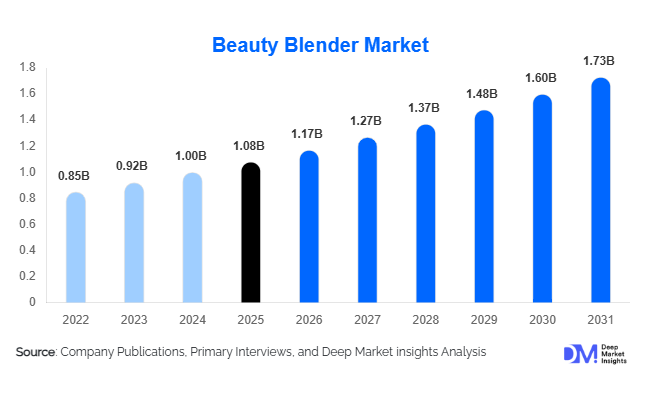
According to Deep Market Insights, the global beauty blender market size was valued at USD 1.08 billion in 2025 and is projected to grow from USD 1.17 billion in 2026 to reach USD 1.73 billion by 2031, expanding at a CAGR of 8.2% during the forecast period (2026–2031). The beauty blender market growth is primarily driven by rising global cosmetics consumption, increasing influence of social media beauty trends, growing adoption of professional-grade makeup tools among consumers, and the expansion of e-commerce beauty retail channels. As makeup application techniques become more sophisticated and consumers seek flawless, airbrushed finishes, beauty blenders have evolved from niche professional tools into mainstream beauty essentials across both developed and emerging markets.
Key Market Insights
- Reusable beauty blenders account for over 80% of global demand, driven by sustainability trends and consumer preference for long-lasting makeup tools.
- Latex-free polyurethane foam remains the dominant material segment, representing nearly 58% of market revenue due to superior blending performance and skin safety benefits.
- North America dominates the global market, accounting for approximately 36% of total revenue, supported by premium beauty product adoption and strong consumer spending.
- Asia-Pacific is the fastest-growing regional market, fueled by increasing cosmetics consumption in China, India, South Korea, and Southeast Asia.
- E-commerce has become the leading distribution channel, contributing nearly 39% of global sales through direct-to-consumer and marketplace platforms.
- Sustainable and antimicrobial beauty blenders are emerging as key innovation areas, attracting environmentally conscious and hygiene-focused consumers.
Beauty Blender Market Trends
Sustainable Beauty Applicators Gaining Momentum
Environmental concerns are increasingly influencing purchasing decisions across the beauty industry. Consumers are demanding eco-friendly alternatives to conventional polyurethane-based beauty sponges, encouraging manufacturers to invest in biodegradable materials, recycled foam technologies, and sustainable packaging solutions. Premium beauty brands are launching reusable beauty blenders with longer life cycles, reducing waste while improving product durability. Retailers are also expanding shelf space for environmentally responsible beauty accessories as sustainability becomes a key differentiator. As regulations around plastic waste and sustainability reporting become more stringent globally, manufacturers are expected to accelerate investments in green product innovation, creating new growth avenues across premium and mass-market categories.
Technology-Driven Product Innovation
Manufacturers are increasingly incorporating advanced material technologies into beauty blender products. Antimicrobial coatings, moisture-control foam structures, and enhanced durability technologies are becoming major differentiators in the premium segment. Consumers are placing greater emphasis on hygiene and product longevity, encouraging brands to introduce self-cleaning materials and bacteria-resistant surfaces. Additionally, digital commerce platforms are leveraging AI-powered product recommendations and virtual beauty consultations to improve consumer engagement. These technological advancements are not only improving product performance but also enabling brands to command premium pricing and strengthen customer loyalty.
Beauty Blender Market Drivers
Expansion of Global Cosmetics Industry
The continued growth of the global cosmetics industry remains one of the strongest drivers for the beauty blender market. Rising expenditure on foundation, concealer, contouring products, and complexion-enhancing cosmetics has directly increased demand for specialized makeup application tools. Consumers are increasingly seeking professional-quality finishes, driving the adoption of beauty blenders across all age groups and income categories. Premium cosmetic brands are also promoting beauty blenders alongside foundation and complexion product launches, further supporting market penetration.
Influence of Social Media and Beauty Content Creators
Beauty influencers, makeup artists, and digital content creators have transformed consumer awareness regarding makeup application techniques. Platforms such as Instagram, TikTok, YouTube, and emerging short-video channels continue to showcase beauty blender usage in tutorials and product demonstrations. Viral beauty trends frequently generate spikes in demand, particularly among younger consumers seeking professional-looking makeup results. The integration of beauty blenders into influencer-led campaigns has made them one of the most recognized beauty accessories globally.
Beauty Blender Market Restraints
Hygiene and Maintenance Concerns
Despite their popularity, beauty blenders require frequent cleaning and replacement to prevent bacterial accumulation and skin irritation. Many consumers fail to maintain proper hygiene practices, creating concerns regarding acne, infections, and product contamination. These challenges may discourage repeat purchases among hygiene-conscious consumers and encourage the adoption of alternative makeup application tools.
Competition from Alternative Applicators
The market faces significant competition from traditional makeup brushes, silicone applicators, airbrush systems, and integrated cosmetic applicators. Many consumers continue to prefer brushes due to perceived durability and ease of cleaning. As beauty tool manufacturers continue introducing multifunctional alternatives, beauty blender brands must continuously innovate to maintain differentiation and consumer relevance.
Beauty Blender Market Opportunities
Eco-Friendly and Biodegradable Product Development
Sustainability represents one of the most significant growth opportunities within the beauty blender market. Consumer demand for environmentally responsible products is encouraging manufacturers to explore plant-based foams, biodegradable materials, and recyclable packaging solutions. Brands that successfully commercialize sustainable alternatives can access premium pricing opportunities while strengthening customer loyalty among environmentally conscious consumers. Retailers are also prioritizing sustainable beauty categories, creating additional visibility and distribution opportunities for innovative manufacturers.
Emerging Market Expansion
Rapid urbanization, rising disposable incomes, and growing beauty consciousness across India, China, Southeast Asia, Brazil, Saudi Arabia, and the UAE are creating substantial demand opportunities. Beauty blender penetration remains significantly lower in these markets compared to North America and Western Europe, providing ample room for growth. Localized product offerings, influencer partnerships, and region-specific pricing strategies are expected to help companies capture market share and accelerate adoption among first-time users.
Report Scope
| Report Metric | Details |
|---|---|
| Market Size in 2025 | USD 1.08 Billion |
| Market Size in 2026 | USD 1.17 Billion |
| Market Size in 2031 | USD 1.73 Billion |
| CAGR | 8.2% (2026-2031) |
| Base Year for Estimation | 2025 |
| Historical Data | 2022-2024 |
| Forecast Period | 2026-2031 |
| Report Coverage | Revenue Forecast, Competitive Landscape, Supply Chain Disruption, Growth Factors, Environment & Regulatory Landscape and Trends |
| Geographies Covered | North America, Europe, APAC, Middle East and Africa, LATAM |
| Countries Covered | U.S., Canada, U.K., Germany, France, Spain, Italy, Russia, Nordic, Benelux, Rest of Europe, China, Korea, Japan, India, Australia, Singapore, Taiwan, South East Asia, Rest of Asia-Pacific, UAE, Turky, Saudi Arabia, South Africa, Egypt, Nigeria, Rest of MEA, Brazil, Mexico, Argentina, Chile, Colombia, Rest of LATAM |
Explore more data points, trends and opportunities Download Free Sample Report
Product Type Insights
Classic egg-shaped beauty blenders dominate the global market, accounting for approximately 42% of total revenue in 2025. The segment's leadership is primarily driven by its versatility across multiple makeup applications, including foundation, concealer, contouring, highlighting, and cream-based cosmetics. The ergonomic shape allows users to seamlessly blend products across large facial areas while simultaneously providing precision around difficult contours such as the nose and under-eye regions. The widespread adoption of liquid and cream-based makeup products globally has further strengthened demand for classic beauty blenders, making them the preferred choice among both professional makeup artists and individual consumers. In addition, major beauty brands continue to prioritize egg-shaped designs within their product portfolios due to strong consumer familiarity and high replacement purchase rates.
Precision beauty blenders are emerging as one of the fastest-growing product categories, driven by increasing demand for detailed makeup application and professional-quality finishes. Professional makeup artists, beauty influencers, and consumers seeking advanced makeup techniques are increasingly adopting micro and precision blenders for targeted coverage and intricate contouring. Flat-edge and multi-angle beauty blenders are also witnessing growing adoption as consumers seek tools capable of delivering faster application and superior coverage efficiency. Meanwhile, silicone beauty blenders are gaining traction among hygiene-conscious consumers due to their non-porous surfaces and reduced product absorption. Disposable beauty sponges continue to maintain demand within commercial beauty environments, including salons, beauty academies, fashion studios, and entertainment production facilities where hygiene standards and frequent applicator replacement are critical.
Material Type Insights
Latex-free polyurethane foam remains the dominant material segment, contributing approximately 58% of global market revenue in 2025. The segment's leadership is largely attributed to increasing consumer preference for hypoallergenic beauty products, superior blending performance, and compatibility with a broad range of cosmetic formulations. Latex-free materials provide a softer texture and enhanced durability compared to conventional foam alternatives, making them suitable for repeated usage while minimizing skin irritation concerns. Growing awareness regarding skin sensitivity and allergies has further accelerated the transition toward latex-free products across both developed and emerging markets.
Silicone-based beauty blenders are witnessing increased adoption due to their hygienic properties, extended lifespan, and ability to reduce cosmetic product wastage. Their non-absorbent structure enables consumers to use less foundation and concealer while maintaining effective coverage, making them attractive to cost-conscious users. Recycled foam and eco-friendly material segments are among the fastest-growing categories within the market as sustainability becomes an increasingly important purchasing criterion. Beauty brands are actively investing in environmentally responsible materials, biodegradable foam technologies, and recyclable packaging solutions to align with evolving consumer preferences and sustainability commitments. Over the forecast period, biodegradable and plant-based beauty blender materials are expected to experience substantial growth as regulatory pressures and consumer demand for sustainable beauty accessories continue to intensify globally.
Application Insights
Foundation application represents the largest application segment, accounting for approximately 46% of global demand in 2025. The segment continues to lead due to the widespread use of liquid and cream foundations, which require effective blending tools to achieve smooth, natural-looking finishes. Beauty blenders provide superior product distribution, reduced streaking, and enhanced coverage compared to traditional applicators, making them the preferred choice for foundation application among consumers and professionals alike. The increasing popularity of high-definition makeup techniques, social media-driven beauty trends, and premium complexion products continues to support growth in this segment.
Concealer application remains a significant market contributor, particularly among professional users and consumers seeking precise coverage for blemishes, dark circles, and skin imperfections. Contouring and highlighting applications are expanding rapidly as advanced makeup techniques become mainstream among younger consumers and beauty enthusiasts. Multi-use beauty blenders capable of handling multiple cosmetic products are gaining popularity due to their convenience, cost-effectiveness, and versatility. Powder and setting product applications are also experiencing increased demand as manufacturers develop specialized sponge structures optimized for setting sprays, finishing powders, and long-wear makeup techniques. As cosmetic formulations continue evolving, beauty blender manufacturers are introducing product-specific applicators designed to maximize makeup performance and application efficiency.
Distribution Channel Insights
Online retail channels account for approximately 39% of global beauty blender sales, making e-commerce the leading distribution segment globally. The dominance of online channels is supported by increasing internet penetration, mobile commerce adoption, influencer-driven purchasing behavior, and the growing popularity of direct-to-consumer beauty brands. Consumers increasingly prefer online platforms due to greater product variety, competitive pricing, convenience, and access to customer reviews and tutorial content. Beauty brands are leveraging social commerce, live-stream shopping, and personalized product recommendations to further strengthen online sales performance.
Specialty beauty stores remain a critical distribution channel, particularly for premium and professional-grade beauty blenders where consumers often prefer in-store product evaluation before purchase. These retailers benefit from strong brand partnerships, expert product recommendations, and bundled cosmetic offerings. Supermarkets and hypermarkets continue to contribute significant sales volumes within economy and mid-range product categories, supported by broad consumer accessibility and impulse purchasing behavior. Department stores focus primarily on premium beauty accessories and prestige cosmetic brands, while professional beauty supply distributors serve salons, makeup artists, training institutes, and commercial beauty businesses. The continued integration of omnichannel retail strategies is expected to further enhance market accessibility and customer engagement across all distribution channels.
End-User Insights
Individual consumers represent the largest end-user segment, accounting for nearly 67% of global market demand in 2025. The segment's dominance is driven by increasing beauty consciousness, growing daily makeup usage, rising disposable incomes, and the widespread availability of beauty education through social media platforms. Beauty influencers, online tutorials, and celebrity endorsements have played a significant role in transforming beauty blenders into essential tools within everyday makeup routines. The growing popularity of premium cosmetics among younger consumers has further accelerated demand for high-quality makeup applicators capable of delivering professional-level results.
Professional makeup artists remain one of the most valuable customer segments due to their preference for premium beauty blender products and high replacement frequency. The expansion of wedding services, fashion events, content creation industries, and entertainment production continues to drive commercial demand for professional-grade beauty accessories. Beauty salons and academies are increasingly incorporating branded beauty blenders into service offerings and educational programs to improve client outcomes and training standards. Additionally, media production houses, television studios, film production companies, and fashion organizations continue to generate specialized demand for beauty blenders capable of supporting high-definition makeup applications under professional working conditions.
Explore more data points, trends and opportunities Download Free Sample Report
Beauty Blender Market Segmentations
By Product Type
- Classic Egg-Shaped Beauty Blenders
- Precision/Micro Beauty Blenders
- Flat-Edge Beauty Blenders
- Silicone Beauty Blenders
- Multi-Angle/Hybrid Beauty Blenders
- Disposable Makeup Sponges
By Material Type
- Latex-Free Polyurethane Foam
- Latex Foam
- Silicone-Based Materials
- Recycled/Eco-Friendly Foam
- Biodegradable Plant-Based Materials
By Application
- Foundation Application
- Concealer Application
- Contouring & Highlighting
- Powder & Setting Product Application
- Multi-Use Makeup Blending
By End User
- Individual Consumers
- Professional Makeup Artists
- Beauty Salons
- Beauty Academies & Training Institutes
- Media, Fashion & Entertainment Studios
By Distribution Channel
- Online Retail
- Specialty Beauty Stores
- Supermarkets & Hypermarkets
- Department Stores
- Professional Beauty Supply Stores
Regional Insights
North America
North America accounts for approximately 36% of global beauty blender market revenue, making it the largest regional market worldwide. The United States contributes nearly 30% of global demand and serves as the industry's innovation and premiumization hub. Market growth across the region is driven by high consumer spending on cosmetics, strong penetration of premium beauty products, and the significant influence of beauty influencers and celebrity-endorsed brands. The region also benefits from a mature e-commerce ecosystem, widespread adoption of professional makeup techniques, and high awareness regarding beauty tools and accessories. Growing demand for sustainable beauty products and cruelty-free cosmetics is encouraging manufacturers to introduce environmentally responsible beauty blender offerings. Canada continues to experience steady growth, supported by premium beauty retail expansion, increasing demand for clean beauty products, and rising consumer interest in sustainable personal care accessories.
Europe
Europe represents approximately 25% of global market demand, with Germany, the United Kingdom, France, Italy, and Spain serving as the primary revenue-generating countries. The region benefits from a highly developed cosmetics industry, strong consumer purchasing power, and increasing preference for premium beauty accessories. One of the key drivers supporting regional growth is the growing consumer focus on sustainability and environmentally responsible beauty products. European consumers are among the earliest adopters of recyclable packaging, biodegradable materials, and clean beauty solutions, creating favorable conditions for innovative beauty blender products. The United Kingdom and Germany lead regional demand due to strong beauty retail networks and high cosmetics expenditure, while France and Italy benefit from their globally recognized beauty and fashion industries. Increasing adoption of direct-to-consumer beauty brands and digital retail channels continues to support long-term market expansion across the region.
Asia-Pacific
Asia-Pacific accounts for approximately 27% of the global market and represents the fastest-growing regional segment, with growth rates significantly exceeding the global average. The region's expansion is driven by rising disposable incomes, increasing beauty consciousness among younger consumers, rapid urbanization, and strong growth in cosmetics consumption. China remains the largest regional market due to its massive beauty consumer base and highly developed beauty e-commerce ecosystem. South Korea continues to influence global beauty trends through innovation in cosmetic products and application techniques, driving demand for advanced beauty accessories. India is emerging as one of the fastest-growing national markets, supported by expanding middle-class populations, increasing female workforce participation, rising beauty expenditures, and extensive social media engagement. Growth across Southeast Asia is further supported by improving digital connectivity, growing beauty retail infrastructure, and increasing adoption of international cosmetic brands.
Latin America
Latin America continues to emerge as an attractive growth market for beauty blender manufacturers, led primarily by Brazil, which accounts for the largest share of regional demand. Strong beauty culture, increasing cosmetics consumption, and growing consumer awareness regarding advanced makeup techniques continue to support market expansion. The region's growth is further driven by increasing penetration of international beauty brands, expansion of e-commerce platforms, and rising disposable incomes among urban populations. Brazil remains a particularly important market due to its large cosmetics industry and high consumer engagement with beauty products. Mexico, Argentina, and Chile are also experiencing rising demand as consumers increasingly seek premium beauty accessories and professional-quality makeup tools. Social media influence and beauty content creation are playing an increasingly important role in shaping purchasing behavior across the region.
Middle East & Africa
The Middle East & Africa region is witnessing steady growth, supported by increasing beauty expenditures, premium cosmetic adoption, and expanding retail infrastructure. The UAE and Saudi Arabia represent the largest markets within the region, driven by high disposable incomes, luxury beauty consumption, and strong demand for premium international beauty brands. Rising participation of women in the workforce, increasing beauty consciousness, and expanding modern retail channels continue to support market growth across Gulf Cooperation Council (GCC) countries. South Africa serves as a key regional hub due to its relatively mature cosmetics industry and growing adoption of advanced beauty products. Additionally, increasing social media influence, urbanization, and the expansion of international beauty retailers across Africa are creating new opportunities for beauty blender manufacturers seeking long-term growth within emerging markets.
Key Players in the Beauty Blender Market
- Beautyblender
- Real Techniques
- e.l.f. Cosmetics
- L'Oréal
- Shiseido
- Sigma Beauty
- Morphe
- EcoTools
- Sephora Collection
- Sonia Kashuk
- ZOEVA
- Coty
- Estée Lauder Companies
- Japonesque
- Crown Brush