Bath Towel Market Size
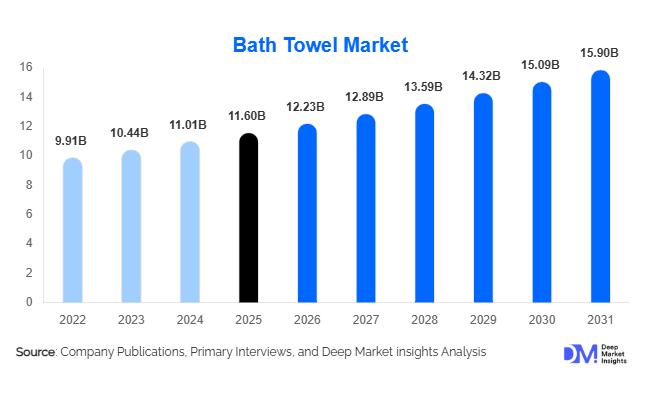
According to Deep Market Insights, the global bath towel market size was valued at USD 11.6 billion in 2025 and is projected to grow from USD 12.23 billion in 2026 to reach USD 15.90 billion by 2031, expanding at a CAGR of 5.4% during the forecast period (2026–2031). The market is primarily driven by increasing consumer spending on home textiles, rising hygiene awareness, expansion of hospitality infrastructure, and growing demand for premium and sustainable towel products. The shift toward luxury bathroom experiences, coupled with growing penetration of e-commerce channels, has significantly enhanced product accessibility and consumer choice across developed and emerging economies.
Key Market Insights
- Cotton towels account for the largest share of the market, representing nearly 47% of global demand due to superior absorbency, durability, and consumer familiarity.
- Residential households remain the dominant end-use segment, contributing approximately 62% of global revenue in 2025.
- Asia-Pacific leads the global market, supported by strong textile manufacturing capabilities and rising consumer spending across China and India.
- Sustainable and organic cotton towels are witnessing accelerated adoption among environmentally conscious consumers.
- Hospitality sector demand is expanding steadily, driven by hotel construction, tourism recovery, and luxury accommodation development.
- Online distribution channels are growing significantly faster than offline retail, supported by direct-to-consumer brands and digital marketing initiatives.
Bath Towel Market Trends
Sustainable and Organic Textile Adoption Accelerating
Sustainability has become one of the most influential trends within the bath towel industry. Consumers increasingly prefer products manufactured using organic cotton, bamboo fibers, recycled materials, and environmentally responsible dyeing processes. Major manufacturers are investing in water-saving technologies, renewable energy integration, and certifications such as OEKO-TEX and Global Organic Textile Standard (GOTS). Retailers are also expanding eco-friendly product portfolios to capture growing demand from environmentally conscious consumers. As sustainability regulations become stricter globally, manufacturers are expected to accelerate investments in traceable and circular textile supply chains.
Premiumization of Home Textile Products
The growing emphasis on home aesthetics and wellness-oriented lifestyles has fueled demand for premium bath towels. Consumers are increasingly seeking hotel-quality products featuring superior GSM ratings, enhanced softness, antimicrobial properties, and luxury fibers such as Egyptian and Turkish cotton. Premium towel collections are benefiting from rising disposable incomes, urbanization, and the popularity of home renovation projects. The trend is particularly strong across North America, Europe, Japan, South Korea, and affluent urban centers in Asia-Pacific.
Bath Towel Market Drivers
Expansion of Global Hospitality Infrastructure
The hospitality sector remains a critical growth driver for the bath towel market. Rising tourism activity, hotel construction projects, serviced apartments, resorts, and vacation rental properties continue generating substantial institutional demand. Premium hotels typically replace towels every 12–18 months, creating recurring procurement cycles. Emerging tourism destinations across Asia-Pacific and the Middle East are further contributing to large-volume purchasing contracts for bath towel suppliers.
Growing Consumer Focus on Hygiene and Wellness
Consumer awareness regarding personal hygiene, wellness, and bathroom cleanliness has increased significantly in recent years. Households are replacing bath towels more frequently and purchasing multiple towel sets for family use. Product innovations such as antimicrobial treatments, quick-dry fabrics, and odor-resistant technologies are further stimulating replacement demand. Rising health consciousness following the pandemic period continues to support long-term market growth.
Growth of E-Commerce and Direct-to-Consumer Sales
Digital commerce has transformed bath towel purchasing behavior globally. Consumers can compare products based on fabric quality, GSM, certifications, customer reviews, and pricing. Direct-to-consumer brands are leveraging online platforms to introduce premium products while maintaining competitive pricing structures. Subscription models, personalized towel collections, and digital marketing campaigns are expanding market reach, particularly among younger consumers.
Bath Towel Market Restraints
Volatility in Cotton Prices
Cotton remains the dominant raw material used in bath towel production. Price fluctuations caused by weather disruptions, water scarcity, geopolitical developments, and agricultural supply constraints significantly impact manufacturing costs. Rising raw material expenses often compress margins or force manufacturers to increase prices, potentially affecting consumer demand in price-sensitive markets.
Intense Market Competition and Pricing Pressure
The global bath towel market remains highly competitive, characterized by the presence of numerous international, regional, and local manufacturers. Commodity-grade towel products face substantial price competition, particularly from low-cost manufacturing regions. Excess production capacity and promotional pricing strategies often limit profitability and create challenges for smaller market participants.
Bath Towel Market Opportunities
Growing Demand for Sustainable Towels
The increasing adoption of environmentally responsible purchasing behavior presents a significant opportunity for manufacturers. Organic cotton, bamboo fiber, recycled textile content, and biodegradable packaging are becoming important differentiators. Companies capable of offering certified sustainable products at competitive prices are expected to gain substantial market share over the forecast period.
Expansion of Hospitality and Tourism Infrastructure in Emerging Economies
Countries across Southeast Asia, the Middle East, and Africa continue investing heavily in tourism infrastructure. New hotel developments, luxury resorts, healthcare tourism facilities, and serviced accommodations create recurring institutional demand for bath towels. Suppliers with strong B2B capabilities are well positioned to capitalize on these opportunities.
Smart and Functional Textile Innovations
Emerging textile technologies are creating opportunities for value-added bath towel products. Antimicrobial coatings, moisture-management technologies, odor-resistant treatments, quick-dry functionality, and temperature-regulating fibers are attracting consumers seeking enhanced performance. Premium pricing associated with functional products also supports margin expansion.
Report Scope
| Report Metric | Details |
|---|---|
| Market Size in 2025 | USD 11.6 Billion |
| Market Size in 2026 | USD 12.23 Billion |
| Market Size in 2031 | USD 15.90 Billion |
| CAGR | 5.4% (2026-2031) |
| Base Year for Estimation | 2025 |
| Historical Data | 2022-2024 |
| Forecast Period | 2026-2031 |
| Report Coverage | Revenue Forecast, Competitive Landscape, Supply Chain Disruption, Growth Factors, Environment & Regulatory Landscape and Trends |
| Geographies Covered | North America, Europe, APAC, Middle East and Africa, LATAM |
| Countries Covered | U.S., Canada, U.K., Germany, France, Spain, Italy, Russia, Nordic, Benelux, Rest of Europe, China, Korea, Japan, India, Australia, Singapore, Taiwan, South East Asia, Rest of Asia-Pacific, UAE, Turky, Saudi Arabia, South Africa, Egypt, Nigeria, Rest of MEA, Brazil, Mexico, Argentina, Chile, Colombia, Rest of LATAM |
Explore more data points, trends and opportunities Download Free Sample Report
Material Type Insights
Cotton towels dominated the global bath towel market, accounting for approximately 47% of total revenue in 2025, making them the largest material segment worldwide. The segment's leadership is primarily attributed to cotton's superior moisture absorption capability, softness, skin-friendliness, durability, and cost-effectiveness compared to alternative materials. Conventional cotton continues to account for the majority of sales due to its widespread availability and affordability, while Turkish and Egyptian cotton varieties command premium pricing owing to their long-staple fibers, enhanced softness, and luxury positioning. The dominance of cotton is further reinforced by its extensive adoption across residential households, hospitality establishments, healthcare facilities, and wellness centers, where comfort and absorbency remain critical purchasing criteria.
The growing trend toward premium home textiles has significantly boosted demand for high-thread-count and luxury cotton towels, particularly across North America, Europe, Japan, South Korea, and affluent urban markets in Asia-Pacific. Additionally, hotel chains and resorts continue to prioritize cotton-based products due to their superior laundering performance and longer replacement cycles. Organic cotton represents the fastest-growing sub-segment within the category, driven by increasing consumer awareness regarding sustainable sourcing, reduced chemical usage, and environmentally responsible manufacturing practices. Major retailers and textile manufacturers are expanding organic cotton product lines to comply with evolving sustainability regulations and consumer expectations.
Beyond cotton, bamboo fiber towels are experiencing robust growth due to their antimicrobial properties, sustainability credentials, and ultra-soft texture. Meanwhile, microfiber towels are increasingly penetrating travel, fitness, and sports applications because of their lightweight structure, compact storage characteristics, and quick-drying functionality. Despite these emerging alternatives, cotton is expected to maintain its dominant market position throughout the forecast period due to its established consumer preference, broad application base, and extensive global manufacturing infrastructure.
Product Type Insights
Standard bath towels accounted for nearly 36% of global market revenue in 2025, making them the largest product category within the bath towel market. Their leadership is primarily supported by universal household usage, frequent replacement cycles, widespread retail availability, and affordability across both developed and developing economies. Standard bath towels serve as an essential household textile product, resulting in relatively stable demand regardless of economic conditions. The segment benefits from recurring purchases driven by wear and tear, household expansion, and rising urbanization levels globally.
The segment's dominance is particularly evident in emerging economies where consumers prioritize functionality, durability, and value pricing over luxury specifications. Furthermore, large-scale procurement by hotels, hospitals, educational institutions, and commercial laundries continues to strengthen demand for standard bath towels due to their operational efficiency and lower acquisition costs. Manufacturers have also introduced improved product variants featuring enhanced absorbency, quick-dry performance, and antimicrobial treatments while maintaining competitive price points, further supporting category growth.
While standard bath towels remain the market leader, premium and luxury towels are witnessing faster growth rates than the overall market. Rising disposable incomes, increasing consumer spending on home aesthetics, and growing interest in hotel-inspired bathroom experiences are driving demand for premium products made from Turkish cotton, Egyptian cotton, and organic fibers. Additionally, hotel-grade towels continue to generate substantial institutional demand, particularly from the expanding global hospitality sector. Quick-dry and antimicrobial towels are also gaining traction as consumers increasingly prioritize hygiene, convenience, and performance-oriented textile products.
Distribution Channel Insights
Offline retail channels dominated the bath towel market in 2025, accounting for approximately 72% of total revenue. Supermarkets, hypermarkets, department stores, home furnishing retailers, and specialty textile stores continue to serve as the primary purchasing destinations for consumers worldwide. The segment's leadership is largely driven by the tactile nature of bath towel purchasing decisions, as consumers often prefer to physically assess softness, fabric quality, absorbency, weight, and overall texture before making a purchase.
Large-format retailers continue to maintain strong market positions through extensive product assortments, promotional pricing strategies, and bundled home textile offerings. In developing regions, organized retail expansion and growing penetration of modern trade channels have further strengthened offline sales. Institutional buyers such as hotels, hospitals, and commercial laundries also continue to rely heavily on distributor networks and wholesale procurement channels that operate predominantly through offline sales structures.
Despite offline dominance, online retail remains the fastest-growing distribution channel globally. E-commerce platforms, direct-to-consumer brands, and digital marketplaces are benefiting from increased internet penetration, smartphone adoption, and evolving consumer shopping behaviors. Online channels provide broader product selections, customer reviews, competitive pricing, and personalized product recommendations, making them particularly attractive to younger consumers. The rapid growth of digital commerce in China, India, Southeast Asia, and North America is expected to gradually increase online market share throughout the forecast period.
End-Use Insights
Residential households represented approximately 62% of global bath towel demand in 2025, making them the largest end-use segment. The segment's dominance is driven by the essential nature of bath towels within everyday personal care routines, resulting in consistent replacement demand across all income groups and geographies. Rising urbanization, increasing household formation rates, growing middle-class populations, and expanding consumer spending on home furnishings continue to support demand growth within the residential sector.
The increasing popularity of premium home décor trends has further elevated household spending on high-quality bath linens, particularly in developed markets. Consumers are increasingly purchasing multiple towel sets to complement bathroom aesthetics, seasonal themes, and wellness-focused lifestyles. Growing awareness of hygiene and cleanliness has also contributed to shorter replacement cycles, further supporting market expansion.
Although residential demand remains dominant, the hospitality sector represents the fastest-growing end-use category, accounting for approximately 22% of global market revenue. Rapid expansion of hotels, resorts, serviced apartments, and vacation rental properties continues to generate substantial institutional procurement opportunities. Healthcare facilities, wellness centers, spas, fitness clubs, and rehabilitation centers are also increasing towel consumption due to stricter hygiene standards, growing patient volumes, and expanding service infrastructure worldwide.
Explore more data points, trends and opportunities Download Free Sample Report
Bath Towel Market Segmentations
By Material Type
- Cotton Towels
- Bamboo Fiber Towels
- Microfiber Towels
- Linen Towels
- Modal & Tencel Towels
- Blended Fiber Towels
By Product Type
- Standard Bath Towels
- Bath Sheets
- Premium & Luxury Towels
- Quick-Dry Towels
- Antimicrobial Towels
- Spa Towels
- Hotel Towels
- Eco-Friendly Towels
By Price Category
- Economy
- Mid-Range
- Premium
- Luxury
By End Use
- Residential Households
- Hospitality Industry
- Healthcare Facilities
- Wellness & Spa Centers
- Fitness & Sports Facilities
- Institutional & Commercial Laundries
By Distribution Channel
- Hypermarkets & Supermarkets
- Department Stores
- Home Textile Specialty Stores
- E-commerce Marketplaces
- Brand-Owned Websites
- Direct-to-Consumer Platforms
Regional Insights
Asia-Pacific
Asia-Pacific accounted for approximately 42% of the global bath towel market in 2025, making it the largest regional market worldwide. The region's leadership is supported by its dual role as both a major manufacturing hub and a rapidly expanding consumer market. China remains the largest contributor, benefiting from extensive textile production capacity, integrated supply chains, strong export competitiveness, and a large domestic consumer base. The country's manufacturing ecosystem enables cost-efficient production while supplying major retail and hospitality markets globally.
India represents one of the fastest-growing markets within the region, driven by rising disposable incomes, rapid urbanization, increasing penetration of organized retail, and strong domestic textile manufacturing capabilities. Government initiatives supporting textile exports and manufacturing modernization further strengthen industry growth. Japan and South Korea contribute significantly to premium towel demand, supported by consumer preference for luxury home textiles, advanced product quality standards, and high spending on personal care products. Additionally, the region benefits from expanding tourism activity, hospitality development, and growing e-commerce penetration, which continue to drive both domestic consumption and export demand.
North America
North America accounted for approximately 24% of global market revenue in 2025, with the United States contributing nearly four-fifths of regional demand. The market is characterized by high per-capita spending on home textiles, strong adoption of premium and luxury towel products, and robust demand from the hospitality industry. Consumers increasingly prefer high-quality products featuring organic fibers, sustainable sourcing certifications, and enhanced functionality such as antimicrobial and quick-dry properties.
Growth in the region is further supported by strong residential renovation activity, rising consumer interest in wellness-oriented home environments, and expanding direct-to-consumer distribution models. The hospitality sector remains a major demand generator due to the presence of extensive hotel, resort, and vacation rental infrastructure. Canada contributes stable demand growth, particularly within premium and environmentally sustainable product categories.
Europe
Europe accounted for approximately 22% of global bath towel revenue in 2025, supported by strong consumer preference for premium-quality and sustainably manufactured textile products. Germany, the United Kingdom, France, Italy, and Spain collectively account for the majority of regional demand. European consumers place significant emphasis on product durability, environmental certifications, organic fibers, and ethical sourcing practices, encouraging manufacturers to invest heavily in sustainable production methods.
The region also benefits from a mature hospitality sector, growing wellness tourism industry, and increasing demand for luxury home textiles. Southern European countries such as Spain, Italy, Greece, and Portugal continue to witness strong institutional demand due to tourism-driven hotel investments. Furthermore, stringent environmental regulations and growing consumer awareness regarding sustainable consumption are accelerating demand for organic cotton and eco-friendly towel products across the region.
Middle East & Africa
The Middle East & Africa is projected to register the fastest growth rate through 2031, supported by large-scale investments in tourism, hospitality infrastructure, and economic diversification initiatives. Saudi Arabia, the United Arab Emirates, and Qatar are witnessing substantial growth in hotel construction, luxury resorts, entertainment destinations, and mega-development projects that require significant procurement of bath linens and hospitality textiles.
Government-led tourism strategies, including Saudi Arabia's Vision 2031 and various Gulf tourism diversification programs, are generating strong institutional demand for premium bath towels. Rising disposable incomes, increasing expatriate populations, and growing luxury retail penetration are also supporting residential consumption. South Africa remains the largest market in Sub-Saharan Africa, benefiting from its developed tourism sector, hospitality infrastructure, and expanding middle-class consumer base.
Latin America
Latin America represents an emerging growth market for bath towels, led by Brazil, Mexico, Argentina, and Chile. Demand growth is supported by expanding urban populations, improving household incomes, rising housing construction activity, and increasing consumer expenditure on home furnishings and personal care products. Brazil remains the largest market due to its sizeable population and well-established textile industry.
The modernization of retail infrastructure, growing penetration of international home furnishing brands, and increasing e-commerce adoption are creating new growth opportunities throughout the region. Mexico continues to benefit from strong manufacturing capabilities and proximity to North American markets, while Argentina and Chile are witnessing rising demand for premium home textile products. As economic conditions stabilize across several countries, the region is expected to experience gradual but sustained market expansion over the forecast period.
Key Players in the Bath Towel Market
- Welspun Living Limited
- Trident Group
- Springs Global
- Loftex Group
- WestPoint Home
- 1888 Mills
- Uchino Co., Ltd.
- Venus Group
- Sunvim Group
- Sanli Group
- Noman Group
- Alok Industries
- American Textile Company
- Canasin Weaving Co.
- EverShine Textiles