Accessory Dwelling Unit (ADU) Market Size
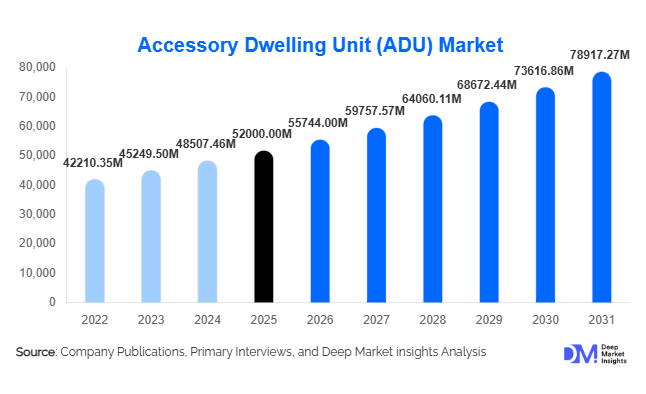
According to Deep Market Insights, the global Accessory Dwelling Unit (ADU) market was valued at USD 52,000 million in 2025 and is projected to grow from approximately USD 55,744.00 million in 2026 to reach nearly USD 78,917.27 million by 2031, expanding at a CAGR of 7.2% during the forecast period (2026–2031). The ADU market growth is primarily driven by rising urban housing shortages, increasing property prices, supportive zoning reforms, and growing demand for flexible multi-generational living solutions across developed and emerging economies.
Key Market Insights
- Housing affordability crisis is accelerating ADU adoption, especially in high-cost urban regions such as North America and Western Europe.
- Prefabricated and modular ADUs are becoming mainstream, reducing construction timelines and improving cost efficiency.
- North America leads global demand due to progressive zoning reforms and strong homeowner participation in rental income generation.
- Asia-Pacific is the fastest-growing region, driven by rapid urbanization and increasing housing density pressures in countries like India and China.
- Rental-income driven ADUs are expanding rapidly, as homeowners seek passive income streams amid rising mortgage costs.
- Smart and sustainable ADU designs are gaining traction, integrating solar systems, energy-efficient materials, and IoT-based home automation.
Accessory Dwelling Unit Market Trends
Rapid Adoption of Modular and Prefabricated Construction
The ADU market is witnessing a strong shift toward modular and prefabricated construction techniques. Factory-built units significantly reduce construction timelines, labor dependency, and cost overruns, making them highly attractive in high-cost labor markets. Standardized designs and scalable production systems are enabling manufacturers to address rising urban demand more efficiently. Additionally, advancements in automation and digital fabrication are improving precision and sustainability, allowing ADUs to be delivered as near-turnkey solutions.
Zoning Liberalization and Urban Housing Reform
Governments across major economies are easing restrictive single-family zoning laws to allow higher-density housing solutions, including ADUs. Cities facing severe housing shortages are introducing fast-track permitting systems and incentives for secondary housing construction. This regulatory transformation is one of the strongest enablers of market expansion, particularly in the United States, Canada, Australia, and select European cities. The shift is also encouraging private developers to integrate ADUs into broader residential planning strategies.
Rise of Rental-Driven and Investment-Oriented ADUs
ADUs are increasingly being viewed as income-generating assets rather than just residential extensions. Homeowners are leveraging unused land to create rental units that generate stable monthly income. This trend is particularly strong in urban areas with high rental demand and limited housing supply. Institutional interest is also growing, with corporate and municipal entities exploring ADUs as workforce housing solutions in high-demand regions.
Accessory Dwelling Unit Market Drivers
Urban Housing Shortage and Rising Property Prices
One of the strongest drivers of ADU adoption is the persistent shortage of affordable housing in urban centers. Rising property prices have made traditional home ownership increasingly difficult, pushing homeowners and investors toward maximizing existing land use. ADUs provide a cost-effective alternative that increases housing density without requiring new land acquisition, making them highly attractive in constrained real estate markets.
Growing Demand for Multi-Generational Living
Changing demographic patterns, including aging populations and evolving family structures, are driving demand for multi-generational housing solutions. ADUs allow families to maintain proximity while ensuring independent living spaces for elderly parents or adult children. This social shift is particularly evident in North America and parts of Asia-Pacific, where cultural preferences for family cohesion are strong.
Accessory Dwelling Unit Market Restraints
High Upfront Construction and Compliance Costs
Despite long-term economic benefits, ADU development involves significant upfront costs related to design, permits, labor, and materials. In many regions, complex approval processes and infrastructure connection fees further increase total project costs. This financial barrier limits adoption among middle-income homeowners and slows market penetration in cost-sensitive regions.
Regulatory Inconsistencies Across Regions
The ADU market faces challenges due to inconsistent zoning regulations, building codes, and permitting requirements across cities and countries. While some regions offer streamlined approvals, others impose strict size limits, parking requirements, and utility constraints. This regulatory fragmentation creates uncertainty for developers and limits large-scale standardized deployment.
Accessory Dwelling Unit Market Opportunities
Expansion of Smart and Net-Zero ADUs
The integration of smart home technologies and sustainable construction materials presents a major growth opportunity. Energy-efficient ADUs equipped with solar panels, battery storage systems, and IoT-enabled home management systems are gaining strong demand. These solutions align with global decarbonization goals and attract environmentally conscious consumers.
Institutional Adoption for Workforce Housing
Corporations and governments are increasingly exploring ADUs as scalable workforce housing solutions in high-cost urban regions. Industries such as healthcare, technology, and construction are adopting ADU-based accommodation models to address employee housing shortages. This institutional demand is expected to create new revenue streams for modular housing providers.
Report Scope
| Report Metric | Details |
|---|---|
| Market Size in 2025 | USD 52000 Million |
| Market Size in 2026 | USD 55744.00 Million |
| Market Size in 2031 | USD 78917.27 Million |
| CAGR | 7.2% (2026-2031) |
| Base Year for Estimation | 2025 |
| Historical Data | 2022-2024 |
| Forecast Period | 2026-2031 |
| Report Coverage | Revenue Forecast, Competitive Landscape, Supply Chain Disruption, Growth Factors, Environment & Regulatory Landscape and Trends |
| Geographies Covered | North America, Europe, APAC, Middle East and Africa, LATAM |
| Countries Covered | U.S., Canada, U.K., Germany, France, Spain, Italy, Russia, Nordic, Benelux, Rest of Europe, China, Korea, Japan, India, Australia, Singapore, Taiwan, South East Asia, Rest of Asia-Pacific, UAE, Turky, Saudi Arabia, South Africa, Egypt, Nigeria, Rest of MEA, Brazil, Mexico, Argentina, Chile, Colombia, Rest of LATAM |
Explore more data points, trends and opportunities Download Free Sample Report
Product Type Insights
Detached ADUs dominate the global market, accounting for the largest share due to their superior privacy, independent access, and higher rental income potential, making them the preferred choice for homeowners seeking long-term asset monetization. Their architectural flexibility also allows customization for luxury rentals, guest housing, and multigenerational living, particularly in suburban regions with sufficient land availability. However, attached ADUs and garage-conversion units are gaining significant traction in dense urban environments where land constraints and zoning flexibility drive adaptive reuse of existing structures.
Prefabricated ADUs represent the fastest-growing segment, supported by industrialized construction methods, reduced build timelines, and predictable cost structures. This growth is further driven by labor shortages in the construction sector and increasing demand for standardized, scalable housing solutions. Interior ADU conversions remain a cost-efficient alternative in metropolitan cities where land acquisition is expensive, while above-garage units are expanding steadily in suburban markets due to zoning relaxations and homeowner preference for maximizing unused vertical space.
The leading driver for detached ADUs is the rising demand for independent rental income-generating housing assets, while prefabricated ADUs are being propelled by the global shift toward modular construction ecosystems and rapid urban housing delivery requirements.
Application Insights
Rental income generation remains the dominant application segment, as homeowners increasingly view ADUs as a stable passive income source amid rising mortgage costs, inflationary pressure, and urban housing shortages. This segment benefits significantly from the expansion of short-term rental platforms and long-term tenant demand in high-density cities.
Multi-generational housing represents another major application, driven by demographic aging trends and cultural preferences for family proximity while maintaining independent living arrangements. Workforce housing is emerging as a strategic segment in technology hubs, healthcare corridors, and industrial zones, where employers and governments are exploring ADUs as scalable accommodation solutions. Additionally, ADUs are increasingly used as home offices, creative studios, guest accommodations, and short-term rental units, expanding their functional versatility across residential ecosystems.
Rental income generation leads due to increasing urban affordability constraints and the rise of property monetization trends, while multi-generational living is supported by aging population structures and shifting household dynamics globally.
Distribution Channel Insights
Direct-to-consumer (D2C) sales channels dominate the ADU market, driven by the rapid digitalization of modular housing platforms that allow homeowners to configure, price, and purchase ADUs through online ecosystems. This model reduces dependency on intermediaries and enhances cost transparency and customization capabilities.
Developer-led ADU projects are expanding rapidly in urban redevelopment zones, particularly where municipalities are encouraging densification and mixed-use housing integration. Contractor-installed ADUs continue to hold relevance in traditional construction markets where customization and on-site adjustments remain essential. Meanwhile, online design-to-build platforms are emerging as a disruptive force, enabling end-to-end visualization, permitting assistance, and turnkey delivery solutions for homeowners.
D2C channels lead due to increasing digital adoption in housing procurement and consumer preference for transparent, customizable, and cost-efficient housing purchase models.
Explore more data points, trends and opportunities Download Free Sample Report
Accessory Dwelling Unit (ADU) Market Segmentations
By Product Type
- Detached ADUs
- Attached ADUs
- Garage Conversion ADUs
- Interior Conversion ADUs (Basement Units)
- Above-Garage ADUs
- Prefabricated / Modular ADUs
By Construction Method
- Site-Built ADUs
- Prefabricated / Modular ADUs
- Panelized Construction ADUs
- Hybrid Construction ADUs
By Application
- Rental Income Generation
- Multi-Generational Living
- Workforce Housing
- Home Office / Studio Use
- Short-Term Rental / Vacation Use
- Guest Accommodation
By Distribution Channel
- Direct-to-Consumer (D2C) Online Platforms
- Developer-Led Housing Projects
- Contractor / Builder Installation
- Online Design-to-Build Platforms
- Retail & Modular Housing Dealers
By End-Use Ownership
- Owner-Occupied Residential ADUs
- Rental / Investment ADUs
- Government & Workforce Housing ADUs
- Corporate Housing Solutions
Regional Insights
North America
North America holds the largest share of the ADU market, accounting for approximately 42% of global demand in 2025, led primarily by the United States. California, Oregon, and Washington remain key demand centers due to progressive zoning reforms and streamlined ADU approval processes. Canada, particularly Toronto and Vancouver, is also witnessing strong adoption driven by acute housing affordability challenges.
The region’s growth is driven by housing affordability crises, widespread zoning deregulation, and strong rental income potential from residential properties. Additionally, increasing acceptance of modular construction and financial incentives such as tax rebates and fast-track permitting systems are accelerating ADU adoption across urban and suburban markets.
Europe
Europe represents nearly 23% of the global ADU market, with key demand concentrated in the United Kingdom, Germany, and the Netherlands. The region is characterized by aging housing infrastructure, high urban density, and strong sustainability mandates, which collectively support ADU integration into urban housing strategies.
Growth in Europe is primarily driven by sustainability regulations, energy-efficient housing mandates, and increasing demand for compact urban living solutions. Rising interest in carbon-neutral construction and government-backed urban infill housing policies are further strengthening ADU adoption across major European cities.
Asia-Pacific
Asia-Pacific is the fastest-growing regional market, supported by rapid urbanization across India, China, Japan, and Australia. Increasing population density in metropolitan cities and rising middle-class income levels are fueling demand for affordable, space-efficient housing alternatives such as ADUs.
The region’s growth is driven by large-scale urban migration, severe housing shortages in Tier 1 cities, and government focus on sustainable urban expansion. Additionally, increasing acceptance of modular construction technologies and smart housing integration is accelerating ADU adoption in both developed and emerging economies.
Latin America
Latin America is an emerging ADU market, with growing adoption in Brazil, Mexico, and Argentina. Demand is gradually increasing as urban populations expand and housing affordability challenges intensify across major cities.
Market expansion is driven by rising urban housing deficits, increasing interest in rental-based income models, and gradual policy support for housing densification. Growing awareness of cost-effective construction methods is also encouraging ADU adoption among middle-income homeowners.
Middle East & Africa
The Middle East & Africa region is witnessing gradual ADU adoption, led by the UAE, Saudi Arabia, and South Africa. ADUs are being explored primarily in luxury residential developments and workforce housing applications in high-income urban zones.
Growth is supported by rising demand for luxury secondary housing units, increasing expatriate workforce accommodation needs, and government-led urban development initiatives. Additionally, strong investment in real estate diversification and smart city projects is expected to support long-term ADU integration in the region.
Key Players in the Accessory Dwelling Unit Market
- Clayton Homes
- Skyline Champion Corporation
- Cavco Industries
- Boxabl
- Plant Prefab
- Guerdon
- Method Homes
- Abodu
- Villa Homes
- NODE