United Arab Emirates Ethnic Food Market Size & Outlook, 2026-2034
Last Updated : 11 August, 2026 |
Study Period : 2022-2034 |
Format : PDF, Excel |
Author : Hannah Blake
United Arab Emirates Ethnic Food Market Insights
- According to Deep Market Insights analysis, the United Arab Emirates Ethnic Food Market size was USD 3529.52 Million in 2025 and is projected to reach USD 7906.32 Million by 2034.
- The United Arab Emirates market is projected to grow at a CAGR of 9.4% between 2026 and 2034.
- By segment, Asian emerged as the largest Cuisine in terms of market size in 2025.
- Middle Eastern is anticipated to remain the most attractive Cuisine segment, recording the fastest growth during the forecast period.
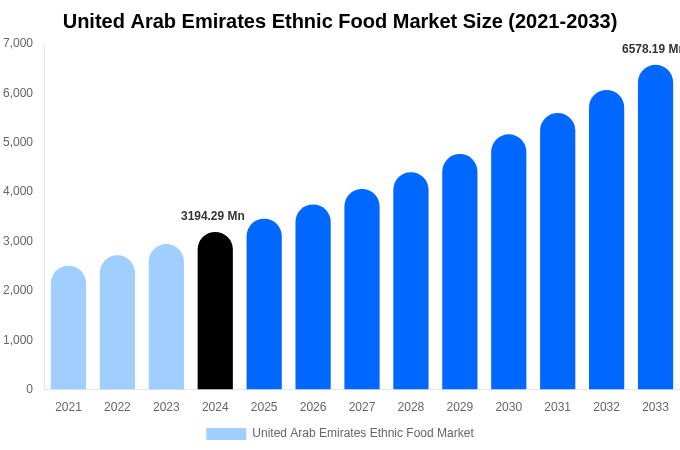
Source: DMI Analysis Company Publications, Primary Interviews.

Other Key Findings
- In 2025, United Arab Emirates accounted for 6.32% of the global Ethnic Food Market size.
- By 2034, United States is expected to lead the global Ethnic Food Market in terms of market size.
- Within Middle East and Africa, United Arab Emirates is projected to dominate the regional Ethnic Food Market size by 2034.
- Saudi Arabia is identified as the fastest-growing market in Middle East and Africa, anticipated to reach USD 2781.76 Million by 2034.
United Arab Emirates Ethnic Food Market Dynamics
- The United Arab Emirates ethnic food market continues expanding as a highly international consumer base, tourism, expatriate communities, premium food consumption, and diverse restaurant culture support demand for global cuisines. Asian, Indian, Middle Eastern, Mediterranean, European, African, and Latin American foods are widely represented across retail and foodservice.
- Supermarkets, hypermarkets, premium grocery stores, specialty ethnic retailers, restaurants, hotels, cafés, foodservice operators, shopping malls, e-commerce platforms, marketplaces, and food-delivery services continue strengthening market accessibility.
- Companies invest in authentic sauces, spices, seasonings, ready meals, frozen foods, noodles, snacks, bakery products, specialty ingredients, meal kits, and premium imported foods. Innovation focuses on authenticity, convenience, premiumization, localized flavors, and multicultural consumer preferences.
- Sustainability initiatives emphasize responsible sourcing, recyclable packaging, food-waste reduction, efficient cold-chain logistics, sustainable ingredients, and supply-chain transparency.
Key Industry Insights
- Expatriate communities support strong demand diversity.
- Tourism strengthens international cuisine consumption.
- Premium grocery expands specialty food availability.
- Food delivery supports ethnic cuisine adoption.
United Arab Emirates Ethnic Food Market Cuisine 2026-2034 (USD Million)
| Cuisine | 2022 | 2023 | 2024 | 2025 | 2026 | 2027 | 2028 | 2029 | 2030 | 2031 | 2032 | 2033 | 2034 |
|---|---|---|---|---|---|---|---|---|---|---|---|---|---|
| Asian | XX.x | XX.x | XX.x | 1423.46 | XX.x | XX.x | XX.x | XX.x | XX.x | XX.x | XX.x | XX.x | XX.x |
| Mexican | XX.x | XX.x | XX.x | XX.x | XX.x | XX.x | XX.x | XX.x | XX.x | XX.x | XX.x | XX.x | XX.x |
| Middle Eastern | XX.x | XX.x | XX.x | XX.x | XX.x | XX.x | XX.x | XX.x | XX.x | XX.x | XX.x | XX.x | XX.x |
| African | XX.x | XX.x | XX.x | XX.x | XX.x | XX.x | XX.x | XX.x | XX.x | XX.x | XX.x | XX.x | XX.x |
| Total | XX.x | XX.x | XX.x | 3,529.52 | XX.x | XX.x | XX.x | XX.x | XX.x | XX.x | XX.x | XX.x | XX.x |
Source: DMI Analysis Company Publications, Primary Interviews.
United Arab Emirates Ethnic Food Market Format 2026-2034 (USD Million)
| Format | 2022 | 2023 | 2024 | 2025 | 2026 | 2027 | 2028 | 2029 | 2030 | 2031 | 2032 | 2033 | 2034 |
|---|---|---|---|---|---|---|---|---|---|---|---|---|---|
| Ready Meals | XX.x | XX.x | XX.x | 1675.47 | XX.x | XX.x | XX.x | XX.x | XX.x | XX.x | XX.x | XX.x | XX.x |
| Sauces | XX.x | XX.x | XX.x | XX.x | XX.x | XX.x | XX.x | XX.x | XX.x | XX.x | XX.x | XX.x | XX.x |
| Snacks | XX.x | XX.x | XX.x | XX.x | XX.x | XX.x | XX.x | XX.x | XX.x | XX.x | XX.x | XX.x | XX.x |
| Total | XX.x | XX.x | XX.x | 3,529.53 | XX.x | XX.x | XX.x | XX.x | XX.x | XX.x | XX.x | XX.x | XX.x |
Source: DMI Analysis Company Publications, Primary Interviews.
United Arab Emirates Ethnic Food Market Distribution 2026-2034 (USD Million)
| Distribution | 2022 | 2023 | 2024 | 2025 | 2026 | 2027 | 2028 | 2029 | 2030 | 2031 | 2032 | 2033 | 2034 |
|---|---|---|---|---|---|---|---|---|---|---|---|---|---|
| Retail Packaged | XX.x | XX.x | XX.x | 1859.71 | XX.x | XX.x | XX.x | XX.x | XX.x | XX.x | XX.x | XX.x | XX.x |
| Foodservice | XX.x | XX.x | XX.x | XX.x | XX.x | XX.x | XX.x | XX.x | XX.x | XX.x | XX.x | XX.x | XX.x |
| Online | XX.x | XX.x | XX.x | XX.x | XX.x | XX.x | XX.x | XX.x | XX.x | XX.x | XX.x | XX.x | XX.x |
| Total | XX.x | XX.x | XX.x | 3,529.53 | XX.x | XX.x | XX.x | XX.x | XX.x | XX.x | XX.x | XX.x | XX.x |
Source: DMI Analysis Company Publications, Primary Interviews.
Report Summary
| Report Scope | Details |
|---|---|
| Base Year for Study | 2025 |
| Study Period | 2022-2034 |
| Historical Period | 2022-2024 |
| Forecast Period | 2026-2034 |
| Market Size In 2025 | USD 3529.52 Million |
| Market Size In 2034 | USD 7906.32 Million |
| Largest segment | Asian |
| Units | Revenue in USD Million |
| CAGR | 9.4% (2026-2034) |
| Report Coverage | Revenue Forecast, Competitive Landscape, Growth Factors, Environment & Regulatory Landscape and Trends |