Japan Ethnic Food Market Size & Outlook, 2026-2034
Last Updated : 11 August, 2026 |
Study Period : 2022-2034 |
Format : PDF, Excel |
Author : Hannah Blake
Japan Ethnic Food Market Insights
- According to Deep Market Insights analysis, the Japan Ethnic Food Market size was USD 1709.91 Million in 2025 and is projected to reach USD 3774.46 Million by 2034.
- The Japan market is projected to grow at a CAGR of 9.21% between 2026 and 2034.
- By segment, Asian emerged as the largest Cuisine in terms of market size in 2025.
- African is anticipated to remain the most attractive Cuisine segment, recording the fastest growth during the forecast period.
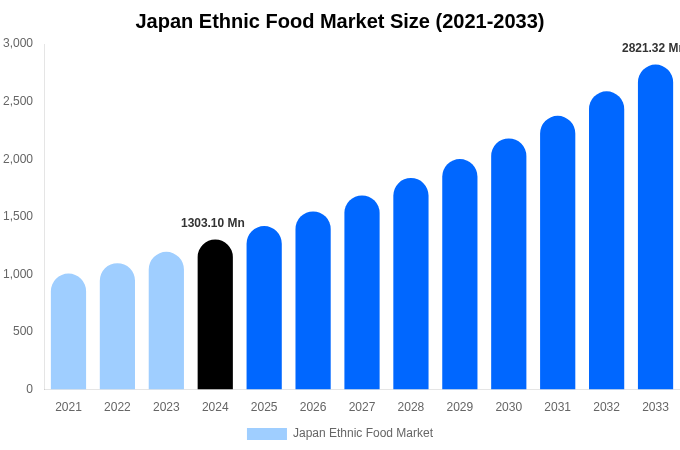
Source: DMI Analysis Company Publications, Primary Interviews.

Other Key Findings
- As of 2025, Japan held 3.06% of the global Ethnic Food Market size.
- By 2034, United States is anticipated to capture the largest share of the global Ethnic Food Market.
- In Asia Pacific, China is expected to lead the regional Ethnic Food Market size by 2034.
- Japan will remain the fastest-growing market in Asia Pacific, reaching USD 3778.63 Million by 2034.
Japan Ethnic Food Market Dynamics
- Japan's ethnic food market continues expanding as consumers increasingly seek diverse international flavors, authentic ingredients, convenient meal solutions, and new culinary experiences. Demand is supported by international tourism, multicultural communities, younger consumers, restaurant culture, and growing interest in Asian, European, Middle Eastern, and Latin American cuisines.
- Supermarkets, specialty food stores, convenience stores, restaurants, foodservice operators, imported-food retailers, e-commerce platforms, and meal-delivery services continue strengthening market accessibility. Online channels make specialty ingredients and imported products more accessible beyond major urban centers.
- Companies invest in ready-to-eat ethnic meals, sauces, seasonings, frozen foods, instant meal formats, spice blends, noodles, bakery products, snacks, and plant-based alternatives. Innovation focuses on authenticity, convenience, localized flavors, premium ingredients, and easy preparation.
- Sustainability initiatives increasingly emphasize responsible sourcing, recyclable packaging, food-waste reduction, efficient logistics, and locally sourced ingredients where appropriate.
Key Industry Insights
- International flavors support market growth.
- Convenience strengthens ethnic food adoption.
- Imported ingredients expand product variety.
- Localization helps brands appeal to Japanese consumers.
Japan Ethnic Food Market Cuisine 2026-2034 (USD Million)
| Cuisine | 2022 | 2023 | 2024 | 2025 | 2026 | 2027 | 2028 | 2029 | 2030 | 2031 | 2032 | 2033 | 2034 |
|---|---|---|---|---|---|---|---|---|---|---|---|---|---|
| Asian | XX.x | XX.x | XX.x | 687.21 | XX.x | XX.x | XX.x | XX.x | XX.x | XX.x | XX.x | XX.x | XX.x |
| Mexican | XX.x | XX.x | XX.x | XX.x | XX.x | XX.x | XX.x | XX.x | XX.x | XX.x | XX.x | XX.x | XX.x |
| Middle Eastern | XX.x | XX.x | XX.x | XX.x | XX.x | XX.x | XX.x | XX.x | XX.x | XX.x | XX.x | XX.x | XX.x |
| African | XX.x | XX.x | XX.x | XX.x | XX.x | XX.x | XX.x | XX.x | XX.x | XX.x | XX.x | XX.x | XX.x |
| Total | XX.x | XX.x | XX.x | 1,709.91 | XX.x | XX.x | XX.x | XX.x | XX.x | XX.x | XX.x | XX.x | XX.x |
Source: DMI Analysis Company Publications, Primary Interviews.
Japan Ethnic Food Market Format 2026-2034 (USD Million)
| Format | 2022 | 2023 | 2024 | 2025 | 2026 | 2027 | 2028 | 2029 | 2030 | 2031 | 2032 | 2033 | 2034 |
|---|---|---|---|---|---|---|---|---|---|---|---|---|---|
| Ready Meals | XX.x | XX.x | XX.x | 841.62 | XX.x | XX.x | XX.x | XX.x | XX.x | XX.x | XX.x | XX.x | XX.x |
| Sauces | XX.x | XX.x | XX.x | XX.x | XX.x | XX.x | XX.x | XX.x | XX.x | XX.x | XX.x | XX.x | XX.x |
| Snacks | XX.x | XX.x | XX.x | XX.x | XX.x | XX.x | XX.x | XX.x | XX.x | XX.x | XX.x | XX.x | XX.x |
| Total | XX.x | XX.x | XX.x | 1,709.91 | XX.x | XX.x | XX.x | XX.x | XX.x | XX.x | XX.x | XX.x | XX.x |
Source: DMI Analysis Company Publications, Primary Interviews.
Japan Ethnic Food Market Distribution 2026-2034 (USD Million)
| Distribution | 2022 | 2023 | 2024 | 2025 | 2026 | 2027 | 2028 | 2029 | 2030 | 2031 | 2032 | 2033 | 2034 |
|---|---|---|---|---|---|---|---|---|---|---|---|---|---|
| Retail Packaged | XX.x | XX.x | XX.x | 903.35 | XX.x | XX.x | XX.x | XX.x | XX.x | XX.x | XX.x | XX.x | XX.x |
| Foodservice | XX.x | XX.x | XX.x | XX.x | XX.x | XX.x | XX.x | XX.x | XX.x | XX.x | XX.x | XX.x | XX.x |
| Online | XX.x | XX.x | XX.x | XX.x | XX.x | XX.x | XX.x | XX.x | XX.x | XX.x | XX.x | XX.x | XX.x |
| Total | XX.x | XX.x | XX.x | 1,709.91 | XX.x | XX.x | XX.x | XX.x | XX.x | XX.x | XX.x | XX.x | XX.x |
Source: DMI Analysis Company Publications, Primary Interviews.
Inside This Report
This section explores Japan's ethnic food industry through international cuisine, imported ingredients, convenience foods, foodservice, e-commerce, and product localization.
- Regional/Country market landscape: Reviews Japan's ethnic food ecosystem.
- Consumer and consumption trends: Explores authenticity, convenience, international flavors, tourism, and changing preferences.
- Product innovation and distribution: Covers sauces, seasonings, frozen foods, ready meals, snacks, ingredients, and retail channels.
- Competitive and industry developments: Highlights product localization, sourcing, foodservice partnerships, e-commerce, sustainability, and commercialization.
Report Summary
| Report Scope | Details |
|---|---|
| Base Year for Study | 2025 |
| Study Period | 2022-2034 |
| Historical Period | 2022-2024 |
| Forecast Period | 2026-2034 |
| Market Size In 2025 | USD 1709.91 Million |
| Market Size In 2034 | USD 3774.46 Million |
| Largest segment | Asian |
| Units | Revenue in USD Million |
| CAGR | 9.21% (2026-2034) |
| Report Coverage | Revenue Forecast, Competitive Landscape, Growth Factors, Environment & Regulatory Landscape and Trends |