Toilet Bowl Brush Market Size
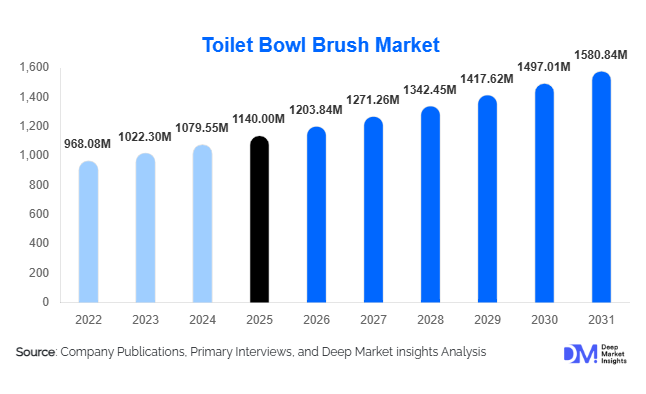
According to Deep Market Insights, the global toilet bowl brush market size was valued at USD 1,140 million in 2025 and is projected to grow from USD 1,203.84 million in 2026 to reach USD 1,580.84 million by 2031, expanding at a CAGR of 5.6% during the forecast period (2026–2031). The toilet bowl brush market growth is primarily driven by increasing global hygiene awareness, rising residential construction, and growing demand for sanitation solutions across commercial facilities such as hotels, hospitals, offices, and educational institutions.
Key Market Insights
- Growing global hygiene awareness is encouraging households and institutions to adopt more effective bathroom cleaning tools.
- Silicone bristle toilet brushes are gaining popularity due to their durability, antimicrobial properties, and ease of cleaning compared to traditional plastic bristles.
- Asia-Pacific dominates the global market, driven by rapid urbanization, rising middle-class populations, and expanding residential housing construction.
- E-commerce channels are expanding rapidly, enabling manufacturers to reach consumers directly and promote premium bathroom cleaning accessories.
- Sustainability trends are influencing product innovation, with manufacturers introducing eco-friendly materials such as bamboo handles, recycled plastics, and biodegradable brush heads.
- Commercial sanitation standards are strengthening across hospitality, healthcare, and office sectors, increasing replacement demand for toilet cleaning tools.
What are the latest trends in the toilet bowl brush market?
Rising Demand for Hygienic and Antimicrobial Cleaning Tools
Consumer awareness regarding bathroom hygiene has significantly increased in recent years, driving demand for toilet cleaning tools designed to reduce bacterial growth and contamination. Silicone bristle brushes, antimicrobial coatings, and self-draining holders are becoming increasingly common across both residential and commercial environments. These innovations help prevent water retention and bacterial buildup, improving sanitation and extending product lifespan. Hospitality operators, healthcare facilities, and commercial cleaning services are particularly adopting hygienic brush systems to meet strict sanitation standards. As hygiene expectations continue to evolve globally, manufacturers are prioritizing designs that improve cleanliness, durability, and user convenience.
Growing Adoption of Premium and Designer Bathroom Accessories
Bathroom accessories are increasingly being viewed as part of interior design rather than purely functional cleaning tools. Consumers are upgrading to aesthetically appealing toilet brush sets featuring stainless steel finishes, ceramic holders, and minimalist designs that complement modern bathroom décor. Premium products often incorporate ergonomic handles, concealed brush heads, and drip-resistant storage containers that enhance hygiene and visual appeal. This trend is especially prominent in developed markets such as North America and Europe, where consumers are willing to pay higher prices for products that combine design and functionality. Manufacturers are responding by launching premium collections targeted at design-conscious consumers.
What are the key drivers in the toilet bowl brush market?
Increasing Global Hygiene Awareness
One of the primary drivers of the toilet bowl brush market is the growing global emphasis on hygiene and sanitation. Public health campaigns and increased awareness about disease prevention have encouraged households to maintain higher standards of bathroom cleanliness. Toilet cleaning tools remain an essential component of sanitation routines, particularly in urban households where hygiene practices are increasingly prioritized. Governments and health organizations worldwide have also emphasized sanitation as a key public health measure, indirectly boosting demand for cleaning accessories such as toilet brushes.
Expansion of Residential Construction and Urban Housing
The steady expansion of residential construction projects across emerging economies is significantly contributing to market growth. Rapid urbanization in countries such as China, India, Indonesia, and Vietnam is increasing the number of households requiring bathroom cleaning products. Every new residential unit requires a full range of bathroom accessories, including toilet cleaning tools. As urban housing development accelerates globally, particularly in the Asia-Pacific region, the demand for toilet bowl brushes continues to rise steadily.
What are the restraints for the global market?
Price Sensitivity in Developing Markets
Despite steady demand growth, the toilet bowl brush market faces challenges related to price sensitivity in developing regions. Many consumers prefer low-cost unbranded products, which intensifies price competition among manufacturers. As toilet brushes are considered low-value household items, consumers often prioritize affordability over brand recognition or premium features. This limits profit margins for manufacturers and creates barriers for premium product adoption in cost-sensitive markets.
Emergence of Automated Bathroom Cleaning Technologies
The growing adoption of automated sanitation systems, including self-cleaning toilets and advanced bathroom cleaning technologies, may reduce reliance on traditional cleaning tools in the long term. Although these technologies are currently limited to high-end residential and commercial properties, they could gradually reduce demand for manual toilet cleaning accessories in premium segments. Manufacturers must therefore focus on innovation and product differentiation to remain competitive in evolving bathroom sanitation ecosystems.
What are the key opportunities in the toilet bowl brush industry?
Expansion of Eco-Friendly Cleaning Products
Sustainability is becoming a key purchasing factor among consumers globally. Traditional plastic toilet brushes contribute to household plastic waste, prompting manufacturers to explore eco-friendly alternatives. Products made from bamboo handles, recycled plastics, and biodegradable fibers are gaining traction in environmentally conscious markets. Governments and institutions are also encouraging sustainable procurement practices, further supporting the adoption of eco-friendly cleaning tools. Companies that invest in sustainable product design and environmentally responsible manufacturing processes are expected to capture significant market share in the coming years.
Growth of E-commerce and Direct-to-Consumer Sales
The rapid growth of e-commerce platforms presents a significant opportunity for toilet bowl brush manufacturers. Online marketplaces allow companies to expand their geographic reach while reducing reliance on traditional retail channels. Digital platforms also enable brands to showcase product innovations, provide detailed demonstrations, and gather consumer feedback. Subscription models for replacement brush heads and disposable cleaning systems are emerging as new revenue streams, particularly for premium brands seeking to build long-term customer relationships.
Report Scope
| Report Metric | Details |
|---|---|
| Market Size in 2025 | USD 1140 Million |
| Market Size in 2026 | USD 1203.84 Million |
| Market Size in 2031 | USD 1580.84 Million |
| CAGR | 5.6% (2026-2031) |
| Base Year for Estimation | 2025 |
| Historical Data | 2022-2024 |
| Forecast Period | 2026-2031 |
| Report Coverage | Revenue Forecast, Competitive Landscape, Supply Chain Disruption, Growth Factors, Environment & Regulatory Landscape and Trends |
| Geographies Covered | North America, Europe, APAC, Middle East and Africa, LATAM |
| Countries Covered | U.S., Canada, U.K., Germany, France, Spain, Italy, Russia, Nordic, Benelux, Rest of Europe, China, Korea, Japan, India, Australia, Singapore, Taiwan, South East Asia, Rest of Asia-Pacific, UAE, Turky, Saudi Arabia, South Africa, Egypt, Nigeria, Rest of MEA, Brazil, Mexico, Argentina, Chile, Colombia, Rest of LATAM |
Explore more data points, trends and opportunities Download Free Sample Report
Product Type Insights
Manual toilet bowl brushes dominate the market, accounting for nearly 78% of global demand. Their widespread adoption is driven by affordability, ease of use, and universal compatibility with different toilet designs. Electric or battery-powered toilet brushes represent a smaller but emerging category, offering improved cleaning efficiency and reduced manual effort. Disposable toilet brush systems with replaceable cleaning heads are also gaining popularity among consumers seeking improved hygiene and convenience. These systems reduce direct contact with contaminated surfaces and simplify disposal after use, making them increasingly attractive for both residential and commercial applications.
Material Insights
Plastic bristle brushes remain the most widely used material due to their affordability and mass production capabilities. However, silicone bristle brushes are rapidly gaining market share due to their superior hygiene characteristics, durability, and resistance to bacterial accumulation. Silicone brushes are easier to clean and dry faster than traditional bristle brushes, making them particularly popular among hygiene-conscious consumers. Natural fiber brushes, made from plant-based materials such as coconut fibers or tampico, represent a smaller but growing niche driven by eco-conscious consumers seeking biodegradable cleaning products.
Distribution Channel Insights
Offline retail channels continue to dominate the toilet bowl brush market, accounting for approximately two-thirds of global sales. Supermarkets, hypermarkets, home improvement stores, and specialty bathroom accessory retailers remain the primary purchase locations for household cleaning tools. Consumers often purchase toilet cleaning accessories alongside other household goods during routine shopping trips. However, online retail is growing rapidly as consumers increasingly rely on e-commerce platforms for convenience and access to a broader range of product options. Online marketplaces and brand-owned websites allow manufacturers to introduce premium designs and innovative products that may not be widely available in physical retail stores.
End-Use Insights
Residential households represent the largest end-use segment in the toilet bowl brush market, accounting for approximately 72% of global demand. Growing urban populations and increasing awareness of hygiene practices are key factors supporting residential demand. Commercial facilities, including hotels, hospitals, offices, retail complexes, and educational institutions, account for the remaining market share. The hospitality industry is a major consumer of toilet cleaning tools due to strict sanitation requirements and frequent replacement cycles. Healthcare facilities also contribute significantly to demand, as infection control protocols require consistent bathroom sanitation practices.
Explore more data points, trends and opportunities Download Free Sample Report
Toilet Bowl Brush Market Segmentations
By Product Type
- Manual Toilet Bowl Brushes
- Electric / Battery-Powered Toilet Bowl Brushes
- Disposable Toilet Brush Systems
By Brush Head Material
- Plastic Bristle Brushes
- Silicone Bristle Brushes
- Natural Fiber Brushes
- Hybrid Bristle Brushes
By Mounting / Storage Type
- Free-Standing Toilet Brush Sets
- Wall-Mounted Toilet Brush Holders
- Enclosed Hygienic Container Systems
By Distribution Channel
- Offline Retail
- Online Retail
By End-Use Sector
- Residential Households
- Commercial Facilities
Regional Insights
Asia-Pacific
Asia-Pacific holds the largest share of the global toilet bowl brush market, accounting for approximately 38% of total demand in 2025. Rapid urbanization, rising disposable incomes, and expanding residential construction are key factors supporting regional growth. China represents the largest market in the region due to its large population and extensive manufacturing capabilities. India is emerging as a major growth market as urban housing development and sanitation awareness continue to expand. Japan and South Korea represent mature markets with strong demand for premium and design-oriented bathroom accessories.
North America
North America accounts for roughly 24% of the global toilet bowl brush market. The United States is the largest contributor, driven by strong consumer spending on household cleaning products and well-established retail distribution networks. Consumers in this region increasingly prefer premium bathroom accessories featuring stainless steel finishes, antimicrobial materials, and modern designs. The region also demonstrates strong adoption of innovative cleaning products, including disposable brush systems and silicone brushes.
Europe
Europe represents approximately 22% of the global market. Germany, the United Kingdom, France, and Italy are key contributors to regional demand. European consumers often prioritize product design, durability, and sustainability, leading to strong demand for premium bathroom cleaning tools and eco-friendly products. The region also benefits from strong retail infrastructure and growing adoption of sustainable household goods.
Latin America
Latin America accounts for nearly 7% of the global market, with Brazil and Mexico serving as the largest demand centers. Rising urbanization and increasing consumer awareness of sanitation practices are supporting steady market growth. Expanding retail networks and growing availability of affordable household cleaning tools are also contributing to market development across the region.
Middle East & Africa
The Middle East and Africa region accounts for around 9% of global demand. Growth is supported by expanding hospitality infrastructure, particularly in countries such as the United Arab Emirates and Saudi Arabia. Increasing urbanization and rising investment in public sanitation infrastructure across African economies are also contributing to steady demand for bathroom cleaning products.
Key Players in the Toilet Bowl Brush Market
- OXO International
- Rubbermaid Commercial Products
- Libman Company
- Casabella Holdings
- Clorox Company
- SC Johnson
- IKEA
- Simplehuman
- Joseph Joseph
- Carlisle Companies
- Ettore Products
- Freudenberg Home and Cleaning Solutions
- Gala Brush
- Vileda Professional
- Addis Housewares