Throw Blankets Market Size
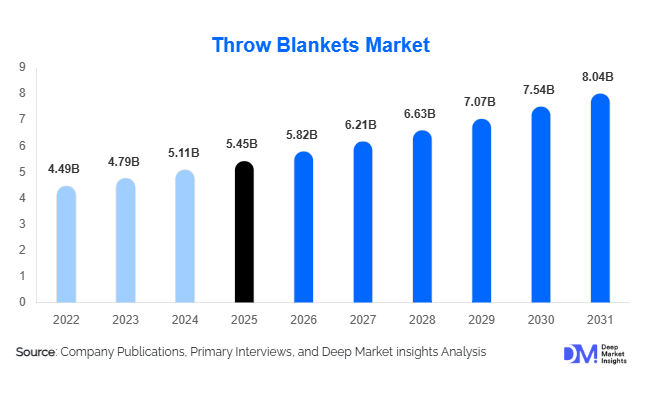
According to Deep Market Insights, the global throw blankets market size was valued at USD 5.45 billion in 2025 and is projected to grow from USD 5.82 billion in 2026 to reach USD 8.04 billion by 2031, expanding at a CAGR of 6.7% during the forecast period (2026–2031). The throw blankets market growth is primarily driven by increasing consumer spending on home décor products, rising demand for premium comfort textiles, growing adoption of sustainable fabrics, and the expansion of online retail channels. Throw blankets have evolved from purely functional household items into lifestyle and decorative accessories that complement modern interior design trends. The market is also benefiting from increasing hospitality investments, growth in vacation rental properties, and rising consumer preference for personalized and luxury home furnishings.
Key Market Insights
- Sustainable and eco-friendly throw blankets are witnessing strong demand growth, particularly products made from organic cotton, recycled polyester, bamboo fibers, and ethically sourced wool.
- Residential applications account for more than 70% of global demand, driven by increasing home improvement expenditures and evolving interior decoration trends.
- North America dominates the global market, supported by high consumer spending on premium home textiles and strong e-commerce penetration.
- Asia-Pacific is the fastest-growing regional market, driven by rising disposable incomes, urbanization, and increasing adoption of modern home furnishing products.
- Online retail channels continue to gain market share, supported by product customization, direct-to-consumer business models, and growing consumer preference for digital shopping experiences.
- Material innovation and premiumization trends are encouraging manufacturers to launch weighted throws, temperature-regulating blankets, and luxury knitted products.
Throw Blankets Market Trends
Sustainable Textile Adoption Accelerating Across Global Markets
Sustainability has emerged as one of the most influential trends shaping the throw blankets industry. Consumers are increasingly seeking products manufactured using environmentally responsible materials and processes. Organic cotton, recycled polyester, bamboo fibers, and biodegradable textile blends are gaining significant traction across North America and Europe. Manufacturers are investing heavily in sustainable sourcing programs, low-impact dyeing technologies, and circular production systems to align with changing consumer preferences. Retailers are also expanding dedicated sustainable home furnishing collections, helping eco-friendly throw blankets gain visibility among mainstream consumers. Sustainability certifications and traceable supply chains are becoming important purchasing criteria, particularly within premium and luxury segments.
Premium and Multifunctional Throw Blankets Driving Product Innovation
The market is witnessing increasing demand for premium and multifunctional throw blankets that combine aesthetics, comfort, and wellness benefits. Consumers are gravitating toward products featuring temperature regulation, hypoallergenic fabrics, weighted construction, and enhanced softness. Luxury knitted throws, faux fur blankets, and designer collections are gaining popularity among affluent households. Personalized products featuring monograms, customized colors, and unique patterns are also driving premium category growth. Technological advancements in knitting, weaving, and textile finishing are enabling manufacturers to introduce differentiated products that command higher margins while enhancing consumer appeal.
Throw Blankets Market Drivers
Growing Consumer Spending on Home Décor and Furnishings
Increasing investments in home improvement and interior decoration are significantly contributing to market growth. Consumers increasingly view throw blankets as decorative accessories that enhance the visual appeal of living rooms, bedrooms, and outdoor spaces. Social media platforms, home design influencers, and lifestyle content continue to influence purchasing decisions, encouraging consumers to refresh home interiors more frequently. As disposable incomes rise globally, demand for premium home textiles is expected to increase steadily.
Expansion of E-Commerce and Direct-to-Consumer Sales Channels
The rapid growth of e-commerce has transformed product accessibility and consumer engagement within the throw blankets market. Online platforms provide consumers with extensive product selections, customization options, competitive pricing, and customer reviews. Direct-to-consumer brands are leveraging digital marketing and data-driven customer insights to strengthen market penetration. Enhanced logistics networks and omnichannel retail strategies are further supporting sales growth across both developed and emerging economies.
Throw Blankets Market Restraints
Volatility in Raw Material and Manufacturing Costs
Manufacturers continue to face challenges associated with fluctuating prices of cotton, wool, polyester fibers, dyes, and energy. Rising labor costs and transportation expenses further impact profitability. These cost pressures often reduce pricing flexibility and create margin challenges, particularly for mid-range and economy product manufacturers operating in highly competitive retail environments.
Seasonal Demand Variability
Demand for throw blankets remains partially influenced by seasonal weather patterns, especially in North America and Europe. Sales typically peak during autumn and winter months, resulting in inventory management challenges and production planning complexities. Manufacturers must balance production capacity and inventory levels to avoid overstocking or supply shortages during peak demand periods.
Throw Blankets Market Opportunities
Expansion of Sustainable and Circular Textile Solutions
The growing consumer preference for environmentally responsible products presents substantial opportunities for manufacturers and new entrants. Brands offering certified sustainable materials, recycled fibers, and transparent supply chains are positioned to gain market share. Governments and retailers are increasingly promoting circular textile initiatives, creating favorable conditions for sustainable throw blanket production. Companies investing in eco-friendly manufacturing technologies and product certifications can differentiate themselves in competitive markets while attracting environmentally conscious consumers.
Hospitality and Vacation Rental Sector Growth
The expansion of luxury hotels, boutique accommodations, resorts, and vacation rental properties is generating significant demand for premium throw blankets. Hospitality operators increasingly use decorative and comfort-enhancing textiles to improve guest experiences and strengthen brand positioning. Growing global tourism, increasing hotel development projects, and rising investments in premium accommodation infrastructure are expected to create long-term procurement opportunities for throw blanket manufacturers.
Report Scope
| Report Metric | Details |
|---|---|
| Market Size in 2025 | USD 5.45 Billion |
| Market Size in 2026 | USD 5.82 Billion |
| Market Size in 2031 | USD 8.04 Billion |
| CAGR | 6.7% (2026-2031) |
| Base Year for Estimation | 2025 |
| Historical Data | 2022-2024 |
| Forecast Period | 2026-2031 |
| Report Coverage | Revenue Forecast, Competitive Landscape, Supply Chain Disruption, Growth Factors, Environment & Regulatory Landscape and Trends |
| Geographies Covered | North America, Europe, APAC, Middle East and Africa, LATAM |
| Countries Covered | U.S., Canada, U.K., Germany, France, Spain, Italy, Russia, Nordic, Benelux, Rest of Europe, China, Korea, Japan, India, Australia, Singapore, Taiwan, South East Asia, Rest of Asia-Pacific, UAE, Turky, Saudi Arabia, South Africa, Egypt, Nigeria, Rest of MEA, Brazil, Mexico, Argentina, Chile, Colombia, Rest of LATAM |
Explore more data points, trends and opportunities Download Free Sample Report
Material Type Insights
Cotton throw blankets account for the largest share of the global market, representing approximately 31% of total revenue in 2025. Their leadership position is supported by affordability, breathability, durability, and widespread consumer familiarity. Organic cotton variants are experiencing particularly strong growth due to sustainability trends. Wool throw blankets remain highly popular in colder climates, especially across Europe and North America, while polyester and microfiber products continue to dominate value-oriented segments due to their cost-effectiveness and ease of maintenance. Premium materials such as faux fur and sustainable bamboo fibers are gaining traction among consumers seeking luxury and environmentally friendly alternatives.
Product Construction Insights
Knitted throw blankets dominate the product construction segment, accounting for approximately 28% of global revenues. Their popularity is driven by aesthetic appeal, handcrafted appearance, and compatibility with contemporary home décor trends. Fleece throws maintain strong demand due to softness and affordability, while plush and faux fur blankets continue to attract premium consumers seeking enhanced comfort and luxury. Weighted throw blankets are emerging as a fast-growing niche category due to increasing awareness of wellness and stress-relief benefits. Heated and electric throws are also gaining adoption in colder regions where energy efficiency and comfort are important purchasing considerations.
Distribution Channel Insights
Online retail channels account for approximately 38% of global throw blanket sales and continue to expand faster than traditional retail formats. E-commerce platforms offer consumers greater product variety, customization options, transparent pricing, and convenient delivery services. Brand-owned websites and direct-to-consumer business models are strengthening customer engagement and improving profit margins. Specialty home furnishing stores remain important sales channels for premium products, while department stores and hypermarkets continue to serve mainstream consumer segments through broad product assortments and promotional pricing strategies.
End User Insights
Residential consumers represent approximately 72% of total market demand, making them the dominant end-user segment. Growing interest in interior design, home comfort, and gifting applications continues to support strong residential demand globally. Hospitality represents the fastest-growing commercial segment, driven by increasing investments in hotels, resorts, serviced apartments, and vacation rental properties. Healthcare facilities are emerging as a niche growth segment, utilizing comfort-oriented blankets to improve patient experiences and wellness outcomes. Corporate offices and commercial spaces are also incorporating decorative textiles into workplace design strategies aimed at improving employee comfort and workplace aesthetics.
Explore more data points, trends and opportunities Download Free Sample Report
Throw Blankets Market Segmentations
By Material Type
- Cotton Throw Blankets
- Wool Throw Blankets
- Polyester & Microfiber Throw Blankets
- Acrylic Throw Blankets
- Faux Fur Throw Blankets
- Blended Fiber Throw Blankets
- Sustainable & Specialty Fiber Throw Blankets
By Product Construction
- Knitted Throws
- Woven Throws
- Fleece Throws
- Quilted Throws
- Plush Throws
- Weighted Throws
- Heated/Electric Throws
By End User
- Residential Consumers
- Hospitality Sector
- Healthcare Facilities
- Corporate & Commercial Spaces
- Travel & Outdoor Users
By Distribution Channel
- Online Retail
- Department Stores
- Specialty Home Textile Stores
- Hypermarkets & Supermarkets
- Furniture & Home Décor Retailers
By Function
- Decorative Throws
- Warmth & Comfort Throws
- Travel Throws
- Outdoor Throws
- Therapeutic & Wellness Throws
Regional Insights
North America
North America accounted for approximately 34% of the global throw blankets market in 2025, making it the largest regional market. The United States alone contributes nearly 27% of global demand due to high household spending on home furnishings, premium home décor products, and luxury textiles. Strong e-commerce penetration and widespread adoption of interior design trends continue to support market expansion. Canada also represents an important market, driven by seasonal demand and increasing interest in sustainable textile products.
Europe
Europe represents approximately 29% of global market revenues and remains a highly attractive market for premium and sustainable throw blankets. Germany, the United Kingdom, France, and Italy are major contributors to regional demand. Consumers in Europe demonstrate strong preference for organic materials, ethically sourced wool, and environmentally responsible manufacturing practices. Growing demand for premium home furnishings and luxury interior design products continues to support market growth across the region.
Asia-Pacific
Asia-Pacific accounts for approximately 25% of global revenues and is the fastest-growing regional market. China, India, Japan, South Korea, and Australia are driving growth through rising disposable incomes, urbanization, and increasing consumer awareness of premium home décor products. China remains the largest market within the region, while India is forecast to record the fastest growth rate due to expanding middle-class populations and rapidly growing online retail infrastructure.
Latin America
Latin America accounts for approximately 6% of global demand, with Brazil and Mexico representing the largest regional markets. Increasing household consumption, urbanization, and improving retail infrastructure are supporting demand growth. Rising interest in modern home furnishings and decorative textiles is expected to strengthen market expansion throughout the forecast period.
Middle East & Africa
The Middle East & Africa region accounts for approximately 6% of global revenues. Demand is driven by luxury hospitality developments, premium residential construction, and growing tourism infrastructure investments. The United Arab Emirates, Saudi Arabia, South Africa, and Turkey represent key regional markets. Turkey also serves as a significant manufacturing and export hub for textile products supplied to Europe and other global markets.
Key Players in the Throw Blankets Market
- Pendleton Woolen Mills
- Berkshire Blanket & Home Co.
- Barefoot Dreams
- UGG Home
- Faribault Mill
- Boll & Branch
- Brooklinen
- Lands' End
- West Elm
- Pottery Barn
- IKEA
- The Company Store
- Rumpl
- Coyuchi
- Matouk