Tablecloths Market Size
According to Deep Market Insights, the global tablecloths market size was valued at USD 12,400 million in 2025 and is projected to grow from USD 13,156.40 million in 2026 to reach USD 17,689.44 million by 2031, expanding at a CAGR of 6.1% during the forecast period (2026–2031). The tablecloths market growth is primarily driven by rising demand from the hospitality and events industry, increasing consumer spending on home décor and lifestyle aesthetics, and the rapid expansion of e-commerce platforms offering customizable textile products across global markets.
Key Market Insights
- Commercial hospitality demand dominates consumption, with hotels, restaurants, and catering services accounting for a major share of global tablecloth usage due to recurring bulk procurement cycles.
- Sustainability is reshaping material preferences, with rising adoption of reusable cotton, linen, and recycled polyester tablecloths replacing single-use and synthetic alternatives.
- APAC leads global production and consumption, driven by strong textile manufacturing ecosystems in China and India, along with rising domestic hospitality demand.
- Online retail is accelerating market accessibility, enabling consumers and businesses to access customized designs, bulk orders, and premium décor options globally.
- Premiumization in home décor is driving mid-to-high-end product demand, especially in urban households and luxury hospitality spaces.
- Technological fabric innovation is emerging, including stain-resistant, antimicrobial, and easy-care textiles for commercial and healthcare applications.
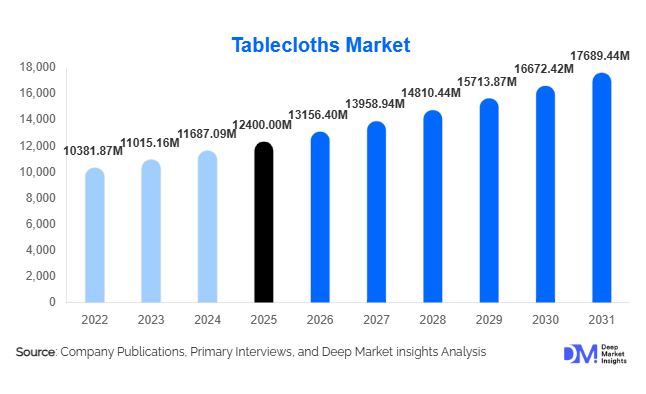
What are the latest trends in the tablecloths market?
Shift Toward Sustainable and Functional Fabrics
The tablecloths market is experiencing a strong shift toward sustainability-driven product innovation. Consumers and commercial buyers are increasingly adopting eco-friendly materials such as organic cotton, linen blends, and recycled polyester. Manufacturers are also integrating functional enhancements such as stain resistance, wrinkle-free finishes, and antimicrobial coatings to improve usability in high-traffic environments like restaurants and hotels. This trend is particularly strong in Europe and North America, where regulatory frameworks and consumer awareness are pushing brands to reduce environmental impact while improving product lifecycle performance.
Rise of E-Commerce and Customization Demand
Digital commerce has transformed the tablecloths market by enabling mass customization and direct-to-consumer engagement. Online platforms allow buyers to select material, size, color, and design specifications, significantly expanding product personalization. Businesses are also leveraging AI-driven recommendation systems and digital catalogs to target hospitality buyers with tailored bulk solutions. Subscription-based procurement models for restaurants and event planners are also emerging, ensuring recurring revenue streams for suppliers while improving supply chain efficiency and inventory planning.
What are the key drivers in the tablecloths market?
Expansion of Hospitality and Event Industries
The global hospitality industry is a primary growth driver for tablecloth demand, supported by increasing international tourism, expansion of hotel chains, and growth in food service establishments. Hotels, banquet halls, and catering services require continuous replacement and bulk procurement of table linens, ensuring stable demand. Rising event culture, including weddings, corporate events, and exhibitions, further strengthens commercial consumption. Emerging economies in the Asia-Pacific and the Middle East are witnessing rapid infrastructure development in hospitality, significantly contributing to market expansion.
Rising Home Décor and Lifestyle Spending
Growing consumer focus on home aesthetics is driving demand for premium and decorative tablecloths. Urban households are increasingly investing in coordinated dining setups, influenced by social media trends and lifestyle branding. This has expanded demand for designer table linens across mid-range and premium segments. Additionally, increasing disposable incomes in developing countries are encouraging consumers to upgrade from functional to decorative table settings, further boosting residential market penetration.
What are the restraints for the global market?
Raw Material Price Volatility
The tablecloths market is highly sensitive to fluctuations in raw material costs, particularly cotton, polyester, and blended textiles. Supply chain disruptions, climate variability affecting cotton yields, and energy price inflation significantly impact production costs. These fluctuations reduce profit margins for manufacturers and create pricing instability in both commercial and retail segments, especially in price-sensitive markets.
High Competition and Price Pressure
The market faces intense competition from low-cost manufacturers, particularly in the Asia-Pacific. This leads to price erosion in standardized product categories such as polyester and disposable tablecloths. Smaller and mid-sized players often struggle to maintain margins due to aggressive pricing strategies by large-scale producers and private-label brands in retail chains, limiting overall profitability in commoditized segments.
What are the key opportunities in the tablecloths industry?
Sustainable and Premium Product Innovation
The growing global shift toward sustainability presents strong opportunities for manufacturers investing in eco-friendly and premium textiles. Organic cotton, recycled fibers, and biodegradable materials are increasingly preferred by environmentally conscious consumers and hospitality brands. Premiumization trends in urban households and luxury hotels are also driving demand for high-quality, designer table linens, enabling higher margin growth opportunities.
Growth in Emerging Hospitality Markets
Rapid tourism expansion and urban development in regions such as Southeast Asia, the Middle East, and Latin America are creating significant demand for table linens. Government investments in tourism infrastructure and rising international travel are increasing the number of hotels, restaurants, and event venues, directly boosting the bulk procurement of tablecloths. These regions represent high-growth opportunities for global suppliers seeking geographic expansion.
Report Scope
| Report Metric | Details |
|---|---|
| Market Size in 2025 | USD 12400 Million |
| Market Size in 2026 | USD 13156.40 Million |
| Market Size in 2031 | USD 17689.44 Million |
| CAGR | 6.1% (2026-2031) |
| Base Year for Estimation | 2025 |
| Historical Data | 2022-2024 |
| Forecast Period | 2026-2031 |
| Report Coverage | Revenue Forecast, Competitive Landscape, Supply Chain Disruption, Growth Factors, Environment & Regulatory Landscape and Trends |
| Geographies Covered | North America, Europe, APAC, Middle East and Africa, LATAM |
| Countries Covered | U.S., Canada, U.K., Germany, France, Spain, Italy, Russia, Nordic, Benelux, Rest of Europe, China, Korea, Japan, India, Australia, Singapore, Taiwan, South East Asia, Rest of Asia-Pacific, UAE, Turky, Saudi Arabia, South Africa, Egypt, Nigeria, Rest of MEA, Brazil, Mexico, Argentina, Chile, Colombia, Rest of LATAM |
Explore more data points, trends and opportunities Download Free Sample Report
Product Type Insights
Reusable tablecloths dominate the global tablecloths market, accounting for approximately 68% of total market share in 2025. The leadership of this segment is primarily driven by its long lifecycle, cost efficiency over repeated use, and increasing alignment with sustainability goals across both residential and commercial end users. In the hospitality sector, where table linens are used extensively daily, reusable tablecloths significantly reduce operational costs compared to disposable alternatives, making them the preferred choice for hotels, restaurants, and banquet facilities. Additionally, advancements in fabric technology, such as stain-resistant coatings, wrinkle-free finishes, and antimicrobial treatments, have further strengthened the value proposition of reusable products.
Within this segment, mid-range reusable fabric tablecloths represent the most commercially dominant sub-category, as they strike a balance between affordability, durability, and aesthetic appeal. These products are widely adopted by mid-tier hotels, restaurants, and households seeking quality without premium pricing. On the other hand, disposable tablecloths, although accounting for a smaller share, are witnessing steady growth, particularly in catering services, outdoor events, and institutional applications where hygiene, convenience, and quick turnaround times are critical. The growing focus on biodegradable disposable options is also supporting incremental demand within this segment.
Application Insights
The commercial segment leads the tablecloths market with approximately 55% share in 2025, driven by consistent and large-scale demand from hotels, restaurants, catering services, and event management companies. The dominance of this segment is supported by the high frequency of usage and replacement cycles, as tablecloths are essential for maintaining hygiene standards and enhancing customer experience in dining and event environments. Growth in global tourism, expansion of quick-service restaurants (QSRs), and an increasing number of large-scale events such as weddings, exhibitions, and corporate gatherings are key drivers fueling this segment’s expansion.
The residential segment is also witnessing steady growth, supported by rising consumer interest in home décor, lifestyle upgrades, and social dining experiences. The increasing influence of social media trends and home styling content is encouraging consumers to invest in decorative table settings. Meanwhile, institutional applications, including hospitals, schools, and corporate cafeterias, are emerging as stable demand contributors. This segment is primarily driven by hygiene compliance requirements and standardized dining infrastructure, particularly in developed markets. Overall, the commercial hospitality segment remains the most influential application area due to its recurring and volume-driven demand patterns.
Distribution Channel Insights
Offline retail channels continue to dominate the tablecloths market, accounting for around 60% of total sales in 2025. The leadership of this segment is driven by the strong presence of supermarkets, hypermarkets, specialty home textile stores, and wholesale distributors, which cater extensively to both individual consumers and bulk buyers such as hotels and event planners. Bulk procurement contracts, particularly in the hospitality industry, are largely fulfilled through direct offline channels, ensuring consistent demand for wholesalers and distributors.
However, online retail is emerging as the fastest-growing distribution channel, supported by increasing digital penetration, convenience, and access to a wide product ассортимент. E-commerce platforms are particularly popular in urban markets, offering customization options, competitive pricing, and doorstep delivery. The ability to compare designs, materials, and prices has enhanced consumer engagement and purchase decision-making. Additionally, direct-to-consumer (D2C) models and B2B e-commerce platforms are gaining traction, enabling manufacturers to directly serve hospitality clients with customized bulk solutions. The integration of AI-based recommendation systems and digital catalogs is further accelerating online channel growth.
End-Use Industry Insights
The hospitality industry remains the largest and fastest-growing end-use segment in the tablecloths market, supported by a global hotel and restaurant industry valued in trillions of USD. The growth of international tourism, expansion of food service chains, and increasing number of luxury and mid-scale hotels are directly driving demand for table linens. Tablecloths are essential operational items in this industry, resulting in recurring bulk purchases and high replacement rates, which significantly contribute to overall market revenue. The residential end-use segment is expanding steadily, driven by rising disposable incomes, urbanization, and growing consumer interest in interior decoration and lifestyle enhancement. Consumers are increasingly investing in coordinated dining setups for both everyday use and special occasions. Institutional applications, including healthcare and education sectors, are emerging as niche but stable demand contributors, driven by strict hygiene standards and uniform dining arrangements. Export-driven demand also plays a crucial role in market dynamics, with major textile-producing countries such as China and India supplying tablecloths to global hospitality supply chains. The integration of global trade networks and cost-efficient manufacturing capabilities continues to strengthen the role of exports in overall market growth.
Explore more data points, trends and opportunities Download Free Sample Report
Tablecloths Market Segmentations
By Material Type
- Cotton Tablecloths
- Polyester Tablecloths
- Linen Tablecloths
- Vinyl/PVC Tablecloths
- Silk & Satin Tablecloths
- Blended Fabrics
By Product Type
- Reusable Tablecloths
- Disposable Tablecloths
By Application
- Commercial
- Residential
- Institutional
By Distribution Channel
- Online Retail
- Supermarkets/Hypermarkets
- Specialty Stores
- Wholesale & Bulk Suppliers
By Price Range
- Economy
- Mid-Range
- Premium/Luxury
Regional Insights
Asia-Pacific
Asia-Pacific dominates the global tablecloths market, accounting for approximately 38% share in 2025, making it the largest regional market. The region’s leadership is primarily driven by strong textile manufacturing capabilities, cost-efficient labor, and large-scale export infrastructure in countries such as China and India. China alone contributes nearly 22% of global demand, supported by its vertically integrated textile industry and high production capacity. India is emerging as one of the fastest-growing markets, driven by rapid urbanization, increasing disposable incomes, and government initiatives supporting textile manufacturing and exports. Additionally, the expansion of domestic hospitality industries, the rising middle-class population, and growing penetration of organized retail and e-commerce platforms are further accelerating regional demand. Asia-Pacific is also the fastest-growing region, with a CAGR exceeding 7%, driven by both domestic consumption and export-oriented production.
North America
North America holds approximately 25% of the global market share, led by the United States. The region’s growth is driven by high consumer spending on home décor, a well-established hospitality sector, and strong adoption of premium and customized products. The presence of large hotel chains, fine dining establishments, and event management companies ensures consistent commercial demand. Additionally, increasing preference for eco-friendly and high-quality textiles is driving demand for sustainable tablecloths. The region also benefits from advanced retail infrastructure and high penetration of e-commerce platforms, enabling widespread product accessibility. Customization and premiumization trends are particularly strong in this region, further supporting market growth.
Europe
Europe accounts for approximately 22% of the global tablecloths market, with key countries including Germany, the UK, and France. The region’s growth is strongly influenced by sustainability regulations, eco-conscious consumer behavior, and demand for premium home textiles. European consumers show a strong preference for organic and environmentally friendly materials, driving innovation in sustainable tablecloth production. Additionally, Europe’s well-established hospitality and tourism industries contribute significantly to market demand. The region also benefits from a strong tradition of textile craftsmanship and high-quality manufacturing standards. Increasing adoption of luxury dining experiences and event-based consumption further supports demand for premium table linens.
Middle East & Africa
The Middle East & Africa region is emerging as a high-growth market, driven by the rapid expansion of tourism infrastructure, luxury hospitality projects, and large-scale international events. Countries such as the UAE and Saudi Arabia are investing heavily in tourism and entertainment sectors, leading to increased demand for high-quality table linens in hotels and event venues. Luxury hotel developments, destination weddings, and corporate events are key demand drivers in the Middle East, while Africa is witnessing gradual growth supported by improving hospitality infrastructure and increasing international tourism. Government initiatives to diversify economies through tourism are further strengthening long-term market potential in this region.
Latin America
Latin America represents a smaller but steadily growing market, with Brazil and Mexico leading regional demand. Growth in this region is driven by the expansion of tourism, increasing urbanization, and rising food service industry investments. The growing middle-class population is also contributing to increased spending on home décor and lifestyle products, supporting residential demand. Additionally, improvements in retail infrastructure and increasing penetration of e-commerce platforms are enhancing product accessibility. While the market remains price-sensitive, the gradual shift toward organized hospitality and event management services is expected to drive consistent demand growth in the coming years.
Key Players in the Tablecloths Market
- Welspun India Ltd.
- Trident Group
- IKEA
- Williams-Sonoma Inc.
- D’Decor Home Fabrics
- Venus Group
- Premier Table Linens
- Ralph Lauren Corporation
- Sferra Fine Linens
- La Redoute
- Zhejiang Xinchang Textile
- Shandong Weiqiao Textile
- Siulas AB
- StarTex Linen
- Prestige Linens