Global Smoked Herring Market Size
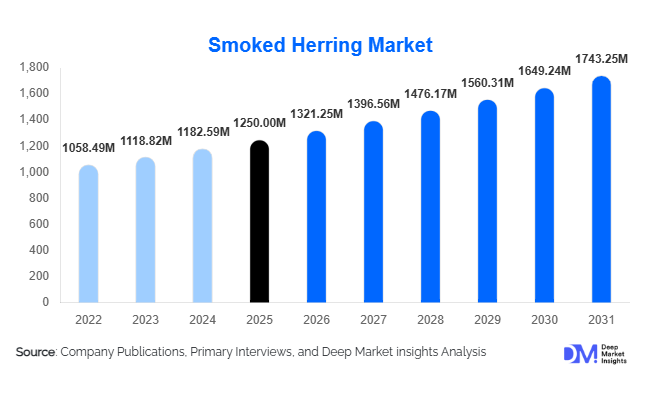
According to Deep Market Insights, the global smoked herring market size was valued at USD 1,250 million in 2026 and is projected to grow from USD 1,321.25 million in 2026 to reach USD 1,743.25 million by 2031, expanding at a CAGR of 5.7% during the forecast period (2026–2031). The smoked herring market growth is primarily driven by rising demand for high-protein seafood products, increasing preference for ready-to-eat and convenience-based food formats, and expanding global acceptance of traditional smoked fish products across both developed and emerging economies.
Key Market Insights
- Smoked herring consumption is strongly rooted in traditional European dietary patterns, particularly in Germany, the Netherlands, Scandinavia, and Eastern Europe.
- Value-added smoked herring products such as fillets and canned variants are gaining traction due to convenience and longer shelf life.
- Supermarkets and hypermarkets dominate distribution, supported by expanding refrigerated seafood sections globally.
- North America shows steady growth driven by increasing demand for ethnic seafood and healthy protein alternatives.
- Asia-Pacific is emerging as the fastest-growing region, supported by rising seafood imports and urban dietary diversification.
- Sustainability certification and traceability are becoming key purchasing criteria across premium seafood retail channels.
smoked herring market latest trends
Premiumization and Value-Added Product Innovation
The smoked herring market is witnessing a clear shift toward premium and value-added product formats, including flavored fillets, smoked spreads, and ready-to-eat packaged meals. Consumers are increasingly prioritizing convenience, taste variety, and healthier protein alternatives, driving manufacturers to innovate beyond traditional whole smoked fish. Vacuum packaging, resealable packs, and single-serve portions are becoming standard offerings, particularly in urban retail environments across Europe and North America.
Expansion of Sustainable and Certified Seafood Supply Chains
Sustainability is becoming a core market trend, with retailers and consumers demanding certified seafood sourced from responsibly managed fisheries. Certification programs such as MSC and traceability systems are increasingly influencing purchasing decisions. Companies are investing in digital supply chain tracking, sustainable fishing quotas, and eco-labeled packaging to improve transparency and build consumer trust. This trend is particularly strong in Western Europe and North America, where regulatory and consumer pressure is highest.
smoked herring market drivers
Rising Demand for Protein-Rich and Functional Foods
Smoked herring is increasingly recognized as a nutrient-dense seafood product rich in omega-3 fatty acids, protein, and essential micronutrients. Growing consumer awareness around healthy eating habits is driving substitution away from processed meat toward seafood-based diets. This trend is particularly strong among health-conscious urban populations, pescatarian consumers, and aging demographics seeking functional food benefits.
Growth of Convenience and Ready-to-Eat Seafood Consumption
Urbanization, busy lifestyles, and expanding retail refrigeration infrastructure are driving demand for convenient seafood products. Smoked herring fillets, canned variants, and pre-packaged snacks are increasingly preferred by working professionals and households. Foodservice operators are also integrating smoked herring into salads, sandwiches, and gourmet menus, further expanding consumption channels beyond traditional retail.
Expansion of Global Seafood Trade and Cold Chain Infrastructure
Improvements in cold-chain logistics, vacuum sealing technologies, and international seafood trade networks are enabling wider global distribution of smoked herring products. Export-oriented production hubs in Northern Europe are benefiting from stronger connectivity to Asia-Pacific and Middle Eastern markets, expanding the overall addressable market.
smoked herring market restraints
Raw Material Supply Volatility and Fishing Quotas
The market remains highly dependent on natural herring stocks, making it vulnerable to seasonal fluctuations, environmental changes, and strict fishing quotas. Regulatory limits imposed to protect marine ecosystems directly impact supply consistency and pricing stability, creating uncertainty for processors and exporters.
Competition from Alternative Smoked Seafood Products
Smoked salmon, mackerel, and tuna continue to dominate global smoked seafood consumption due to stronger brand positioning and wider consumer familiarity. In many non-traditional markets, smoked herring faces limited awareness and lower preference, restricting its penetration potential without significant marketing and product education efforts.
smoked herring industry key opportunities
Expansion in Emerging Asia-Pacific Seafood Markets
Rising disposable incomes, urbanization, and growing exposure to global cuisines are driving increased seafood consumption in Asia-Pacific. Countries such as China, India, Japan, and South Korea present strong growth opportunities for smoked herring imports. E-commerce and modern retail expansion are further improving product accessibility in these markets.
Growth of Premium Gourmet and Ethnic Seafood Segments
The increasing popularity of gourmet food culture is creating opportunities for premium smoked herring offerings. Flavored variants, artisanal smoking methods, and chef-curated seafood products are gaining traction in high-income consumer segments. This trend is expanding smoked herring beyond traditional consumption into upscale dining and specialty retail.
Sustainability-Led Branding and Certification Premiumization
Companies adopting sustainable fishing practices and traceability systems are gaining competitive advantages. Certified products command higher price premiums and stronger retail placement. ESG-focused procurement policies among retailers and foodservice chains are expected to further strengthen demand for certified smoked herring products.
Report Scope
| Report Metric | Details |
|---|---|
| Market Size in 2025 | USD 1250.00 Million |
| Market Size in 2026 | USD 1321.25 Million |
| Market Size in 2031 | USD 1743.25 Million |
| CAGR | 5.7% (2026-2031) |
| Base Year for Estimation | 2025 |
| Historical Data | 2022-2024 |
| Forecast Period | 2026-2031 |
| Report Coverage | Revenue Forecast, Competitive Landscape, Supply Chain Disruption, Growth Factors, Environment & Regulatory Landscape and Trends |
| Geographies Covered | North America, Europe, APAC, Middle East and Africa, LATAM |
| Countries Covered | U.S., Canada, U.K., Germany, France, Spain, Italy, Russia, Nordic, Benelux, Rest of Europe, China, Korea, Japan, India, Australia, Singapore, Taiwan, South East Asia, Rest of Asia-Pacific, UAE, Turky, Saudi Arabia, South Africa, Egypt, Nigeria, Rest of MEA, Brazil, Mexico, Argentina, Chile, Colombia, Rest of LATAM |
Explore more data points, trends and opportunities Download Free Sample Report
Product Type Insights
Smoked herring fillets represent the leading product category within the market, primarily driven by growing consumer preference for convenient, ready-to-eat seafood formats. Their boneless structure, ease of preparation, and suitability for modern dietary habits have made them especially popular in urban households where time efficiency and nutritional value are key purchasing considerations. The increasing shift toward high-protein diets and on-the-go meal solutions further reinforces demand for fillets, particularly in applications such as salads, sandwiches, wraps, and ready meal assemblies.Kippers remain a niche yet stable category, with demand concentrated primarily in the United Kingdom and select Northern European markets. Their sustained relevance is supported by traditional breakfast consumption habits and a loyal consumer base that values distinctive smoked flavor profiles. While growth is moderate, the segment remains resilient due to strong cultural association.Smoked herring spreads and pastes are emerging as a high-growth, value-added segment, driven by increasing demand for innovative seafood-based convenience foods. This category benefits from rising snacking trends, premiumization in urban retail channels, and the expansion of gourmet and fusion food culture. Product innovation, flavor diversification, and positioning as ready-to-use culinary ingredients are key drivers accelerating this segment’s growth.
Application Insights
Household consumption continues to dominate the smoked herring market, supported by expanding retail penetration and increasing consumer inclination toward convenient, nutritious, and protein-rich meal options. The primary growth driver in this segment is the shift in urban lifestyles, where time-constrained consumers seek ready-to-eat or minimally prepared seafood products that align with health-conscious eating patterns. Rising awareness of omega-3 benefits and lean protein intake further strengthens household demand.Foodservice applications are experiencing rapid growth, fueled by the expansion of restaurants, cafés, hotels, and catering services that increasingly incorporate smoked herring into diverse culinary offerings. Menu innovation, particularly in brunch menus, gourmet appetizers, and fusion cuisine, is a significant driver supporting this segment. The global rise in tourism and experiential dining is also encouraging chefs to utilize smoked seafood as a premium ingredient to differentiate offerings.Industrial food processing represents a steadily expanding application area, driven by the increasing demand for convenience foods such as ready meals, packaged salads, seafood spreads, and frozen food products. The key growth driver here is the accelerating consumption of processed and semi-prepared foods, supported by busy consumer lifestyles and the need for longer shelf-life ingredients. The industry’s focus on clean-label formulations and high-protein food development further enhances smoked herring’s role in industrial applications.
Distribution Channel Insights
Supermarkets and hypermarkets remain the dominant distribution channels, primarily due to their extensive refrigerated seafood sections, wide product assortment, and strong consumer trust in quality assurance. The growth of organized retail infrastructure and increasing demand for packaged seafood products are key drivers reinforcing this channel’s leadership position. The availability of multiple product formats under one roof further enhances consumer accessibility and purchasing convenience.Online retail is expanding rapidly, supported by the advancement of cold-chain logistics, digital payment systems, and increasing consumer confidence in e-commerce grocery platforms. The key driver of this channel’s growth is the convenience of home delivery combined with broader product availability, including niche and imported smoked seafood varieties. Subscription models and direct-to-consumer seafood brands are also contributing to sustained online expansion.Foodservice distribution channels are gaining importance as restaurants, institutional buyers, and hospitality operators increasingly source smoked seafood directly from processors and specialized distributors. Efficiency in bulk procurement, consistent quality supply, and customized product specifications are the main drivers supporting this channel’s growth. The expansion of the global hospitality sector further reinforces its relevance.
Explore more data points, trends and opportunities Download Free Sample Report
Smoked Herring Market Segmentations
By Product Type
- Whole Smoked Herring
- Smoked Herring Fillets
- Kippers
- Canned Smoked Herring
- Smoked Herring Paste & Spreads
By Processing Technique
- Hot Smoked Herring
- Cold Smoked Herring
- Brined & Hybrid Smoked Herring
By Distribution Channel
- Supermarkets & Hypermarkets
- Convenience Stores & Grocery Retailers
- Online Retail & E-commerce Platforms
- Specialty Seafood Stores & Delicatessens
- Foodservice
By End-use Application
- Household/Retail Consumption
- Foodservice Industry
- Food Processing & Industrial Use
Regional Insights
Europe
Europe remains the dominant regional market for smoked herring, supported by deeply rooted traditional consumption patterns and a highly developed seafood processing ecosystem. Strong demand is concentrated in countries such as Germany, the Netherlands, Poland, Denmark, Norway, and Sweden, where smoked fish is an integral part of dietary culture. Germany stands out as the largest individual market, driven by high per capita seafood consumption and strong retail penetration.The primary growth drivers in Europe include long-standing culinary traditions, high consumer awareness of smoked seafood products, and the presence of advanced cold-chain and processing infrastructure. Additionally, stringent sustainability regulations and certifications are encouraging responsible fishing practices, which enhance consumer trust and long-term market stability. Proximity to North Atlantic fisheries further strengthens Europe’s position as both a production and export hub.
North America
North America demonstrates steady and sustained growth, with the United States accounting for the majority of regional consumption. Rising interest in ethnic cuisines, expanding demand for premium seafood products, and increasing health consciousness are key factors driving market expansion. Canada also contributes significantly due to strong seafood availability and well-established retail networks.Growth in this region is primarily driven by increasing consumer preference for high-protein, nutrient-rich foods and the growing popularity of globally inspired diets. Sustainability certification and traceability of seafood sources are also important purchasing drivers, as environmentally conscious consumers increasingly influence market dynamics. The expansion of specialty food retail and gourmet seafood offerings further supports regional demand.
Asia-Pacific
Asia-Pacific represents the fastest-growing regional market, supported by rising disposable incomes, rapid urbanization, and increasing exposure to international cuisines. China leads regional demand, followed by Japan and South Korea, where seafood already forms a core part of dietary habits. Emerging markets such as India and Southeast Asia are gradually increasing adoption through modern retail expansion and e-commerce penetration.The key growth drivers in Asia-Pacific include shifting dietary patterns toward protein-rich foods, expanding cold-chain logistics, and rapid growth of organized retail infrastructure. The increasing influence of Western food culture, combined with a strong domestic seafood consumption base, is accelerating product acceptance. Digital grocery platforms are also playing a critical role in expanding accessibility across urban centers.
Middle East & Africa
The Middle East is emerging as a premium import market for smoked seafood, with strong demand concentrated in the UAE and Saudi Arabia. Growth is primarily driven by the expansion of the hospitality sector, rising tourism activity, and a large expatriate population with diverse culinary preferences. Smoked herring is increasingly positioned as a premium and imported delicacy within high-end retail and foodservice channels.Africa is witnessing gradual but steady growth, led by South Africa due to its relatively developed retail infrastructure and growing awareness of processed seafood products. The primary drivers in the region include urbanization, improving supermarket penetration, and increasing demand for affordable protein sources. Limited cold-chain infrastructure remains a challenge, but ongoing retail modernization is expected to support future expansion.
Latin America
Latin America is an emerging market for smoked herring, with Brazil, Argentina, and Chile showing increasing adoption of processed seafood products. Growth is being driven by rising urban populations, expanding supermarket networks, and a gradual shift toward healthier dietary preferences. The region’s strong domestic fishing industry also supports familiarity with seafood consumption.The main growth drivers include increasing awareness of nutritional benefits, improving retail modernization, and the expansion of middle-class consumer segments seeking diversified protein sources. As cold-chain logistics and import channels continue to improve, smoked herring consumption is expected to gain further traction in both retail and foodservice sectors.
Key Players in the Global Smoked Herring Market
- Mowi ASA
- Lerøy Seafood Group
- Thai Union Group
- Nippon Suisan Kaisha (Nissui)
- Young’s Seafood
- High Liner Foods
- Iceland Seafood International
- Royal Greenland
- Austevoll Seafood ASA
- Cooke Inc.
- Trident Seafoods Corporation
- Bumble Bee Foods